A wedding sherwani can look spectacular on a hanger and still feel completely wrong once the ceremony begins. Fabric that is too heavy, an awkward shoulder fit, excessive embroidery, or poorly coordinated colors can turn an elegant groom outfit into something uncomfortable and distracting.
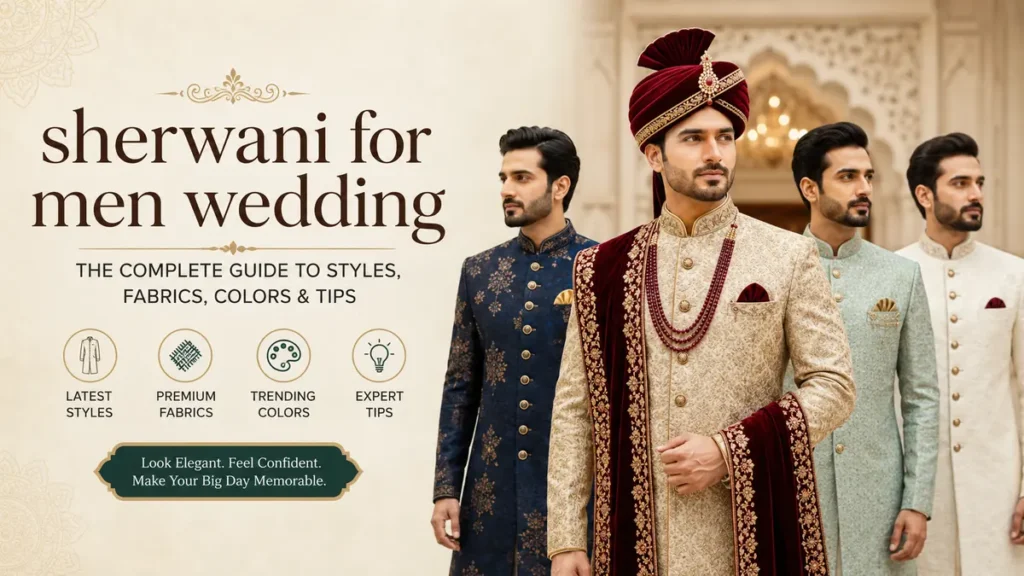
For anyone researching sherwani for men wedding attire, the strongest choice balances four things: fit, fabric, occasion, and personal style. Traditional wedding sherwanis typically feature a long structured silhouette, a closed collar, formal fabrics such as raw silk, jamawar, brocade, jacquard, or velvet, and accessories such as a stole, turban, brooch, or traditional footwear.
How to Choose a sherwani for men wedding
Choosing a groom sherwani becomes much easier when you stop looking at embroidery first.
Start with the wedding function, season, venue, and length of time you will wear the outfit. Then decide on the silhouette and fabric. Color and decorative work should come afterward.
A useful order is:
- Decide which wedding event the sherwani is for.
- Choose a fabric appropriate for the weather.
- Select the cut according to your proportions.
- Pick a color that works with the ceremony and surrounding palette.
- Coordinate rather than exactly match the bride’s outfit.
- Decide how much embroidery the occasion needs.
- Complete alterations before selecting final accessories.
This approach prevents one of the most common groom-wear mistakes: choosing an impressive-looking garment without considering how it will actually feel after several hours of sitting, walking, greeting guests, posing for photographs, and participating in wedding rituals.
What exactly is a sherwani?
A sherwani is a long, structured formal coat traditionally worn over trousers, a churidar, pajama, or shalwar depending on regional custom. It generally extends to the knee or below it and commonly has a closed stand collar and front button fastening.
The garment developed into an important form of South Asian formal menswear and today remains strongly associated with wedding ceremonies and other major celebrations. In Pakistan, a sherwani is particularly common as formal groom attire for the Barat, often paired with a shalwar, pagri and traditional footwear.
Do not confuse every high-collared ethnic jacket with a sherwani. An achkan is generally slimmer and somewhat shorter, while a prince coat or bandhgala jacket usually ends around the hip or thigh and has a more Western-tailored appearance.
| Garment | Typical length | Overall feel | Often suited to |
|---|---|---|---|
| Sherwani | Knee to below knee | Ceremonial and regal | Main wedding ceremony, Barat |
| Achkan | Around knee | Refined and lighter | Nikah, daytime functions |
| Prince coat / Bandhgala | Hip to thigh | Contemporary formal | Walima, reception |
| Kurta with waistcoat | Variable | Festive but relaxed | Mehndi, Mayun, pre-wedding events |
| Suit or tuxedo | Western cut | Modern formal | Reception or Walima |
Best sherwani for men wedding styles
There is no single sherwani style that suits every groom. Modern collections range from heavily embellished traditional garments to monochromatic designs where texture and tailoring do most of the work.
Current 2026 groom-wear guides consistently highlight softer colors, textured jacquards, controlled embroidery and lighter construction rather than relying solely on extremely heavy embellishment.
Classic embroidered sherwani
The classic version is usually structured, long and symmetrical, with decorative work concentrated around the collar, chest, cuffs, front opening and hem.
Zardozi, dabka, threadwork and related hand-embroidery techniques can create a distinctly ceremonial appearance. Pakistani wedding guides also frequently reference kora, dabki, stones and crystal detailing.
A classic embroidered sherwani works particularly well when the wedding itself is traditional and formal.
The trick is restraint.
If the fabric already has a strong woven motif, dense embroidery across every surface can make the outfit appear visually heavy. A better result often comes from letting either the fabric or the embroidery dominate—not both.
Minimalist sherwani
A minimalist sherwani uses clean tailoring, tonal buttons, subtle threadwork, self-patterned fabric or lightly embellished collars and cuffs.
Ivory, cream, champagne, beige and muted pastels work particularly well with this approach.
Minimal designs are useful for grooms who want ceremonial clothing without looking overly ornate. They also place more attention on tailoring, because there is less decoration to hide an imperfect fit.
Angrakha-style sherwani
The angrakha silhouette uses an overlapping or asymmetric front rather than the conventional straight button placket.
It creates additional movement and visual interest, which can work beautifully for festive functions and fashion-forward wedding styling. Contemporary groom guides have noted renewed interest in the angrakha silhouette alongside classic long sherwanis and achkan-inspired cuts.
Because the front already creates drama, embroidery can usually stay restrained.
Indo-Western sherwani
An Indo-Western groom outfit may combine asymmetrical closures, layered hems, unconventional trousers, contemporary tailoring or jacket-inspired construction with traditional sherwani elements.
This style works best when the ceremony itself has a modern aesthetic.
For a highly traditional wedding, a classic sherwani generally looks more natural and ages better in photographs.
Achkan-inspired sherwani
An achkan-inspired silhouette is narrower, cleaner and usually less flared.
It can be particularly useful for shorter men because excess fabric and extremely wide hems can visually overwhelm the body. Vertical embroidery, tonal detailing and cleaner front lines also help create a longer-looking silhouette.
Choosing the right sherwani fabric
Fabric affects far more than appearance. It controls heat, movement, structure, drape, embroidery weight and how the garment behaves after hours of wear.
That makes fabric one of the most practical decisions in the entire outfit.
Raw silk
Raw silk offers a slightly textured surface and enough structure to maintain a formal silhouette.
It can support embroidery without necessarily becoming as heavy as thick velvet or dense brocade, which is why it appears frequently in wedding-wear guidance.
It is particularly versatile for grooms who want a traditional appearance without extreme bulk.
Jamawar
Jamawar is valued for its elaborate woven patterns.
Because the fabric already contributes decorative detail, it can look sophisticated with relatively restrained embroidery. It is especially associated with luxurious Pakistani groom wear and more formal wedding styling.
For warm outdoor ceremonies, however, fabric weight and lining should be considered carefully.
Brocade
Brocade creates richness through woven motifs rather than surface embroidery alone.
It holds structure well and lends itself to traditional, regal sherwani designs. Silk and brocade are repeatedly featured in groom-wear guides for formal wedding events.
Brocade already has visual depth, so additional ornamentation should be balanced carefully.
Jacquard
Jacquard is a useful middle ground for men who want texture without exceptionally heavy decoration.
Self-patterned jacquard sherwanis can look sophisticated in ivory, beige, sage, pista, blue or champagne. Textured jacquards and restrained embellishment are among the recurring directions in current groom styling.
Velvet
Velvet creates depth and richness that works particularly well under evening lighting.
It is also one of the warmest common sherwani materials.
For that reason, velvet is generally better suited to winter celebrations and evening receptions than outdoor summer weddings. Multiple current guides specifically position velvet as a colder-weather fabric.
Cotton silk and lighter blends
Cotton-silk and lightweight silk blends offer greater comfort for long daytime ceremonies.
They are especially worth considering when the groom expects to remain dressed for many hours or the weather is warm.
Lighter fabrics can still appear formal when the tailoring, collar, buttons and finishing are precise.
Georgette and crepe
Georgette and similar lighter materials provide movement and may suit warmer climates, outdoor weddings and destination events.
They do not create the rigid architecture of heavy brocade or velvet, so the tailor must understand how to maintain the sherwani’s shape without making the internal construction unnecessarily heavy.
Fabric comparison
| Fabric | Visual character | Comfort/weight | Particularly useful for |
|---|---|---|---|
| Raw silk | Textured, elegant | Light to medium | Versatile wedding wear |
| Jamawar | Ornate woven design | Medium to heavy | Traditional formal events |
| Brocade | Rich and structured | Medium to heavy | Grand ceremonies |
| Jacquard | Textured, modern | Medium | Minimal or contemporary looks |
| Velvet | Deep and luxurious | Heavy/warm | Winter evenings |
| Cotton silk | Smooth and refined | Lighter | Daytime ceremonies |
| Georgette/crepe | Fluid and soft | Light | Warm-weather events |
Quick takeaway: Pick the fabric for the weather before choosing the embroidery. A lighter sherwani that you can comfortably wear for five hours will usually look better by the end of the ceremony than an elaborate outfit you can barely move in.
Best wedding sherwani colors for men
Color changes depending on ceremony timing, venue lighting, skin undertone, wedding décor and what the bride is wearing.
There is therefore no universal “best sherwani color.”
Ivory, cream and champagne remain dependable choices because they provide a neutral base for gold, beige, maroon, emerald and pastel accessories. Current groom-wear coverage also shows strong interest in mint, dusty rose, powder blue, sage and other softer tones alongside traditional maroon, gold and jewel shades.
Ivory and cream
Ivory is arguably one of the easiest groom colors to style.
It works especially well for daytime ceremonies and Nikah looks, and it coordinates naturally with antique-gold, beige, maroon, green and pastel accents.
Cream is softer than stark white and often photographs well under both indoor and outdoor lighting.
Gold and champagne
Gold can create a ceremonial, royal effect without requiring extremely dense embroidery.
Champagne is subtler. It retains warmth while giving the outfit a cleaner contemporary character.
If the base fabric is already metallic or reflective, keep jewellery and embroidery controlled so that the complete outfit does not compete with itself.
Maroon and burgundy
Maroon remains strongly associated with traditional South Asian wedding palettes.
It works particularly well for evening ceremonies and cooler seasons, especially in velvet, silk or brocade.
When the bride’s outfit is dominated by red or maroon, however, exact color matching can flatten the couple’s appearance in photographs. Choosing ivory or another complementary base and repeating her color in a stole or accessory often produces better visual separation.
Navy and royal blue
Navy gives a groom the depth of a dark formal outfit without relying on black.
It works particularly well with antique gold, silver, ivory or champagne detailing and is increasingly seen as a modern alternative to traditional cream and maroon.
Royal blue is brighter and more dramatic, so it needs slightly more restraint in embroidery.
Green
Bottle green and emerald feel rich enough for evening ceremonies, while sage and mint create a lighter daytime effect.
Pastel greens work especially well with ivory bottoms and understated gold embroidery.
Pastels
Pista, dusty rose, powder blue, lavender, mint and soft peach can work extremely well for daylight weddings.
The advantage of a pastel sherwani is that it feels contemporary without abandoning traditional dress.
The risk is that very pale shades can change dramatically under artificial lighting, so view fabric samples in both daylight and indoor light before making the final decision.
How should the groom match the bride?
The goal is coordination, not duplication.
If both people wear exactly the same dominant shade with similarly heavy embroidery, the result can look more like a uniform than a deliberately styled pair.
Instead, repeat smaller elements.
For example, an ivory groom sherwani can pick up the maroon in a bride’s lehenga through the turban, stole or embroidery. If she wears pastel pink, the groom might choose cream with dusty-rose details rather than an entirely pink outfit.
Contemporary groom styling guidance similarly recommends complementing the bride rather than matching her main outfit exactly.
Also consider the venue.
Warm ballroom lighting, outdoor daylight, camera flash and colorful stage lighting can all change how fabrics appear. Satin surfaces and metallic threads may reflect much more light than matte raw silk.
Whenever possible, photograph the chosen fabric under several lighting conditions before approving it.
sherwani for men wedding fit and body shape
A good sherwani should shape the body without locking it into place.
The shoulders matter most. The seam should sit naturally near the end of the shoulder rather than hanging beyond it or pulling inward.
The collar should lie neatly around the neck without creating visible gaps.
The chest must allow comfortable breathing, and the armholes should let you raise your arms for greetings, garlands, photographs and wedding rituals. One current styling guide specifically recommends testing whether the groom can comfortably lift his arms during fittings.
For taller men
Tall grooms can generally handle greater visual detail.
Jamawar, brocade, wider borders, strong motifs and longer silhouettes can all work because the frame provides enough space for them.
Avoid making the sherwani excessively long, though. Even on a tall groom, disproportionate length can shorten the visible leg line.
For shorter men
Cleaner lines usually work better than oversized patterns.
Choose controlled flare, properly proportioned length and vertical or linear embroidery. Avoid extremely broad borders and bulky layering.
A slightly slimmer achkan-influenced shape may create a more balanced appearance.
For broad or athletic men
A structured shoulder and clean chest can emphasize the build without adding unnecessary volume.
Heavy flare around the lower half can make the silhouette appear wider than intended.
Keep embroidery strategic rather than covering every panel.
For lean men
Textured materials, jacquard, brocade and moderate layering can add visual substance.
A stole or contrasting waistcoat can also introduce dimension without requiring an oversized sherwani.
The movement test
A groom does more than stand still.
During the fitting, sit in a chair, raise your arms, walk normally, climb a few steps and bend enough to put on footwear.
If buttons pull across the stomach or chest while sitting, the sherwani is too tight.
If the shoulders rise toward the ears when you lift your arms, the armholes or shoulder construction need adjustment.
If the collar digs into the neck after five minutes, it will feel much worse after several hours.
How much embroidery should a groom sherwani have?
Embroidery should establish hierarchy rather than simply fill empty fabric.
A groom can certainly wear heavier decoration than most guests, but “heavier” does not mean every visible surface needs embellishment.
Zardozi creates traditional metallic richness. Dabka and kora can add dimension, while fine threadwork provides a softer, less reflective finish. Crystal, stone and sequin work can catch artificial light but should be used carefully if the venue already has intense stage lighting.
One practical method is to choose three focal zones—for example:
- collar and front placket;
- cuffs and shoulders;
- hem and side panels.
Letting some fabric remain visible helps the craftsmanship stand out.
For a minimalist sherwani, tonal thread embroidery may be enough.
What to wear with a wedding sherwani
A groom sherwani is rarely worn alone. The complete outfit includes the lower garment, footwear and carefully selected accessories.
Shalwar, churidar or trousers
Regional convention matters.
Pakistani groom styling commonly pairs sherwanis with a shalwar, while Indian styling frequently uses churidars or fitted trousers. Contemporary designs may also use straight trousers.
The bottom should remain visually quieter than the sherwani unless the design intentionally uses contrast.
Stole or shawl
A stole introduces movement, color and another surface for coordinated embroidery.
It can be placed over one shoulder, draped around both shoulders or arranged asymmetrically.
Match one detail—not necessarily the entire color—to either the sherwani embroidery, turban or bride’s outfit.
Pagri or safa
A pagri or safa can dramatically increase the ceremonial character of a groom’s appearance.
Rather than matching the turban exactly to the sherwani, consider using it to repeat an accent color.
For example, an ivory sherwani with subtle gold embroidery can be paired with a maroon, dusty rose or muted green turban if that tone appears elsewhere in the wedding palette.
Kalgi and brooch
A kalgi adds a traditional decorative element to the turban.
A brooch can perform a similar finishing role on the sherwani itself. Some grooms coordinate the metals or stones used in both pieces rather than choosing identical designs. Pakistani groom guides also identify the kalgi, sehra and kamarbandh among traditional accessories used with sherwani styling.
Khussa, mojari and traditional footwear
Khussa or mojari naturally suits the long line of a classic sherwani.
Footwear should be fitted and broken in before the wedding day. New traditional shoes can feel surprisingly stiff after several hours.
Comfort matters because a painful pair of shoes changes posture—and posture affects how the entire sherwani looks.
Which sherwani suits each wedding event?
The main wedding ceremony usually deserves the most formal version of the outfit, while surrounding functions can be progressively lighter.
Nikah
A Nikah sherwani often works best in ivory, off-white, beige or subtle pastel shades with controlled embroidery.
Raw silk and cotton-silk can provide formality without excessive visual weight.
A simple sherwani or achkan also allows the solemnity of the ceremony to remain central. Contemporary Pakistani guidance commonly positions lighter colors and understated styling for this event.
Barat
For many Pakistani weddings, the Barat is where the groom wears his most elaborate sherwani.
Jamawar, brocade, raw silk or winter velvet can support richer embroidery, while maroon, deep green, navy, gold, champagne and ivory all work depending on the overall wedding palette.
A pagri, kalgi and khussa can complete the traditional groom silhouette.
Walima or reception
The reception often permits a cleaner, more contemporary approach.
Some men choose a refined sherwani, while others switch to a prince coat, bandhgala, tuxedo or suit.
If wearing another sherwani, changing the mood makes sense. Instead of repeating the heavily embellished Barat outfit, choose a cleaner silhouette in navy, charcoal, champagne, ivory or another restrained tone.
Mehndi and pre-wedding celebrations
A full ceremonial sherwani may feel unnecessarily formal for a casual Mehndi.
A kurta with waistcoat, lighter achkan or relaxed Indo-Western outfit often allows more movement while still looking festive.
That difference also prevents the main wedding outfit from losing its visual impact before the primary ceremony.
Summer vs winter wedding sherwani
Season should change both the exterior fabric and the construction inside it.
For a hot-weather wedding, consider lighter raw silk, cotton-silk, fine jacquard, georgette or breathable blends. Limit dense lining and heavy embroidery wherever possible.
For winter, jamawar, brocade and velvet become much easier to wear. Velvet in particular can create an impressive evening look when the temperature supports it.
Outdoor ceremonies require another consideration: sunlight.
Metallic embroidery and sequins can appear far more reflective outside than they did in a softly lit showroom.
Indoor evening weddings provide greater freedom for deep colors, velvet and metallic detailing because controlled lighting complements these textures.
Ready-made vs bespoke sherwani
Ready-made and custom sherwanis can both work. The difference is how much alteration your body requires and how specific you want the design to be.
A ready-made sherwani is convenient when the shoulders, chest and length already sit close to your measurements. Minor sleeve, waist and trouser alterations can then refine the result.
Bespoke tailoring allows the garment to account for posture, shoulder slope, chest proportions, sleeve position, collar height and overall balance from the beginning. Bespoke guidance emphasizes that these details—not simply chest and waist measurements—determine how naturally a sherwani sits and moves.
Neither route compensates for rushing.
Current Pakistani wedding guidance suggests that custom sherwanis can require several weeks for construction and fittings, with additional lead time advisable during peak wedding periods.
For a custom outfit, multiple fittings are useful because embroidery, lining and final finishing can alter how the garment sits.
Common sherwani mistakes to avoid
The first mistake is buying purely from photographs. A sherwani that looks excellent on a model may have been pinned, styled and photographed under controlled conditions.
The second is sacrificing movement for a tight silhouette. Wedding clothing has to function while sitting, walking and raising the arms.
Another common problem is wearing winter-weight fabric in hot weather. Thick velvet, dense lining and heavy surface work can become uncomfortable very quickly during long ceremonies. Current groom guides repeatedly emphasize matching fabric weight to season.
Over-accessorizing causes a different problem. If you already have heavy embroidery, an elaborate turban, a large kalgi, multiple necklaces, a brooch, embellished footwear and a richly patterned stole, there may be no visual focal point left.
Finally, avoid tailoring the sherwani too early without scheduling a final fitting. Even small changes in weight or posture can affect a closely fitted collar, chest and waist.
What makes a sherwani look expensive?
Price alone does not make a sherwani look refined.
The most noticeable signs of quality are usually:
- shoulders that sit correctly;
- embroidery that aligns across seams and openings;
- buttons that remain straight when fastened;
- a collar that lies flat around the neck;
- clean sleeve length;
- balanced garment length;
- lining that does not bunch;
- motifs sized appropriately for the groom’s proportions;
- accessories that support rather than overwhelm the outfit.
A simple ivory raw-silk sherwani with excellent construction can look far more sophisticated than a poorly fitted garment covered in expensive embellishment.
That is why tailoring should receive as much attention as decorative work.
Final sherwani fitting checklist
Wear the complete outfit to the last fitting rather than testing the sherwani alone.
Bring the actual trousers or shalwar, shoes and any waistcoat you plan to wear underneath. If possible, also test the stole.
Check that the hem does not interfere with walking and that the sleeves reveal the intended amount of cuff. Close every button and sit down for several minutes.
Then look at photographs rather than relying entirely on the mirror.
Take one from the front, one from each side and one while sitting. Photography often exposes collar gaps, pulling buttons, excessive length and uneven shoulders that are less obvious in person.
Also view the sherwani from several meters away. Fine handwork matters, but wedding guests and cameras usually see the complete silhouette first.
Choosing a sherwani that still looks good years later
Trends can inspire the outfit, but they should not control every detail.
Pastel colors, jacquard textures, understated embroidery and lighter styling are prominent in current 2026 groom-wear coverage. Yet a groom does not need to use all of them simultaneously.
A better approach is to keep the foundation timeless and let one or two details feel current.
That might mean a classic ivory sherwani in a contemporary jacquard, a traditional maroon outfit with cleaner embroidery, or a conventional silhouette in sage rather than gold.
For sherwani for men wedding styling, the strongest final look is rarely the one with the most embroidery or the newest trend. It is the one whose fabric suits the weather, whose color belongs in the ceremony, whose proportions suit the groom, and whose tailoring allows him to move comfortably and confidently throughout the wedding.
Choose those fundamentals first. Everything decorative becomes much easier afterward.