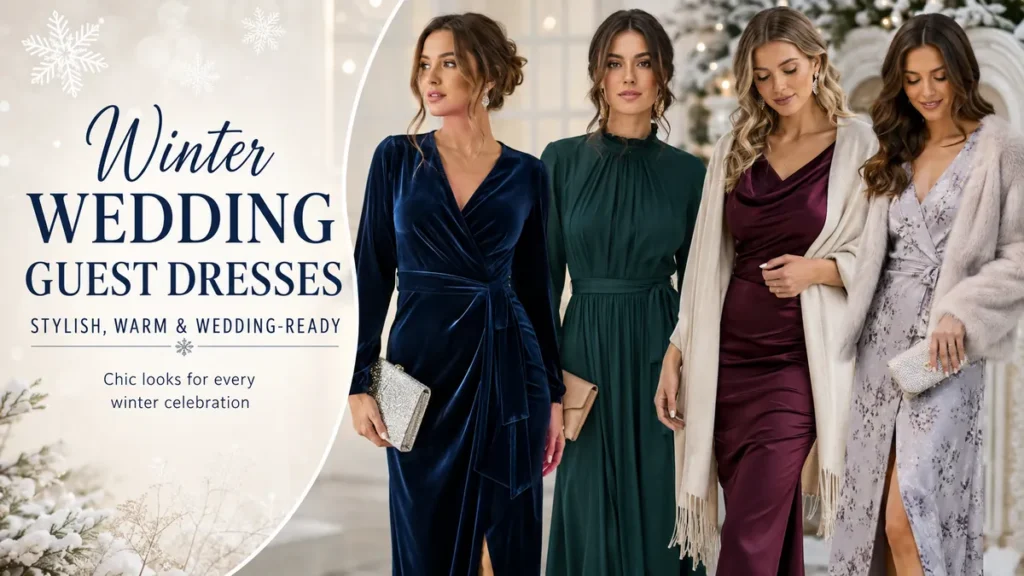
Getting dressed for a winter wedding creates a problem summer guests rarely face: you need to look polished enough for the celebration without spending the ceremony wishing you had worn your coat.
The good news is that winter wedding guest dresses are especially versatile. Rich velvet, satin, crepe, brocade, jacquard, sequins, long sleeves, deeper colors, and elegant midi or maxi silhouettes all feel naturally suited to cold-weather celebrations. Current winter collections and fashion guidance consistently emphasize substantial fabrics, seasonal jewel tones, longer lengths, and thoughtful layering.
The best winter wedding guest dress follows the invitation first and the weather second. Choose a floor-length gown for black tie, an elegant midi or maxi for formal or cocktail events, and warmer fabrics such as velvet, heavy satin, crepe, brocade, or jacquard. Add polished outerwear, practical shoes, and discreet layers when temperatures drop.
The season actually gives you more room to experiment than you might expect. Burgundy velvet, emerald satin, chocolate brown, navy, metallic details, dramatic sleeves, and subtle embellishment can all work beautifully.
The trick is knowing which combination fits your wedding.
How to Choose Winter Wedding Guest Dresses
Before thinking about color or trends, read the invitation carefully.
A beautiful velvet midi can still feel wrong at an explicitly black-tie wedding, while a dramatic floor-length embellished gown may be excessive for a relaxed afternoon ceremony.
Use four questions to narrow your choices:
- What is the dress code?
- Where is the ceremony and reception?
- How much time will be spent outdoors?
- What will the temperature realistically be?
Dress code should carry the most weight.
Venue comes next. A candlelit ballroom, country estate, restaurant, church, mountain lodge, and outdoor winter ceremony create very different practical requirements.
Then think about the journey between spaces.
A wedding may technically be indoors, but you could still spend considerable time outside arriving, waiting for transportation, taking photographs, or moving between the ceremony and reception. That is where good layering becomes essential.
Winter wedding dress quick guide
| Wedding style | Dress length | Fabrics to consider | Useful colors | Layer |
|---|---|---|---|---|
| Black tie | Floor length | Velvet, satin, silk, crepe | Black, navy, emerald, burgundy | Formal long coat |
| Formal | Midi or maxi | Satin, velvet, jacquard, crepe | Plum, wine, navy, forest green | Tailored coat |
| Cocktail | Midi | Velvet, crepe, satin | Jewel tones, black, metallics | Wrap or dress coat |
| Semi-formal | Midi or refined knee length | Crepe, knit, satin | Brown, navy, berry tones | Structured coat |
| Festive | Midi or maxi | Sequins, velvet, metallic fabric | Gold, silver, burgundy, green | Simple outerwear |
| Outdoor | Midi or maxi | Heavier crepe, velvet, lined fabrics | Dark seasonal shades | Insulated elegant coat |
The simplest rule is formality first, warmth second, personal style third.
That order prevents most winter wedding outfit mistakes.
Best Fabrics for Winter Wedding Guest Dresses
Fabric has an unusually large influence on whether a winter outfit actually works.
Summer chiffon can look beautiful indoors, but it provides little protection when you step outside. Winter gives you access to richer textures that look luxurious while providing slightly more substance.
Current cold-weather wedding guidance repeatedly highlights velvet, satin, crepe and other richer fabrics as strong seasonal choices.
Velvet
Velvet might be the quintessential winter wedding fabric.
Its texture naturally suits evening celebrations, historic venues, holiday weddings, and formal receptions. It photographs beautifully under softer winter lighting and works particularly well in saturated colors.
Consider:
- Burgundy velvet
- Emerald green velvet
- Navy velvet
- Black velvet
- Chocolate brown velvet
- Deep plum velvet
A long-sleeve velvet midi is particularly useful because it can move between cocktail, semi-formal, and some formal weddings depending on its construction and accessories.
For black tie, look toward a velvet maxi or floor-length gown.
The drawback is temperature control. Heavy velvet can become warm once you are inside a crowded reception, so consider the venue rather than assuming heavier is always better.
Satin and silk
Satin brings fluidity and shine to winter dressing.
High-shine satin maxi dresses, corset styles, column dresses, and pleated silhouettes remain prominent in current winter wedding collections.
Deep colors make satin feel particularly seasonal:
- Navy
- Wine
- Forest green
- Chocolate
- Bronze
- Plum
- Black
Silk can achieve a similar effect, though lightweight silk does not provide much warmth by itself.
If you choose a sleeveless satin or silk slip dress, treat your outer layer as part of the outfit rather than an emergency addition.
Crepe
Crepe is one of the most useful options when you want something less shiny.
A substantial crepe dress drapes elegantly, works across several levels of formality, and can be easier to style than sequins or velvet.
It is especially effective for:
- Column dresses
- Long-sleeve midis
- Structured gowns
- One-shoulder dresses
- Jumpsuits
Crepe also provides an excellent backdrop for statement jewelry.
Brocade and jacquard
Brocade and jacquard bring texture without relying on sparkle.
These fabrics can look particularly appropriate at grand hotels, formal dinners, holiday weddings, and evening ceremonies.
Because the fabric itself creates visual interest, keep accessories relatively restrained.
Sequins and embellished fabrics
Winter is one of the easiest seasons for wearing sequins to a wedding.
December celebrations and New Year’s Eve weddings especially lend themselves to metallic finishes and embellishment. Current winter edits feature sequins, metallics, beading, and embellished eveningwear alongside classic velvet and satin.
There is still a difference between festive and attention-grabbing.
If your dress is heavily embellished, simplify the shoes, bag, jewelry, and hairstyle.
Chiffon
Chiffon is not forbidden in winter.
It simply needs more planning.
A lined chiffon maxi with sleeves can work beautifully at an indoor formal wedding. A thin sleeveless chiffon mini at an outdoor January ceremony is much harder to make practical.
Quick Takeaway: You do not need the thickest possible dress. You need a fabric appropriate for the venue, dress code, and amount of outdoor exposure.
Best Colors for Winter Wedding Guest Dresses
Winter is ideal for saturated color.
Emerald, burgundy, navy, plum, chocolate brown, black, metallics, and dark neutrals regularly appear across current winter wedding collections and editorial recommendations.
Burgundy and wine
Burgundy is easy to wear because it feels festive without being tied exclusively to the holidays.
It works especially well in velvet, satin, lace, and crepe.
A wine-colored satin maxi can look formal and modern, while burgundy velvet gives the same palette a richer, more traditional feel.
Emerald and forest green
Deep green works beautifully against winter scenery.
Emerald satin brings brightness to evening events, while forest green velvet feels quieter and more sophisticated.
Green also pairs naturally with gold jewelry.
Navy
Navy is an excellent choice when black feels too severe.
It can work for cocktail attire, formal weddings, black-tie optional celebrations, and some black-tie events when the silhouette is suitably formal.
Try navy in satin, velvet, crepe, or embellished fabrics.
Chocolate brown
Chocolate brown has become a strong alternative to conventional winter black.
British Vogue highlighted chocolate brown among its cold-weather color choices, while contemporary collections continue to feature brown and chocolate dresses.
The shade works especially well with:
- Gold jewelry
- Bronze accessories
- Cream outerwear
- Deep burgundy accents
A chocolate satin or velvet maxi can look especially refined at an evening wedding.
Black
Yes, you can generally wear black to a modern wedding unless the couple’s instructions or cultural context suggest otherwise.
Black is particularly natural at evening, city, cocktail, formal, and black-tie winter weddings. British Vogue specifically notes that the old assumption that black is inherently inappropriate for weddings no longer generally applies.
Make it feel celebratory through texture or accessories.
A plain black office sheath may look too corporate, while a black velvet gown, draped satin midi, or embellished long-sleeve dress clearly reads as occasionwear.
Metallics
Gold, bronze, and silver can work beautifully for festive winter celebrations.
Instead of covering yourself in sparkle from head to toe, consider one dominant metallic element.
For example:
bronze dress + simple earrings + neutral clutch
usually feels more sophisticated than
sequin dress + crystal shoes + glitter clutch + statement necklace.
Can you wear pastels in winter?
Absolutely.
Seasonal colors are an option, not a requirement.
Dusty blue, muted rose, sage, lavender, and other subdued pastels can work when the fabric and silhouette feel substantial enough for the occasion.
Color should never override the invitation.
Colors to approach carefully
White and ivory remain the obvious shades to avoid unless the couple specifically asks guests to wear them.
Be cautious with very pale champagne, cream, blush, or silver dresses that photograph close to white.
The safest test is simple: if you have to repeatedly ask yourself whether a dress looks bridal, choose something else.
Winter Wedding Guest Dresses by Dress Code
A December date does not automatically make a wedding formal.
The invitation determines formality.
That distinction matters because winter wedding searches often mix black tie, formal, cocktail, and semi-formal outfits even though these dress codes require different approaches.
Black-tie winter wedding guest dresses
Black tie is where winter fashion becomes especially fun.
Floor-length evening gowns are the safest choice, particularly in luxurious fabrics. Current black-tie winter guidance emphasizes full-length gowns in materials such as silk, satin, and velvet.
Strong options include:
- Velvet floor-length gowns
- Satin column gowns
- Draped one-shoulder gowns
- Long-sleeve embellished gowns
- Formal off-the-shoulder dresses
- Elegant sequin gowns
- Structured crepe gowns
Rich jewel tones work beautifully here.
Emerald, navy, burgundy, plum, chocolate, and black all have enough depth for an evening winter setting.
Formal and black-tie optional weddings
Formal or black-tie optional gives you more flexibility.
A sophisticated floor-length dress works, but so can an exceptionally polished midi.
Focus on quality of silhouette rather than length alone.
A structured satin midi with refined accessories may feel more appropriate than a casual maxi that happens to reach the floor.
Cocktail winter wedding guest dresses
Cocktail attire is one of the easiest winter dress codes.
A sophisticated midi usually hits the right balance.
Think:
- Velvet midi dress
- Long-sleeve crepe midi
- Metallic pleated midi
- Satin wrap dress
- One-shoulder midi
- Tasteful sequin dress
- Lace midi
You can introduce more personality here than at black tie.
A statement neckline, asymmetric hem, dramatic sleeve, or richer texture can make a relatively simple silhouette feel special.
Semi-formal winter wedding guest dresses
Semi-formal sits below cocktail in formality but still requires intentional dressing.
A midi dress is an easy solution, although an elegant knee-length style or polished jumpsuit can also work.
Avoid going too casual simply because the event is daytime.
Instead of everyday jersey or casual knits, consider crepe, satin, textured fabrics, refined knitwear, or subtle jacquard.
Festive attire
If the invitation says “festive,” you have permission to have some fun.
Think jewel tones, velvet, metallic fabrics, tasteful sequins, statement earrings, rich texture, or a dramatic silhouette.
Festive does not necessarily mean Christmas-themed.
You do not need red-and-green combinations, novelty accessories, or obvious holiday motifs unless that genuinely suits the event.
Long-Sleeve Winter Wedding Guest Dresses
Long sleeves solve only part of the warmth problem, but they are still exceptionally useful.
Fashion experts regularly recommend sleeves for cold-weather wedding dressing, particularly when guests may spend time in draughty churches or outdoors.
The key is making the sleeves feel intentional.
Consider:
Fitted sleeves
Clean fitted sleeves work beautifully on velvet, crepe, and embellished dresses.
They create a streamlined silhouette and fit easily beneath a coat.
Sheer sleeves
Sheer mesh or lace sleeves add visual coverage rather than substantial insulation.
They are excellent when the reception will be warm but you still want a winter-appropriate silhouette.
Balloon sleeves
A subtle balloon sleeve can balance a simple midi skirt and make an otherwise minimal dress feel more occasion-ready.
Be careful with very voluminous sleeves if you need to wear a closely fitted coat.
Long-sleeve maxi dresses
For someone who gets cold easily, this is one of the most practical combinations.
A long-sleeve maxi in velvet or substantial crepe provides considerably more coverage than a slip dress, while still looking formal.
Remember, however, that sleeves do not replace outerwear when temperatures are genuinely low.
Midi vs. Maxi vs. Mini: Which Length Works Best?
There is no universal winter wedding length.
The right choice depends primarily on dress code and venue.
Maxi dresses
Maxi dresses naturally suit:
- Black-tie weddings
- Formal evening weddings
- Grand venues
- Ballroom receptions
- Cold-weather ceremonies
A longer skirt also gives you slightly more flexibility with discreet thermal layers underneath.
Just watch the hem if snow, rain, or slush is likely.
A beautiful floor-skimming satin gown can quickly become inconvenient when you have to cross a wet parking lot.
Midi dresses
The midi may be the most versatile winter wedding option.
It works particularly well for cocktail, semi-formal, daytime formal, restaurant, and city weddings.
Midi lengths also let you show off elegant closed-toe shoes, boots, or tights when appropriate.
Mini dresses
A mini can work, particularly for cocktail or festive events, but winter makes styling more complicated.
Balance the shorter hem with elements such as:
- Long sleeves
- Tights
- Closed-toe shoes
- Rich fabric
- A substantial coat
Avoid a mini if the dress code is black tie unless the hosts have clearly established a less traditional interpretation.
How to Stay Warm in Winter Wedding Guest Dresses
The biggest mistake guests make is trying to make the dress itself do all the work.
It cannot.
Even velvet will not replace proper outerwear in genuinely cold weather.
The better strategy is to build layers that can disappear once you reach the reception.
Start with the dress
Choose a lined dress when possible.
Lining can improve comfort, reduce cling, and give lightweight fabrics slightly more structure.
Then look at coverage.
Long sleeves, midi or maxi lengths, and higher necklines can all help, but you do not need all three simultaneously.
Add thermal layers strategically
A thin thermal camisole may fit beneath dresses with sufficient coverage.
Depending on the silhouette, thermal shorts can also provide warmth without changing the appearance of the outfit.
For midi dresses, tights are another practical option.
Choose hosiery deliberately rather than treating it as an afterthought.
Wear real outerwear
Your everyday puffer jacket might be wonderfully warm, but a winter wedding is a good opportunity for more polished outerwear when practical.
Consider:
- Long wool coat
- Tailored dress coat
- Faux-fur wrap
- Faux-fur jacket
- Cape
- Velvet wrap
- Formal shawl
The temperature should determine how substantial your layer needs to be.
A shawl may be enough for walking from a hotel room to a ballroom in mild weather. It is not enough for standing outside during a snowy ceremony.
Don’t forget indoor temperatures
Overheating is the opposite problem.
Reception venues can become surprisingly warm once dozens or hundreds of guests start dancing.
That is why removable layers often work better than simply choosing the heaviest dress possible.
Quick Takeaway: Build warmth around the dress rather than sacrificing the dress code for insulation. Removable layers give you much more control throughout the day.
What Shoes Go With Winter Wedding Guest Dresses?
Winter footwear has to survive conditions that delicate summer sandals never encounter.
Snow, ice, rain, wet pavement, and freezing temperatures all matter.
Closed-toe heels
A classic pump is the easiest formal winter option.
It offers more coverage than an open sandal while still working with cocktail dresses and gowns.
Block heels
Block heels provide greater stability on uneven surfaces.
They are particularly useful for historic venues, outdoor photographs, gravel drives, and events where you will walk between buildings.
Dressy boots
An elegant ankle boot can work with certain midi dresses and less formal winter weddings.
Tall boots can also look sophisticated with the right midi silhouette.
The key is ensuring they look intentional rather than like boots you happened to wear because it was cold.
Formal sandals
You can still wear strappy heels indoors.
If that is your preference, travel in weather-appropriate shoes and change after arriving.
This is one of those practical choices nobody notices but you will appreciate enormously when the pavement is icy.
How to Layer a Winter Wedding Outfit Without Ruining It
The coat problem is real.
You spend time choosing an elegant dress and then cover the entire thing with outerwear.
Instead of seeing your coat as something separate, treat it as part of the arrival outfit.
Match formality
A floor-length black-tie gown deserves outerwear with comparable polish.
A tailored long coat usually looks more cohesive than a cropped casual jacket.
For cocktail weddings, you have greater flexibility with wool coats, wraps, capes, and faux-fur jackets.
Watch proportions
A long coat over a maxi creates a clean vertical line.
With midi dresses, both knee-length and longer coats can work.
Cropped jackets can complement certain fitted or A-line silhouettes but may look awkward over dresses with substantial volume.
Use accessories for warmth
Small additions can make a surprising difference.
Consider:
- Tights
- Gloves for travel
- A wrap
- Closed-toe shoes
- Warm insoles
- A scarf removed before entering
- Thermal underlayers
You do not need every layer to appear in wedding photographs.
Practical travel pieces can be checked with your coat once you arrive.
Winter Wedding Guest Dresses for Different Venues
Two weddings on the same January afternoon can require completely different outfits.
Venue matters.
Hotel or ballroom
This is the easiest environment for dramatic eveningwear.
You can comfortably consider:
- Satin gowns
- Velvet gowns
- Strapless dresses
- Off-the-shoulder silhouettes
- Sequins
- Formal heels
You will still need warm outerwear for arriving and leaving.
Church or historic venue
Older buildings can be much colder than modern hotels.
Long sleeves, a wrap, or a substantial coat become particularly useful.
You may also want a little more coverage for the ceremony depending on local customs.
Country estate
Velvet, jacquard, brocade, long sleeves, and jewel tones fit naturally into this setting.
Block heels are worth considering if you will walk over gravel or grass.
Outdoor winter wedding
Prioritize reality over the outfit you imagined.
A dress alone will rarely be enough in genuinely cold conditions.
Choose substantial outerwear, stable footwear, and layers that allow you to remain comfortable for the entire ceremony.
Mountain or snowy destination
A mountain wedding requires extra attention to shoes.
Traction matters.
Consider traveling to the venue in boots and changing indoors rather than attempting to cross snow in stilettos.
Warm-weather destination in winter
“Winter wedding” describes the calendar, not necessarily the climate.
A February wedding in a tropical destination requires completely different clothing from February in New York, London, or the mountains.
Follow the destination’s actual weather.
Lightweight satin, chiffon, silk, and sleeveless designs can all make sense when temperatures are warm.
How to Accessorize Winter Wedding Guest Dresses
Winter textures already create visual richness, so accessories often work best when they support rather than compete with the dress.
Jewelry
Gold complements burgundy, emerald, chocolate, and other warm jewel tones beautifully.
Silver or white metals work particularly well with navy, black, icy blue, and cool-toned metallic dresses.
There is no hard rule, though.
Pay attention to the neckline.
A high-neck sequin dress may need only earrings. An off-the-shoulder velvet gown gives you more room for a necklace.
Clutch
Choose something compact enough to remain formal but large enough for essentials.
A satin, metallic, beaded, velvet, or structured clutch can add texture without overwhelming your outfit.
Hair and makeup
Winter evening weddings can support slightly richer beauty choices.
A deep lip, softly defined eye, polished updo, or smooth waves can complement velvet and formal satin particularly well.
But your makeup does not need to match the dress color.
Coordination usually looks more sophisticated than literal matching.
What Not to Wear to a Winter Wedding
Cold weather does not change basic wedding guest etiquette.
White or bridal-looking colors
Unless specifically requested, avoid white and obvious bridal shades.
Ivory is especially risky.
Pale champagne and extremely light silver can also photograph much lighter than they appear in person.
Something that ignores the dress code
A gorgeous cocktail dress is still underdressed at a strict black-tie wedding.
Likewise, a ball gown may look excessive at a casual afternoon ceremony.
When in doubt, the wording on the invitation matters more than seasonal fashion trends.
A dress that only works without a coat
Think through the complete outfit before leaving home.
If your sleeves are too voluminous for your outerwear or your gown drags through wet pavement, you have a practical problem.
Uncomfortable shoes
A wedding is not the best place to discover that you cannot stand in your heels for longer than twenty minutes.
Consider walking distance, stairs, flooring, snow, and ice.
Too many winter trends at once
Velvet can be enough.
Sequins can be enough.
A dramatic jewel tone can be enough.
You do not necessarily need velvet + sequins + faux fur + metallic shoes + statement jewelry in one outfit.
Give one or two elements room to stand out.
A Practical Winter Wedding Outfit Formula
When you feel overwhelmed by choices, use a simple formula.
For black tie
Floor-length velvet or satin gown + formal coat + elegant closed-toe heels + refined clutch + minimal jewelry
For formal attire
Structured midi or maxi + tailored long coat + pumps + understated jewelry
For cocktail attire
Velvet or satin midi + tights if appropriate + block heels + wool coat + small clutch
For semi-formal attire
Refined midi + structured outerwear + polished shoes + simple jewelry
For a festive December wedding
Jewel-tone or subtly embellished dress + simple coat + metallic accessories + comfortable heels
These are frameworks, not uniforms.
Personal style should still show through.
How to Pick a Dress You’ll Actually Wear Again
One of the most overlooked parts of choosing winter wedding guest dresses is what happens after the wedding.
Highly specific occasionwear can spend years untouched in a wardrobe.
If repeat wear matters to you, prioritize versatility.
A navy crepe midi might work later for a formal dinner. A black velvet dress can return for holiday parties. A chocolate satin maxi may work for another evening wedding with completely different accessories.
Ask yourself three questions before committing:
Could I wear this to another type of event?
Can I change its personality with different accessories?
Do I actually feel comfortable enough to wear it for six or eight hours?
Comfort deserves more attention than it gets.
You will sit, eat, walk, dance, take photographs, and possibly move between venues. A dress that looks extraordinary while standing still in front of a mirror may be miserable after two hours.
Check how it feels when you:
- Sit down
- Raise your arms
- Walk quickly
- Bend slightly
- Wear your intended coat
- Wear your intended shoes
That simple test catches many problems before the wedding day.
Final Thoughts on Winter Wedding Guest Dresses
The best winter wedding guest dresses balance three things: the invitation, the environment, and your personal style.
Start with the dress code. Then choose a seasonal fabric such as velvet, satin, crepe, jacquard, or brocade when appropriate. Burgundy, emerald, navy, plum, chocolate brown, black, and metallic shades all work naturally with winter celebrations, but you are not restricted to a dark palette.
Most importantly, plan the entire outfit rather than just the dress.
Think about your coat, tights, footwear, indoor temperature, outdoor photographs, transportation, and weather before the day arrives. A beautiful winter wedding outfit should let you enjoy the ceremony and dance through the reception—not spend the evening wondering when you can put your coat back on.