Have you ever looked at two numbers and wondered which comparison symbol belongs between them? The greater than sign makes it easy to show which number has the higher value.
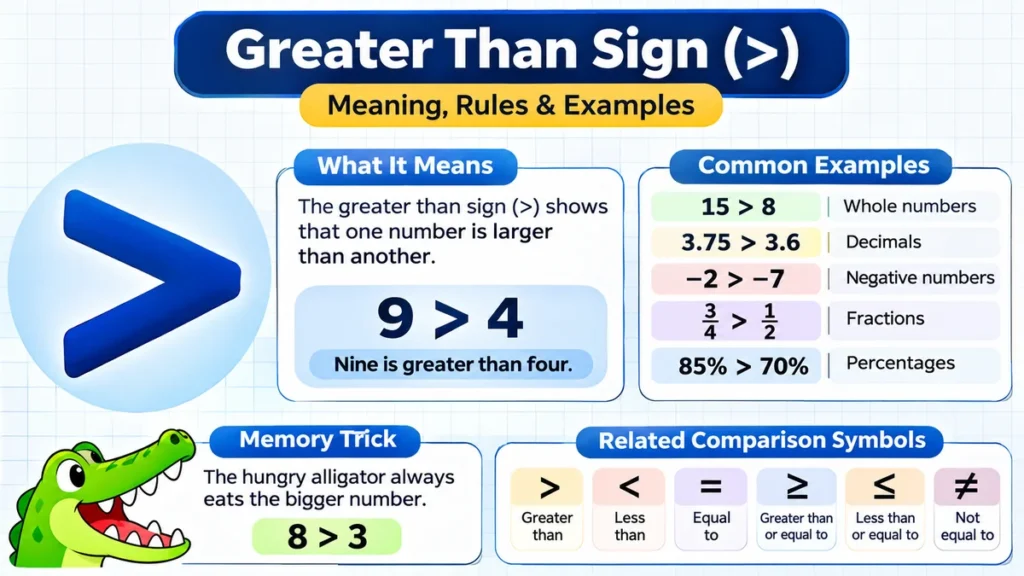
The greater than sign (>) is a mathematical symbol used to indicate that one number or quantity is larger than another. For example, 9 > 4 means “nine is greater than four.” The wide opening faces the larger number, while the pointed end faces the smaller number. It is commonly used in arithmetic, algebra, and inequalities.
Understanding this simple symbol helps students compare whole numbers, decimals, fractions, negative numbers, and algebraic expressions. It also appears in computer programming, spreadsheets, and everyday numerical comparisons.
What Is the greater than sign in Math?
The greater than sign is written as >. It belongs to a group of mathematical symbols called inequality symbols, which express relationships between values that are not necessarily equal.
GREATER THAN SYMBOL
9 > 4
Nine is greater than four
Larger number: 9
Smaller number: 4
The wide side of the symbol faces 9, and its pointed end faces 4.
Mathematically, for two real numbers \(a\) and \(b\):
\[ a>b \]
This means that \(a\) has a greater value than \(b\). Equivalently, the difference \(a-b\) is positive.
For example:
- \(15>8\) — fifteen is greater than eight.
- \(100>75\) — one hundred is greater than seventy-five.
- \(0>-3\) — zero is greater than negative three.
- \(2.5>2.1\) — 2.5 is greater than 2.1.
The symbol represents a strict inequality. This means that equal values do not satisfy a greater-than statement.
For instance, \(5>5\) is false because both values are equal.
How do you read the greater than sign?
Read a mathematical expression from left to right.
For example:
\[ 12>7 \]
Say, “Twelve is greater than seven.”
In algebra, \(x>10\) is read as “x is greater than ten.” This describes every possible value of \(x\) that exceeds 10.
The expression does not tell you the exact value of \(x\); it establishes a condition that the value must satisfy.
Greater Than vs. Less Than: Understanding the Difference
The greater than and less than signs look similar, but their directions are opposite.
The greater than symbol (>) opens toward the left, while the less than symbol (<) opens toward the right.
| Symbol | Meaning | Example |
|---|---|---|
> | Greater than | 8 > 3 |
< | Less than | 3 < 8 |
= | Equal to | 8 = 8 |
≥ | Greater than or equal to | 8 ≥ 8 |
≤ | Less than or equal to | 3 ≤ 8 |
≠ | Not equal to | 8 ≠ 3 |
These comparison symbols form the foundation of mathematical inequalities. mathsisfun.com+1
How to remember greater than and less than symbols
One popular memory trick is the hungry alligator method.
Imagine that the inequality symbol is an alligator’s open mouth. The alligator always wants to eat the bigger number.
8 > 3
Greater thanThe mouth opens toward 8.
3 < 8
Less thanThe mouth opens toward 8.
Another simple rule is to remember that the pointed end always faces the smaller value.
This works for positive numbers, negative numbers, decimals, and fractions.
Can greater than and less than mean the same comparison?
Yes, when you reverse the order of the numbers and switch the symbol.
For example:
\[ 10>6 \]
expresses the same relationship as:
\[ 6<10 \]
Both statements are true. The numbers have changed positions, but their relationship remains the same.
How to Use the greater than sign to Compare Numbers
Comparing numbers involves identifying which quantity has a higher numerical value.
The method depends on the types of numbers being compared.
Comparing whole numbers
For positive whole numbers, the number with more digits is generally larger. If both numbers have the same number of digits, compare them from left to right.
Consider 4,582 and 4,529.
Both numbers contain four digits. Their thousands and hundreds digits match, but the tens digits differ:
- 4,582 has 8 tens.
- 4,529 has 2 tens.
Because 8 is greater than 2:
\[ 4582>4529 \]
This place-value method is especially useful for comparing large numbers.
Comparing decimal numbers
When comparing decimals, align their decimal points and compare corresponding place values.
For example:
\[ 3.75>3.6 \]
You can rewrite 3.6 as 3.60. Since 75 hundredths is greater than 60 hundredths, 3.75 is larger.
Another example is:
\[ 0.81>0.79 \]
Both numbers have zero whole units, but 8 tenths is greater than 7 tenths.
Comparing negative numbers
Negative numbers can be confusing because the number with the larger absolute value is not necessarily greater.
For example:
\[ -2>-7 \]
Although 7 is larger than 2 when both are positive, negative two is greater than negative seven.
On a number line, -2 appears to the right of -7, which means it has a higher value.
Remember: Among two negative numbers, the one closer to zero is greater.
Comparing fractions
Fractions can be compared using common denominators or cross-multiplication when the denominators are positive.
For example:
\[ \frac34>\frac12 \]
Convert one-half to fourths:
\[ \frac12=\frac24 \]
Since three-fourths is greater than two-fourths, the comparison is correct.
For fractions with different positive denominators, such as \(\frac58\) and \(\frac37\), cross-multiply:
\[ 5\times7=35 \]
\[ 3\times8=24 \]
Because 35 is greater than 24:
\[ \frac58>\frac37 \]
Comparing percentages
Percentages can also be compared directly when they refer to the same whole.
For example:
\[ 85\%>70\% \]
This means 85 percent represents a greater proportion than 70 percent.
However, when percentages describe different totals, the larger percentage does not always represent a larger absolute quantity. For example, 50% of 10 is smaller than 20% of 100.
Greater Than and Greater Than or Equal To
The symbols > and ≥ have different mathematical meanings.
The greater than sign excludes equality, while the greater than or equal to sign includes it.
For example:
\[ x>5 \]
means that \(x\) must be strictly larger than 5.
Possible values include 6, 7, 5.1, and 100, but not 5.
By contrast:
\[ x\geq5 \]
allows 5 itself, along with every larger number.
| Expression | Meaning | Is 5 included? |
|---|---|---|
| x > 5 | x is greater than 5 | No |
| x ≥ 5 | x is at least 5 | Yes |
| x < 5 | x is less than 5 | No |
| x ≤ 5 | x is at most 5 | Yes |
The distinction matters in algebra, statistics, eligibility rules, and computer programming. LSE+1
When should you use ≥ instead of >?
Use ≥ whenever the boundary value is permitted.
Suppose a student needs at least 60 marks to pass an examination.
The condition is:
\[ m\geq60 \]
A score of exactly 60 qualifies.
If the requirement instead says “more than 60 marks,” the correct condition becomes:
\[ m>60 \]
In that case, a score of exactly 60 does not qualify.
Words such as at least, minimum, and no less than commonly indicate ≥. Phrases such as more than, exceeds, and higher than generally indicate >.
How the greater than sign Works in Algebra
In algebra, the greater than sign connects expressions containing variables. Such statements are called inequalities.
Unlike equations, which describe equality, inequalities identify a range of possible solutions.
Solving simple greater-than inequalities
Consider:
\[ x+4>10 \]
Subtract 4 from both sides:
\[ x>6 \]
Every real number greater than 6 satisfies the inequality.
For example, 7, 8, 9.5, and 100 are valid solutions.
However, 6 is not included because the inequality is strict.
Multiplying or dividing inequalities
When multiplying or dividing both sides of an inequality by a positive number, its direction stays the same.
For example:
\[ 2x>12 \]
Divide both sides by 2:
\[ x>6 \]
But when multiplying or dividing both sides by a negative number, the inequality symbol must reverse direction.
Consider:
\[ -3x>12 \]
Divide both sides by -3:
\[ x<-4 \]
The symbol changes from greater than to less than.
This is one of the most common mistakes students make when solving algebraic inequalities.
Using greater than on a number line
A number line provides a visual way to understand inequalities.
For \(x>3\), place an open circle at 3 and extend the solution to the right.
An open circle excludes 3, and the arrow shows all values greater than 3.
The open circle indicates that the endpoint is excluded.
For \(x\geq3\), the circle would be filled because 3 is included.
In interval notation, the solution \(x>3\) is written as:
\[ (3,\infty) \]
The parenthesis indicates that 3 is excluded, while infinity shows that the interval continues without an upper bound.
Compound inequalities
Sometimes a variable must satisfy two conditions simultaneously.
For example:
\[ 10>x>4 \]
This means that \(x\) is less than 10 but greater than 4.
The same relationship can be written as:
\[ 4<x<10 \]
The solution contains every real number strictly between 4 and 10.
How to Type and Copy the greater than sign
The greater than symbol is available on standard computer keyboards and most mobile keyboards.
Copy the greater than symbol
>
Copy symbol
Typing the greater than symbol on Windows
On a standard US keyboard:
- Hold the Shift key.
- Press the period (
.) key. - Release both keys.
This produces >.
The same shortcut works on many Windows laptops and desktop computers.
Typing the greater than symbol on Mac
On a standard US Mac keyboard, press Shift + . to type >.
The key combination may differ on international keyboard layouts.
Typing the symbol on Android and iPhone
Open your phone’s keyboard and switch to the numbers or symbols layout.
Look for > among the available punctuation or mathematical symbols. Some keyboards place it on a secondary symbols screen.
Greater than symbol in Unicode, HTML, and LaTeX
The standard greater than character has the Unicode code point U+003E.
| Format | Representation |
|---|---|
| Standard character | > |
| Unicode | U+003E |
| HTML entity | > |
| HTML numeric reference | > |
| LaTeX math notation | > |
| Greater than or equal Unicode | U+2265 |
In HTML, the named entity > represents the greater than character.
In LaTeX mathematical expressions, you can write:
$a > b$The rendered result is \(a>b\).
The greater-than-or-equal symbol can be written in LaTeX as \geq.
Uses of the greater than sign in Everyday Life and Technology
Although the greater than sign is introduced in elementary mathematics, its applications extend well beyond the classroom.
Comparing measurements and quantities
The symbol is useful for comparing measurable quantities expressed in compatible units.
For example:
\[ 25\text{ kg}>18\text{ kg} \]
This means that 25 kilograms is greater than 18 kilograms.
Other examples include:
- A temperature of 35°C is greater than 30°C.
- A distance of 12 km is greater than 8 km.
- A price of $120 is greater than $95.
- A test score of 92 is greater than 85.
These comparisons communicate numerical relationships quickly.
Using greater than in computer programming
In programming languages such as Python, JavaScript, Java, and C++, the > operator commonly compares two values.
For example, in Python:
age = 20if age > 18: print("Age is greater than 18")The condition evaluates to true because 20 is greater than 18.
In many programming languages, >= represents greater than or equal to.
Comparison operators are used in conditional statements, loops, validation rules, and algorithms.
Using greater than in Excel and Google Sheets
Spreadsheet applications use greater-than comparisons in formulas.
For example:
=A1>100This checks whether the value in cell A1 exceeds 100.
The formula returns TRUE when the condition is satisfied and FALSE otherwise.
You can also combine the comparison with the IF function:
=IF(A1>100,"Above 100","100 or below")This is useful for analyzing grades, budgets, sales figures, and numerical thresholds.
Greater than in mathematical logic
In mathematical logic and number theory, the symbol describes ordering relationships.
For example:
\[ a>b \]
and
\[ b>c \]
together imply:
\[ a>c \]
This property is called transitivity.
Another important property is asymmetry: if \(a>b\), then \(b>a\) cannot also be true.
These properties help establish consistent numerical ordering.
Common Mistakes When Using the greater than sign
Understanding the symbol is straightforward, but several mistakes can lead to incorrect mathematical statements.
Confusing the direction of the symbol
A common error is writing:
\[ 4>9 \]
This is false because 4 is smaller than 9.
The correct expression is:
\[ 9>4 \]
Always check which value the wide opening faces.
Assuming the larger digit means the larger number
Consider:
\[ 0.9>0.85 \]
This statement is true, even though 85 is a larger whole number than 9.
Decimal place value matters. Writing 0.9 as 0.90 makes the comparison easier.
Comparing negative numbers incorrectly
Students sometimes assume that -10 is greater than -3 because 10 is greater than 3.
The correct relationship is:
\[ -3>-10 \]
Negative three lies farther to the right on a number line.
Forgetting to reverse the inequality
When solving:
\[ -2x>8 \]
dividing by -2 changes the inequality to:
\[ x<-4 \]
Failing to reverse the symbol produces the wrong solution.
Confusing > with ≥
If a rule states that a number must be greater than 10, the value 10 itself does not qualify.
The statement \(x>10\) excludes 10, while \(x\geq10\) includes it.
Practice Greater Than and Less Than Comparisons
Try these questions to test your understanding of mathematical comparison symbols.
Quick practice quiz
0 of 5 answered
1. Which comparison is correct?7 > 1212 > 77 = 12
2. Which number is greater?-8-3They are equal
3. Which statement is true?0.6 > 0.750.75 > 0.60.75 = 0.6
4. What does x > 5 mean?x can equal 5x must be less than 5x must be strictly greater than 5
5. Solve -2x > 8.x > -4x < -4x = -4
Check answersReset
Practicing with positive numbers, negative numbers, decimals, and variables helps build a stronger understanding of inequalities.
Why the greater than sign Matters in Mathematics
The greater than sign is one of the most fundamental mathematical comparison symbols. It allows us to describe numerical relationships, establish limits, solve inequalities, and analyze quantities.
Its meaning remains consistent across arithmetic and algebra: the value on the left must be strictly larger than the value on the right.
The easiest way to remember the symbol is to look at its shape. The wide opening faces the larger value, while the pointed end faces the smaller one.
Once you understand that rule, you can confidently use the greater than sign to compare numbers, interpret algebraic expressions, and solve more advanced mathematical problems.