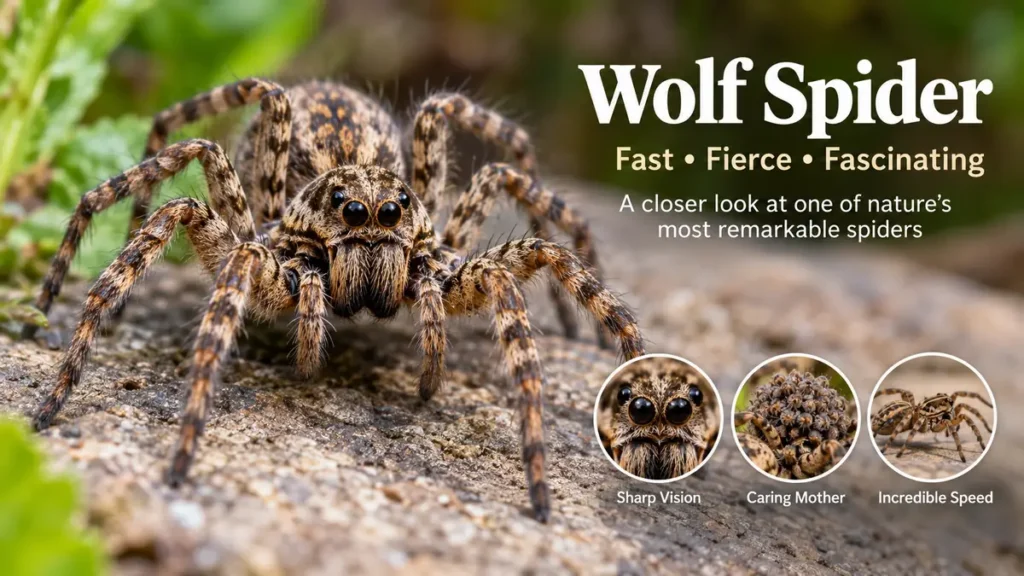
A large, hairy spider sprinting across the floor can be startling. If it is a wolf spider, though, its intimidating appearance usually overstates the danger it poses to people.
Wolf spiders belong to the family Lycosidae, a widespread group of active hunting spiders found in many habitats around the world. Rather than relying on a prey-catching web, most chase, stalk, or ambush insects and other small animals. Their distinctive eight-eye arrangement, strong eyesight, ground-hunting behavior, and unusual maternal care make them easier to recognize once you know what to look for.
Quick answer: A wolf spider is a ground-hunting spider in the family Lycosidae. It usually has a robust, hairy brown or gray body and eight eyes arranged in three rows. Wolf spiders use venom to subdue prey but are not considered dangerous to humans; bites usually cause temporary local pain, redness, itching, or swelling.
What Is a Wolf Spider?
The name wolf spider applies not to a single species but to a large family of spiders. Taxonomically, they belong to Animalia, Arthropoda, Arachnida, Araneae, and the family Lycosidae.
Their common name comes from their reputation as active hunters. Instead of waiting in a sticky web for an insect to become trapped, many wolf spiders roam across soil and vegetation looking for prey. Others remain near burrows and ambush animals that venture within striking distance.
That hunting strategy is one reason they have relatively well-developed vision compared with many other spiders. Their prominent eyes are useful not only for hunting but also for identifying the family.
Wolf spiders are predators and form part of the natural food web. Around gardens, fields, forests, and other habitats, they consume insects and other small invertebrates, making them beneficial predators rather than household pests that damage buildings, food, or clothing. The University of Minnesota Extension describes them as beneficial insect predators that do not harm people.
Why Are They Called Wolf Spiders?
The comparison with wolves comes from their hunting behavior rather than any close behavioral resemblance to actual wolves.
Wolf spiders are generally solitary hunters. Many run after prey or wait for an opportunity to attack instead of constructing an elaborate capture web.
Once prey is caught, the spider uses its chelicerae, which contain the fangs, to inject venom. The venom helps immobilize and begin digesting small prey.
How to Identify a Wolf Spider
Color alone is a poor way to identify a wolf spider.
Numerous unrelated spiders are brown, gray, hairy, or striped. The most useful clues are the eyes, body structure, behavior, and reproductive habits.
| Feature | Typical wolf spider characteristic |
|---|---|
| Family | Lycosidae |
| Body | Robust, often hairy |
| Color | Usually brown, gray, tan, or mottled |
| Eyes | Eight arranged in three rows |
| Hunting | Runs, stalks, or ambushes prey |
| Capture web | Generally absent |
| Habitat | Mostly ground level, under cover, or in burrows |
| Egg sac | Female carries it attached to spinnerets |
| Young | Spiderlings ride on the mother’s abdomen |
| Human danger | Generally low |
Look at the Eight Eyes
The eye pattern is one of the strongest identification clues.
A typical wolf spider has eight eyes arranged in three rows:
- Four small eyes form the lower/front row.
- Two very large eyes form the middle row.
- Two medium-sized eyes sit higher on the cephalothorax.
This arrangement gives the spider a distinctive face when viewed closely. The two prominent middle eyes are especially noticeable.
Avoid getting close enough to a wild spider to inspect its eyes directly. A clear zoomed photograph is safer and often more useful.
Wolf Spider Eyes Can Shine at Night
Wolf spiders have reflective structures associated with some of their eyes. When light reaches them from near the observer’s viewing angle, it can be reflected back as noticeable eyeshine.
This is why tiny greenish or bright points sometimes appear across lawns or leaf litter when illuminated with a flashlight at night. Researchers can also use eyeshine while surveying wolf spiders.
This feature is useful evidence, although it should not be your only identification method.
Body Shape, Hair, and Color
Most wolf spiders have a sturdy, ground-running build.
Typical colors include:
- brown
- dark brown
- gray
- tan
- combinations of pale and dark stripes
- mottled patterns
These subdued colors provide camouflage against soil, bark, rocks, dead leaves, and grass.
Their bodies are divided into a cephalothorax, which carries the eyes, mouthparts, pedipalps, and legs, and an abdomen containing many of the spider’s internal organs.
Like other spiders, they have eight legs rather than the six found on insects.
How Big Is a Wolf Spider?
Size varies considerably among species and genera.
The University of Minnesota Extension describes wolf spiders ranging from about 1/4 inch to 1 inch or more, while other references report considerable variation across the family.
One particularly large North American example is Hogna carolinensis, the Carolina wolf spider. Penn State Extension reports female body lengths of roughly 22–35 millimeters, while males are approximately 18–20 millimeters.
Remember that measurements can refer either to body length or the spider including its legs. Mixing those measurements is one reason online descriptions of spider size can appear contradictory.
Wolf Spider vs. Brown Recluse and Other Lookalikes
Misidentification is common because several unrelated spiders share brown coloration.
A large brown spider should therefore never be identified from color alone.
Wolf Spider vs. Brown Recluse
A brown recluse belongs to a completely different family and has several characteristics that distinguish it from a wolf spider.
| Feature | Wolf spider | Brown recluse |
|---|---|---|
| Eyes | 8, in three rows | 6, arranged in pairs |
| General build | Often robust and hairy | Usually less hairy, relatively slender |
| Typical markings | Variable stripes/mottling | May have characteristic violin-like marking |
| Hunting behavior | Active ground hunter | Wandering hunter, often hidden by day |
| Medical significance | Bites generally mild | Bites can sometimes cause medically significant injury |
Cleveland Clinic specifically notes that wolf spiders have eight eyes, while brown recluses have six and possess the familiar violin-shaped marking.
The eye count is much more informative than simply asking whether a spider is brown.
Wolf Spider vs. Grass Spider
Grass spiders and other funnel weavers can look surprisingly similar.
A grass spider commonly creates a conspicuous horizontal or funnel-like web. Wolf spiders generally do not construct webs to capture prey.
Spinnerets can also provide a clue. Funnel weavers often have more noticeable elongated spinnerets at the rear of the abdomen.
Behavior helps too: a spider repeatedly sitting inside a funnel web is unlikely to be a typical wolf spider.
Wolf Spider vs. Fishing Spider
Fishing spiders, members of the family Pisauridae, can also be large, long-legged, and brown.
Reproductive behavior provides an excellent distinction. Female wolf spiders attach the egg sac to their spinnerets and carry it behind the abdomen. Fishing and nursery-web spiders carry their egg sacs differently, using their mouthparts.
Fishing spiders are also strongly associated with aquatic environments in many species and can move across the water’s surface.
Wolf Spider vs. Jumping Spider
Both groups have relatively prominent eyes and active hunting behavior, but jumping spiders are generally more compact and are famous for their sudden jumping movements.
Wolf spiders usually run smoothly across the ground. Missouri’s Department of Conservation notes that jumping spiders commonly hunt in plants during daylight, whereas wolf spiders frequently hunt on the ground and many are active at night.
Wolf Spider vs. Tarantula
Large wolf spiders are sometimes mistaken for tarantulas.
Tarantulas in the family Theraphosidae are typically much heavier-bodied and more robust. Wolf spiders tend to be built for relatively fast running.
For an uncertain identification, eye arrangement and a good photograph are more reliable than apparent size.
Quick Takeaway: If you need to identify a possible wolf spider, prioritize its eight-eye pattern, active ground-hunting behavior, lack of a prey-catching web, and—if it is a female—how it carries its egg sac or young.
Where Do Wolf Spiders Live?
Wolf spiders occupy an impressive variety of environments.
Depending on the species, they can occur in:
- forests and woodland
- grasslands and meadows
- gardens
- agricultural fields
- shorelines and beaches
- leaf litter
- beneath stones and logs
- underground burrows
- landscaped areas around buildings
University of Minnesota Extension records them in habitats including fields, forests, and shorelines, usually on the ground or beneath stones.
Some species wander continuously, while others use protected retreats. Certain wolf spiders construct silk-lined burrows in soil. The silk is used for shelter and reproduction rather than as a sticky prey trap.
Why Do Wolf Spiders Come Inside?
A wolf spider in a house is usually a visitor rather than evidence that it is feeding on the building itself.
They may enter through:
- gaps beneath doors
- cracks around foundations
- damaged screens
- openings around pipes
- garages
- basements
- crawl spaces
Changes outdoors can also increase encounters. Colorado State University Extension notes that wolf spiders may enter homes in newly developed areas where their natural habitat has been disturbed.
Indoor insects can provide another reason for hunting spiders to remain around a building.
Seeing one wolf spider therefore does not automatically mean there is an infestation.
What Do Wolf Spiders Eat?
Wolf spiders are carnivorous predators.
Their prey varies with the spider’s size, species, habitat, and whatever animals are locally available. Common prey includes small insects and other arthropods.
Rather than constructing an orb or funnel-shaped capture web, a wolf spider typically uses its eyesight, speed, and sensitivity to movement to locate prey.
It may:
- detect movement,
- approach or wait in ambush,
- rush or pounce,
- grip the prey,
- inject venom through its fangs,
- consume the liquefied tissues.
This predatory lifestyle explains why wolf spiders can be useful around gardens and other ecosystems. They naturally help regulate populations of insects and other small invertebrates.
Do Wolf Spiders Make Webs?
Yes, wolf spiders can produce silk, but saying they “don’t make webs” can be misleading.
They generally do not build prey-catching webs like orb weavers or funnel weavers. However, silk still has several purposes.
Depending on the species and life stage, it may be used for:
- lining a retreat or burrow
- producing egg sacs
- safety or drag lines
- reproductive activities
So the more accurate description is that wolf spiders are active hunters that do not normally depend on a capture web for food.
Wolf Spider Behavior and Hunting
The sudden speed of a wolf spider is often what frightens people.
Fast movement is part of its hunting and escape strategy, not evidence that it wants to chase humans.
Wolf spiders use a combination of vision and sensitivity to vibrations to navigate their surroundings and locate prey.
Some species roam across open ground. Others stay close to a retreat or burrow and ambush passing prey.
Activity patterns also vary. Many species are especially noticeable at night, while others may hunt during the day. University of Minnesota Extension notes that wolf spiders may hunt during either day or night when conditions are warm.
Are Wolf Spiders Aggressive?
Not toward people.
A wolf spider’s first response to a large animal is normally escape. Biting is primarily defensive and may occur if the spider is trapped against skin, handled, squeezed, or otherwise unable to retreat.
This matters when moving boxes, firewood, rocks, shoes, garden materials, or other objects where a spider might be hiding.
Giving the spider room to escape greatly reduces the chance of a defensive bite.
The Unusual Way Wolf Spiders Care for Their Babies
Parental care is one of the most fascinating parts of wolf spider biology.
A female produces a silken egg sac and attaches it to the spinnerets at the rear of her abdomen. She then carries the sac as she continues moving and hunting.
This differs from nursery web and fishing spiders, which carry their egg sacs using their mouthparts.
Why Does a Wolf Spider Carry Babies on Its Back?
After the spiderlings hatch, they climb onto their mother’s abdomen.
A female covered in dozens of tiny spiderlings can initially look like one unusually textured spider. Those “bumps” may actually be individual babies.
The young remain on the female for a period before dispersing and living independently. This behavior is one of the clearest visual indicators that you are looking at a wolf spider.
If you find a female carrying spiderlings indoors, crushing her can cause the babies to scatter. Capturing the entire spider carefully in a container is usually a cleaner option when safe to do so.
Are Wolf Spiders Venomous?
Wolf spiders possess venom because they need it to subdue prey.
But venomous does not automatically mean dangerous to humans.
Their venom is adapted primarily for small prey, and medically significant effects in people are not expected from a typical wolf spider bite. Cleveland Clinic states that wolf spider venom is not considered dangerous to humans and that most bites can be managed without medical treatment.
It is also useful to distinguish venomous from poisonous.
A venomous animal actively delivers a toxin, usually through a bite or sting. A poisonous organism causes harm when its toxins are eaten, touched, or otherwise absorbed.
By that definition, wolf spiders are venomous spiders—not poisonous spiders.
What Does a Wolf Spider Bite Look Like?
A confirmed wolf spider bite may resemble many ordinary insect bites.
Possible local symptoms include:
- a red bump
- localized redness
- swelling
- pain or tenderness
- itching
- small fang punctures
These signs are not unique enough to diagnose the species that caused the bite.
In fact, identifying a spider bite from the skin lesion alone is unreliable. Cleveland Clinic notes that there is no test that can identify which spider caused a bite; actually seeing and identifying the spider is the clearest way to determine the species involved.
That distinction matters because infections, other arthropod bites, and unrelated skin conditions can sometimes be blamed on spiders without evidence.
Is a Wolf Spider Bite Dangerous?
For most people, a wolf spider bite is expected to cause a mild, localized reaction rather than a serious medical emergency.
Pain and swelling should gradually improve. Wolf spider venom is not considered deadly to humans.
A severe or worsening reaction should not simply be assumed to be “just a wolf spider bite,” particularly when the spider was never positively identified.
Wolf Spider Bite vs. Brown Recluse Bite
This is an important distinction because the medical significance is different.
Wolf spider bites are generally associated with temporary local symptoms. Brown recluse bites can, in some cases, cause more significant tissue injury.
Do not diagnose either one solely from a photograph of a skin lesion.
If the spider was safely captured or photographed, that information may help a qualified professional identify it. Never risk another bite merely to catch the animal.
How to Treat a Wolf Spider Bite
For a mild bite from a positively identified wolf spider, basic first aid is usually sufficient.
Cleveland Clinic recommends measures such as:
- Wash the area. Clean the bite with soap and warm water.
- Apply something cold. Use an ice pack wrapped in cloth or a cool damp compress to reduce discomfort and swelling.
- Avoid scratching. Scratching damaged skin can increase the chance of infection.
- Manage symptoms appropriately. An antihistamine may help itching, while an over-the-counter pain reliever may help pain or swelling when it is safe for you to take those medicines.
- Watch the area. Symptoms should generally improve rather than progressively worsen.
Do not cut the bite, attempt to suck out venom, burn the skin, or use other aggressive home remedies.
When Should You Seek Medical Care?
Get medical advice if symptoms become severe, continue worsening, or do not improve as expected.
More concerning symptoms after a suspected spider bite include:
- difficulty breathing
- facial or mouth swelling
- dizziness or fainting
- spreading hives or rash
- severe headache
- nausea or vomiting
- muscle cramping
- fever
- discharge or other signs of infection
- unusual weakness
Difficulty breathing or other signs of anaphylaxis require emergency medical attention.
The key issue is not that wolf spiders normally cause these reactions. Rather, serious symptoms deserve medical assessment because the spider may have been misidentified, an allergic reaction may be occurring, or another medical problem may be responsible.
Are Wolf Spiders Good to Have Around?
Outdoors, wolf spiders are generally beneficial.
They prey on insects and other arthropods and contribute to natural predator-prey relationships in gardens, fields, forests, and grasslands.
They also do not:
- eat wood
- damage structural materials
- consume clothing
- contaminate stored food in the way many household pests do
Their presence can indicate that suitable prey and habitat exist nearby.
Indoors, however, most people understandably prefer to remove them, especially large individuals found in bedrooms or living spaces.
What Should You Do If You Find One?
If practical, place a wide container over the spider, carefully slide stiff paper or cardboard underneath, and release it outdoors away from frequently used entrances.
Avoid picking it up with bare hands.
If spiders appear repeatedly, focus on why they are getting inside rather than killing each individual.
Useful preventive steps include:
- seal gaps around doors and windows
- repair damaged screens
- seal cracks around foundations
- reduce clutter in garages and basements
- keep firewood away from the house
- inspect stored objects before carrying them indoors
- reduce insect prey around the building
- shake out shoes, gloves, and outdoor clothing before wearing them
Cleveland Clinic also recommends precautions such as checking firewood and shaking out footwear and clothing in situations where spiders may be present.
Common Myths About Wolf Spiders
Wolf spiders attract plenty of exaggerated claims because they are large, fast, and hairy.
Myth: Wolf Spiders Chase People
A spider running rapidly in your direction may simply be trying to reach cover.
Humans are not prey for wolf spiders. From the spider’s perspective, a person is an enormous potential threat.
Myth: Every Large Brown Spider Is a Wolf Spider
Brown coloration is common among spiders.
Grass spiders, fishing spiders, nursery web spiders, huntsman spiders, and other groups can be confused with wolf spiders.
Use multiple characteristics, especially eye arrangement and behavior.
Myth: Wolf Spiders Are Deadly
They possess venom, but typical bites are not considered dangerous to humans.
The more realistic concerns are temporary pain, swelling, itching, an uncommon allergic reaction, infection from damaged skin, or incorrectly identifying a medically significant spider as a wolf spider.
Myth: Wolf Spiders Cannot Produce Silk
They can.
They simply do not usually rely on a sticky prey-catching web. Silk is still important for egg sacs, retreats, burrow lining, and other purposes.
Myth: A Spider Covered in Tiny Spiders Is Being Attacked
If you see a large female carrying numerous tiny spiders on her abdomen, those are likely her young.
This maternal behavior is one of the signature characteristics of wolf spiders.
Wolf Spider Facts at a Glance
Wolf spiders combine several characteristics that are unusual enough to make them fascinating once the initial fear passes.
- Scientific family: Lycosidae
- Order: Araneae
- Class: Arachnida
- Legs: Eight
- Eyes: Eight, arranged in three rows
- Diet: Predatory; primarily insects and other small invertebrates
- Hunting method: Active pursuit or ambush rather than a capture web
- Typical colors: Brown, gray, tan, striped, or mottled
- Habitat: Ground-level environments ranging from forests and fields to gardens, shorelines, and burrows
- Silk use: Egg sacs, retreats, drag lines, and sometimes burrow lining
- Notable behavior: Female carries the egg sac attached to her spinnerets
- Parental care: Newly hatched spiderlings ride on their mother’s abdomen
- Human risk: Low; bites are usually mild and defensive
- Ecological role: Predator of insects and other arthropods
Why Wolf Spiders Matter
A wolf spider is much more than a large brown spider that occasionally wanders across a floor.
Members of the family Lycosidae are highly adapted ground predators with strong vision, distinctive eye arrangements, fast hunting behavior, and remarkable maternal care. Females transport their egg sacs and later carry their newly hatched spiderlings directly on their backs—a behavior that makes the group especially recognizable.
For people, the practical takeaway is straightforward: wolf spiders look more threatening than they normally are. They are not aggressive toward humans, do not typically cause medically serious bites, and are beneficial predators outdoors.
If you encounter one, avoid handling it with bare hands and relocate it when practical. For identification, concentrate on the eight eyes in three rows, ground-hunting behavior, robust body, and distinctive reproductive habits rather than relying on color or size alone.