
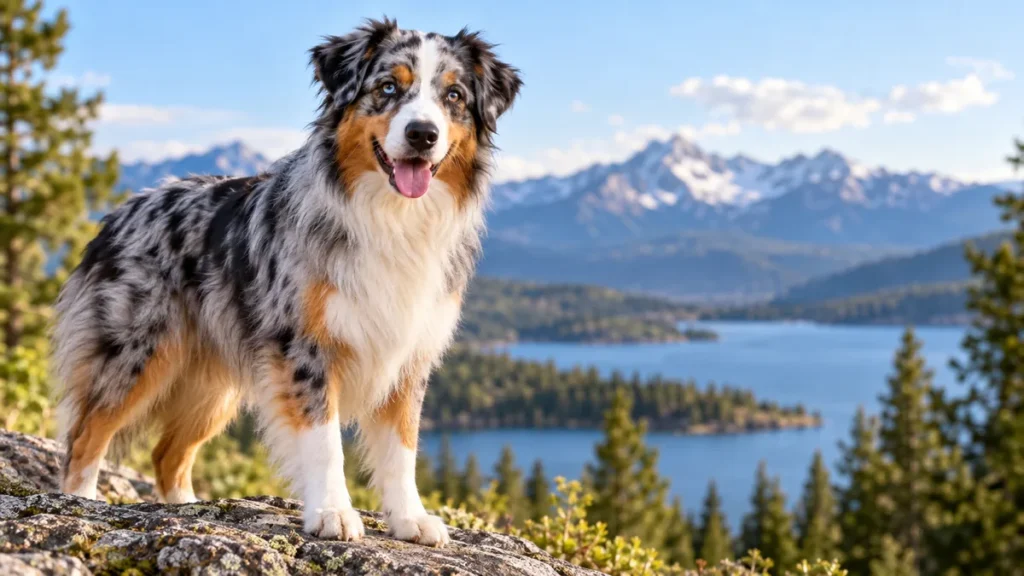
The australian shepherd has the looks of a show dog and the work ethic of a ranch hand. Behind the striking blue-merle coats and bright eyes is an intensely intelligent herding dog that expects far more from its day than a quick walk around the block.
An australian shepherd is a medium-sized, athletic herding breed developed largely in the United States. Adults typically stand 18–23 inches tall and weigh about 40–65 pounds. Aussies are intelligent, energetic, loyal, trainable, and strongly people-oriented, but they require substantial exercise, mental stimulation, socialization, grooming, and consistent training to thrive.

| Breed characteristic | Typical australian shepherd |
|---|---|
| Breed group | Herding/Pastoral |
| Height | 18–23 inches |
| Weight | 40–65 pounds |
| Lifespan | About 12–15 years |
| Coat | Medium-length double coat |
| Common colors | Black, red, blue merle, red merle |
| Shedding | Moderate to heavy |
| Energy level | Very high |
| Trainability | Very high |
| Grooming | Weekly or more often during shedding |
| Best suited to | Active, involved households |
| Hypoallergenic | No |
Exact characteristics vary among individual dogs, especially between working and companion lines.
australian shepherd History: Why the Breed Isn’t Really Australian
One of the most surprising facts about the australian shepherd is that the breed was not primarily developed in Australia.
The modern Aussie became established as a working ranch dog in the western United States, particularly in states such as California, Colorado, Wyoming, and Idaho. Its history is intertwined with sheep ranching, Basque shepherds, European herding dogs, and livestock brought through Australia before reaching America.
The American Kennel Club describes the breed’s development as an American story with European ancestry and an Australian connection. Genetic research discussed by the AKC has linked Australian Shepherds with the UK Rural group of herding dogs, alongside breeds such as the Border Collie, Collie, and Shetland Sheepdog.
These dogs became particularly associated with American ranchers and cowboys because they could control livestock while working for long periods across challenging terrain.
Their athleticism eventually took them beyond ranch work. Today, Aussies participate in:
- Livestock herding
- Agility
- Obedience
- Rally
- Flyball
- Search and rescue
- Therapy and assistance work
- Hiking and running
- Competitive dog sports
The Australian Shepherd Club of America (ASCA) continues to emphasize the breed’s intelligence, versatility, stamina, agility, and strong working instincts.
Why is it called an australian shepherd?
The exact origin of the name is less straightforward than the breed’s modern history.
Dogs associated with shepherds and sheep arriving through Australia became known to Americans as Australian shepherd dogs. Over time, the name stuck even though the recognizable modern breed was developed mainly in the United States.
Quick takeaway: The australian shepherd is essentially an American ranch breed with European herding ancestry and historical links to Australia.
australian shepherd Size, Appearance, Colors, and Coat
An adult Aussie is a medium-sized dog built for speed, endurance, and sudden changes of direction rather than sheer bulk.
According to current breed information, adults generally measure 18–23 inches at the shoulder and weigh approximately 40–65 pounds, with males usually larger than females.
The body is slightly longer than it is tall, producing an athletic but balanced appearance. ASCA describes the ideal dog as strong and agile, with an efficient, smooth gait appropriate for demanding livestock work.
Australian Shepherd colors
The main recognized coat colors include:
- Black
- Red
- Blue merle
- Red merle
Dogs may also have white markings, copper or tan points, or combinations of these markings.
Merle produces the mottled pattern that gives many Aussies their particularly distinctive appearance.
ASCA recognizes blue merle, red merle, solid black, and solid red as the principal colors in its breed description.
What color eyes do Australian Shepherds have?
Australian Shepherds may have brown, blue, amber, or differently colored eyes.
Some dogs have heterochromia, meaning one eye differs in color from the other. Individual eyes can sometimes contain more than one color as well.
Blue eyes are particularly noticeable in merle Aussies, although coat and eye color combinations vary considerably.
Do Australian Shepherds have tails?
They can be born with either full-length or naturally short tails.
The breed has historically also been associated with tail docking. PetMD notes that the American Veterinary Medical Association (AVMA) opposes tail docking when performed solely for cosmetic reasons.
A naturally bobbed tail is different from a surgically docked tail.
australian shepherd Temperament and Personality
Intelligence is probably the characteristic most closely associated with the breed, but intelligence alone does not explain what living with an Aussie is actually like.
A typical Australian Shepherd combines:
- High intelligence
- Strong attachment to family
- High energy
- Working drive
- Alertness
- Trainability
- Herding instinct
- Athleticism
- Some natural reserve around strangers
ASCA describes the breed as an intelligent working dog with strong herding and guardian instincts that is generally reserved rather than shy with strangers.
That distinction matters.
A well-socialized Aussie does not need to enthusiastically greet every unfamiliar person. Some naturally prefer observing newcomers before becoming comfortable.
Are Australian Shepherds affectionate?
Most are highly attached to their people.
Many follow family members from room to room and want to participate in whatever is happening. That close relationship makes training rewarding, but it can also create problems when a dog never learns how to relax independently.
PetMD notes that overly strong attachment can contribute to separation-related behavior in some individuals.
Teaching calm independence should therefore start during puppyhood.
Are Australian Shepherds aggressive?
Aggression is not supposed to be a defining breed characteristic.
Aussies can, however, be protective, territorial, watchful, and reserved with unfamiliar people. Poor socialization, fear, frustration, uncontrolled arousal, or inappropriate breeding can turn those tendencies into behavioral problems.
Early positive exposure to different people, environments, sounds, surfaces, dogs, and situations helps a puppy learn what is normal.
Socialization should create confidence rather than simply forcing a puppy to interact with everyone it encounters.
How Much Exercise Does an Australian Shepherd Need?
Aussies were developed to perform physical work. That heritage remains obvious even in dogs that have never seen a sheep.
The Royal Kennel Club categorizes Australian Shepherds as dogs that may require more than two hours of exercise per day, while other breed resources similarly emphasize their very high energy and need for sustained activity.
That does not mean every dog requires exactly the same number of minutes. Age, health, conditioning, working lineage, temperature, and activity type all matter.
A healthy adult might combine:
- A substantial morning walk or run.
- Short training sessions.
- Fetch, tug, or structured play.
- Sniffing and exploration.
- An evening walk.
- Mental challenges such as obedience or scent work.
Mental exercise matters just as much
Trying to solve an Australian Shepherd’s behavior problems using physical exercise alone can backfire.
If every day consists of increasingly long runs and endless ball chasing, you may simply build a fitter dog that requires even more activity.
Include activities that make the dog think.
Good options include:
- Obedience training
- Trick training
- Nose work
- Food puzzles
- Hide-and-seek
- Agility
- Herding
- Rally
- Controlled retrieving
- Tracking
- Problem-solving games
PetMD lists agility, herding trials, flyball, obedience, hiking, running, fetch, and long walks among activities well suited to the breed.
Exercise for Australian Shepherd puppies
Puppies should not simply receive miniature versions of an adult athlete’s workout.
PetMD advises avoiding demanding long-distance running and similar high-impact exercise until physical maturity, generally around 12–16 months, because bones and joints are still developing.
Puppies benefit more from controlled play, exploration, training, socialization, and age-appropriate walks.
Quick takeaway: A tired Aussie is not necessarily a fulfilled Aussie. The best routine combines physical exercise, training, exploration, problem-solving, and adequate rest.
australian shepherd Training: What Actually Works
Australian Shepherds learn quickly.
Unfortunately, that means they can learn unwanted behavior just as efficiently as desirable behavior.
If jumping gets attention, pulling gets them to the park faster, or barking makes someone throw a ball, the dog has learned something—even though the owner never intended to teach it.
Use positive reinforcement
PetMD recommends positive-reinforcement training for the breed.
Reward behaviors you want repeated with appropriate reinforcement such as:
- Food
- Toys
- Play
- Praise
- Access to sniffing
- Permission to move toward something interesting
Short, focused training sessions often work better than repetitive drilling.
Teach an off-switch
One of the most useful skills for an australian shepherd is something surprisingly simple: doing nothing.
Teach the dog to settle on a bed or mat while everyday life happens around it.
Without this skill, some high-drive Aussies begin expecting entertainment every waking minute.
Recall training is essential
Herding breeds naturally notice movement. Wildlife, cyclists, joggers, livestock, children, or vehicles can trigger pursuit.
Build recall gradually under controlled conditions before relying on it around serious distractions.
PetMD recommends using a leash or secure fenced environment when recall is not reliable because Aussies may chase moving animals or vehicles.
Watch for herding behavior
Aussies may attempt to control movement by:
- Circling
- Blocking paths
- Staring
- Chasing
- Barking
- Occasionally nipping at heels
These behaviors come from herding ancestry, but that does not mean owners should allow the dog to herd children.
Interrupt inappropriate behavior and redirect the dog toward structured games or training.
Are Australian Shepherds Good Family Dogs?
They can be excellent family companions in the right household.
Australian Shepherds are loyal, playful, trainable, and strongly bonded to their families. Properly socialized individuals can live successfully with children, dogs, and cats.
The more useful question is not simply, “Are Australian Shepherds good with kids?”
It is:
Can the household realistically meet the needs of a high-drive herding dog every day?
Australian Shepherds and children
Many Aussies enjoy children, particularly when raised with them.
Problems can occur when fast-running or shouting children activate herding instincts. The dog may chase, circle, bark at, or attempt to control them.
Adult supervision is therefore important, especially with young children.
Children should also learn not to disturb a dog while it is eating, sleeping, or trying to move away.
Australian Shepherds and other dogs
Well-socialized Aussies frequently live successfully with other dogs.
Some may be more selective with unfamiliar dogs, however, and individual temperament matters more than a breed label.
Can Australian Shepherds live with cats?
Yes, many can.
Early socialization usually makes the transition easier. Because the breed can have strong chasing and herding instincts, introductions should be controlled and the cat must always have safe escape areas.
Can an Australian Shepherd Live in an Apartment?
Possible? Yes.
Ideal for every Aussie? No.
A large garden does not automatically produce a fulfilled dog, and an apartment does not automatically produce an unhappy one. Daily lifestyle matters far more than floor space alone.
However, the Royal Kennel Club describes the breed as particularly suited to larger homes, substantial exercise, and country environments.
An apartment owner needs to compensate with purposeful outdoor activity, enrichment, training, bathroom trips, and opportunities to decompress.
Potential apartment challenges include:
- Barking
- High exercise requirements
- Herding reactions to hallway traffic
- Limited indoor running space
- Separation problems
- Heavy shedding
Someone who works long hours away from home and wants a low-maintenance dog is unlikely to find this breed an easy match.
Australian Shepherd Grooming and Shedding
The beautiful Aussie coat requires regular maintenance, although professional grooming every few weeks is usually unnecessary for a healthy household dog.
Australian Shepherds have a medium-length double coat designed to provide weather protection.
Do Australian Shepherds shed?
Yes.
They shed throughout the year and typically shed more heavily during seasonal coat changes, particularly in spring and fall.
Regular brushing helps remove loose undercoat before it reaches furniture and clothing.
Basic grooming routine
A practical routine includes:
| Grooming task | General approach |
|---|---|
| Brushing | At least weekly; increase during heavy shedding |
| Bathing | When dirty or as needed |
| Nail trimming | Regularly, before nails become overgrown |
| Ear checks | Routine inspection and cleaning when appropriate |
| Teeth | Ideally brushed daily |
| Skin check | During grooming |
| Eye check | Watch for discharge or changes |
Dogs that frequently hike, swim, work livestock, or play outdoors may need more frequent coat inspection.
Should you shave an Australian Shepherd?
Generally, no.
PetMD advises against shaving an Aussie’s double coat because the coat provides environmental protection.
Clipping individual mats or performing medically necessary shaving is different from routinely shaving the entire coat for summer.
Good brushing, shade, hydration, sensible exercise timing, and temperature management are more appropriate approaches to hot weather.
Australian Shepherd Health Problems to Know About
The average australian shepherd is generally considered a reasonably healthy dog, but responsible ownership means understanding conditions that occur more frequently within the breed.
PetMD places typical lifespan at approximately 12–15 years.
Important conditions include the following.
Hip and elbow dysplasia
Hip dysplasia and elbow dysplasia involve abnormal joint development and may eventually cause pain, lameness, or osteoarthritis.
Responsible breeding programs use orthopedic screening to reduce risk.
ASCA specifically highlights elbow dysplasia as an issue deserving proper screening within the breed.
Progressive retinal atrophy
Progressive retinal atrophy (PRA) is a group of inherited retinal diseases that progressively damage vision and can eventually lead to blindness.
Early signs may include difficulty seeing in low light.
There is currently no cure for PRA, making genetic screening and responsible breeding especially valuable.
Collie eye anomaly
Collie eye anomaly (CEA) is another inherited condition affecting structures at the back of the eye.
Severity varies. Some affected dogs retain useful vision, while severe cases can result in substantial visual impairment.
Hereditary cataracts
Australian Shepherds can develop hereditary cataracts.
PetMD reports that inherited cataracts frequently become apparent between approximately one and five years of age, although individual presentation varies.
Iris coloboma
Iris coloboma occurs when part of the iris fails to develop normally.
Veterinary ophthalmology examinations are an important component of responsible eye-health screening in this breed.
Epilepsy
Primary epilepsy can occur in Australian Shepherds and causes recurring seizures due to abnormal electrical activity in the brain.
PetMD notes that there is currently no genetic test capable of identifying all dogs that may develop or transmit the breed’s epilepsy risk.
MDR1 drug sensitivity
One health issue every Aussie owner should recognize is MDR1, also known as an ABCB1 mutation.
The mutation affects the way a dog’s body handles certain medications. Dogs carrying affected variants may experience dangerous neurological reactions to particular drugs or doses that other dogs tolerate.
The breed’s relationship with the MDR1 mutation is also consistent with its genetic links to other herding breeds.
A DNA test can identify the relevant mutation.
Owners should share their dog’s MDR1 status with their veterinarian rather than attempting to decide independently which medications are safe.
Autoimmune thyroiditis
ASCA identifies autoimmune thyroiditis as an important inherited health concern in Australian Shepherds. Possible signs can include weight changes, skin or coat problems, and altered tolerance to temperature, although symptoms are not specific enough for owners to diagnose the disease themselves.
Veterinary testing is necessary.
Merle Genetics and the Double-Merle Problem
Merle produces some of the breed’s most recognizable coats, but coat color genetics have serious health implications when breeding decisions are made incorrectly.
A puppy receiving a merle allele from both parents may become a double merle.
Double-merle dogs have a significantly greater risk of congenital hearing and vision abnormalities and often have large areas of white pigmentation.
The Royal Kennel Club states that it does not register puppies from merle-to-merle matings because of the increased risk of impaired hearing and vision associated with the genetic combination.
A responsible breeder therefore understands the genetic status of breeding dogs rather than selecting parents simply because their colors are attractive.
Deafness testing
A BAER test, short for Brainstem Auditory Evoked Response, can determine whether hearing loss is present.
PetMD specifically notes the connection between double-merle genetics, reduced pigmentation, and an increased risk of deafness.
Quick takeaway: Merle itself is not a disease. The serious concern is breeding two merle dogs together and producing puppies that inherit merle from both parents.
Feeding and Maintaining a Healthy Weight
There is no special diet that every Aussie requires.
Food choice should reflect:
- Age
- Body condition
- Activity
- Health
- Reproductive status
- Calorie requirements
PetMD recommends a complete diet meeting Association of American Feed Control Officials (AAFCO) nutritional guidelines in the United States. Highly active working or sporting dogs may require different calorie, protein, and fat levels from comparatively sedentary pets.
An athletic-looking breed can still become overweight.
Assess body condition rather than assuming an active dog can eat unlimited calories.
You should generally be able to feel the ribs beneath a modest layer of tissue, while the dog should show an identifiable waist when viewed from above.
Exact food quantities cannot responsibly be determined from breed name alone. Follow the diet’s calorie information and adjust with veterinary guidance according to the individual dog’s condition.
Australian Shepherd Puppy Development and Socialization
The first months of life influence how comfortably an Aussie handles the world as an adult.
Good socialization involves carefully exposing puppies to normal experiences while keeping those experiences manageable.
Useful exposure includes:
- Adults and children
- Calm dogs
- Different surfaces
- Traffic sounds
- Grooming tools
- Vehicle travel
- Veterinary handling
- Household appliances
- People wearing hats or uniforms
- Rural and urban environments
- Being calmly alone for short periods
The goal is not maximum exposure at any cost.
A frightened puppy forced into overwhelming situations may learn fear rather than confidence.
Pair new experiences with distance, food, play, and the ability to retreat.
Start handling exercises early
Practice touching:
- Paws
- Ears
- Mouth
- Tail
- Coat
- Collar area
That makes future nail trims, dental care, grooming, and veterinary examinations easier.
Prevent separation problems before they start
Because Aussies tend to become strongly attached to their families, practice short, comfortable periods of independence from puppyhood.
A puppy that spends every second beside someone may struggle when suddenly expected to remain alone for several hours.
Australian Shepherd vs. Miniature American Shepherd
One common source of confusion is the so-called “mini Australian Shepherd.”
The recognized smaller breed is the Miniature American Shepherd, which shares historical ancestry and many visual similarities with the Australian Shepherd but is recognized as a separate breed.
It should not simply be treated as an undersized australian shepherd.
Both breeds can display strong herding instincts, intelligence, athleticism, merle coloring, and considerable exercise requirements.
Do not assume that choosing the smaller version automatically means choosing a low-energy dog.
Australian Shepherd vs. Border Collie
Australian Shepherds and Border Collies are frequently compared because both are intelligent livestock-herding breeds.
| Trait | Australian Shepherd | Border Collie |
|---|---|---|
| Original working role | Ranch and livestock herding | Intensive livestock herding |
| General energy | Very high | Very high |
| Training ability | Excellent | Excellent |
| Family attachment | Often extremely strong | Often extremely strong |
| Stranger response | Can be reserved/protective | Varies; often more task-focused |
| Coat | Medium double coat | Smooth or rough varieties |
| Mental stimulation | Essential | Essential |
Neither should be chosen merely because intelligence sounds convenient.
An intelligent working dog notices patterns, invents activities, and needs constructive outlets. Without those outlets, intelligence may appear as escape behavior, barking, chasing, chewing, or obsessive habits.
Is an Australian Shepherd a Good First Dog?
It can be, but it is not one of the easiest choices for an inexperienced owner.
The Royal Kennel Club describes the breed as more appropriate for owners with some experience and gives it substantial daily exercise requirements.
A committed first-time owner who enjoys training and outdoor activity may succeed very well.
The breed becomes difficult when someone wants:
- Minimal exercise
- Minimal shedding
- A naturally quiet dog
- A dog that spends most of the day alone
- Little ongoing training
- An independent pet requiring limited interaction
A better match is someone who enjoys actively building their dog’s routine into everyday life.
What to Look for in a Responsibly Bred Australian Shepherd
Appearance should never be the only consideration.
Blue eyes, unusual markings, or a dramatic merle pattern tell you very little about long-term health or temperament.
A responsible breeding program places health, stable behavior, and functional structure ahead of fashionable colors.
Relevant considerations include screening for:
- Hip dysplasia
- Elbow dysplasia
- Hereditary eye disease
- MDR1 status
- Breed-relevant DNA conditions
- Appropriate temperament
ASCA provides dedicated health and genetics resources because inherited disease prevention depends heavily on informed breeding decisions.
Be particularly cautious if someone deliberately markets “rare” coloring while providing little evidence of health screening.
Likewise, merle-to-merle breeding should be treated as a major warning sign because of the increased risk of sensory defects in double-merle puppies.
Common Mistakes Australian Shepherd Owners Make
1. Choosing one because of its appearance
Blue eyes and merle coats attract attention, but those features say nothing about whether your lifestyle suits a high-energy herding dog.
Start with temperament and daily needs.
2. Providing exercise but no mental work
Running alone does not fully satisfy a breed developed to think while working.
Mix exercise with training and problem-solving.
3. Waiting too long to address chasing
Chasing bicycles, joggers, cars, animals, or children can become increasingly rewarding to the dog.
Teach recall, impulse control, and alternative behaviors early.
4. Allowing a puppy to overexercise
An Aussie puppy may appear capable of running endlessly before its developing joints are ready for repetitive high-impact exercise.
Build activity gradually.
5. Skipping socialization because the puppy seems friendly
Adult temperament develops over time.
Continue thoughtful exposure throughout adolescence.
6. Mistaking intelligence for automatic obedience
Smart dogs are not automatically trained dogs.
An Australian Shepherd still needs clear reinforcement, repetition, boundaries, and consistent communication.
7. Never teaching relaxation
Constant stimulation can create a dog that expects constant stimulation.
Reward calm behavior too.
Who Should—and Shouldn’t—Live With an Australian Shepherd?
The breed often fits people who:
- Exercise regularly
- Enjoy dog training
- Want an interactive companion
- Have time for daily activity
- Enjoy hiking or dog sports
- Appreciate intelligent working dogs
- Can provide ongoing enrichment
- Accept regular shedding and grooming
Think carefully before choosing one if you:
- Are away from home most of the day
- Want minimal exercise responsibilities
- Dislike shedding
- Cannot dedicate time to training
- Need an exceptionally independent dog
- Expect a backyard alone to provide sufficient stimulation
Living successfully with an Aussie is less about owning a huge property than about providing meaningful activity and involvement.
Living Successfully With an australian shepherd
The most satisfying part of sharing life with an australian shepherd is also the source of most challenges: these dogs want to participate.
They notice everything. They learn routines quickly. They monitor movement, follow their people, and usually approach new tasks with enthusiasm.
Give that brain something constructive to do and you can have an exceptionally versatile companion.
Neglect the same needs and the dog may create its own job—guarding a window, dismantling the garden, chasing movement, barking at neighbors, or reorganizing the contents of your home.
A successful daily routine should combine exercise, structured training, free sniffing, social interaction, enrichment, adequate sleep, and quiet time.
The australian shepherd is therefore not simply a beautiful medium-sized dog. It is a genuine working breed whose intelligence, athleticism, loyalty, and herding instincts remain central to its personality. For an active household prepared to meet those needs consistently, few breeds offer the same combination of partnership, versatility, and enthusiasm.


