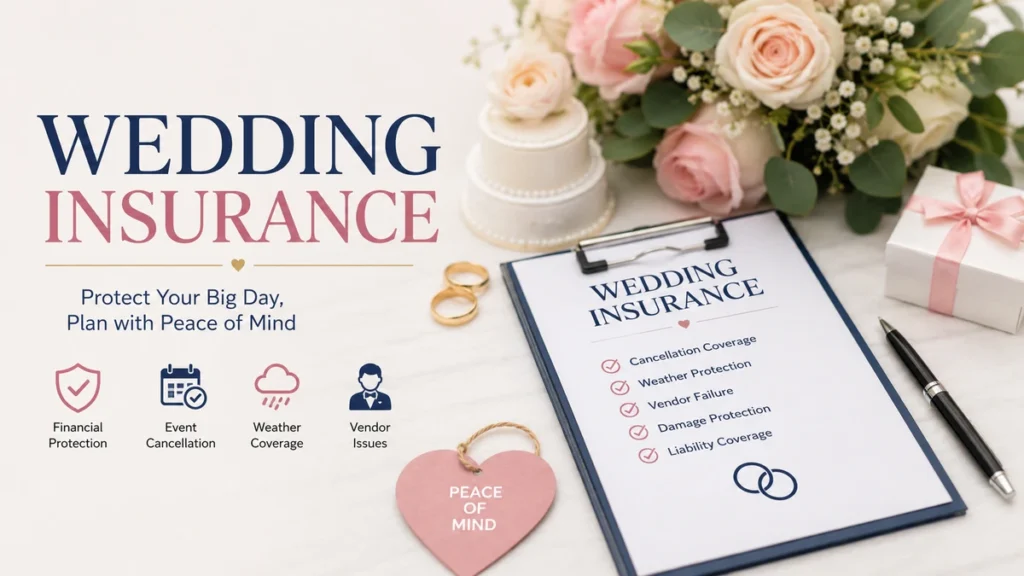
A wedding can involve months of planning and thousands of dollars in deposits long before the ceremony begins. A venue closure, severe weather, sudden illness, vendor failure, damaged property, or guest injury can turn those financial commitments into unexpected losses.
Wedding insurance is a form of special event insurance designed to protect against certain financial losses connected with a wedding. Policies generally provide cancellation or postponement coverage, event liability coverage, or both. Depending on the policy, protection may also extend to deposits, vendors, wedding attire, gifts, photographs, property damage, guest injuries, and alcohol-related liability.
The key word is covered. Wedding insurance does not guarantee reimbursement whenever wedding plans change. Every policy has covered causes, exclusions, coverage limits, deductibles, and conditions that determine whether a claim will be paid.
This guide explains how wedding insurance works, the main types of coverage, common exclusions, typical costs, venue requirements, destination weddings, claims, and the questions couples should understand before choosing coverage.
What Is Wedding Insurance?
Wedding insurance is specialized event insurance that provides financial protection against specified problems before or during a wedding.
The two primary forms are:
- Cancellation and postponement insurance
- Wedding liability insurance
They protect against different risks and may be purchased separately or together. The National Association of Insurance Commissioners (NAIC) identifies liability and cancellation insurance as the two most common types of event insurance.
Cancellation coverage focuses primarily on money that has already been committed to the wedding. Liability coverage focuses on claims arising when someone is injured or another person’s property is damaged.
For example, imagine a couple has paid nonrefundable deposits to a venue, caterer, florist, DJ, and photographer. Days before the ceremony, severe weather makes the venue inaccessible.
If the circumstances satisfy the cancellation policy’s terms, some of the nonrefundable expenses or reasonable rescheduling costs could potentially be reimbursed.
Now consider a different situation: during the reception, a guest slips on the dance floor and is injured. That is primarily a liability issue rather than a cancellation claim.
Understanding this distinction is one of the most important parts of wedding insurance.
What Does Wedding Insurance Cover?
Exactly what wedding insurance covers depends on the insurer, policy wording, selected limits, location, and optional coverages.
A policy may include protection for:
- Cancellation or postponement
- Lost nonrefundable deposits
- Vendor failure
- Severe weather
- Unexpected illness or injury
- Venue problems
- Bodily injury liability
- Property damage liability
- Host liquor liability
- Wedding attire
- Gifts
- Jewelry
- Photographs and video
- Additional expenses required to rearrange a covered event
Some policies extend beyond the ceremony and reception to associated events such as a rehearsal dinner. Coverage varies substantially, so these protections should never be assumed merely because a policy is described as “wedding insurance.”
Wedding Cancellation and Postponement Insurance
Wedding cancellation insurance can reimburse certain nonrefundable costs when a wedding must be canceled or postponed because of a reason specifically covered by the policy.
Potential covered circumstances may include:
- Severe or extreme weather
- Unexpected serious illness or injury
- A venue becoming unusable after covered damage
- Certain vendor failures
- Unexpected military obligations
- Other unforeseen events defined by the policy
The NAIC notes that cancellation insurance may protect against expenses resulting from delays, rescheduling, or cancellation caused by covered unforeseen events. Examples can include weather, illness or injury, and a vendor failing to provide contracted services.
Suppose a couple paid a $4,000 nonrefundable venue deposit and the venue later becomes unusable because of a covered fire. Cancellation or postponement coverage could potentially reimburse eligible losses, subject to the policy’s terms, deductible, and coverage limit.
It does not mean every canceled wedding qualifies.
Wedding Liability Insurance
Wedding liability insurance protects against certain third-party bodily injury and property damage claims arising from the event.
A typical example is a guest getting injured during the reception.
Another might involve accidental damage to the venue.
Depending on the circumstances and policy, liability insurance could help with covered medical expenses, property damage, legal defense costs, or settlements up to the applicable limits.
This coverage is particularly important because many venues require couples to obtain event liability insurance before the wedding. Some may also require the venue or property owner to appear as an additional insured on the policy.
Host Liquor Liability
Alcohol creates an additional liability exposure at receptions.
Host liquor liability can provide protection for certain alcohol-related incidents when alcohol is served at the event. The NAIC notes that event liability insurance may be available with or without host liquor liability.
This should not be confused with every form of liquor liability coverage.
The appropriate protection can depend on who is supplying and serving the alcohol, whether it is being sold, local laws, and the terms of the venue and insurance policy.
Couples planning an open bar or other alcohol service should therefore check the policy wording rather than assuming general liability automatically covers every alcohol-related claim.
Wedding Insurance Coverage at a Glance
| Wedding risk | Coverage that may apply | Important limitation |
|---|---|---|
| Wedding canceled after covered severe weather | Cancellation/postponement | Weather must satisfy policy conditions |
| Vendor fails to provide contracted service | Cancellation/vendor coverage | Known vendor problems may be excluded |
| Venue becomes unusable after covered damage | Cancellation/postponement | Reason must be covered |
| Guest is injured | Event liability | Subject to exclusions and limits |
| Guest damages venue property | Property damage liability | Policy conditions apply |
| Alcohol-related incident | Host liquor liability | Coverage varies |
| Wedding dress is damaged | Special property/attire coverage | Limits may be relatively low |
| Wedding gifts are stolen | Gift coverage | Limits and security requirements may apply |
| Photographer fails or images are lost | Photography coverage | Depends on policy wording |
| Couple simply changes their mind | Usually not covered | Common exclusion |
| Honeymoon is canceled | Usually separate | Travel insurance may be needed |
Quick Takeaway: Cancellation coverage protects eligible wedding expenses; liability coverage protects against certain claims involving other people or property. One should not be mistaken for the other.
What Does Wedding Insurance Not Cover?
Exclusions deserve as much attention as the coverage itself.
A policy can look comprehensive until you discover that the particular event you are worried about is specifically excluded.
Change of Heart
Standard wedding insurance generally does not cover cancellation simply because one person decides not to get married.
This is commonly described as “change of heart” or “cold feet.”
Some specialized products may offer limited exceptions or optional protection under very specific circumstances, but couples should not assume ordinary cancellation insurance includes it.
Known or Pre-Existing Problems
Insurance is intended primarily for uncertain future events, not losses that were already known or reasonably foreseeable when coverage was purchased.
For example, purchasing insurance after learning that a venue is about to close may not protect against that closure.
Likewise, a known medical problem or already developing weather event could be treated differently from an unexpected event arising after coverage starts.
The exact definition of a pre-existing or known circumstance depends on the policy.
Communicable Disease and Pandemic Exclusions
Pandemic and communicable-disease provisions became especially significant following COVID-19.
Some current event policies specifically exclude pandemic-related cancellation or communicable disease losses.
Never assume a future outbreak will be treated as ordinary illness coverage. Read the current policy wording because exclusions can differ between insurers and jurisdictions.
Financial Problems
Changing plans because the wedding has become too expensive generally isn’t the same as suffering an insured loss.
If a couple voluntarily cancels because they can no longer afford the celebration, ordinary cancellation coverage typically will not reimburse the wedding expenses.
Honeymoon Problems
Wedding insurance and travel insurance are separate products.
A wedding policy may occasionally include limited related travel benefits, but couples should not automatically expect it to cover canceled flights, overseas medical treatment, baggage problems, or a honeymoon cancellation.
MoneyHelper specifically distinguishes wedding insurance from travel insurance for honeymoon-related risks.
How Much Does Wedding Insurance Cost?
There is no universal wedding insurance price.
Premiums vary according to factors such as:
- Wedding budget
- Cancellation coverage limit
- Liability limit
- Number and type of events
- Location
- Number of guests
- Alcohol service
- Optional coverage
- Policy provider
- Event risk characteristics
Current U.S. market examples show that wedding insurance can range from under $100 for relatively basic protection to more than $1,000 depending on the coverage purchased.
The cheapest policy is not automatically the most suitable one.
A $100 policy with insufficient limits may provide less useful protection for a large wedding than a more expensive policy structured around the couple’s actual financial exposure.
What Determines the Amount of Coverage You Need?
For cancellation coverage, start with the amount of money you could realistically lose.
Review contracts and calculate nonrefundable or potentially nonrefundable expenses for:
- Venue
- Catering
- Photography
- Videography
- Entertainment
- Florist
- Wedding planner
- Rentals
- Transportation
- Attire
- Decorations
- Cake
- Other major vendors
If your total wedding budget is $40,000 but only $15,000 has been committed to potentially nonrefundable costs, the risk looks different from a wedding where nearly the entire $40,000 has already been prepaid.
For liability coverage, the venue contract is often the starting point. If the venue requires a specific liability limit and additional insured status, the policy needs to satisfy those requirements.
Is Wedding Insurance Required?
Wedding insurance generally isn’t automatically required simply because two people are getting married.
A venue, however, may require event liability coverage as part of its rental agreement.
This distinction matters.
A venue might require liability insurance but not cancellation coverage because the venue is primarily concerned about injuries and property damage occurring on its premises.
The venue’s own insurance does not necessarily eliminate the couple’s potential liability.
The NAIC advises consumers to check whether existing homeowners or renters insurance provides personal liability protection that could extend to a scheduled event, although separate event insurance may still be required or appropriate.
What Is a Certificate of Insurance?
A venue may ask for a certificate of insurance, commonly called a COI.
The certificate provides evidence that the required policy exists and identifies information such as coverage dates and limits.
The venue may also request to be named as an additional insured.
Check the rental agreement carefully because the venue may specify:
- Required liability limits
- Exact legal name for the additional insured
- Required coverage dates
- Alcohol-related requirements
- Deadline for submitting the certificate
A common planning mistake is waiting until the final days before the wedding to discover these requirements.
Is Wedding Insurance Worth It?
There is no single answer for every couple.
A better question is:
How much financial loss could you comfortably absorb if something unexpected happened?
Wedding insurance becomes more relevant when a large amount of money is at risk.
It may deserve particular consideration when:
- Significant deposits are nonrefundable
- The wedding has a high overall budget
- Several independent vendors are involved
- The venue requires liability coverage
- Alcohol will be served
- The event depends heavily on outdoor conditions
- Severe weather could affect access
- The wedding requires substantial travel
- Rebooking vendors at short notice would be expensive
A smaller wedding with flexible contracts, refundable deposits, minimal prepaid expenses, and strong existing liability protection may have a different risk profile.
Insurance should therefore be evaluated against actual exposure rather than the emotional importance of the wedding alone.
When Should You Buy Wedding Insurance?
Timing can directly affect what a policy protects.
A practical approach is to investigate coverage once meaningful nonrefundable deposits begin to be paid.
Waiting until shortly before the wedding creates two problems.
First, something that happens before you buy the policy obviously may not qualify as a new covered event.
Second, insurers can impose deadlines governing how far in advance—or how close to the event date—specific coverage may be purchased. Allstate, for example, notes that purchase windows can apply and advises checking an insurer’s timing restrictions.
Cancellation protection is especially sensitive to timing because insurance generally cannot be purchased after a known problem has emerged and then used to cover that problem.
Quick Takeaway: Start researching wedding insurance when you begin signing contracts and paying substantial deposits, not after something starts going wrong.
How to Choose Wedding Insurance Coverage
Comparing policies requires more than looking at the premium.
Use a structured process.
1. Calculate Your Financial Exposure
List every major wedding expense and separate it into:
- Paid and refundable
- Paid and nonrefundable
- Contracted but not yet paid
- Replaceable at similar cost
- Potentially expensive to replace
This reveals what actually needs protection.
2. Read Your Venue Contract
Look for insurance requirements before selecting liability coverage.
Pay particular attention to:
- Liability limits
- Additional insured requirements
- Alcohol provisions
- Ceremony and reception locations
- Setup and teardown periods
- Certificate deadlines
3. Compare Covered Reasons for Cancellation
Two policies with identical cancellation limits can provide different protection.
Look at exactly what triggers reimbursement.
Consider severe weather, illness, injury, venue damage, vendor failure, military obligations, and other circumstances relevant to your event.
4. Compare Exclusions
This may be the most revealing part of the policy.
Check provisions dealing with:
- Change of heart
- Known circumstances
- Pre-existing medical conditions
- Communicable diseases
- Government restrictions
- Financial difficulties
- Intentional acts
- Destination weddings
- Alcohol
- High-risk activities
The Financial Ombudsman Service notes that wedding insurance disputes often depend heavily on the actual policy wording and whether the reason for cancellation falls within the events covered by the contract.
5. Review Coverage Limits and Sub-Limits
A policy may advertise a large overall cancellation limit while providing much smaller limits for individual categories.
For example, separate sub-limits may apply to:
- Gifts
- Attire
- Jewelry
- Photography
- Lost deposits
- Extra expenses
Do not evaluate protection using the headline number alone.
6. Check the Deductible
A deductible is the amount the policyholder may have to pay before insurance reimbursement applies.
A lower premium combined with a much larger deductible may not necessarily offer better value.
7. Understand the Claims Requirements
Ask what documentation would be required after a loss.
Contracts, receipts, payment records, photographs, written vendor correspondence, medical evidence, police reports, and cancellation notices could all become relevant depending on the claim.
Wedding Insurance and Vendor Failure
Vendor problems are particularly disruptive because weddings depend on many businesses performing on one specific date.
Potential problems include:
- Caterer closing unexpectedly
- Photographer failing to appear
- Florist becoming unable to fulfill the contract
- Venue becoming unusable
- Transportation company failing to provide service
Some cancellation policies can cover eligible deposits or additional expenses associated with a covered vendor failure. The NAIC specifically identifies vendor nonperformance as a potential area of cancellation coverage.
However, insurance does not replace vendor due diligence.
Couples should still use written contracts, verify cancellation and refund terms, keep payment records, and investigate vendors before paying substantial deposits.
If warning signs existed before the insurance was purchased, the resulting loss may face coverage problems.
Does Wedding Insurance Cover Bad Weather?
It can—but not simply because the weather is unpleasant.
Weather coverage generally applies when severe conditions cause circumstances that meet the policy’s definition of cancellation or postponement.
A little rain at an outdoor wedding usually isn’t the same as a hurricane, blizzard, flood, or another event that prevents the ceremony from proceeding or makes the venue inaccessible.
Policies can impose specific conditions for weather-related claims.
That is why couples planning outdoor weddings should understand both their insurance policy and their venue’s backup arrangements.
A tent, indoor alternative, flexible date clause, or weather contingency plan may prevent a loss more effectively than relying solely on insurance.
Does Wedding Insurance Cover Illness?
Some cancellation policies cover unexpected illness or injury involving people whose presence is essential to the wedding.
Exactly who qualifies can vary.
Coverage might depend on whether the affected person is one of the people getting married, an immediate family member, or another individual defined by the policy.
Pre-existing conditions may also be treated differently from an unexpected illness arising after coverage begins.
Do not interpret the phrase “illness coverage” as unlimited protection for every medical situation.
Does Wedding Insurance Cover Wedding Dresses, Gifts, and Photos?
Some policies provide additional or special coverage for wedding-related property.
Potentially protected items can include:
Wedding Attire
Coverage may apply if a wedding dress, suit, or other specified attire is lost or damaged because of a covered event.
Gifts
Some policies provide protection against covered theft or damage to wedding gifts, often subject to limits and conditions.
Jewelry
Wedding jewelry may have separate sub-limits. Valuable engagement rings and other jewelry may require separate jewelry insurance or scheduled coverage rather than relying entirely on a wedding policy.
Photography and Video
Certain policies may provide benefits when photographs or recordings are lost, damaged, or need to be recreated because of covered circumstances.
These categories frequently have limits below the policy’s overall cancellation limit, making the declarations and coverage schedule important.
Wedding Insurance for Destination Weddings
Destination weddings introduce risks that ordinary local celebrations may not have.
These can include:
- International travel
- Multiple jurisdictions
- Overseas venues
- Flight disruptions
- Foreign vendors
- Extreme weather
- Currency-related expenses
- Medical emergencies abroad
A standard wedding insurance policy may not automatically provide worldwide protection.
The NAIC notes that general event policies may not cover costs incurred in other countries, making destination or foreign coverage an important point to investigate.
Travel insurance also has a different role.
Travel insurance may cover certain flights, baggage, medical emergencies, and other travel-related problems, while wedding insurance focuses on insured losses connected with the wedding itself.
For an overseas celebration, the two forms of insurance may complement each other rather than substitute for one another.
Wedding Insurance vs. Other Types of Insurance
Wedding insurance overlaps with several products, but they are not interchangeable.
| Insurance type | Primary purpose |
|---|---|
| Wedding cancellation insurance | Covered cancellation, postponement and related financial losses |
| Wedding liability insurance | Guest injury and third-party property damage claims |
| Host liquor liability | Certain alcohol-related liability |
| Homeowners/renters insurance | Personal property and liability, with possible limited event overlap |
| Jewelry insurance | Valuable rings and other jewelry |
| Travel insurance | Flights, baggage, overseas medical issues and covered trip cancellations |
Before purchasing duplicate coverage, check whether an existing homeowners or renters policy provides any applicable liability protection.
But never assume it meets a venue’s requirements. Confirm coverage with the insurer and compare it against the venue contract.
How Does a Wedding Insurance Claim Work?
The precise process varies by insurer, but a typical claim follows several basic steps.
- Contact the insurer promptly. Report the event as soon as reasonably possible.
- Prevent additional loss when possible. Take reasonable steps to avoid unnecessary additional expenses or damage.
- Collect documentation. Keep contracts, receipts, invoices, bank records, emails, photographs, and other evidence.
- Explain the cause of the loss. The insurer needs to determine whether the event falls within the policy’s covered causes.
- Document the financial amount claimed. Show what was paid, what was refunded, and what remains unrecoverable.
- Cooperate with the claims review. Additional documentation may be requested.
- Review the settlement against limits and deductibles. A covered claim does not necessarily mean every dollar of loss will be reimbursed.
If a vendor cancels, for example, keep the original contract, proof of deposit, written cancellation notice, refund correspondence, and receipts for any replacement service.
Documentation can make the difference between a straightforward claim and a difficult one.
Common Wedding Insurance Mistakes
Insurance works best when couples understand it before the event rather than discovering the details during a claim.
Assuming Everything Unexpected Is Covered
“Unexpected” does not automatically mean “insured.”
The cause must satisfy the policy wording and not fall within an exclusion.
Buying Only the Coverage Required by the Venue
A venue may require liability coverage.
That requirement says nothing about protecting the couple’s deposits if the wedding must be canceled.
Liability and cancellation protection address different financial risks.
Ignoring Sub-Limits
A $50,000 cancellation policy does not necessarily provide $50,000 of protection for a stolen wedding dress or lost photography.
Individual categories can have substantially smaller limits.
Waiting Too Long
Insurance cannot normally be used to insure a loss that has already happened or a problem that was known before coverage began.
Assuming Vendor Insurance Protects the Couple
A caterer’s or venue’s business insurance primarily protects that business against its own insured risks.
It is not automatically a substitute for the couple’s event coverage.
Failing to Keep Contracts and Receipts
Wedding planning produces a large paper trail for a reason.
Store contracts, invoices, receipts, emails, payment confirmations, and policy documents in one secure place.
If something goes wrong, those records help establish both what happened and how much was lost.
Questions to Ask Before Choosing a Policy
Before relying on any wedding insurance policy, make sure you can answer these questions:
- Does it include cancellation, liability, or both?
- What specific events trigger cancellation coverage?
- Which people are covered under illness or injury provisions?
- What happens if a vendor goes out of business?
- Is severe weather covered, and under what conditions?
- Are communicable diseases excluded?
- Does the policy cover alcohol-related liability?
- Can the venue be added as an additional insured?
- Are rehearsal dinners or other wedding events included?
- Are setup and teardown periods covered?
- Does coverage apply to an overseas destination?
- What are the limits for attire, gifts, jewelry, and photography?
- What deductible applies?
- What documentation is required for a claim?
- What are the policy’s major exclusions?
The answers matter more than the marketing name attached to the policy.
The Bottom Line on Wedding Insurance
Wedding insurance cannot prevent a storm, stop a vendor from failing, or guarantee that every part of a celebration goes according to plan. Its purpose is narrower: transferring certain financial risks that would otherwise fall on the couple or whoever is paying for the wedding.
The most important distinction is between cancellation and postponement coverage, which protects eligible prepaid expenses, and liability coverage, which addresses certain injuries and property damage connected with the event. Some policies add protection for host liquor liability, wedding attire, gifts, jewelry, photographs, or other specific risks.
Wedding insurance is most useful when it is matched to the actual wedding rather than purchased as a generic box to check.
Review the venue contract, total the money genuinely at risk, identify nonrefundable deposits, understand existing insurance, and then read the proposed policy’s covered causes, exclusions, limits, sub-limits, and deductible.
That process tells you far more about the protection you have than the words wedding insurance on the front of the policy.