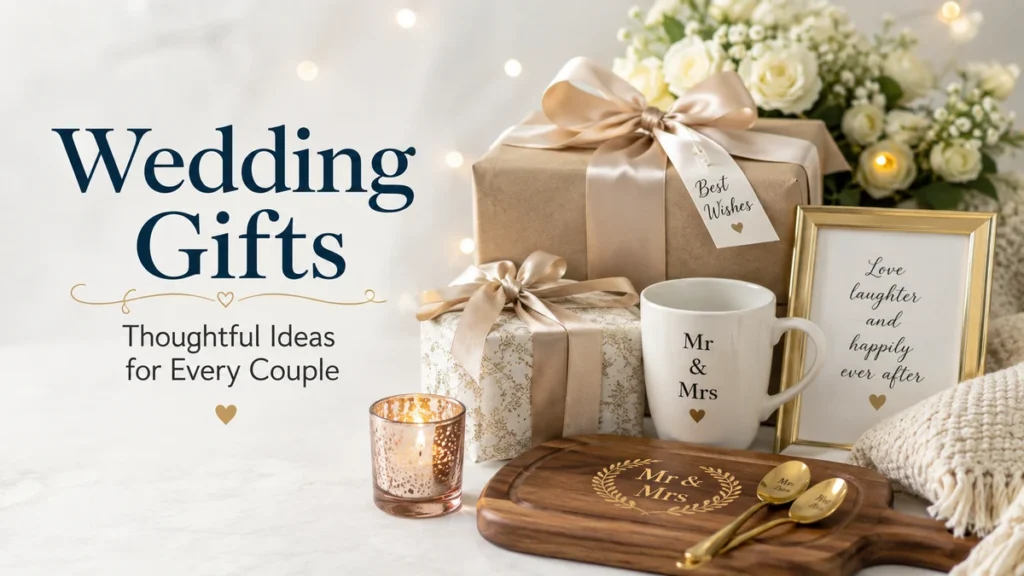
Choosing wedding gifts sounds easy until you actually have to buy one. The couple may already own everything they need, the registry may be nearly empty, or you may be wondering whether cash feels too impersonal.
The good news is that a memorable wedding present does not have to be expensive or unusual. It needs to fit the couple, your relationship with them, and your budget.
The best wedding gifts are useful, meaningful, or enjoyable for both partners. Start with the wedding registry when one exists, then consider cash, honeymoon contributions, experience gifts, quality home essentials, or personalized keepsakes. Spend an amount you can comfortably afford rather than trying to match the cost of your meal or another guest’s gift.
What Makes a Good Wedding Gift?
A good wedding gift supports the couple as they begin—or continue—their life together. That can mean helping them furnish a home, funding an experience, preserving a memory, or simply giving them the flexibility to buy something they genuinely need.
The most useful way to think about wedding presents is through four qualities:
- Relevant: It suits the couple’s lifestyle.
- Useful: They will actually use or enjoy it.
- Appropriate: It reflects how well you know them.
- Affordable: It fits your budget without creating financial pressure.
Price alone does not determine whether a gift is thoughtful.
A close friend might create an inexpensive photo album filled with years of shared memories. A group of coworkers might pool their money for a premium registry item. Parents might contribute toward a honeymoon or first home.
All can be excellent gifts because the context is different.
Start With the Couple, Not the Product
Before searching for gift ideas, think about the recipients.
Ask yourself:
- Do they already live together?
- Have they created a wedding registry?
- Are they moving into a new home?
- Do they prefer experiences over possessions?
- What hobbies or interests do they share?
- Are they saving for a honeymoon, house, renovation, or another major goal?
- Would they appreciate sentimental gifts?
These questions quickly eliminate ideas that look impressive but do not suit the couple.
A large decorative item, for example, can become a burden for people living in a small apartment. Expensive cookware may be wasted on people who rarely cook. A highly personalized ornament may not fit a minimalist home.
The gift should reflect their lives—not the giver’s taste.
Wedding Gifts From the Registry: Why They Are Usually the Safest Choice
If the couple has a wedding registry, checking it should normally be your first step.
Registries exist because couples can identify what they need, choose styles they like, and reduce the likelihood of receiving duplicate items. Emily Post describes a registry as a convenience rather than a requirement, meaning guests remain free to choose something else.
Buying from the registry isn’t lazy or impersonal. In many cases, it is the most considerate choice.
Common Registry Gifts
Traditional and modern registries can include:
| Category | Examples | Particularly Useful For |
|---|---|---|
| Kitchen | Cookware, knives, appliances, dinnerware | Couples building a kitchen |
| Bedroom | Sheets, pillows, duvet covers | A shared or new home |
| Bathroom | Towels, bath accessories | Practical everyday use |
| Entertaining | Glassware, serving dishes, barware | Couples who host |
| Home | Lamps, storage, décor | New homeowners |
| Travel | Luggage, travel accessories | Frequent travelers |
| Outdoor | Camping or gardening equipment | Couples with shared hobbies |
| Experiences | Classes, activities, trips | Couples who value memories |
| Cash funds | Honeymoon or home funds | Established households |
Modern registries have moved well beyond china and household appliances. Couples can include hobbies, travel, experiences, charitable contributions, and financial goals.
Do You Have to Buy From the Wedding Registry?
No.
Wedding etiquette does not require guests to purchase from a registry. Emily Post specifically describes the registry as guidance rather than a mandate.
Going off-registry makes the most sense when:
- You know the couple extremely well.
- You have a genuinely personal idea.
- Most affordable registry items have already been purchased.
- The couple doesn’t have a registry.
- You are giving cash or contributing toward an experience.
- Your gift has sentimental significance.
If you barely know the couple, however, an experimental off-registry present carries more risk.
When uncertain, trust the registry.
How Much Should You Spend on Wedding Gifts?
There is no universal amount that every wedding guest should spend.
Your budget comes first.
Your relationship with the couple, local customs, travel expenses, participation in the wedding party, and whether you’re attending other wedding-related events can all influence what feels reasonable.
Most importantly, forget the old idea that your present should “cover your plate.” Etiquette guidance from Emily Post explicitly rejects the idea that your gift must equal what the hosts spent on you.
The Knot’s August 2026 guidance similarly says there isn’t one mandatory gift amount and recommends considering both your relationship with the couple and your personal budget. Its published ranges vary substantially according to the relationship.
A Better Way to Set Your Budget
Instead of asking, “What am I supposed to spend?” ask:
“What can I comfortably give that appropriately reflects this relationship?”
That distinction matters.
Someone attending a destination wedding may already have spent heavily on flights and accommodation. A bridesmaid or groomsman may have paid for clothing, travel and other wedding-party commitments. A student may have a very different financial situation from an established professional.
There is no reason to take on debt simply to meet an imagined wedding-gift threshold.
Group Wedding Gifts
If the couple has registered for something expensive, consider a group gift.
Friends, siblings, coworkers or members of the wedding party can pool their budgets toward one substantial item.
This approach works particularly well for:
- Premium cookware
- Furniture
- Major appliances
- Luggage
- Hotel stays
- Honeymoon activities
- Home improvement funds
- Large registry items
One genuinely useful gift can be better than five smaller items the couple doesn’t need.
Cash Wedding Gifts: Are They Appropriate?
Yes. Giving money as a wedding gift is perfectly acceptable.
Emily Post recognizes cash or checks as appropriate wedding presents and notes that monetary gifts can be particularly useful for couples who have already established a household or are saving for something specific.
Cash gifts can help with:
- A honeymoon
- A home down payment
- Renovations
- Furniture
- Future travel
- Wedding expenses
- Shared savings
- Another goal selected by the couple
Cash is especially practical for couples who have lived together for years and already own household essentials.
Cash Funds and Honeymoon Funds
Modern registries often allow couples to create dedicated funds rather than simply requesting unspecified money.
For example:
Honeymoon Fund → Dinner in Rome → $100 contribution
feels more tangible than:
Give us $100.
The gift is still monetary, but the giver understands what they’re helping make possible.
Cash and honeymoon registries have become a mainstream part of modern wedding planning. The Knot reported in July 2026 that its Annual Registry Study found 75% of couples asked for cash as part of their wedding gifting preferences.
How to Make a Cash Gift Feel Personal
Money doesn’t have to feel transactional.
Pair it with a handwritten wedding card explaining what you hope the couple enjoys with it.
For example, you might mention that the contribution is intended for a wonderful dinner on their honeymoon or something special for their new home.
That personal note provides the emotional component while the money provides flexibility.
Personalized Wedding Gifts That Actually Feel Personal
Personalized wedding gifts can be wonderful—but adding two names to an object doesn’t automatically make it meaningful.
The strongest personalized gifts connect to something specific about the couple.
Think about:
- Where they met
- Their engagement
- Their wedding date
- A favorite destination
- Their shared hobby
- Their first home
- A family tradition
- An important photograph
- A meaningful song or quotation
- A shared experience
Personalized Gift Ideas
Consider:
- Custom wedding photo album
- Professionally framed wedding photograph
- Illustrated map of where they met
- Custom artwork of their wedding venue
- Engraved serving board
- Personalized glassware
- Monogrammed linens
- Custom recipe book
- Family recipe collection
- Engraved keepsake box
- Wedding-date ornament
- Commissioned portrait
- Memory book from friends and family
- Personalized travel journal
The key is restraint.
Not every object becomes better after adding names, initials or a wedding date.
Be Careful With Names and Monograms
Never assume that either partner will change their surname after marriage.
If you’re ordering something personalized before the wedding, confirm the names, spelling and preferred format.
This is especially important for:
- Monograms
- Towels
- Glassware
- Signs
- Cutting boards
- Stationery
- Artwork
When you aren’t certain, using first names or the wedding date can be safer than assuming a shared surname.
Unique Wedding Gifts for Couples Who Have Everything
Some couples genuinely don’t need another household item.
Perhaps they’ve lived together for ten years. Maybe they own a fully equipped home. Or they simply prefer fewer possessions.
This is where experience gifts become particularly useful.
Experience Wedding Gift Ideas
Good options include:
- Cooking class for two
- Concert tickets
- Theater tickets
- Museum membership
- Couples’ spa experience
- Weekend getaway
- Hotel stay
- Food tour
- Photography session
- Art or pottery class
- Outdoor adventure
- Sailing excursion
- Restaurant experience
- Dance lessons
- Travel contribution
Experiences are especially appealing when they connect to something the couple already enjoys.
Don’t give adventure activities to people who hate adventure simply because the gift sounds exciting.
Make Experience Gifts Flexible
There is one major drawback to experience gifts: scheduling.
Newlyweds may be dealing with a honeymoon, work, travel and post-wedding commitments. A reservation that expires quickly or only works on one particular weekend can create another task.
Whenever possible, choose an experience that offers:
- Flexible dates
- A long redemption period
- Easy booking
- Transfer or exchange options
- Locations convenient for the couple
Giving freedom can be as important as giving the experience itself.
Practical Wedding Gifts Couples Can Use for Years
“Practical” should never be confused with boring.
Some of the most appreciated wedding gifts are objects people use constantly.
Kitchen Gifts
Quality kitchen essentials are classics for a reason.
Useful choices include:
- Dutch oven
- Cast-iron skillet
- Chef’s knife
- Cutting board
- Coffee maker
- Stand mixer
- Food processor
- Dinnerware
- Glassware
- Bakeware
- Serving pieces
Check the registry before buying appliances. Kitchens have limited storage, and receiving three coffee machines isn’t particularly helpful.
Bedroom and Bath Gifts
High-quality everyday essentials can provide years of use:
- Sheet sets
- Duvet covers
- Pillows
- Blankets
- Bath towels
- Robes
Pay attention to dimensions, colors and materials.
A beautiful king-size sheet set isn’t useful if the couple owns a queen-size bed.
Gifts for Entertaining
For couples who regularly host friends or family, consider:
- Serving platters
- Serving bowls
- Cheese boards
- Glassware
- Table linens
- Bar accessories
- Coffee sets
- Outdoor serving pieces
These gifts work particularly well when you already know their entertaining style.
Wedding Gifts for Different Types of Couples
The easiest way to find a thoughtful present is often to match it to the couple’s lifestyle.
For Food Lovers
Consider quality cookware, a cooking class, specialty ingredients, restaurant experiences, serving pieces or a recipe collection.
For Travelers
Useful possibilities include luggage, packing accessories, travel journals, hotel contributions or an experience they can use during their honeymoon.
Avoid booking flights or accommodation without consulting them. Travel plans involve schedules, passports, preferences and other details that guests may not know.
For Homeowners
Homeowners may appreciate:
- Quality tools
- Gardening equipment
- Home improvement contributions
- Outdoor entertaining pieces
- Smart-home accessories
- Practical décor selected from their registry
Again, don’t assume their decorating taste.
For Minimalists
Avoid adding clutter.
Cash, experiences, consumables, charitable donations requested by the couple, or contributions toward a larger registry item generally make more sense.
For Couples Who Love the Outdoors
Depending on their interests, think about:
- Camping equipment
- Picnic gear
- Outdoor cookware
- Hiking accessories
- National or local park experiences
- Gardening equipment
A modern registry can absolutely reflect hobbies rather than traditional household expectations; Emily Post’s registry guidance specifically recognizes alternatives such as camping and gardening equipment.
For Sentimental Couples
This is where personal history matters most.
A collection of family recipes may mean more than expensive cookware. A beautifully restored photograph can carry more emotional value than generic décor.
Consider preserving a story rather than simply customizing an object.
Wedding Gifts When There Is No Registry
No registry doesn’t necessarily mean “no gifts.”
It may simply mean the couple already has what they need or prefers not to create a formal wish list.
Start by checking their wedding website for guidance.
If there is none, safe choices include:
- Cash with a thoughtful card
- A flexible gift card
- An experience
- A quality household essential you know they’ll use
- A personalized gift if you know them well
- A group contribution toward something significant
The less you know about their tastes, the more flexible the gift should become.
For a coworker, cash or a broadly useful gift may be safer than personalized wall art.
For your sibling, you probably have enough knowledge to choose something much more personal.
When Should You Send a Wedding Gift?
Sending the gift before the wedding is usually convenient because the couple doesn’t have to transport it home from the reception.
Shortly after the wedding is also acceptable.
Emily Post recommends sending a wedding gift before the ceremony or soon afterward and advises against relying on the old claim that guests automatically have a full year. Its guidance suggests sending it no later than about three months after the wedding.
Earlier is usually easier for everyone.
Should You Bring the Gift to the Wedding?
Traditions vary.
Some receptions have designated gift tables, while other couples prefer gifts shipped directly to their homes.
Large boxes are particularly inconvenient at a reception. Someone eventually has to secure them, transport them and make sure nothing disappears.
For physical registry items, direct delivery is generally simpler.
A card or small envelope is easier to carry, although monetary gifts should always be handled securely.
Do You Give a Gift If You Cannot Attend?
This is partly a question of tradition, relationship and personal circumstances.
Traditional etiquette has generally treated wedding gifts as connected to the invitation rather than simply payment for attending the reception. Modern expectations, however, are becoming more flexible, particularly where travel costs and individual financial circumstances are involved.
Your relationship is a useful guide.
If your sibling or best friend is getting married and you cannot attend, you will probably still want to send something.
For a distant acquaintance whose wedding you cannot attend, a warm card or modest present may feel sufficient depending on the circumstances.
A wedding gift should express goodwill, not function as an admission fee.
Destination Wedding Gift Etiquette
Destination weddings create a special situation because guests may already be paying for:
- Flights
- Hotels
- Local transportation
- Meals
- Clothing
- Time away from work
Those expenses matter.
Don’t create financial hardship because you believe the physical gift has to match what you would have spent at a local wedding.
Choose something comfortable within your remaining budget.
A smaller registry item, group gift, modest cash contribution or meaningful card can all be appropriate.
The couple invited you because they wanted you there—not because they were calculating the value of your present.
Do Bridesmaids and Groomsmen Still Give Wedding Gifts?
Members of the wedding party often give gifts, but their circumstances deserve consideration.
Bridesmaids and groomsmen may already have spent substantial amounts on:
- Clothing
- Travel
- Accommodation
- Pre-wedding events
- Bachelor or bachelorette celebrations
- Hair and makeup
- Other wedding responsibilities
If your budget is stretched, don’t feel pressured to make an extravagant additional purchase.
A smaller registry gift, sentimental keepsake or group present from the wedding party can still be meaningful.
Wedding Shower Gift vs. Wedding Gift
A bridal or wedding shower and the wedding are separate gifting occasions in traditional etiquette, but that doesn’t mean both presents need to be equally expensive.
If you’re attending multiple events, establish one overall gifting budget.
For example, you could allocate a smaller portion to the shower and reserve most of the budget for the wedding.
Shower gifts are often practical and registry-based, such as:
- Kitchen accessories
- Linens
- Small appliances
- Home essentials
- Personalized items
This keeps your total spending manageable rather than treating every invitation as a completely separate financial obligation.
Cultural Traditions Can Change Wedding Gift Etiquette
There isn’t one universal gifting tradition.
Cash may feel highly modern in one community while being the traditional choice in another.
For example, monetary wedding gifts have long played an important role across many Asian and Middle Eastern wedding traditions. Pakistani weddings commonly include salami—money presented to the couple, often in an envelope—with the precise customs varying among families and regions.
Other cultures have their own expectations concerning:
- Cash
- Gold
- Jewelry
- Household goods
- Presentation
- Gift amounts
- Auspicious numbers
- When the gift is given
If you’re attending a wedding from a tradition unfamiliar to you, asking someone close to the family about local customs is entirely reasonable.
Cultural awareness is more useful than applying one generic etiquette rule everywhere.
Wedding Gifts to Avoid
A gift can be expensive and still be a poor choice.
Oversized Décor
Large paintings, sculptures and decorative furniture require space and need to match the couple’s taste.
Unless specifically requested, avoid making permanent decorating decisions for someone else’s home.
Pets
Never surprise newlyweds with an animal.
A pet involves years of expenses, care, housing considerations and responsibility. It should always be the couple’s decision.
Gifts Intended Mostly for One Partner
A wedding gift is generally for the couple.
Unless you have a particular reason otherwise, avoid something clearly designed for only one person’s interests.
Extremely Personal Items
Clothing, fragrances and other highly personal products depend heavily on taste, fit and preferences.
These are risky unless you know exactly what the recipients want.
Difficult-to-Use Experiences
An experience isn’t helpful when it requires the couple to travel hundreds of miles, book on a specific weekday or redeem it immediately.
Check the restrictions first.
Duplicate Household Items
This is exactly the problem a wedding registry helps prevent.
Before buying cookware, appliances, bedding or dinnerware off-registry, make sure the couple hasn’t already requested a particular version.
How to Choose Wedding Gifts Step by Step
When you’re stuck between dozens of ideas, simplify the decision.
- Check the wedding website and registry. Look for explicit preferences first.
- Set your budget. Decide what you can comfortably afford before shopping.
- Consider your relationship. The closer you are, the more personal the gift can reasonably become.
- Think about the couple’s lifestyle. Consider their home, hobbies, travel habits and interests.
- Choose practical, experiential or sentimental. Pick the category that best fits them.
- Check for duplicates and restrictions. Especially important for household items and experiences.
- Include a personal message. A few sincere sentences can make even a straightforward gift memorable.
- Send it at a convenient time. Direct delivery before the wedding is often easiest.
Quick Takeaway: When you’re uncertain, choose something from the registry. When there is no registry, give flexibility. When you know the couple exceptionally well, that’s when a truly personal gift can shine.
Registry vs. Cash vs. Personalized vs. Experience Gifts
There isn’t one “best” category for every couple.
| Gift Type | Biggest Advantage | Main Drawback | Best When |
|---|---|---|---|
| Registry gift | Known to be wanted | Less surprising | You’re unsure what to choose |
| Cash | Maximum flexibility | Can feel less personal without a note | Couple has established household |
| Honeymoon fund | Supports a shared goal | May involve platform conditions | Couple specifically requested it |
| Personalized gift | Strong sentimental value | Easy to misjudge taste | You know them very well |
| Experience | Creates shared memories | Scheduling can be difficult | Couple values activities over possessions |
| Gift card | Flexible and practical | Less distinctive | You know stores/services they use |
| Group gift | Makes expensive items accessible | Requires coordination | Registry contains major purchases |
| Household gift | Useful for years | Duplicate risk | Couple is establishing a home |
This comparison also explains why there is no universally perfect wedding present.
Different couples need different things.
Common Wedding Gift Mistakes
The most frequent mistakes happen when guests focus too much on impressing the recipients.
Spending More Than You Can Afford
Generosity shouldn’t create debt.
Your financial circumstances matter more than an arbitrary number found online.
Assuming Expensive Means Meaningful
A $300 object the couple doesn’t want is less useful than a modest item they selected themselves.
Ignoring the Registry Without a Reason
Going off-registry should usually be intentional.
If the couple specifically selected the exact cookware, towels or luggage they need, replacing those choices with your preferred versions may not help them.
Personalizing Too Soon
Confirm names and spellings before engraving anything.
Don’t assume surname changes.
Forgetting Both Partners
A wedding celebrates a partnership. The present should normally recognize both people.
Forgetting the Card
This tiny detail matters.
Years later, the couple may remember the message attached to the gift more clearly than its price.
The Simple Rule for Choosing Better Wedding Gifts
Good wedding gifting doesn’t require discovering something nobody else has ever thought of.
It requires paying attention.
Start with what the couple has told you through their registry or wedding website. Consider how they actually live. Decide what you can comfortably spend. Then choose something practical, flexible, experiential or personal.
Registry items remain one of the safest options. Cash and honeymoon funds offer flexibility. Experiences suit couples who prefer memories to possessions. Personalized keepsakes work beautifully when they’re based on genuine knowledge of the couple rather than personalization for its own sake.
Most importantly, wedding gifts aren’t a competition. You don’t need to cover the cost of your dinner, match another guest’s spending or prove how much you care through a price tag. Established etiquette guidance leaves the amount to the giver’s budget and relationship with the couple.
The right next step is simple: check the couple’s registry or wedding website, set a comfortable budget, and choose the gift that best reflects the life they’re building together.