The word bride appears everywhere around weddings, from invitations and speeches to phrases such as “bride and groom” and “mother of the bride.” But exactly who is considered a bride, and how is the word different from fiancée, wife, or newlywed?
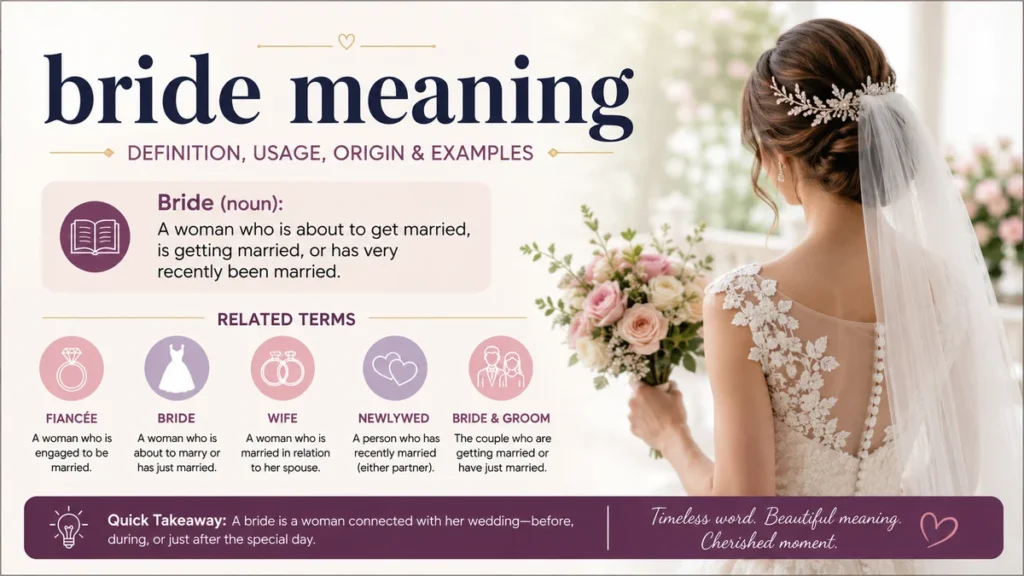
Bride means a woman who is about to get married, is getting married, or has very recently been married. The word is most closely associated with the wedding period itself. A woman may be called a bride shortly before the ceremony, on her wedding day, and for a short period afterward.
Understanding bride meaning becomes easier when you look at how the word functions before, during, and after a wedding.
What Is the bride meaning in English?
In standard English, a bride is a woman who is about to marry or who has recently married.
Major English dictionaries give remarkably consistent definitions. Merriam-Webster defines the term as referring to a woman who has just married or is about to marry, while Cambridge describes a bride as a woman approaching marriage or one who has just married. Oxford places particular emphasis on the period immediately around the wedding day.
The pronunciation is:
Bride: /braɪd/
It rhymes with:
- hide
- side
- ride
- pride
- wide
Bride is a countable noun, so its plural is brides.
For example:
The bride walked down the aisle before the wedding ceremony began.
Everyone gathered around the bride and groom for photographs.
Her sister helped the bride prepare for the ceremony.
In each case, the word identifies the woman specifically in relation to her wedding.
Simple definition of bride
For someone learning English, the easiest definition is:
Bride = a woman who is getting married.
There is a little more flexibility than that simple definition suggests, however. Someone does not suddenly become a bride only at the exact moment a marriage ceremony begins.
The term commonly covers a short period before and after the wedding as well.
When Does a Woman Become a Bride?
There is no universal clock that determines the precise second someone becomes or stops being a bride.
In everyday English, context matters.
Before the wedding
A woman preparing to marry may be described as a bride-to-be.
For example:
The bride-to-be chose her wedding dress several months before the ceremony.
This phrase makes it especially clear that the wedding has not happened yet.
The word bride itself can also be used for a woman shortly before her wedding, particularly when discussing wedding arrangements:
The bride selected flowers for the reception.
On the wedding day
The wedding day is where the meaning is clearest.
A woman getting married is the bride.
Terms such as these therefore sound completely natural:
- bride and groom
- bride’s dress
- bridal gown
- bridal party
- bride’s family
- mother of the bride
- father of the bride
Oxford describes a bride specifically in relation to her wedding day and the period just before or after it.
After the wedding
A woman can still be called a bride immediately after getting married.
For example:
He returned from his honeymoon with his new bride.
Here, the marriage has already happened, but bride remains natural because the woman is newly married.
As more time passes, wife becomes the ordinary relationship term rather than bride.
Quick Takeaway
| Stage | Common term |
|---|---|
| Engaged and planning a wedding | Fiancée / bride-to-be |
| Immediately before the ceremony | Bride |
| During the wedding | Bride |
| Immediately after marriage | Bride / newlywed / wife |
| Established marriage | Wife / spouse |
These boundaries are based on normal language usage rather than a formal legal classification.
Bride vs. Fiancée vs. Wife vs. Newlywed
One of the easiest ways to understand bride meaning is to compare it with similar marriage-related words.
Bride vs. fiancée
A fiancée is a woman who is engaged to be married.
A bride is a woman viewed specifically in connection with the upcoming, current, or very recent wedding.
Consider:
Sarah became engaged in January.
During most of her engagement, Sarah can be called a fiancée.
As the wedding approaches, particularly in wedding-related conversations, she may be called the bride or bride-to-be.
On the wedding day, bride is the normal term.
So the words overlap, but they emphasize different things:
Fiancée emphasizes engagement. Bride emphasizes the wedding.
Bride vs. wife
A wife is a married woman in relation to her spouse.
A bride may technically become a wife as soon as the marriage takes effect, yet people continue using bride around the wedding because it describes her ceremonial role and newly married status.
For example:
The bride and groom left the reception.
sounds natural.
Months or years later:
The husband and wife bought a house.
would usually sound more appropriate.
The difference is therefore largely about time and context.
Bride vs. newlywed
A newlywed is someone who has recently married.
Unlike bride, newlywed is not inherently limited to a woman.
Both members of a recently married couple can be described as newlyweds:
The newlyweds left for their honeymoon.
Bride vs. spouse
Spouse is a broad term for a married partner.
It is not primarily a wedding-day title.
Someone may remain a spouse throughout a marriage, whereas bride normally describes only the period surrounding the wedding.
What Is the Male Equivalent of Bride?
The traditional male counterpart of bride is bridegroom, usually shortened in modern English to groom.
This gives us the familiar expression:
bride and groom
For example:
The bride and groom exchanged wedding vows.
Guests applauded as the bride and groom entered the reception.
Historically, bridegroom is an interesting word in its own right. Its Old English ancestor was brydguma, combining the ancestor of bride with a word meaning “man.”
Modern wedding vocabulary is also becoming more flexible. Depending on the couple and their preferred terminology, expressions such as couple, partners, newlyweds, and spouses may be used instead of gender-specific wedding terms.
Bride Meaning in a Wedding Context
Although dictionaries provide a simple definition, the word carries a broader cultural meaning within weddings.
The bride traditionally refers to one of the people getting married and may be associated with several elements of a wedding ceremony and celebration.
These can include:
- wedding attire
- wedding vows
- processional
- wedding ceremony
- wedding rings
- wedding photographs
- reception
- bridal party
- honeymoon
Not every wedding follows the same traditions.
Customs differ significantly between religions, cultures, countries, families, and individual couples. Even practices strongly associated with Western weddings—such as white wedding dresses, bridesmaids, or walking down an aisle—are traditions rather than requirements for someone to be considered a bride.
A woman does not need a particular dress, ceremony style, venue, ring, or wedding custom to fit the ordinary meaning of the word.
What does “bride and groom” mean?
Bride and groom traditionally describes a woman and man who are getting married or have just married.
Cambridge includes the expression in its usage examples, reflecting how established it is in everyday wedding vocabulary.
For same-sex couples or couples who prefer different terminology, alternatives can include:
the couple, the newlyweds, the spouses, or simply the individuals’ names.
Common Words and Phrases Related to Bride
Wedding vocabulary contains many expressions built around bride.
Bride-to-be
A bride-to-be is a woman who will soon be married.
Example:
The bride-to-be spent the weekend celebrating with friends.
It is particularly useful when you want to make clear that the wedding has not happened yet.
Bridal
Bridal is an adjective associated with a bride or wedding.
Common expressions include:
- bridal gown
- bridal shower
- bridal party
- bridal makeup
- bridal bouquet
- bridal suite
- bridal accessories
- bridal wear
Interestingly, bridal has a much older history than its modern appearance suggests.
The word developed from Old English brydealo, referring to a marriage feast and literally combining the ancestors of bride and ale. Over time, the ending came to be understood like the familiar English -al suffix.
Bridal party
The bridal party traditionally refers to people accompanying or supporting the bride as part of the wedding celebration.
Depending on the wedding, this could include bridesmaids, a maid or matron of honor, or other attendants.
Today, wedding party is also widely useful because it can describe attendants without tying the group specifically to one member of the couple.
Mother of the bride
The mother of the bride is simply the bride’s mother.
The phrase is so established in English that Cambridge uses it among its standard examples of bride.
New bride
A new bride is a woman who has recently married.
For example:
The new bride thanked everyone who attended the wedding.
The expression illustrates why bride can remain appropriate briefly after the ceremony.
Bride Meaning and Word Origin
The word bride has been part of English for centuries.
Merriam-Webster traces it through Middle English to Old English brȳd and records English use from before the 12th century. Related historical forms appear in other Germanic languages.
Etymological evidence connects Old English bryd with Proto-Germanic forms represented by relatives such as Old Frisian breid, Dutch bruid, Old High German brut, and modern German Braut.
Collins similarly identifies connections with Old Norse, Gothic, Old High German, and other Germanic forms.
The deeper origin is less certain.
Some historical theories have attempted to connect the term with an Indo-European root associated with cooking or brewing, potentially reflecting historical household roles. That connection is speculative rather than a settled explanation of the word’s origin.
That distinction matters because simplified etymology explanations online sometimes present uncertain theories as established facts.
The reliable conclusion is straightforward: bride has very old Germanic roots, while its ultimate prehistoric origin remains uncertain.
How to Use Bride Correctly in a Sentence
Because bride is a noun, it normally identifies a person.
Here are several natural examples.
Before a wedding
The bride chose a simple bouquet for the ceremony.
Everyone surprised the bride-to-be with a small celebration.
During the ceremony
The bride walked toward the ceremony area with her father.
The bride and groom exchanged rings.
The bride read her wedding vows.
At the reception
Guests raised their glasses to the bride and groom.
The bride thanked her family during the reception.
Shortly after marriage
The newly married bride left for her honeymoon the following morning.
He introduced his new bride to relatives who had missed the wedding.
Possessive form
The singular possessive is bride’s:
The bride’s bouquet was made with roses.
The bride’s family arrived early.
The plural is brides:
Both brides selected flowers for the ceremony.
The plural possessive is brides’:
The brides’ families celebrated together.
These small distinctions are especially useful for English learners because bride, brides, and bride’s can sound similar when spoken quickly.
Is a Bride Always a Woman?
In traditional English dictionary definitions, bride refers to a woman who is about to marry or has recently married. Merriam-Webster, Cambridge, Collins, Dictionary.com, and Oxford all retain this female-specific core definition.
Real-world wedding language, however, depends on how individuals describe themselves.
Some couples use traditional terms such as bride and groom, while others prefer gender-neutral terms such as:
- partner
- spouse
- nearlywed
- newlywed
- wedding couple
- person getting married
The best approach when referring to a specific person is to use the terminology that person prefers.
Bride Meaning in Other Languages
The concept represented by bride exists across languages, although individual words can carry slightly different cultural or grammatical nuances.
For example, Collins gives equivalents including:
| Language | Common equivalent |
|---|---|
| Arabic | عَروس |
| Spanish | novia |
| French | mariée / future mariée |
| German | Braut |
| Italian | sposa |
| Portuguese | noiva |
| Japanese | 花嫁 |
| Korean | 신부 |
| Turkish | gelin |
| Vietnamese | cô dâu |
A direct translation does not always reproduce every nuance of the English word. Some languages distinguish more clearly between an engaged woman, someone on her wedding day, and a newly married woman.
That is why context remains important when translating wedding terminology.
Does Bride Mean Wife?
Bride and wife are related, but they do not mean exactly the same thing.
A bride is connected specifically with the period surrounding marriage. A wife is a woman who is married in relation to her spouse.
Imagine a couple getting married on Saturday.
On Friday, the woman might be described as the bride-to-be or fiancée.
On Saturday, she is the bride.
Immediately afterward, she can naturally be called either a bride, newlywed, or wife, depending on context.
Years later, wife remains appropriate, while bride normally would not—unless someone were referring back to her wedding:
She was a nervous bride on her wedding day.
That example shows that bride describes a person’s role or status around a particular wedding rather than a permanent marital status.
Is Bride the Same as Girlfriend?
No.
A girlfriend is a female romantic partner. The term itself does not indicate engagement or marriage.
A fiancée is engaged to be married.
A bride-to-be is approaching her wedding.
A bride is about to marry, is getting married, or has just married.
A wife is married.
The relationship can therefore progress through several terms:
girlfriend → fiancée → bride → wife
Not every relationship follows this exact sequence, and people may choose different terminology, but it provides a simple way to understand the conventional meanings.
Other Meanings of the Word Bride
The wedding-related definition is overwhelmingly the meaning most people intend, but dictionaries record a few less common uses.
In lacemaking and needlework, bride can refer to a thread, loop, bar, or tie connecting portions of a design. Dictionary.com and Collins both record this specialized meaning.
Capitalized Bride can also occur as a name connected with Saint Bride, another name associated with Saint Brigid in dictionary entries.
These meanings are highly context-dependent.
If someone says:
The bride entered the room.
the wedding meaning is obvious.
If the word appears in technical instructions about needlepoint lace, however, it may have nothing to do with marriage.
Common Mistakes When Using the Word Bride
The basic definition is simple, but several usage mistakes are common.
Calling every engaged woman a bride
An engaged woman can certainly be described as a bride-to-be, especially when wedding planning has begun. But fiancée is usually the more precise general term for her relationship status before marriage.
Treating bride as a permanent synonym for wife
A bride becomes a wife, but bride normally remains tied to the wedding and newly married period.
Someone married for ten years would not ordinarily be introduced as “his bride” in neutral everyday speech, although the expression can occasionally be used affectionately or stylistically.
Assuming bridal means only clothing
Bridal can describe far more than a dress.
A bridal bouquet, bridal party, bridal suite, bridal shower, and bridal accessories all use the adjective correctly.
Confusing bride with bridal
The difference is grammatical:
Bride is primarily a noun:
The bride arrived.
Bridal is primarily an adjective:
She selected a bridal gown.
That simple distinction prevents many common errors.
Understanding bride meaning in Modern English
The simplest answer to bride meaning is a woman who is about to get married, is getting married, or has recently married. That core definition has remained remarkably stable across major English dictionaries.
What changes is the context around it.
Before the wedding, fiancée or bride-to-be may be more precise. On the wedding day, bride is the standard traditional term. Immediately afterward, bride, newlywed, and wife can overlap. As time passes, wife or spouse becomes the normal description.
Knowing those distinctions makes wedding vocabulary much easier to understand—and helps you use bride naturally and accurately in everyday English.