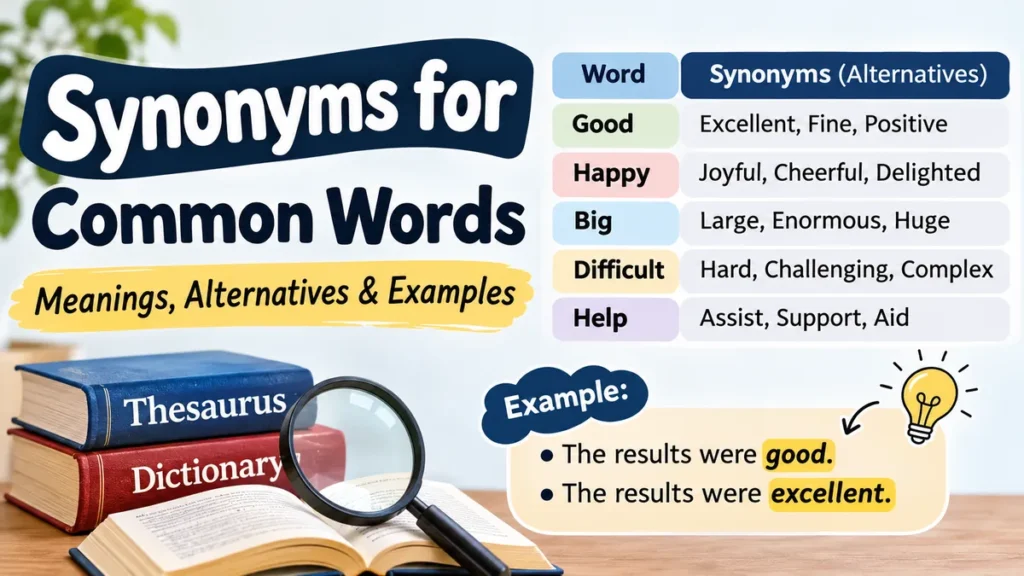
Finding the right word can make a sentence clearer, more precise, and more engaging. But replacing a word with another that looks similar in a thesaurus does not always preserve its meaning.
If you’re searching for synonyms for a particular word, the most useful approach is to consider its meaning, context, tone, and grammatical role before choosing an alternative.
Synonyms are words or expressions that have the same or nearly the same meaning as another word. For example, happy can be replaced with joyful, pleased, or delighted in certain contexts. However, these alternatives express different levels of emotion, so the best choice depends on the sentence.
What Are Synonyms?
A synonym is a word that shares an identical or closely related meaning with another word. Synonyms help writers avoid unnecessary repetition, communicate subtle differences in meaning, and select language appropriate for their audience.
For example, consider these sentences:
- The student gave a good presentation.
- The student gave an excellent presentation.
- The student gave an informative presentation.
Although good, excellent, and informative can all describe a presentation positively, they communicate different qualities. Excellent emphasizes high quality, while informative emphasizes useful information.
The term synonym comes from Greek roots meaning “same” and “name.” In linguistics, synonymy describes the semantic relationship between words with similar meanings.
Types of Synonyms
Linguists distinguish between several kinds of synonymy.
Absolute synonyms have identical meanings in virtually every context. They are extremely rare because words usually differ in usage, connotation, or technical meaning.
Partial synonyms share a core meaning but differ in intensity, tone, or application. For example, angry, furious, and irritated all describe negative emotional states, but not at the same intensity.
Contextual synonyms function as alternatives only in particular situations. For example, bright and intelligent may describe the same person, but bright and luminous are more closely related when discussing light.
Understanding these distinctions prevents awkward substitutions.
Synonyms for Commonly Used Words
Many everyday words have several useful alternatives. The following table provides examples, but the words are not necessarily interchangeable in every sentence.
| Common word | Possible synonyms |
|---|---|
| Good | Excellent, fine, favorable, positive |
| Bad | Poor, unpleasant, harmful, inferior |
| Happy | Joyful, cheerful, pleased, delighted |
| Sad | Unhappy, sorrowful, miserable, downcast |
| Beautiful | Attractive, lovely, gorgeous, stunning |
| Important | Significant, essential, crucial, vital |
| Big | Large, enormous, huge, substantial |
| Small | Little, tiny, miniature, compact |
| Smart | Intelligent, clever, bright, perceptive |
| Fast | Quick, rapid, speedy, swift |
| Easy | Simple, straightforward, effortless |
| Difficult | Hard, challenging, demanding, complicated |
| Interesting | Fascinating, engaging, intriguing, compelling |
| Help | Assist, support, aid, facilitate |
| Show | Display, demonstrate, reveal, illustrate |
| Explain | Clarify, describe, interpret, elaborate |
| Improve | Enhance, strengthen, refine, upgrade |
| Change | Alter, modify, transform, adjust |
| Start | Begin, initiate, commence, launch |
| End | Finish, conclude, terminate, complete |
The correct alternative depends on what the original word means in its specific context.
For example, large is a natural substitute for big in “a big house,” but important is usually more suitable in “a big decision.”
How to Find Synonyms for a Word
Finding alternatives involves more than collecting words with similar dictionary definitions. A reliable method considers meaning, grammar, and natural usage.
1. Identify the Original Meaning
First, determine what the word communicates in the sentence.
Consider the word light:
- A light suitcase is easy to carry.
- A light room receives plenty of illumination.
- A light meal is not particularly heavy or filling.
Each example requires a different group of synonyms.
For the suitcase, lightweight may work. For the room, bright is suitable. For the meal, small or modest may be appropriate.
2. Check the Part of Speech
A replacement should usually perform the same grammatical function.
For example, success is a noun, successful is an adjective, and succeed is a verb.
Although these words belong to the same word family, they cannot be substituted directly without changing sentence structure.
A thesaurus may provide related terms, but the writer must verify their grammatical compatibility.
3. Compare Meaning and Intensity
Some alternatives express stronger or weaker meanings.
Consider this progression:
Different levels of anger
Illustrative intensity scale; actual meaning depends on context.
Replacing annoyed with furious can substantially change the message.
4. Consider Formality and Tone
Words with similar meanings may belong to different registers.
For example:
- Help is common in everyday conversation.
- Assist sounds somewhat more formal.
- Facilitate often means making a process easier rather than directly helping someone.
A professional report may require different vocabulary from a casual message.
5. Test the Replacement in Context
Read the entire sentence after making a substitution.
Original: “The new policy had a significant impact.”
Possible replacement: “The new policy had a substantial impact.”
Both sound natural.
However, replacing significant with famous would be incorrect, even though significant can sometimes mean noteworthy.
A suitable synonym must preserve the intended meaning, not merely share one possible dictionary association.
Synonyms for Different Parts of Speech
Synonyms exist across nouns, verbs, adjectives, and adverbs. Knowing the part of speech helps narrow the search to grammatically appropriate alternatives.
Noun Synonyms
Nouns name people, places, things, ideas, or conditions.
| Noun | Synonyms |
|---|---|
| Idea | Concept, notion, thought |
| Problem | Issue, difficulty, challenge |
| Goal | Objective, aim, target |
| Answer | Response, reply, solution |
| Job | Occupation, position, role |
| Friend | Companion, ally, confidant |
| Mistake | Error, fault, blunder |
| Reason | Cause, explanation, rationale |
For example, “The team achieved its goal” could become “The team achieved its objective” without substantially changing the meaning.
However, goal and objective may have different technical meanings in project management.
Verb Synonyms
Verbs express actions, events, or states.
| Verb | Synonyms |
|---|---|
| Say | State, mention, declare |
| Make | Create, produce, construct |
| Think | Consider, believe, reflect |
| Look | Observe, examine, inspect |
| Get | Obtain, receive, acquire |
| Use | Employ, utilize, apply |
| Find | Discover, locate, identify |
| Build | Construct, assemble, develop |
Verb selection can make descriptions more specific.
“The researcher looked at the results” is less precise than “The researcher examined the results.”
The second sentence communicates deliberate analysis rather than simple observation.
Adjective Synonyms
Adjectives describe qualities or characteristics.
For example, beautiful may have alternatives such as elegant, attractive, picturesque, or stunning.
Each highlights a different quality. Picturesque is especially suitable for visually appealing scenery, while elegant can suggest refined simplicity.
Similarly, difficult might become challenging, complex, or demanding, depending on whether the emphasis is effort, intricacy, or requirements.
Adverb Synonyms
Adverbs often modify verbs, adjectives, or other adverbs.
Examples include:
- Quickly — rapidly, swiftly, speedily
- Carefully — cautiously, attentively, meticulously
- Quietly — silently, softly, discreetly
- Clearly — plainly, distinctly, explicitly
- Frequently — often, regularly, repeatedly
Not every alternative expresses exactly the same idea. Frequently describes how often something happens, while regularly can also imply a predictable pattern.
Synonyms for Formal and Academic Writing
Academic writing benefits from precise vocabulary, but complicated words do not automatically make writing better.
Consider these commonly used expressions:
| Common expression | Possible academic alternative |
|---|---|
| A lot of | Many, numerous, substantial |
| Show | Demonstrate, indicate, illustrate |
| Find out | Determine, establish, discover |
| Look into | Investigate, examine, analyze |
| Talk about | Discuss, address, examine |
| Point out | Highlight, identify, emphasize |
| Deal with | Address, manage, resolve |
| Because of | Due to, owing to, as a result of |
| In the end | Ultimately, eventually, finally |
| Make better | Improve, enhance, refine |
These alternatives should be chosen according to the intended meaning.
For example, demonstrate may suggest stronger evidence than indicate. A study that suggests a possible relationship should not be described as demonstrating a definitive causal connection.
Using Synonyms in Essays
Students often search for alternatives to words such as important, shows, good, and bad.
A useful strategy is to identify the specific quality being discussed.
Instead of writing:
“The results were very good.”
Write:
“The results were consistent across the three experiments.”
The revised sentence is stronger because it provides meaningful information rather than simply using a more impressive adjective.
Synonyms in Professional Communication
Business writing often favors clarity and brevity.
Compare these expressions:
- “We will commence the meeting” versus “We will begin the meeting.”
- “Please utilize the document” versus “Please use the document.”
- “We need to facilitate communication” versus “We need to improve communication.”
Formal alternatives are not always more professional. Familiar, precise language often communicates more effectively.
Synonyms for Emotions, Personality, and Descriptions
Descriptive vocabulary is especially useful when writing stories, personal statements, reviews, and everyday messages.
Synonyms for Positive Emotions
| Emotion | Related words | Distinction |
|---|---|---|
| Happy | Cheerful, delighted, joyful | Different levels and forms of happiness |
| Excited | Enthusiastic, thrilled, eager | Anticipation or strong positive emotion |
| Calm | Peaceful, relaxed, composed | Emotional or behavioral steadiness |
| Proud | Pleased, satisfied, gratified | Positive feelings about achievement |
| Grateful | Thankful, appreciative, indebted | Different expressions of gratitude |
A person may feel pleased about a small achievement but thrilled about a major accomplishment.
Synonyms for Negative Emotions
| Emotion | Related words | Distinction |
|---|---|---|
| Sad | Unhappy, sorrowful, dejected | Different kinds of unhappiness |
| Afraid | Fearful, frightened, terrified | Increasing or varying fear |
| Worried | Concerned, anxious, apprehensive | Different forms of unease |
| Angry | Irritated, furious, outraged | Different levels and causes of anger |
| Tired | Fatigued, exhausted, weary | Different kinds of fatigue |
Words describing emotions are rarely perfect substitutes.
For instance, anxious can describe worry or nervous anticipation, while apprehensive often suggests concern about something that may happen.
Personality Synonyms
Words describing personality can also carry positive or negative connotations.
Confident and arrogant may both involve a strong belief in one’s abilities, but arrogant suggests an exaggerated sense of superiority.
Likewise, careful and timid can both describe cautious behavior, but timid suggests a lack of confidence or courage.
Choosing the wrong adjective can unintentionally change how readers perceive a person.
Synonyms for vs. Antonyms: What’s the Difference?
Synonyms and antonyms describe different semantic relationships.
A synonym shares a meaning with another word, while an antonym expresses an opposite or contrasting meaning.
| Original word | Synonym | Antonym |
|---|---|---|
| Happy | Joyful | Sad |
| Strong | Powerful | Weak |
| Easy | Simple | Difficult |
| Honest | Truthful | Dishonest |
| Increase | Rise | Decrease |
| Accept | Receive | Reject |
| Ancient | Old | Modern |
| Generous | Giving | Stingy |
Antonyms can also differ by context. For example, the opposite of light may be heavy when describing weight, but dark when describing brightness.
Synonyms, Homonyms, and Related Words
These linguistic concepts are sometimes confused.
Synonyms share similar meanings, such as quick and fast.
Antonyms express opposing meanings, such as hot and cold.
Homonyms share the same spelling or pronunciation but have different meanings, depending on the definition being used. For example, bank can refer to a financial institution or the side of a river.
Related words share a conceptual connection without necessarily being synonyms. Doctor, hospital, and medicine are related, but they do not mean the same thing.
Recognizing these distinctions helps students understand vocabulary relationships more accurately.
Best Dictionaries and Thesauruses for Finding Synonyms
A thesaurus is a reference resource that organizes words by meaning and provides synonyms, antonyms, and related vocabulary.
Several established resources can help writers find suitable alternatives.
Cambridge Dictionary and Thesaurus
The Cambridge English Thesaurus provides synonyms, antonyms, explanations, and usage examples in British and American English.
It is particularly useful for comparing similar words because it explains differences in meaning and formality rather than presenting alternatives without context.
Merriam-Webster Thesaurus
The Merriam-Webster Thesaurus organizes alternatives according to shared meanings.
It also distinguishes synonyms from related words and near antonyms, which can help prevent inappropriate substitutions.
Oxford Thesaurus
Oxford thesaurus resources organize alternatives by word sense and may include usage labels, grammatical information, and illustrative phrases.
This approach is useful for words with multiple meanings because it separates alternatives according to context.
How to Use an Online Thesaurus Effectively
Suppose you want another word for strong.
A thesaurus may suggest powerful, sturdy, robust, intense, and resilient.
The best choice depends on the noun:
- A powerful engine
- A sturdy table
- A robust system
- An intense emotion
- A resilient community
These examples demonstrate why dictionary definitions and usage examples are more reliable than choosing the first word in a synonym list.
Common Mistakes When Using Synonyms
Synonyms improve communication only when they preserve the intended meaning.
Replacing Every Repeated Word
Repetition is not always a problem. In technical, scientific, legal, and instructional writing, consistent terminology often improves accuracy.
For example, replacing temperature with heat simply to avoid repetition would be misleading because the terms describe different scientific concepts.
Ignoring Collocations
Collocations are words that naturally appear together.
English speakers commonly say strong coffee rather than powerful coffee, even though strong and powerful overlap in meaning.
Similarly, make a decision is natural, while construct a decision sounds unusual.
A replacement may be grammatically possible but still sound unnatural.
Overlooking Connotations
Denotation refers to a word’s basic meaning. Connotation refers to the associations or feelings it carries.
Consider slim and skinny. Both can describe a thin person, but slim often has a positive connotation, while skinny can sound critical.
Context, audience, and tone determine whether a substitution is appropriate.
Using Unnecessarily Complicated Vocabulary
Longer words are not inherently better.
“Use” is often clearer than “utilize.” “Begin” is often simpler than “commence.”
Good writing prioritizes accuracy, readability, and audience understanding.
How Synonyms Improve Vocabulary and Communication
Learning synonyms expands expressive flexibility. Rather than memorizing long lists of disconnected words, students can organize vocabulary into meaningful groups.
For example, a vocabulary group centered on walking might include strolling, wandering, marching, hiking, and pacing.
Each word describes a different type of movement:
- Strolling suggests a relaxed pace.
- Wandering suggests movement without a fixed destination.
- Marching suggests deliberate, rhythmic movement.
- Hiking usually refers to extended walking, often outdoors.
- Pacing suggests repeated movement back and forth.
Learning these distinctions develops a more practical understanding of vocabulary.
A Simple Vocabulary Practice Method
Try this exercise using any unfamiliar word.
Synonym practice of 3 correct
[Try again]
After practicing individual words, use each new synonym in an original sentence. This helps reinforce its meaning, grammatical function, and typical context.
Reading different types of material also exposes learners to vocabulary in natural situations. News articles, novels, academic texts, and everyday conversations use different registers, making them valuable sources of examples.
Final Thoughts on Synonyms for Everyday English
Understanding synonyms for common words is about more than finding alternatives. It involves recognizing subtle differences in meaning, emotional intensity, formality, and usage.
A well-chosen synonym can make a sentence more precise, reduce unnecessary repetition, or communicate a particular feeling more effectively. An unsuitable synonym can distort the original message.
The most reliable approach is simple: identify the intended meaning, compare suitable alternatives, check their usage, and choose the word that communicates the idea most accurately.