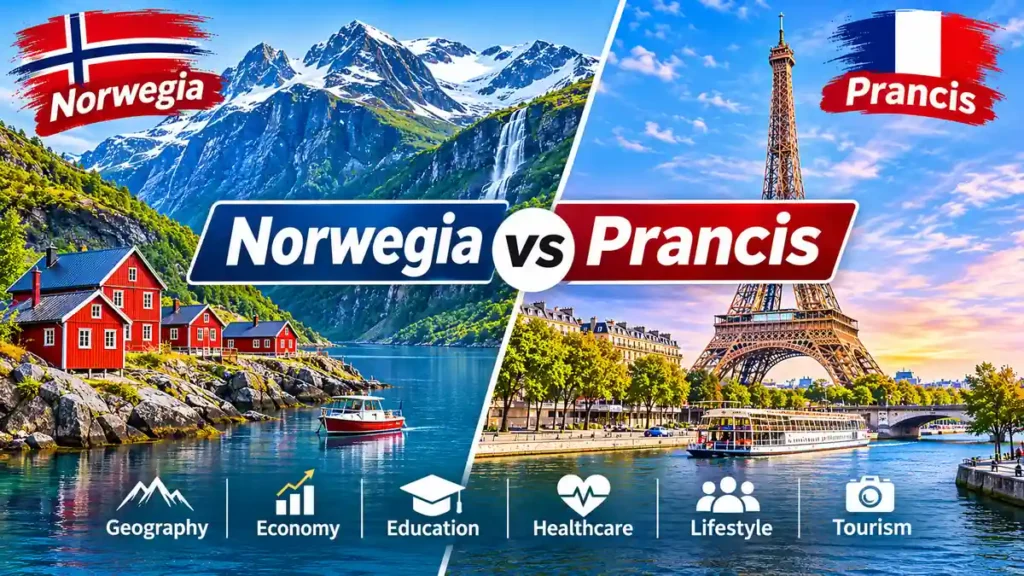
Norway and France are two of Europe’s most influential countries, yet they offer remarkably different experiences. From Norway’s dramatic fjords and Nordic lifestyle to France’s historic cities and Mediterranean coastline, each country has distinctive advantages.
The comparison norwegia vs prancis means Norway versus France in Indonesian. Norway is a wealthy Nordic country known for its natural landscapes, high living standards, and energy resources. France is a major Western European economy recognized for its cultural heritage, diverse geography, manufacturing industries, and international influence.
Understanding their differences requires looking beyond famous landmarks. Population, economic structure, climate, healthcare, education, and everyday living conditions all help explain how these countries compare.
norwegia vs prancis: Key Differences at a Glance
Norway and France share European values and strong public institutions, but their geography, population, political relationships, and economic systems differ considerably.
| Feature | Norway | France |
|---|---|---|
| Official name | Kingdom of Norway | French Republic |
| Capital | Oslo | Paris |
| Region | Northern Europe | Western Europe |
| Population | Approximately 5.6 million | Approximately 68.5 million |
| Main language | Norwegian | French |
| Currency | Norwegian krone (NOK) | Euro (EUR) |
| Government | Constitutional monarchy | Semi-presidential republic |
| European Union membership | No | Yes |
| Schengen Area | Yes | Yes |
| NATO membership | Yes | Yes |
| Economic strengths | Energy, maritime industries, fisheries, technology | Services, aerospace, manufacturing, agriculture, tourism |
| Climate | Temperate coastal to subarctic | Oceanic, continental, Mediterranean, and alpine |
| Notable landscapes | Fjords, mountains, glaciers | Alps, plains, vineyards, Mediterranean beaches |
Population figures are rounded estimates; exact totals depend on the reference date and statistical definition.
The most striking distinction is scale. France has roughly twelve times Norway’s population and a much larger total economy. Norway, however, has considerably higher economic output per resident and a substantial sovereign wealth fund.
Geography and Natural Landscapes
Geography shapes everything from transportation and settlement patterns to tourism and climate.
Norway: Fjords, Mountains, and Northern Wilderness
Norway occupies the western portion of the Scandinavian Peninsula. Its coastline is deeply indented by fjords, while mountains, forests, glaciers, and lakes dominate much of the interior.
Notable geographical features include:
- Geirangerfjord: A UNESCO-listed fjord famous for steep cliffs and waterfalls.
- Sognefjord: Norway’s longest and deepest fjord.
- Lofoten Islands: An archipelago known for fishing villages and dramatic mountain scenery.
- Jotunheimen National Park: A mountainous region containing some of Northern Europe’s highest peaks.
- North Cape: A popular destination associated with Arctic landscapes and the midnight sun.
Norway also administers the Svalbard archipelago in the Arctic.
Its mountainous terrain and long coastline create major transportation challenges, particularly in sparsely populated northern regions.
France: Diverse Landscapes and Geographic Regions
Metropolitan France has a more varied combination of plains, hills, mountains, river valleys, and coastlines.
Important geographical regions include:
- French Alps: Home to Mont Blanc, one of Europe’s highest mountains.
- Pyrenees: A mountain range forming much of the border with Spain.
- Provence: Known for Mediterranean scenery, lavender fields, and traditional villages.
- French Riviera: A Mediterranean coastal region including Nice and Cannes.
- Loire Valley: Famous for historic châteaux, vineyards, and river landscapes.
- Normandy and Brittany: Atlantic and Channel coastal regions with distinctive maritime histories.
France also has overseas regions and territories, extending its geographical presence into the Caribbean, South America, Indian Ocean, and Pacific.
Which Country Has More Diverse Geography?
France offers greater climatic and landscape variety, particularly when its overseas territories are included.
Norway is especially distinctive for its fjords, Arctic environments, glaciers, and mountainous coastline.
The better landscape depends on whether someone prefers northern wilderness or a mixture of mountains, countryside, historic towns, and warmer coastlines.
Climate and Weather: Norway vs France
Climate is one of the most noticeable differences between the countries.
Norway’s Climate
Norway is often associated with freezing temperatures, but its climate varies considerably by region.
The North Atlantic Current helps moderate temperatures along the western coastline, making some coastal areas much milder than their latitude might suggest.
In winter, northern Norway experiences extended darkness, while some areas above the Arctic Circle experience polar night. During summer, the midnight sun allows continuous daylight for part of the season.
Oslo generally has colder winters than Paris, while Bergen is particularly known for frequent precipitation.
France’s Climate
France experiences several climate types:
- Oceanic conditions in western regions, with relatively mild temperatures and regular rainfall.
- More continental conditions in the northeast, with colder winters and warmer summers.
- Mediterranean conditions in the south, with hot, dry summers and generally mild winters.
- Alpine conditions in mountainous regions, including substantial winter snowfall.
Paris has a temperate climate, while Nice and Marseille generally enjoy warmer winters.
Seasonal Comparison
| Season | Norway | France |
|---|---|---|
| Spring | Cool, with late snow in some regions | Mild to warm |
| Summer | Mild to warm; long northern daylight | Warm to hot, especially in the south |
| Autumn | Cool, often wet | Mild to cool |
| Winter | Cold, snowy in many regions | Mild in some areas, cold in mountains and northeast |
France generally provides more opportunities for warm-weather activities, while Norway offers exceptional conditions for winter sports, northern lights viewing, and Arctic experiences.
Economy, GDP, and Employment
Both countries are high-income developed economies, but their sources of wealth are different.
Norway’s Economic Model
Norway combines a market economy with substantial public services and government participation in important sectors.
Its major industries include petroleum, natural gas, hydropower, shipping, aquaculture, and maritime technology.
A defining feature of Norway’s economy is the Government Pension Fund Global, commonly called the Norwegian sovereign wealth fund.
The fund invests petroleum-related government revenues in international financial assets. Its purpose includes supporting long-term management of national wealth and benefiting future generations.
Norway’s relatively small population and substantial energy resources contribute to its high GDP per capita.
However, the economy remains exposed to international energy markets, even as policymakers pursue diversification.
France’s Economic Model
France has a large, diversified economy with major contributions from services, manufacturing, agriculture, tourism, and advanced technology.
Prominent sectors include:
- Aerospace and aviation, including Airbus-related activities.
- Automotive manufacturing and engineering.
- Luxury goods, fashion, and cosmetics.
- Agriculture and food production.
- Banking, insurance, and professional services.
- Nuclear energy and electricity generation.
- Tourism and hospitality.
France is a member of the European Union and euro area, giving it an important role in European economic policy.
Its larger domestic market supports a broader range of industries and employment opportunities.
GDP vs GDP Per Capita
Total gross domestic product measures the overall size of an economy. GDP per capita divides economic output by population.
France has a much larger total GDP because of its population and extensive industrial and service sectors.
Norway has a significantly higher nominal GDP per capita.
This does not mean every Norwegian household earns more than every French household. GDP per capita is an economic average, not a direct measurement of individual income, wealth distribution, or purchasing power.
For living-standard comparisons, purchasing power parity, household disposable income, taxation, and local prices are also relevant.
Cost of Living and Purchasing Power
Both countries can be expensive, particularly in major cities. Norway generally has higher consumer prices, although the difference depends on location and spending habits.
Housing and Rent
Oslo is one of Norway’s most expensive housing markets, with substantial demand for centrally located apartments.
Paris is also expensive, especially in popular central districts.
However, France has numerous smaller cities and regional towns where housing can be considerably cheaper than in Paris.
Norwegian cities such as Bergen, Trondheim, and Stavanger offer alternatives to Oslo, although housing costs can remain high.
Food, Transportation, and Daily Expenses
| Expense | Norway | France |
|---|---|---|
| Groceries | Generally expensive | Generally more affordable |
| Restaurants | High prices | Wider range of price levels |
| Alcohol | High taxes and prices | Generally less expensive |
| Public transportation | Well developed in major cities | Extensive urban and intercity networks |
| Housing | Expensive in major cities | Highly variable by region |
| Domestic travel | Distances and terrain can increase costs | Extensive rail and road connections |
Norway’s higher wages can offset some of its elevated consumer prices.
France’s lower prices for many everyday goods do not automatically translate into greater purchasing power because salaries, taxes, and housing expenses also differ.
Which Country Is More Affordable?
France is generally more affordable for everyday consumption, particularly outside Paris and the French Riviera.
Norway may provide strong purchasing power for residents earning Norwegian salaries, despite higher prices.
A realistic comparison should use after-tax income and expenses in specific cities rather than national averages alone.
Education Systems and Universities
Norway and France have well-established education systems, supported by public funding and national standards.
Education in Norway
Norway provides compulsory schooling for children from approximately ages six to sixteen.
The education system emphasizes inclusive learning, student welfare, and relatively limited academic competition during the earliest school years.
Public higher education includes institutions such as the University of Oslo, University of Bergen, and Norwegian University of Science and Technology (NTNU).
Norwegian and European Economic Area students generally benefit from tuition-free education at public universities, while most degree-seeking students from outside the EU/EEA must pay tuition fees. Exceptions and exemptions may apply.
English-taught programs are available, particularly at postgraduate level, but Norwegian-language proficiency can significantly expand educational and employment opportunities.
Education in France
France has a large and internationally recognized higher education system.
Its institutions include Sorbonne University, Université Paris-Saclay, and the Paris-based research and higher education institution PSL University.
France also has specialized grandes écoles, including institutions focused on engineering, business, public administration, and other disciplines.
Public universities generally charge regulated tuition fees, although the amounts vary by student status, institution, degree, and applicable exemptions.
French is the principal language of instruction, but many universities offer English-taught programs, especially at master’s level.
Which Country Is Better for International Students?
Norway offers a relatively small academic environment, strong research institutions, and opportunities in energy, marine sciences, environmental studies, and technology.
France provides a larger university system, a wider variety of institutions, and strong academic traditions in engineering, mathematics, humanities, business, and the arts.
For international students, the most important differences often involve tuition eligibility, living expenses, language requirements, and post-study residence rules.
Healthcare and Quality of Life
Both countries have extensive healthcare systems and high life expectancy.
Norway’s Healthcare System
Norway operates a predominantly publicly funded healthcare system.
Residents generally access primary care through general practitioners, while hospitals provide specialized treatment.
Many healthcare services involve regulated patient fees, although exemptions and annual payment ceilings protect eligible patients from excessive costs.
The system emphasizes universal access, preventive medicine, and coordinated care.
Challenges include waiting times for some non-emergency services and providing specialist care across geographically remote regions.
France’s Healthcare System
France uses a statutory health insurance model, with public financing and contributions supporting healthcare coverage.
Patients can access general practitioners, specialists, hospitals, and pharmacies through a combination of public and private providers.
The French system commonly reimburses a substantial portion of eligible medical expenses. Supplementary health insurance, known as mutuelle, often covers part of the remaining costs.
France is particularly known for its extensive network of medical professionals and healthcare facilities, although access can vary between urban and rural areas.
Life Expectancy and Well-Being
According to World Bank data, life expectancy at birth in 2024 was approximately 83 years in both countries.
High life expectancy reflects a combination of healthcare, sanitation, education, income, and living conditions.
However, quality of life is broader than life expectancy. Housing affordability, employment security, personal relationships, environmental quality, and access to public services also matter.
Norway is often associated with strong work-life balance and outdoor recreation. France combines extensive public services with a rich cultural and social environment.
Neither country’s healthcare system is free from challenges, and individual experiences depend on residence, coverage, medical needs, and location.
Culture, Language, and Everyday Lifestyle
Cultural differences are among the most interesting aspects of the norwegia vs prancis comparison.
Norwegian Culture
Norwegian culture places considerable emphasis on nature, personal independence, social trust, and practical living.
The concept of friluftsliv, commonly translated as outdoor life, reflects the importance of spending time in natural surroundings.
Hiking, skiing, fishing, and cabin trips are popular activities.
Norwegian society is also associated with relatively informal workplace relationships and a strong emphasis on balancing professional responsibilities with family and leisure time.
Norwegian is the principal national language, with Bokmål and Nynorsk as its two official written forms. Sámi languages also have recognized rights and official status in specified contexts.
English proficiency is widespread, especially among younger generations and in urban areas.
French Culture
French culture has influenced global literature, philosophy, art, architecture, cinema, fashion, and gastronomy.
Paris is an internationally important cultural center, home to institutions such as the Louvre Museum and Musée d’Orsay.
French cuisine is known for regional diversity, including cheeses, bread, pastries, wines, and traditional dishes.
Everyday social life often includes café culture, local markets, restaurants, and regional festivals.
France also has substantial regional cultural differences, with distinctive traditions in Brittany, Alsace, Provence, Corsica, and other areas.
French is the official language. English proficiency varies by region, age, and professional environment.
Food and Culinary Traditions
Norwegian cuisine
Seafood, salmon, cod, potatoes, rye bread, dairy products, and traditional preserved foods.
French cuisine
Baguettes, croissants, cheeses, regional stews, pastries, and a broad range of culinary traditions.
Norwegian cuisine reflects the country’s maritime geography and colder climate.
French cuisine is particularly diverse because of the country’s varied agricultural regions, climates, and historical influences.
Both have distinctive food cultures, but France has a larger international culinary footprint.
Tourism and Famous Attractions
Norway and France are major European travel destinations, although they appeal to somewhat different interests.
Popular Attractions in Norway
Norway is especially attractive to travelers seeking natural scenery and outdoor adventure.
Important destinations include:
- Oslo: The capital, known for museums, modern architecture, and waterfront attractions.
- Bergen: A historic coastal city and gateway to western Norway’s fjords.
- Tromsø: A popular destination for northern lights viewing and Arctic activities.
- Lofoten Islands: Known for dramatic peaks, fishing villages, and coastal scenery.
- Preikestolen: A famous cliff overlooking Lysefjord.
- Flåm: A village known for its scenic railway and fjord excursions.
Winter is especially popular for northern lights tourism, while late spring through early autumn generally offers more accessible hiking and sightseeing conditions.
Popular Attractions in France
France combines historic architecture, museums, natural attractions, and internationally recognized cities.
Important destinations include:
- Paris: Home to the Eiffel Tower, Louvre Museum, and Notre-Dame Cathedral.
- Versailles: Famous for the Palace of Versailles and its gardens.
- Mont Saint-Michel: A remarkable historic island commune in Normandy.
- Nice: A Mediterranean city known for its coastal scenery.
- Chamonix: A major alpine destination near Mont Blanc.
- Loire Valley: Renowned for castles, vineyards, and historic landscapes.
France offers attractions throughout the year, from Mediterranean beaches in summer to Alpine skiing in winter.
Which Country Is Better for Tourism?
Norway is particularly appealing for fjords, wilderness, Arctic experiences, and outdoor photography.
France is especially attractive for architecture, museums, gastronomy, historic towns, beaches, and cultural experiences.
Travel costs also differ. Norway generally requires a larger budget for accommodation, restaurants, and transportation, while France provides a broader range of budget and luxury travel options.
Government, European Union Membership, and International Relations
Both countries are democratic members of NATO, but their political systems and relationships with the European Union differ.
Norway’s Political System
Norway is a constitutional monarchy with a parliamentary system.
The monarch serves as head of state, while the prime minister leads the government.
Norway is not a member of the European Union.
However, it participates in the European Economic Area through the EEA Agreement, which gives it access to much of the EU single market.
Norway also belongs to the European Free Trade Association (EFTA) and the Schengen Area.
Its international relationships include cooperation on security, energy, maritime policy, Arctic affairs, and environmental protection.
France’s Political System
France is a semi-presidential republic.
The president serves as head of state, while the prime minister heads the government.
France is a founding member of the European integration project and a major participant in EU policymaking.
It is also a member of the euro area, NATO, the United Nations Security Council as a permanent member, and the Group of Seven (G7).
France maintains extensive diplomatic relationships and international influence through its economy, military capabilities, overseas territories, and cultural institutions.
EU vs EEA: Why the Difference Matters
France participates directly in EU institutions and uses the euro.
Norway participates in much of the European single market but does not vote in EU institutions as a member state.
Both countries participate in the Schengen Area, facilitating travel across participating European countries.
However, Schengen membership does not automatically give every visitor the right to work or reside permanently.
Residence and employment rights depend on citizenship, nationality, and applicable immigration rules.
Norway vs France: Population, GDP, and Economic Indicators
Economic statistics provide a clearer picture of how the countries differ in size and wealth.
The following figures use the World Bank’s 2025 data.
| Indicator | Norway | France |
|---|---|---|
| Population | 5.61 million | 68.72 million |
| GDP (nominal) | $530.8 billion | $3.37 trillion |
| GDP per capita (nominal) | $94,594 | $48,986 |
| GDP per capita (PPP) | $104,044 | $63,975 |
| Unemployment rate (modeled ILO) | 4.6% | 7.5% |
| Consumer price inflation | 3.0% | 0.9% |
Sources: World Bank country profiles and economic indicators. Figures are rounded; data revisions may occur.
GDP per capita, 2025 (nominal US dollars)
These figures highlight three important differences.
First, France has a much larger economy in absolute terms, reflecting its substantially greater population and industrial base.
Second, Norway produces much more economic output per resident.
Third, Norway’s lower modeled unemployment rate in 2025 indicates different labor market conditions, although unemployment statistics alone cannot establish which country provides better employment opportunities for a particular profession.
The purchasing power parity comparison also matters. PPP adjusts for differences in national price levels, making it more useful than nominal exchange-rate comparisons for some living-standard assessments.
Sports and Football: Norway vs France
Football is popular in both countries, although their international achievements differ significantly.
Norway’s Football Profile
Norway has produced several internationally recognized footballers, including Erling Haaland, Martin Ødegaard, and Ada Hegerberg.
The men’s national team has historically had fewer major tournament appearances than France, but Norwegian football has attracted growing attention through its internationally successful players.
Women’s football is an important part of Norway’s sporting history. Norway won the FIFA Women’s World Cup in 1995 and the women’s Olympic football tournament in 2000.
Winter sports also play a major role in Norwegian sporting culture, particularly cross-country skiing, biathlon, and ski jumping.
France’s Football Profile
France has one of the most successful men’s national football teams in international history.
Its major achievements include winning the FIFA World Cup in 1998 and 2018.
Prominent French footballers include Zinedine Zidane, Thierry Henry, Antoine Griezmann, and Kylian Mbappé.
France also has a highly developed professional football system, with Ligue 1 serving as its top domestic men’s division.
Beyond football, France has strong traditions in cycling, rugby, tennis, and motorsport.
Which Country Has the Stronger Football History?
France has the stronger historical record in men’s international football, with multiple World Cup titles and regular appearances in major tournaments.
Norway has a notable women’s football history and has developed outstanding individual players.
For a specific Norway–France football match, the result depends on the competition, date, squad availability, and form. Historical national-team success should not be treated as a prediction of an individual fixture.
Environmental Policies and Energy Resources
Norway and France both pursue climate policies, but their energy systems are built around different resources.
Norway’s Energy Sector
Norway is a major exporter of petroleum and natural gas.
At the same time, most of its domestic electricity generation comes from hydropower.
This creates an unusual energy profile: Norway exports substantial fossil fuels while producing much of its electricity from renewable sources.
The country has also achieved widespread adoption of electric passenger vehicles.
However, petroleum exports remain a major source of economic activity and government revenue, creating an ongoing debate about climate commitments and fossil fuel production.
France’s Energy Sector
France relies heavily on nuclear power for electricity generation.
Its nuclear fleet provides substantial low-carbon electricity, supported by hydropower, wind, solar, and other sources.
France also participates in European climate policies, including emissions reduction targets and energy transition initiatives.
Important challenges include modernizing energy infrastructure, expanding renewable generation, improving building efficiency, and reducing fossil fuel consumption in transport and heating.
Which Country Has Greener Electricity?
Both countries generate relatively low-carbon electricity compared with countries that rely heavily on coal or natural gas.
Norway’s electricity system is dominated by hydropower, while France relies predominantly on nuclear generation.
However, electricity production is only one part of environmental performance. Transport, industry, land use, consumption, and fossil fuel exports also influence a country’s overall climate impact.
Safety, Transportation, and Infrastructure
Both Norway and France have modern infrastructure, but their transportation networks reflect different population patterns.
Norway has a relatively small population spread across mountainous terrain and an extensive coastline.
Road tunnels, bridges, ferries, domestic flights, and railways help connect communities.
Driving can involve long distances, challenging winter conditions, and mountain roads.
France has a much larger transportation network, including extensive highways, regional trains, and high-speed rail services operated under the TGV system.
Paris has a comprehensive public transportation network, while major cities such as Lyon, Marseille, Lille, and Bordeaux have urban transit systems.
Both countries are generally safe destinations by international standards, although crime patterns and personal safety risks vary by city and neighborhood.
Travelers should take ordinary precautions and consult official guidance for weather, road conditions, and local security concerns.
norwegia vs prancis: Which Country Is Better to Live In?
There is no universally better country. The answer depends on personal priorities, income, family circumstances, language ability, and lifestyle preferences.
| Priority | Country with a general advantage | Main reason |
|---|---|---|
| Higher GDP per capita | Norway | Greater economic output per resident |
| Lower everyday consumer prices | France | Generally lower price levels |
| Warmer climate options | France | Mediterranean and temperate regions |
| Arctic landscapes | Norway | Fjords, mountains, northern lights |
| Larger job market | France | Bigger and more diversified economy |
| Hydropower-based electricity | Norway | Extensive renewable generation |
| High-speed rail connectivity | France | Broad TGV and regional rail networks |
| Major art and museum destinations | France | Extensive cultural institutions |
| Outdoor wilderness experiences | Norway | Large natural areas and hiking opportunities |
These are broad comparisons rather than guarantees about individual experiences.
Someone employed in Norway’s energy or maritime sectors may find excellent career opportunities there. A professional working in aerospace, luxury goods, or certain manufacturing industries may find a larger market in France.
Similarly, a family seeking a quieter environment and easy access to wilderness may prefer a Norwegian city, while another family may value France’s climate diversity and extensive intercity connections.
Language is also important. English can be useful in both countries, but learning Norwegian or French significantly improves access to employment, public services, and community life.
Final Verdict: Norway or France?
The norwegia vs prancis comparison shows two prosperous European countries with different strengths.
Norway stands out for its high GDP per capita, fjord landscapes, hydropower resources, Arctic attractions, and outdoor-oriented lifestyle.
France stands out for its larger economy, cultural influence, diverse geography, extensive transportation networks, and internationally recognized institutions.
Norway may be the stronger choice for people who prioritize northern landscapes, outdoor recreation, and certain high-income industries. France may be more appealing for those seeking varied climates, cultural experiences, a larger employment market, and generally lower consumer prices.
Neither country is superior in every category. The most useful comparison is one that matches the differences in climate, employment, living costs, public services, and culture to the needs of the person making the decision.