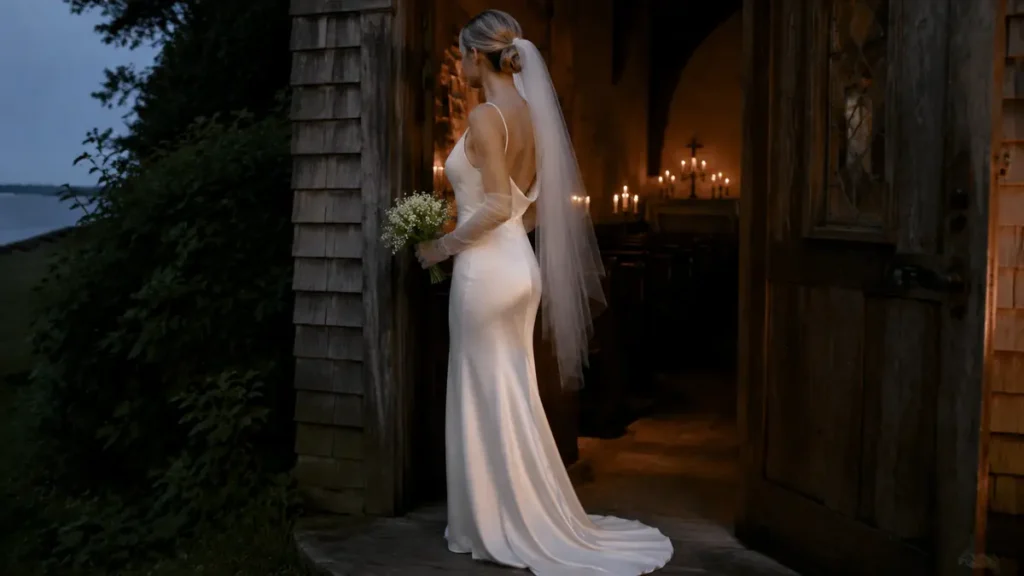
Some wedding gowns capture the mood of a season. Carolyn Bessette-Kennedy’s captured an entirely new way of dressing for marriage.
When she married John F. Kennedy Jr. in 1996, Bessette rejected the elaborate bridal conventions of the period. Her unembellished silk slip dress looked remarkably simple, yet its fabric, bias-cut construction, and precise fit made it an exceptional piece of design.
The carolyn bessette wedding dress was a pearl-white silk crepe slip gown designed by Narciso Rodriguez. It featured slender straps, a softly draped cowl neckline, a bias-cut silhouette, and an exposed back. Its restrained design helped establish minimalist wedding dresses as a modern bridal standard.
The gown was more than a famous celebrity outfit. It expressed Bessette’s personal style, introduced Rodriguez to an international audience, and changed what brides believed a wedding dress could look like.
Who Designed the carolyn bessette wedding dress?
Narciso Rodriguez designed the gown while working at the Italian fashion house Cerruti. Although he was not yet a household name, he and Bessette already shared a close professional and personal connection.
They met through the New York fashion industry. Bessette worked in public relations for Calvin Klein, where her instinct for clothes and understanding of understated luxury became central to her public image. Rodriguez had also worked at Calvin Klein before moving to Cerruti.
According to accounts of their collaboration, Bessette asked Rodriguez to make the dress while the two were having drinks at The Odeon in New York City. Their friendship shaped the process. Rodriguez was not designing for an abstract celebrity client; he was creating a dress for someone whose taste, personality, and body language he understood.
The designer later described the gown as clean, classic, sensual, and reflective of Carolyn herself. That personal understanding explains why the dress feels so consistent with the rest of her wardrobe.
Was it a Narciso Rodriguez or Cerruti dress?
The gown is correctly identified as a Narciso Rodriguez design. Rodriguez was employed by Cerruti at the time, so some fashion histories describe him as “Narciso Rodriguez of Cerruti.”
The distinction matters because the dress was his creative work rather than an established Cerruti bridal design. Its worldwide reception became a defining moment in his career. In 1997, he launched his namesake label and received major fashion-industry recognition.
Rodriguez subsequently became known for sculptural, body-conscious clothing with clean lines. He earned multiple Council of Fashion Designers of America honors and dressed prominent figures including Michelle Obama. The wedding gown remains one of his most recognizable creations.
Every Detail of the carolyn bessette wedding dress
The gown was a floor-length slip dress made from pearl-colored silk crepe. Its apparent simplicity concealed sophisticated dressmaking decisions that controlled how the fabric fell, moved, and followed the body.
| Design element | Description |
|---|---|
| Designer | Narciso Rodriguez |
| Year | 1996 |
| Fabric | Pearl-white silk crepe |
| Silhouette | Bias-cut, floor-length slip dress |
| Neckline | Softly draped cowl neckline |
| Straps | Narrow spaghetti straps |
| Back | Low, open-back treatment |
| Decoration | No lace, embroidery, sequins, or beading |
| Reported value | Approximately $40,000 |
| Overall style | Minimalist, sensual, and modern |
The bias-cut construction
A bias-cut garment is cut diagonally across the grain of the fabric rather than parallel to it. This technique gives woven material greater flexibility and allows it to drape fluidly around the body.
On Bessette’s gown, the bias cut created a long, uninterrupted line. The silk skimmed her figure and then fell softly toward the floor instead of relying on corsetry, stiff underskirts, or visible structural panels.
This construction also made the dress far more technically demanding than it appeared. Silk cut on the bias can stretch unevenly, reveal poor workmanship, or lose its intended shape. The final effect depended on accurate cutting, carefully balanced seams, and meticulous fittings.
Reports indicate that Bessette attended lengthy couture fittings in Paris and considered more than one version before the final pearl silk crepe gown was selected.
The cowl neckline and open back
The neckline draped gently rather than lying flat against the chest. That subtle cowl added softness and dimension without introducing decoration.
At the back, the dress exposed more skin and reinforced its lingerie-inspired character. The contrast was carefully controlled: the front appeared quiet and refined, while the back made the gown unexpectedly sensual.
There was no lace, crystal work, embroidery, dramatic train, or conventional bridal bodice. Fabric, cut, and proportion did all the work.
Quick takeaway: The dress was not memorable because it was merely plain. It was memorable because every visible detail had been removed until only exceptional material, fit, and silhouette remained.
How Carolyn Bessette Styled the Gown
Bessette maintained the same restrained approach throughout her wedding look. Instead of surrounding the dress with statement jewelry or a complicated hairstyle, she chose accessories that supported its clean lines.
Her bridal ensemble included:
- A long, sheer tulle veil
- Sheer, elbow-length gloves
- Crystal-beaded Manolo Blahnik satin sandals
- A sleek low bun
- A hair clip associated with Jacqueline Kennedy Onassis
- A small bouquet of lily of the valley
- Soft, natural-looking makeup
- Little or no conspicuous jewelry
The delicate gloves introduced a traditional bridal element, but their transparency prevented them from competing with the gown. The veil created movement and ceremony while preserving the simplicity of the overall silhouette.
Her Manolo Blahnik sandals were similarly refined. They supplied a touch of light and texture without changing the dress’s minimalist character.
The significance of the hair clip
Bessette’s bun was reportedly secured with a clip that had belonged to Jacqueline Kennedy Onassis, John F. Kennedy Jr.’s mother. The accessory provided a private connection to the Kennedy family without turning the bridal look into a display of historical symbolism.
It was a particularly fitting choice for a woman marrying into one of America’s most scrutinized families. The detail was meaningful but visually discreet.
The lily-of-the-valley bouquet
The small bouquet was associated with Rachel Lambert “Bunny” Mellon, a close friend of Jacqueline Kennedy Onassis and an influential figure in American gardening and design.
Lily of the valley complemented the gown’s scale and restraint. A large cascading arrangement would have obscured its neckline and narrow silhouette. The compact white flowers instead reinforced the intimate atmosphere of the ceremony.
The Secret 1996 Wedding on Cumberland Island
Carolyn Bessette and John F. Kennedy Jr. married on September 21, 1996, on Cumberland Island, Georgia. The location was remote enough to help the couple avoid the intense press attention that followed them in New York.
The ceremony took place at the First African Baptist Church, a tiny wooden chapel with only a few pews. It had no electricity, and the wedding was held by candlelight.
Only close friends and relatives attended. The precise number varies among published accounts, but it was a remarkably small gathering for two globally recognizable people. Members of the Kennedy and Bessette families participated in the ceremony, while the reception was held at the historic Greyfield Inn.
The secrecy had an unexpected effect on the dress’s legacy. There was no red carpet, televised entrance, or official fashion presentation. Most people first encountered the gown through a handful of photographs, particularly an image of John kissing Carolyn’s hand as they left the chapel.
That limited visual record gave the wedding an almost cinematic quality. The dress appeared not as a carefully managed publicity moment but as part of an intimate event caught briefly on camera.
Was there a wedding-day dress problem?
Older accounts claimed that Bessette struggled to put on the zipperless bias-cut gown and that scarves were used to protect the silk from her hair and makeup. Some versions of the story turned the moment into a dramatic wardrobe malfunction.
Rodriguez has since pushed back against exaggerated interpretations. A narrow slip dress without a zipper naturally requires careful handling, particularly after hair and makeup have been completed. The available accounts support a complicated dressing process more clearly than they support the idea that the gown itself failed.
Bessette was late to the chapel, but guests also remembered the delay as contributing to the beauty of the ceremony: the fading evening light gave way to candlelight inside the church.
Why the Dress Was Revolutionary in 1996
The gown can seem familiar now because its influence has been absorbed into mainstream bridal fashion. In 1996, however, it represented a sharp break from the dominant wedding imagery of the preceding years.
Princess Diana’s 1981 wedding dress had helped establish an era of royal-scale bridal fashion: large sleeves, voluminous skirts, elaborate trains, and highly visible ornamentation. Although streamlined gowns existed before Bessette’s wedding, formal bridal culture still favored dresses that announced themselves through volume and decoration.
Bessette chose the opposite:
| Conventional bridal emphasis | Bessette’s approach |
|---|---|
| Structured bodice | Fluid, body-skimming construction |
| Full skirt | Narrow slip silhouette |
| Lace and beading | Unembellished silk |
| Elaborate bridal hair | Simple low bun |
| Statement jewelry | Minimal visible jewelry |
| Grand public spectacle | Private island ceremony |
| Dress as transformation | Dress as personal expression |
Her gown did not make her look like a different person for one day. It translated her existing style into bridal form.
That was the revolutionary element. Bessette demonstrated that a bride could look ceremonial without wearing a conventional “princess” dress. She could choose restraint without appearing unfinished and sensuality without relying on obvious exposure or theatrical embellishment.
How the Gown Changed Bridal Fashion
Images from the wedding generated immediate interest in slip-style bridal gowns. Designers and retailers began responding to demand for cleaner silhouettes, while Bessette’s look became a reference point for brides who wanted something modern and less formal.
Its influence can be seen in several enduring bridal trends:
- Bias-cut silk and satin gowns
- Minimal cowl necklines
- Spaghetti straps
- Low or open backs
- Unembellished column silhouettes
- Lingerie-inspired evening construction
- Veils paired with otherwise pared-back dresses
- Bridal styling centered on fit rather than ornament
The dress also expanded the meaning of luxury. Nothing about it depended on easily recognizable status symbols. Its quality was communicated through the movement of the silk, the accuracy of the cut, and the relationship between the garment and the wearer.
Fashion editors and designers have repeatedly described it as a turning point in modern bridal history. Its legacy is visible in the work of contemporary bridal designers such as Danielle Frankel and Alexandra Grecco, as well as in the continued popularity of minimalist gowns from larger bridal labels.
Influence on later celebrity wedding dresses
Meghan Markle publicly identified Bessette-Kennedy’s gown as a favorite celebrity wedding dress before marrying Prince Harry in 2018. Markle’s Stella McCartney reception gown—a clean, sleeveless halter design—was widely compared with the restrained glamour associated with Bessette.
The connection does not mean later brides copied the original literally. Its larger contribution was conceptual: it made a simple dress feel like a confident choice rather than an absence of effort.
Modern celebrity brides frequently wear second dresses, silk columns, and minimal slip gowns. That visual language now feels established, but Bessette helped bring it into the center of bridal culture.
Why It Still Looks Modern
The dress has survived repeated changes in wedding fashion because it is not built around a conspicuous novelty. There are no era-specific sleeves, decorative motifs, or exaggerated proportions to date it immediately.
Three qualities account for its longevity.
1. The design followed the wearer
Bessette was already known for neutral colors, sleek tailoring, simple separates, and a carefully edited wardrobe. The gown belonged to that same aesthetic.
Authenticity made it convincing. She did not adopt minimalism solely because it was emerging in 1990s fashion; she consistently dressed that way.
2. The proportions were carefully balanced
A slip dress can resemble nightwear when its length, neckline, fabric weight, and fit are slightly wrong. Rodriguez balanced those elements so the gown remained sensual but formal.
The gentle cowl softened the narrow straps. The open back introduced drama, while the long skirt restored elegance. The silk followed Bessette’s figure without behaving like a tightly fitted bodycon dress.
3. The styling left room around the gown
Modern minimalist outfits often fail because too many accessories are added in an attempt to make them feel complete. Bessette allowed empty space to be part of the composition.
Her unadorned neckline, restrained bouquet, plain veil, and sleek hair directed attention toward her face and the movement of the fabric.
Quick takeaway: The look remains relevant because it was based on proportion and personal style, not a short-lived wedding trend.
How to Recreate the Carolyn Bessette Look
A successful interpretation requires more than purchasing a white slip dress. The original depended on fabric quality, internal construction, alterations, and disciplined styling.
Prioritize fabric before embellishment
Look for silk crepe, silk satin, or a high-quality crepe-back satin with enough weight to fall smoothly. Very thin material can cling unpredictably and show every seam or undergarment.
Pure silk offers exceptional movement but wrinkles easily and usually costs more. Modern silk blends may provide greater resilience while retaining a fluid appearance.
Understand how a bias-cut dress should fit
A bias-cut gown should skim the body rather than squeeze it. It needs enough room to settle naturally across the waist and hips.
Because bias-cut fabric can lengthen after hanging, alterations should not be finalized too early. A knowledgeable bridal tailor may allow the gown to hang before setting the hem.
When trying one on:
- Walk, sit, and raise your arms.
- Check the drape from the front, side, and back.
- Examine the fabric under natural and artificial light.
- Confirm that seams do not twist.
- Test the intended undergarments at the fitting.
- Recheck the hem after the dress has been stored hanging.
Choose the neckline carefully
A softly draped cowl creates a closer reference to Bessette’s gown, but it must sit securely. Too much fabric can collapse or expose more than intended, while too little can look tight and flat.
Brides who want more support can preserve the general mood with a structured scoop-neck or straight-neck silk column instead of copying every detail.
Keep accessories restrained
A sheer veil, delicate sandals, a small white bouquet, and one meaningful hair accessory are enough. If gloves are included, lightweight transparent styles will look closer to the original than heavy opera gloves.
Minimalism does not require removing every personal detail. It requires deciding which details deserve attention.
Common Mistakes When Copying the Dress
The original gown looked effortless, which can make it seem easy to reproduce. In practice, simple dresses leave little room to hide errors.
Choosing fabric that is too light
Cheap satin often photographs with harsh shine and reveals every crease. A slightly heavier, matte-finished silk or crepe generally produces a more sophisticated drape.
Buying an overly tight silhouette
The dress followed Bessette’s body, but it did not appear stretched across it. A replica that is tight through the hips loses the fluid movement created by the bias cut.
Ignoring professional alterations
Minimal gowns magnify uneven hems, pulling seams, poorly placed straps, and incorrect undergarments. Precise tailoring matters more when there is no lace or beading to distract the eye.
Adding too many nostalgic details
A cowl neck, gloves, low bun, vintage hair clip, lily-of-the-valley bouquet, and identical sandals can turn inspiration into costume. Selecting two or three elements usually produces a more personal result.
Treating simplicity as a shortcut
A minimalist wedding look is edited, not unfinished. Fabric quality, steaming, fit, posture, footwear, and bouquet scale all become more visible when decoration is removed.
What Happened to the Original Dress?
The current location and ownership of the original gown have not been publicly confirmed through a definitive institutional record. It is not known to be part of a permanent museum collection or a publicly accessible fashion archive.
Claims that a particular family member possesses it remain speculation unless supported by the family, the designer, or a verified collection record.
This uncertainty is consistent with the private nature of the wedding and Bessette’s life. Although some of her clothing has appeared in exhibitions, books, and auctions, the wedding gown itself has remained largely outside public view.
Its absence has arguably strengthened its mystique. The dress is remembered through a small group of photographs, eyewitness accounts, design histories, and Rodriguez’s recollections rather than repeated public display.
The 2026 Recreation for Love Story
Interest in the gown intensified again with the FX series Love Story: John F. Kennedy Jr. & Carolyn Bessette. Costume designer Rudy Mance recreated the bridal look for Sarah Pidgeon, who portrayed Bessette.
The production reportedly conducted extensive research into the gown’s construction and fabric. Its team traced the original material to B&J Fabrics in New York and developed multiple versions to reproduce the movement and fit accurately.
This recreation also demonstrated why the original is difficult to imitate. A plain silk dress offers no decorative elements behind which a costume department can hide approximations. The fabric, cowl depth, strap placement, back exposure, and drape all have to work together.
The television version should still be understood as a costume reconstruction, not the original Narciso Rodriguez gown. It offers a researched interpretation of a dress that has rarely been seen beyond wedding photographs and private footage.
The Enduring Meaning of the carolyn bessette wedding dress
The carolyn bessette wedding dress changed bridal fashion because it made restraint feel radical. Narciso Rodriguez replaced the expected structure and ornament of a high-profile wedding gown with pearl silk, a bias cut, and an unwavering commitment to fit.
Its continuing relevance is not simply the result of renewed interest in 1990s minimalism. The gown represents a durable principle: bridal style is most powerful when it reflects the person wearing it.
For anyone inspired by the look, the best next step is not to reproduce every accessory. Start with its central lesson—choose an excellent silhouette, insist on precise tailoring, and remove anything that does not feel genuinely yours.