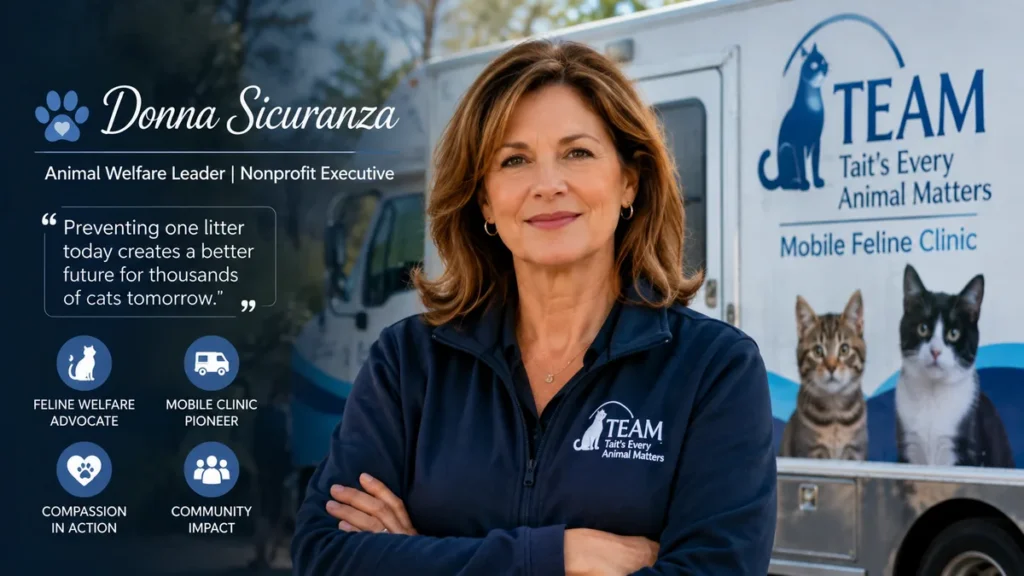
Donna Sicuranza is best known for something far removed from traditional celebrity: decades of practical animal welfare work in Connecticut. Her name is closely associated with Tait’s Every Animal Matters (TEAM), a nonprofit organization that operates a mobile feline spay, neuter, and vaccination clinic.
That distinction matters because online searches for Donna Sicuranza can lead to conflicting biographies. Some pages mix her information with that of another woman with the same name. The strongest public record instead connects Donna Sicuranza—also publicly identified as Donna Sicuranza Marconi—with nonprofit leadership, communications, affordable veterinary access, and efforts to reduce feline overpopulation in Connecticut.
Quick answer: Donna Sicuranza is a Connecticut animal welfare and nonprofit professional associated with Tait’s Every Animal Matters. She helped establish TEAM’s mobile feline clinic with veterinarian Dr. John A. Caltabiano in 1997. The program was designed to make spay, neuter, vaccination, and preventive care more accessible to cat owners and caretakers across Connecticut.
Who Is Donna Sicuranza?
Donna Sicuranza is an American nonprofit executive whose public career is centered on animal welfare. She is associated with TEAM—short for Tait’s Every Animal Matters—a Westbrook, Connecticut organization known for taking affordable feline veterinary services directly into communities.
Current biographical coverage identifies her as Donna Sicuranza Marconi, while historical materials use Donna Sicuranza or Donna J. Sicuranza. These references concern the animal welfare professional connected with TEAM.
Her work is particularly significant because TEAM approaches feline overpopulation from a preventive angle. Rather than focusing solely on finding homes after unwanted kittens are born, the organization makes sterilization more accessible to domestic-cat owners, rescue groups, and people caring for feral or community cats.
That approach has been at the center of Sicuranza’s public work for decades.
| Detail | Publicly documented information |
|---|---|
| Name | Donna Sicuranza |
| Also publicly listed as | Donna Sicuranza Marconi |
| Field | Animal welfare and nonprofit leadership |
| Organization | Tait’s Every Animal Matters (TEAM) |
| Location | Westbrook, Connecticut |
| Major program | TEAM Mobile Feline Spay/Neuter Clinic |
| Clinic established | 1997 |
| Earlier professional field | Journalism, writing and public relations |
| Known for | Expanding access to affordable feline sterilization and vaccination |
Donna Sicuranza and Tait’s Every Animal Matters
To understand Donna Sicuranza’s career, it helps to understand the problem TEAM was created to address.
Veterinarian Dr. John A. Caltabiano had previously established an animal-adoption organization. According to a Connecticut Magazine account, a later bequest connected to animal lover Vernon A. Tait allowed the nonprofit effort to be reestablished under the name that became Tait’s Every Animal Matters.
The organization’s eventual focus emerged from a very practical problem: unwanted cats and kittens.
Caltabiano established a telephone line where people could discuss animal-related problems. Sicuranza, who was working in journalism and public relations at the time, recalled that calls repeatedly involved excessive numbers of cats, unwanted litters, and conflicts surrounding feral cats.
That pattern pointed toward prevention.
If affordable sterilization could be made easier to obtain, fewer unwanted litters would be born in the first place.
The Mobile Clinic Idea
Accessibility was a major obstacle.
Traditional veterinary hospitals could provide spaying and neutering, but cost and location could prevent some caretakers from obtaining the services. A mobile clinic offered a different model: bring veterinary services closer to the communities that needed them.
In 1997, Caltabiano and Sicuranza partnered to put a mobile feline spay/neuter clinic on the road in Connecticut. Historical TEAM material identifies the clinic as Connecticut’s first mobile spay/neuter and vaccination clinic specifically for cats.
TEAM’s 2019 newsletter says the first clinic day altered 12 cats.
That beginning was modest compared with what followed.
How the TEAM Mobile Feline Clinic Grew
The mobile model allowed TEAM to serve multiple communities instead of limiting its services to one permanent veterinary location.
By 2001, only four years after the clinic began, contemporary reporting said TEAM had already sterilized more than 40,000 cats. Donna Sicuranza told the Middletown Press that the mobile unit averaged around 40 surgeries per visit at that time.
The same report noted that approximately one-third of cats treated by TEAM came from feral colonies.
Years later, the numbers became considerably larger.
A 2021 report about the clinic said more than 200,000 cats had been spayed or neutered and vaccinated since the program’s launch in 1997. TEAM-related materials and more recent reporting place the cumulative figure above 225,000 cats.
The scale illustrates why Donna Sicuranza’s public biography is closely tied to TEAM rather than to a conventional personal or celebrity profile.
Her most visible achievement is organizational.
Why Spaying and Neutering Became TEAM’s Core Mission
Feline overpopulation can create a repeating cycle.
One unsterilized population can produce additional kittens, some of which may become homeless, enter shelters, join outdoor colonies, or reproduce again.
TEAM’s model tackles the problem earlier.
Instead of relying entirely on shelter intake and adoption after kittens have been born, sterilization prevents additional litters. Vaccination and other basic services can also improve health outcomes for cats already living in homes or outdoor colonies.
This is particularly relevant to feral cats.
Historical reporting shows that TEAM supported a trap-treat-return approach rather than automatically euthanizing healthy feral cats simply because they lived outdoors. Sicuranza discussed this philosophy publicly as early as 2001.
Today, this broader strategy is commonly associated with Trap-Neuter-Return, or TNR: cats are humanely trapped, sterilized, treated as appropriate, and returned to their established outdoor locations when suitable.
Why a Mobile Clinic Makes a Difference
The concept is straightforward: veterinary care cannot help an animal if the caretaker cannot realistically reach or afford it.
Mobile clinics can reduce some of those barriers by bringing services closer to communities.
For TEAM, that has meant traveling around Connecticut and providing scheduled services instead of requiring every cat owner or colony caretaker to travel to a single centralized clinic.
This model is especially useful for people managing multiple cats, rural populations, rescue organizations, and caretakers of community-cat colonies.
Donna Sicuranza’s Role Is Administrative, Not Veterinary
One point deserves clarification.
Donna Sicuranza is associated with veterinary services, but that does not mean she is publicly identified as a veterinarian.
Her role is organizational leadership.
TEAM materials distinguish administrative leadership from the licensed veterinarians and veterinary technicians who perform clinical procedures.
That difference is important when understanding her contribution.
A mobile veterinary nonprofit needs more than surgeons. It also needs scheduling, fundraising, public education, donor relationships, communications, staffing, community partnerships, logistics, and long-term organizational planning.
Those functions are particularly relevant to Sicuranza’s background.
Her Background in Journalism and Communications
Before her long association with animal welfare, Donna Sicuranza worked in communications.
A Connecticut Magazine profile described her as working in journalism and public relations when the early ideas behind TEAM’s feline program were taking shape.
Public professional information also associates her with writing, editing, and public-relations work.
That experience fits naturally with nonprofit management.
Animal welfare organizations must explain complicated and sometimes emotionally charged issues to the public. They need to communicate why sterilization matters, encourage responsible animal care, maintain donor confidence, work with volunteers, respond to questions, and turn abstract problems such as “overpopulation” into practical actions people can take.
Sicuranza’s communications experience therefore appears closely connected to the public-facing side of TEAM’s mission.
She has also served as an editor of TEAM communications. The organization’s 2019 newsletter, for example, identifies Donna Sicuranza as its editor.
Working With Dr. John A. Caltabiano
Dr. John A. Caltabiano was central to the development of TEAM’s mobile veterinary program.
Historical reporting describes Caltabiano and Sicuranza as partners in launching the mobile clinic in 1997. Their approach combined veterinary expertise with administration, communications, outreach, and a shared interest in preventing feline overpopulation.
Their connection was personal as well as professional.
Caltabiano’s 2009 obituary identified Donna Sicuranza as his longtime partner. It also highlighted his commitment to animal care and directed memorial donations to Tait’s Every Animal Matters.
After his death, TEAM’s work continued.
That continuity is an important part of Sicuranza’s professional story. Programs built around a charismatic founder can struggle after that person is gone. TEAM, however, continued operating its mobile clinic and eventually passed major treatment milestones.
What Services Does TEAM Provide?
TEAM’s central purpose has remained preventive feline healthcare.
Its mobile clinic has historically provided services built around spaying and neutering, along with vaccinations and selected basic treatments.
The exact package and pricing have changed over time, so old figures should not be treated as current rates.
For example, reporting from 2001 listed a fee of $39, while TEAM’s 2019 newsletter listed a $110 package. Those historical prices show how long the program has operated, but they should not be used to estimate what someone would pay today.
The broader model has remained consistent: provide a focused, comparatively accessible service for feline sterilization and preventive care.
TEAM has also emphasized that a mobile spay/neuter program is not intended to replace a cat’s regular veterinary hospital.
Sicuranza explained this distinction in a 2021 interview, noting that traditional veterinarians remain important for everyday and ongoing healthcare while TEAM focuses on making its specific services accessible to people who may otherwise struggle to afford them.
That distinction makes the program complementary to conventional veterinary practices rather than a substitute for comprehensive veterinary medicine.
Donna Sicuranza and Feral Cat Welfare
Feral and community cats have been an important part of TEAM’s work from relatively early in its history.
Outdoor-cat management can be difficult because simply removing cats does not necessarily address the conditions that produced the population. Meanwhile, uncontrolled reproduction can rapidly create additional litters.
Sterilization changes that equation.
When cats can no longer reproduce, colony growth can be reduced while caretakers continue managing the existing animals.
TEAM’s historical emphasis on feral cats therefore connects its mobile veterinary work with a broader population-management strategy.
For Sicuranza, public education has been part of that effort.
Her comments in early news coverage did not present sterilization simply as an individual veterinary procedure. They framed it as a humane tool for dealing with the larger problem of unwanted and free-roaming cat populations.
How Large Has TEAM’s Impact Become?
Numbers cannot describe every outcome in animal welfare, but TEAM has one unusually clear metric: cats treated.
The clinic had reportedly sterilized more than 40,000 cats by 2001.
By 2019, TEAM celebrated its 200,000th sterilization procedure, according to organizational material cited in subsequent coverage.
By 2021, reporting described more than 200,000 cats as having been spayed or neutered and vaccinated through the mobile clinic.
More recent TEAM-based accounts place the total above 225,000.
The progression tells a more useful story than a single number.
TEAM was not a short-term campaign. It became a long-running piece of Connecticut’s animal welfare infrastructure.
The Impact Goes Beyond Individual Surgeries
One sterilization procedure affects one animal directly, but its population impact extends further because it prevents future reproduction.
That means a clinic’s influence cannot be measured only by the number of animals entering its vehicle.
Preventing unwanted litters may also reduce pressure on shelters and rescue groups, help colony caretakers stabilize outdoor populations, and reduce the number of cats requiring future intervention.
Those broader effects explain why accessible spay and neuter programs have become a major component of companion-animal population management.
Is Donna Sicuranza the Woman Who Died in 2017?
No. This is one of the most important pieces of misinformation to avoid.
Search results also contain records for Donna Marie Sicuranza, a New York woman born in 1942 who died in March 2017.
According to Pelham Funeral Home, Donna Marie Sicuranza worked for Walker Studios and later spent more than 20 years with the Bank of New York in Bronxville. She married Angelo Sicuranza in 1960 and had a family in New York.
Those details should not be attached to Donna Sicuranza of TEAM.
The Connecticut animal welfare professional continued to be publicly associated with TEAM after 2017, and contemporary TEAM-related material identifies her in the organization’s leadership.
The shared name appears to be the source of considerable online confusion.
What About Donna Sicuranza’s Age?
A verified date of birth for the TEAM executive is not established in the reliable public sources reviewed here.
That means articles assigning her the March 24, 1942 birth date are apparently confusing her with Donna Marie Sicuranza of New York.
Without a reliable first-party or authoritative biographical record, an exact age should not be stated as fact.
The same caution applies to many personal details.
What Is Publicly Known About Her Family?
Some family information can be established through historical public records, but much of Donna Sicuranza’s private life has remained outside her professional profile.
A 2011 obituary for Robert Sicuranza identified Donna J. Sicuranza of Westbrook as his daughter and also named Dina M. Sicuranza. Robert Sicuranza had served on the board of Tait’s Every Animal Matters.
Dr. John Caltabiano’s obituary, meanwhile, described Donna Sicuranza as his longtime partner.
Beyond documented information of this kind, claims about marriages, children, or other relationships should be handled cautiously unless they can be traced to dependable records.
Her public identity has consistently focused much more on TEAM than on her personal life.
Is Donna Sicuranza Marconi the Same Person?
Current coverage based on TEAM’s staff information identifies the executive as Donna Sicuranza Marconi, while older materials identify her as Donna Sicuranza or Donna J. Sicuranza.
The organizational continuity strongly indicates these names refer to the same TEAM professional rather than separate animal welfare executives.
For readers researching historical material, this explains why older newspaper stories, newsletters, and professional references may simply say Donna Sicuranza.
Why Donna Sicuranza’s Work Matters
Animal welfare is often discussed through dramatic rescue stories.
TEAM represents another side of the field: prevention.
A cat that is rescued from an unsafe situation clearly benefits from immediate intervention. But preventing generations of unwanted kittens addresses the problem before many animals ever require rescue.
That is the logic behind accessible spay and neuter programs.
Donna Sicuranza’s career illustrates how this work depends on several disciplines operating together:
- Veterinary professionals perform safe medical procedures.
- Administrators keep programs functioning.
- Donors provide financial support.
- Volunteers and rescue organizations connect animals with services.
- Community-cat caretakers manage outdoor populations.
- Communications professionals explain why the work matters.
- Mobile services help reduce geographic and financial barriers.
Sicuranza’s contribution has largely occupied the organizational and communications side of that system.
A Career Defined More by Continuity Than Celebrity
There is surprisingly little traditional celebrity-style information about Donna Sicuranza.
That is not necessarily a gap that needs filling.
Her public importance comes from a measurable body of work rather than fame, entertainment coverage, social-media visibility, or personal publicity.
Historical reporting places her at the formation of TEAM’s mobile clinic in 1997. Contemporary reporting documented her discussing the program in 2001. TEAM communications continued to identify her with the organization years later, and more recent public material lists Donna Sicuranza Marconi in its leadership.
That creates a remarkably consistent professional timeline.
The numbers moved from thousands of cats to tens of thousands and eventually beyond 200,000, but the underlying idea remained essentially the same: make preventive feline care easier to access.
The Lasting Legacy of Donna Sicuranza and TEAM
Donna Sicuranza’s story is ultimately less about personal fame than about building an organization capable of doing the same useful thing thousands of times, year after year.
Working alongside Dr. John A. Caltabiano, she helped establish TEAM’s mobile feline spay/neuter clinic in 1997. The program brought affordable sterilization and vaccination services into Connecticut communities and developed into a long-running resource for domestic cats, feral cats, their owners, and caretakers.
Decades later, the reported number of cats treated has exceeded 225,000.
For anyone searching Donna Sicuranza, that is the clearest way to understand her public significance. She is an animal welfare and nonprofit leader whose reputation rests on sustained community service, preventive veterinary access, communications, and the long-term mission of Tait’s Every Animal Matters.
Her career also offers a useful lesson about animal advocacy: meaningful impact does not always come from national recognition. Sometimes it comes from keeping a practical service running long enough to help one animal, then another, and eventually hundreds of thousands.