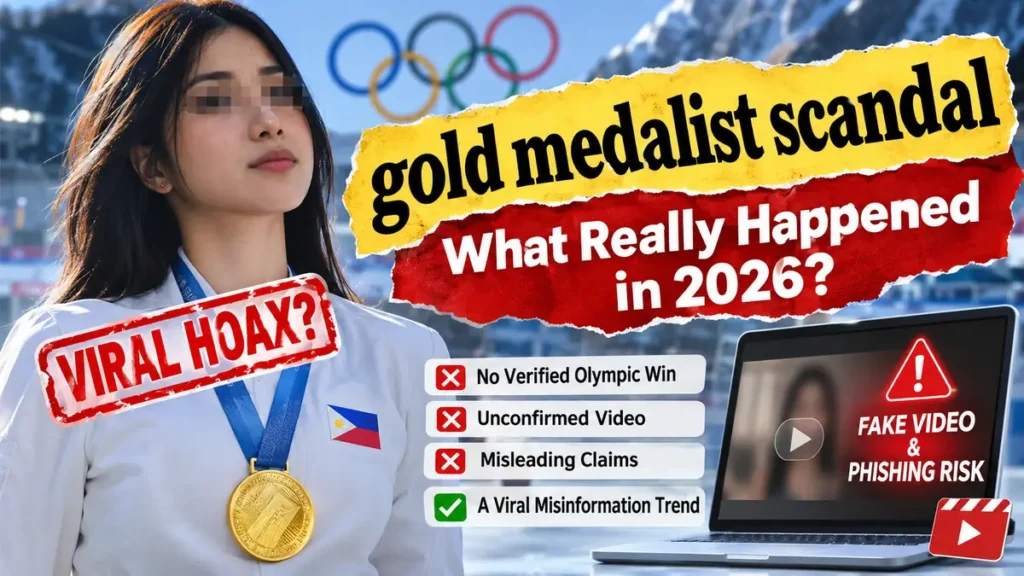
A supposed Olympic gold medalist, an alleged leaked video, and thousands of social media posts created a viral controversy in February 2026. But the story behind the gold medalist scandal was very different from what the sensational headlines suggested.
Instead of exposing misconduct by an Olympic champion, reporting uncovered misleading claims, an invented sporting identity, and suspicious links that could put internet users at risk.
The gold medalist scandal refers to a viral 2026 misinformation trend involving Filipino social media creator Zyan Cabrera, also known online as Jerriel Cry4zee. Posts falsely associated her with Olympic gold and promoted an alleged private video. Credible reporting found no verified Olympic connection or authenticated scandal footage, while warning about phishing links. IBTimes UK+2
Understanding what happened requires separating three things: the person whose identity appeared in the posts, the allegations made about her, and the websites that attempted to profit from public curiosity.
What Is the gold medalist scandal?
The controversy emerged during the 2026 Winter Olympics in February 2026, when posts referring to a supposed Filipina gold medalist began circulating across social media.
These posts often featured photographs of a young woman alongside captions suggesting that she had won an Olympic medal and subsequently become involved in a private video controversy.
Some accounts encouraged viewers to follow external links to watch supposedly exclusive footage. Others directed users to private messaging groups or Telegram channels.
However, the central sporting claim was unsupported.
Reports published by IBTimes UK in February 2026 found no evidence connecting the individuals named in the posts to an actual Olympic gold medal. The reporting also identified patterns commonly associated with phishing campaigns. IBTimes UK+1
Viral claims versus verified information
| Viral claim | What reporting established |
|---|---|
| A Filipina Olympic gold medalist was involved | No verified Olympic athlete was identified |
| Zyan Cabrera won an Olympic gold medal | No credible evidence supported the claim |
| An authentic scandal video was leaked | The alleged footage was not independently authenticated |
| Links provided the original recording | Reports identified suspicious redirects and phishing risks |
| Social media images proved the story | Images and captions did not establish the claims |
The controversy was therefore primarily about online misinformation and potentially malicious links, rather than a confirmed scandal involving an Olympic champion.
Who Is Zyan Cabrera, Also Known as Jerriel Cry4zee?
Zyan Cabrera is a Filipino social media content creator whose name became associated with the viral posts.
She has also appeared online under the name Jerriel Cry4zee, with variations in the spelling of that handle.
According to February 2026 reporting, her online activity included short-form entertainment videos, dancing, lip-sync content, and lifestyle-related posts.
Her identity became connected to the gold medalist narrative after social media accounts circulated images and allegations about a supposed Olympic athlete. IBTimes UK+1
Is Zyan Cabrera really an Olympic gold medalist?
No credible evidence establishes that Zyan Cabrera has competed in the Olympic Games or won an Olympic gold medal.
The distinction matters because an Olympic medal is a publicly documented sporting achievement.
Genuine Olympic medalists normally have verifiable competition records, including their country, sporting event, results, and medal history.
In this case, the viral claims did not provide those supporting details.
Reporting instead described Cabrera as a content creator whose image and identity were used in misleading posts. IBTimes UK+1
Why was she called a gold medalist?
The timing offers an explanation.
The viral campaign appeared during the Milano Cortina 2026 Winter Olympics, when interest in athletes, medal tables, and Olympic achievements was especially high.
By attaching the term “gold medalist” to a sensational allegation, misleading accounts could attract attention from people searching for Olympic-related news.
This does not establish that every account used the label for the same purpose. However, the repeated combination of Olympic references, provocative captions, and suspicious links strongly resembles a clickbait and phishing strategy.
Was the gold medalist scandal Video Real?
One of the most frequently repeated claims involved an alleged private video supposedly featuring the woman identified in the viral posts.
The available reporting did not independently authenticate the alleged recording or establish that the sensational claims surrounding it were true.
In February 2026, IBTimes UK reported that posts advertising a supposed leaked video were not connected to a verified Olympic athlete. The articles also warned that links promising access to footage could lead to deceptive websites. IBTimes UK+1
That does not mean every video uploaded with a similar title has been individually examined. It means the viral allegation itself lacked reliable supporting evidence.
Why did people believe the alleged video existed?
Several features made the story appear convincing.
First, posts repeatedly used similar headlines. Seeing the same allegation across different platforms can create the impression that multiple independent sources have confirmed it.
Second, some posts included blurred thumbnails or reused images, encouraging viewers to assume that additional footage existed.
Third, comment sections contained requests for links, making the story appear popular and widely discussed.
Finally, references to the Olympics gave the allegation a recognizable sporting context.
None of these elements independently proves that a recording is authentic.
Can a thumbnail prove a video is genuine?
No.
A thumbnail can be taken from unrelated footage, edited, generated using artificial intelligence, or presented with a misleading description.
Even an apparently realistic image cannot establish the identity of a person or confirm the circumstances of an alleged recording without additional evidence.
Reliable verification requires an identifiable original source, supporting context, and independent confirmation.
How the gold medalist scandal Spread Across Social Media
The controversy gained visibility through several major platforms, including Facebook, TikTok, X, Instagram, and Telegram.
Different platforms played different roles in the circulation of the allegations.
Facebook and viral comment threads
Facebook posts often relied on attention-grabbing captions and requests to message an account for more information.
Some comments encouraged users to ask privately for a link rather than providing a verifiable public source.
This approach can move users away from visible discussions and toward direct messages where suspicious URLs are easier to distribute.
TikTok and short-form videos
Short-form content helped expose the phrase to audiences who might not have been actively searching for the story.
A brief clip, trending audio, or provocative caption can generate interest without providing meaningful evidence.
When viewers subsequently search for the alleged scandal, the resulting search activity can increase its visibility.
Telegram and private groups
Telegram appeared prominently in reporting about the supposed full-video links.
Posts sometimes directed users to channels that claimed to provide exclusive access to the recording.
A February 12 report described the repeated use of blurred imagery, recycled photographs, and Telegram links in the campaign. IBTimes UK+1
The presence of content in a private messaging group does not make it authentic or safe.
X and repeated viral captions
On X, posts promoting the alleged scandal often used short descriptions, hashtags, and external links.
Repetition across multiple accounts can make a false narrative seem more established than it is.
A widely shared claim remains unverified until credible evidence supports it.
Why Were the Viral Links Considered Dangerous?
The most significant verified concern surrounding the controversy was the use of suspicious links.
Reports described websites that appeared to promise exclusive footage but instead redirected visitors, requested account information, or encouraged downloads.
These are recognizable features of phishing and malware distribution campaigns. IBTimes UK+1
How phishing works
Phishing is a form of deception in which attackers attempt to persuade people to disclose sensitive information or interact with malicious content.
A typical campaign may follow this sequence:
- A sensational social media post attracts attention.
- The post promises access to exclusive content.
- The viewer clicks an unfamiliar external link.
- The destination displays a fake login page, misleading verification request, or download prompt.
- If the viewer submits credentials or installs malicious software, attackers may gain access to sensitive information.
Not every suspicious link produces the same result, but these are common risks associated with deceptive online campaigns.
Warning signs of a suspicious scandal link
| Warning sign | Why it matters |
|---|---|
| “Watch full video” with no credible source | May be clickbait designed to generate clicks |
| Requests to send a private message | Moves the interaction away from public scrutiny |
| Unexpected login screen | Could be an attempt to steal account credentials |
| Forced download | May expose the device to malicious software |
| Multiple redirects | Can conceal the final destination |
| Urgent or sensational language | Encourages action before verification |
| Unknown website or shortened URL | Makes the destination harder to assess |
These indicators do not prove that every link is malicious, but they justify additional caution.
Were AI-Generated Images or Deepfakes Involved?
Artificial intelligence has become an increasingly relevant part of online misinformation.
Some reporting and commentary surrounding the gold medalist narrative raised concerns about manipulated imagery and the possibility of AI-generated content.
However, it is necessary to distinguish between confirmed manipulation and speculation about how particular images were produced.
An image can be misleading without being generated by AI.
AI-generated images versus misleading edits
An AI-generated image may depict a scene that never occurred.
A deepfake may use artificial intelligence to alter a person’s appearance, face, or voice.
A conventional edited image, meanwhile, might simply combine an existing photograph with a fabricated caption, medal graphic, or unrelated background.
All three techniques can mislead viewers, but they are not interchangeable.
The available evidence does not establish that every image associated with this viral campaign was an AI-generated deepfake.
Why visual misinformation spreads quickly
Images often make an allegation feel more concrete.
A photograph accompanied by a convincing headline can appear more trustworthy than an unsupported text claim, even when the photograph has no genuine connection to the event.
This is particularly effective when the subject is already recognizable from social media.
For that reason, checking the original context of an image is as important as reading the caption attached to it.
How to Verify a Viral Gold Medalist Claim
The gold medalist scandal illustrates why a basic verification process can prevent misinformation from spreading.
When a post claims that an athlete has won a major sporting title or become involved in a controversy, the first step should be to establish whether the person and achievement can be independently verified.
1. Check official sporting records
For Olympic claims, consult the official Olympics website.
Look for the athlete’s name, represented country, sport, competition event, and medal result.
If none of those details can be established, the sporting claim should not be treated as confirmed.
2. Look for independent reporting
Search for coverage from established news organizations.
A legitimate major sporting controversy will often have identifiable reporting that provides dates, sources, official statements, or documented evidence.
Multiple websites repeating the same anonymous social media claim do not constitute independent verification.
3. Examine the original source
Determine where the allegation first appeared.
An anonymous account, unexplained screenshot, or reposted thumbnail provides less reliable evidence than a documented statement or original record.
Be especially cautious when a post refuses to identify its source but repeatedly asks viewers to click an external link.
4. Check images in their original context
Reverse-image search tools can help determine whether a photograph appeared online before the alleged event.
If the image comes from an unrelated post, the new caption may be misleading.
Even when an image is genuine, its use in a different context can create a false impression.
5. Avoid distributing unverified private material
Do not repost alleged intimate recordings or identify individuals based solely on anonymous allegations.
Sharing unverified material can amplify harassment, expose private information, and cause reputational harm.
The public’s curiosity does not establish the authenticity of a claim or justify distributing someone’s private content.
What Should You Do If You Clicked a Suspicious Link?
Accidentally opening a suspicious page does not automatically mean that your account or device has been compromised.
The appropriate response depends on what happened after opening the link.
If you only opened the webpage
Close the page and avoid interacting with unexpected prompts.
Do not grant notification permissions, install browser extensions, or download files offered by the site.
Make sure your browser and operating system are up to date.
If you entered your password
Change the affected password immediately using the service’s official website or application.
If the same password is used elsewhere, change it on those accounts as well.
Enable multifactor authentication and review recent account activity for unfamiliar sessions.
If you downloaded a file
Do not open or execute the file.
If it has already been opened, run a security scan using trusted antivirus software.
Review installed applications and browser extensions for anything unfamiliar.
If the device shows signs of compromise, consider seeking professional technical assistance.
If you shared financial information
Contact the relevant financial institution through its official support channel.
Monitor your accounts for unauthorized activity and follow the institution’s guidance on securing payment methods.
For additional guidance about phishing, the U.S. Cybersecurity and Infrastructure Security Agency provides practical advice on recognizing and reporting suspicious messages.
Why the Controversy Matters Beyond One Viral Rumor
The gold medalist scandal demonstrates how easily an individual’s online identity can become attached to an unsupported narrative.
The immediate consequences may include unwanted attention, misleading search results, harassment, and damage to someone’s reputation.
There are also wider implications for how people consume information.
The reputational cost of false allegations
A person does not need to be a celebrity or professional athlete to become the subject of a widely circulated rumor.
When their photographs are repeatedly paired with sensational allegations, viewers may begin associating their name with events that were never established.
Corrections often receive less attention than the original claims.
That makes responsible reporting especially important when private individuals or social media creators are involved.
The role of curiosity-driven misinformation
Sensational stories spread partly because they create unanswered questions.
A post may deliberately withhold important details, encouraging viewers to click, comment, or search for more information.
That behavior can generate engagement even when the underlying allegation has little or no factual basis.
The popularity of a search term therefore reveals public interest, not necessarily the existence of a genuine event.
Why online safety and fact-checking are connected
Misinformation can do more than distort public understanding.
When misleading stories direct people toward malicious websites, believing the claim can create a practical cybersecurity risk.
In this case, the alleged Olympic controversy functioned as an attention-grabbing premise for links that reporting identified as suspicious.
Learning to verify sensational claims can therefore protect both personal information and the people named in those claims.
What Was the Final Outcome of the gold medalist scandal?
Reporting published in February 2026 did not establish a genuine Olympic scandal involving Zyan Cabrera or another identifiable gold medalist.
Instead, coverage consistently highlighted the absence of verified sporting credentials, the unconfirmed nature of the alleged private footage, and the risks associated with suspicious links.
By November 2026, the evidence reviewed for this article did not establish a subsequent official confirmation of the original allegations.
The distinction between a viral rumor and a verified event remains central to understanding the story.
What can be confirmed?
The available reporting supports several conclusions:
- Social media posts promoted a supposed Filipina gold medalist controversy in February 2026.
- Zyan Cabrera, also known as Jerriel Cry4zee, became associated with the viral narrative.
- No credible evidence established that she was an Olympic gold medalist.
- The alleged private scandal video was not independently authenticated.
- Reports identified suspicious links and warned about phishing and malware risks.
These findings are supported by reporting published between February 9 and February 14, 2026. IBTimes UK+3
Final Verdict: The Truth Behind the gold medalist scandal
The gold medalist scandal was not a verified controversy involving an Olympic champion. It was a viral misinformation story that attached an unsupported sporting identity and unverified private-video allegations to Filipino content creator Zyan Cabrera.
The most serious documented concern was the circulation of deceptive links that could expose internet users to phishing and other cybersecurity threats.
The case offers a useful reminder that trending headlines, repeated social media posts, and convincing images are not substitutes for independent evidence.
Before believing or sharing a sensational story, check official records, consult credible reporting, and avoid unfamiliar links promising exclusive footage.
In the gold medalist scandal, the verified story was not about an athlete losing a reputation after a confirmed incident. It was about how an unsupported allegation could spread widely while creating real risks for both the person named and the people who encountered it.