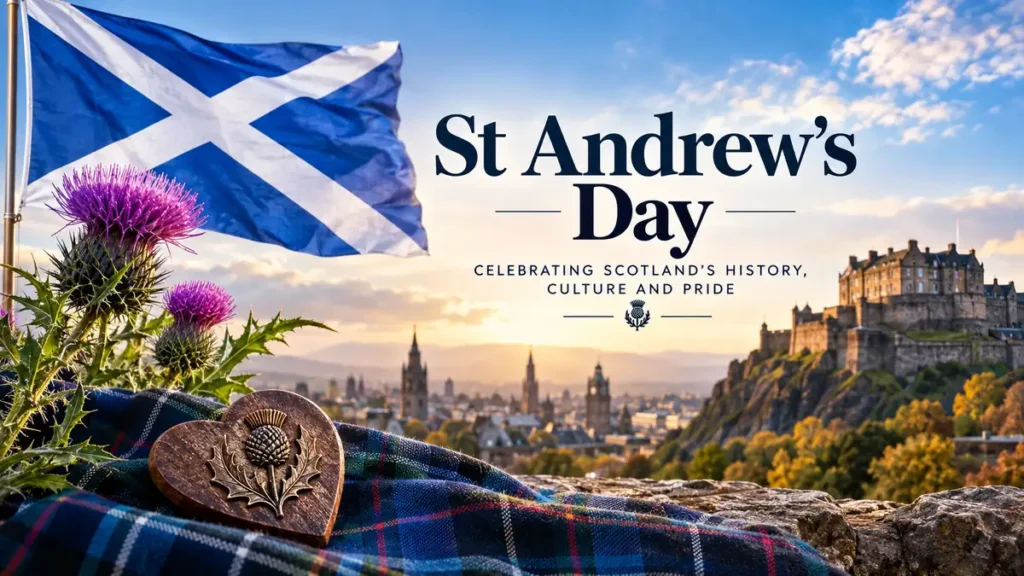
Every November 30, Scotland celebrates its patron saint with flags, music, dancing, traditional food and gatherings that connect modern Scottish culture with centuries of history. Yet Saint Andrew himself was not Scottish. He was a Galilean fisherman, an apostle of Jesus and the brother of Saint Peter.
st andrew’s day is Scotland’s national day, observed annually on November 30 in honour of Saint Andrew, Scotland’s patron saint. Celebrations commonly feature the Saltire, ceilidh dancing, Scottish music, cultural events and traditional foods such as haggis, neeps and tatties. The feast also has religious and cultural significance in several other countries.
The story behind the day reaches from the Sea of Galilee to Patras in Greece, medieval Scotland and Scottish communities around the world. Understanding that journey explains why a first-century Christian apostle became such a powerful symbol of Scottish identity.
What Is st andrew’s day?
st andrew’s day is the feast day of Saint Andrew the Apostle and is celebrated on November 30 each year. In Scotland, it functions as a national celebration of Scottish heritage, history and culture as well as retaining its Christian religious meaning.
Saint Andrew has been associated with Scotland for centuries. His distinctive diagonal cross—the Saltire or St Andrew’s Cross—became one of the country’s most recognizable national symbols.
Modern celebrations can include:
- Flying the Scottish Saltire
- Ceilidhs and traditional Scottish dancing
- Folk and bagpipe music
- Community festivals and cultural events
- Scottish food and drink
- Family or community meals
- Religious services
- Events organized by Scottish societies overseas
For many people, therefore, November 30 is about more than commemorating a saint. It provides an opportunity to celebrate Scotland itself.
In 2026, November 30 falls on a Monday.
Why is st andrew’s day celebrated?
The simplest answer is that Saint Andrew is the patron saint of Scotland.
Patron saints traditionally have a particular association with a country, community, profession or group. Their feast days can consequently develop into broader cultural occasions.
In Scotland’s case, Saint Andrew became closely tied to national identity. The Saltire carries his symbolism directly into Scotland’s national flag, while the town of St Andrews in Fife preserves his name and a long tradition concerning his relics.
Today, the celebration combines several layers: Christian observance, Scottish history, national identity and contemporary cultural festivities.
Who Was Saint Andrew?
Before becoming a Scottish national symbol, Andrew was one of the earliest followers of Jesus in Christian tradition.
According to the New Testament, Andrew and his brother Simon Peter, later known as Saint Peter, were fishermen. Andrew became one of the Twelve Apostles of Jesus.
Christian tradition connects him with missionary activity beyond the Holy Land, although accounts of his later travels contain a mixture of early traditions and much later legends.
Scotland.org describes him as a Galilean fisherman and notes that his name is traditionally associated with strength.
How did Saint Andrew die?
Christian tradition holds that Andrew was martyred at Patras in Greece.
He later became particularly associated with an X-shaped cross. This diagonal form is commonly called a St Andrew’s Cross or saltire.
That image matters enormously to the Scottish story because the white diagonal cross on Scotland’s blue national flag represents Saint Andrew.
The familiar account says Andrew considered himself unworthy to die on the same form of cross as Jesus and was therefore crucified on a different-shaped cross. That detail belongs to Christian tradition rather than a securely documented contemporary account of his execution, so it is better understood as part of the saint’s later religious story rather than established first-century history.
What was Saint Andrew the patron saint of?
Scotland is only one place associated with him.
Saint Andrew has patronal connections across several countries and communities. Traditions concerning him are particularly significant in places including Greece, Romania, Ukraine, Russia and Cyprus, alongside Scotland.
His international importance helps explain why November 30 is not exclusively a Scottish occasion.
How Did Saint Andrew Become Scotland’s Patron Saint?
This is where documented history and legend become intertwined.
Saint Andrew never visited medieval Scotland according to reliable historical evidence. Instead, traditions about his relics, miraculous protection and symbolic importance developed over centuries.
One enduring legend says relics of Saint Andrew were brought to the area that became the town of St Andrews.
Different versions of the story name a figure called St Regulus, or St Rule, as the person who transported relics associated with Andrew. These accounts should be treated as medieval religious tradition rather than a straightforward historical record.
Nevertheless, possession of—or belief in the presence of—important Christian relics could transform a medieval religious centre. St Andrews eventually became one of Scotland’s most significant pilgrimage destinations.
The House of Commons Library notes both the relic tradition in Fife and evidence of St Andrew’s Day being celebrated in Scotland during the reign of Malcolm III in the 11th century. His wife, Margaret of Wessex, later St Margaret of Scotland, supported pilgrimages to the shrine and helped travellers crossing the Firth of Forth.
The Declaration of Arbroath and Saint Andrew
Another important milestone came in 1320.
The Declaration of Arbroath, one of the most famous documents in Scottish history, appealed to Pope John XXII during Scotland’s struggle to maintain independence from English rule.
Saint Andrew’s standing within Christianity strengthened Scotland’s religious and diplomatic identity. Scotland.org notes that his relationship as the brother of Saint Peter gave medieval Scots an especially useful connection when appealing to the papacy.
By this period, the relationship between Saint Andrew and Scotland had become deeply embedded in the country’s national story.
Quick Takeaway
Saint Andrew did not become Scotland’s patron saint because he was Scottish. The connection developed through medieval Christianity, traditions surrounding his relics, pilgrimage, political symbolism and centuries of national identification with the saint.
Why Is Scotland’s Flag Called the Saltire?
The Scottish national flag is a white diagonal cross against a blue background.
It is commonly known as the Saltire or St Andrew’s Cross because its shape represents the cross traditionally associated with Andrew’s martyrdom.
The flag’s origin has its own famous legend.
According to the traditional story, a Scottish or Pictish force facing an enemy near Athelstaneford in East Lothian saw a white diagonal cross appear against the blue sky. The sign was associated with Saint Andrew and interpreted as a promise of victory.
The details and dating vary between versions of the legend, so the miraculous battlefield story should not be confused with firmly established historical evidence.
What is historically clearer is that the St Andrew’s cross became established as a Scottish symbol during the medieval period.
By 1286, the Great Seal of the Guardians of Scotland incorporated St Andrew’s cross. In 1385, the Scottish Parliament ordered Scottish soldiers to display a white St Andrew’s cross for identification. The cross subsequently appeared on Scottish coins and ships.
That long history explains why the Saltire is much more than decoration on st andrew’s day. It visually links the modern celebration with medieval Scotland.
When Is st andrew’s day?
st andrew’s day is always celebrated on:
November 30
The date does not change from year to year, although the associated Scottish bank holiday can be observed on the following Monday when November 30 falls on a weekend.
| Year | st andrew’s day | Day |
|---|---|---|
| 2025 | November 30 | Sunday |
| 2026 | November 30 | Monday |
| 2027 | November 30 | Tuesday |
In 2025, for example, November 30 fell on Sunday, so the Scottish bank holiday was observed on Monday, December 1. In 2026, November 30 itself is Monday.
Is st andrew’s day a bank holiday in Scotland?
Yes. November 30 is an official bank holiday in Scotland under the St Andrew’s Day Bank Holiday (Scotland) Act 2007.
The Scottish Parliament passed the legislation that created the bank holiday in November 2006, and it received Royal Assent in January 2007. The legislation provides for November 30, or the following Monday when November 30 falls on Saturday or Sunday, to be a Scottish bank holiday.
There is an important practical distinction, however.
A bank holiday does not automatically mean that every worker receives the day off. Working arrangements depend on employers, employment contracts and individual organizations. Banks and businesses are not universally required to close simply because the date is a bank holiday.
Nor is St Andrew’s Day a UK-wide bank holiday. Its bank-holiday status applies specifically to Scotland.
How Is st andrew’s day Celebrated in Scotland?
A modern st andrew’s day celebration can look very different from a medieval religious feast.
Some people attend church. Others go to a ceilidh, meet friends for dinner, visit a cultural event or simply use November 30 as an opportunity to enjoy Scottish music and food.
The emphasis is increasingly inclusive: celebrating Scotland’s culture and communities rather than requiring participants to approach the day as a religious observance.
Ceilidh dancing
A ceilidh is one of the activities most strongly associated with Scottish celebrations.
Modern ceilidhs combine traditional music with social dancing. A band usually plays while a caller explains the steps, meaning people do not necessarily need previous dancing experience.
Popular Scottish dances can involve couples, lines or sets of dancers moving through repeating patterns.
For newcomers, the practical rule is simple: listen to the caller and don’t worry about getting every step right. The social element is as important as technical perfection.
Scottish music
Traditional and contemporary Scottish music are both natural parts of the day.
Depending on the event, that might mean:
- Bagpipes
- Fiddles
- Accordion
- Folk songs
- Gaelic music
- Ceilidh bands
- Modern Scottish performers
Large organized events may combine music, storytelling, dancing and other performances.
Flying the Saltire
November 30 is an obvious occasion for displaying Scotland’s national flag.
Schools, community groups, public buildings and individuals may fly or display the Saltire. Because the diagonal white cross represents St Andrew’s Cross, the connection between flag and feast day is unusually direct.
Tartan and Highland dress
Some celebrations feature tartan, kilts or other forms of Highland dress.
Wearing a kilt is not a requirement for celebrating the day, and Scottish culture extends far beyond Highland imagery. Still, tartan provides a recognizable visual connection with Scotland and is particularly common at formal dinners, ceilidhs and events organized by Scottish associations overseas.
Community gatherings
Many modern events focus on bringing people together.
That reflects a long history of Scottish associations using St Andrew’s Day to strengthen community connections. For Scots living overseas, the occasion can become particularly meaningful because it provides a shared date for celebrating ancestry and cultural identity.
Traditional st andrew’s day Food
There is no single compulsory st andrew’s day menu.
Instead, celebrations often showcase foods associated with Scotland and its regional produce.
A traditional-style meal might include:
| Food | What it is |
|---|---|
| Haggis | A traditional savoury Scottish dish |
| Neeps | Mashed turnip or swede, depending on regional terminology |
| Tatties | Potatoes, often mashed |
| Cullen skink | Thick Scottish soup traditionally made with smoked haddock |
| Scottish salmon | Salmon associated with Scotland’s rivers and aquaculture |
| Cranachan | Dessert traditionally combining cream, oats, raspberries and whisky |
| Shortbread | Rich, crumbly Scottish biscuit |
Scotland.org highlights haggis, neeps and tatties, Cullen skink and cranachan among foods enjoyed around St Andrew’s Day, while modern celebrations can also feature dishes such as haggis pakora or haggis-topped pizza.
That mixture of old and new is worth noticing. Scottish food culture is not frozen in the past; contemporary celebrations often combine established dishes with influences from Scotland’s diverse communities.
Haggis, neeps and tatties
This is probably the combination international visitors most readily identify as Scottish.
Haggis provides the savoury centrepiece, accompanied by mashed neeps and potatoes. It is also strongly associated with Burns Night, so it appears across more than one major Scottish cultural celebration.
Vegetarian and vegan versions of haggis have made the dish easier to include at modern gatherings with different dietary requirements.
Cranachan
Cranachan makes an appropriate Scottish dessert because it uses ingredients closely associated with the country’s food traditions.
Common versions combine toasted oats, cream, raspberries, honey and whisky.
Recipes vary, however, and families and chefs often put their own spin on the dessert.
st andrew’s day Traditions and Folklore
Not every St Andrew’s tradition involves flags and ceilidhs.
Like many old European feast days, November 30 accumulated layers of folk belief, particularly customs concerning marriage, luck and predicting the future.
Scottish folklore recorded practices in which unmarried women sought clues about future husbands around midnight on November 29. Traditions included peeling an apple in one continuous strip and throwing the peel over the shoulder, with its resulting shape supposedly revealing an initial. Other customs involved shoes and attempts to interpret signs about future marriage.
These practices are better understood as historical folklore than serious predictions.
They also reveal something broader: religious feast days frequently became intertwined with local seasonal customs. Communities could observe the Christian saint while simultaneously developing traditions that had more to do with courtship, luck and winter social life.
How Old Are st andrew’s day Celebrations?
The answer depends on what counts as the modern celebration.
Devotion to Saint Andrew in Scotland stretches back many centuries. Historical evidence links observance of his feast with medieval Scotland, including the period of Malcolm III and St Margaret in the 11th century.
But the recognizable international social celebration developed differently.
One particularly interesting chapter occurred among Scottish emigrants in North America.
The St Andrew’s Society of Charleston in South Carolina was founded in 1729 by Scottish immigrants. A St Andrew’s Society followed in New York in 1756, combining Scottish community identity with charitable work. Similar societies eventually appeared around the world.
This helps explain why St Andrew’s celebrations are sometimes especially visible among the Scottish diaspora.
Did st andrew’s day celebrations begin in America?
This question needs a careful answer.
The religious feast of Saint Andrew obviously did not begin in America, and Scotland had been honouring Saint Andrew for centuries before the 18th century.
What developed among Scottish communities in North America was an influential form of organized social and cultural celebration associated with November 30. Scotland.org specifically highlights Charleston’s 1729 St Andrew’s Society when explaining the development of popular celebrations.
So it is more accurate to distinguish the ancient Christian feast from the later organized Scottish social tradition.
st andrew’s day Around the World
Saint Andrew’s importance extends far beyond Scotland.
His feast appears in different forms across Europe and other regions. The religious meaning, public-holiday status and folk traditions vary substantially from country to country.
Romania
Saint Andrew is an important religious and national figure in Romania, where November 30 is a national public holiday.
Known as Ziua Sfântului Andrei, the feast combines Christian observance with older folk traditions. In 2026, it falls on Monday, November 30, and is a public holiday when many schools and businesses are closed.
Romanian folklore surrounding the night includes customs involving marriage predictions, dreams and protection from supernatural threats.
These traditions differ from Scottish celebrations but demonstrate how the same saint’s feast acquired distinctive meanings in different cultures.
Poland and Andrzejki
In Poland, the night of November 29 leading into November 30 is associated with Andrzejki, a traditional evening of fortune-telling.
Historically, unmarried young women used various customs to predict future marriage. One of the best-known involved pouring melted wax through the opening of a key into cold water and interpreting the resulting shape.
Modern Andrzejki gatherings are generally social and playful rather than serious attempts at divination.
Greece
The connection with Greece is especially significant because Christian tradition places Andrew’s martyrdom at Patras.
Saint Andrew is consequently important to the city, where a major church dedicated to him stands and traditions surrounding his relics remain part of local Christian heritage.
Ukraine and other Eastern Christian traditions
Saint Andrew also occupies an important place in Christian traditions associated with Ukraine and Russia, partly because legends describe his missionary journeys around the Black Sea and farther north.
These stories contributed to his patronal status across several Eastern European traditions.
Scottish communities overseas
For Scottish communities in the United States, Canada, Australia, New Zealand and elsewhere, November 30 can serve as a cultural link with Scotland.
St Andrew’s societies, Caledonian societies, heritage organizations and community groups may organize dinners, dances and charity events.
This international dimension means a person does not need to be physically in Scotland to encounter a traditional Scottish St Andrew’s celebration.
What Is the Difference Between st andrew’s day, Burns Night and Hogmanay?
These celebrations occur close together, but they commemorate very different things.
| Celebration | Date | Main significance |
|---|---|---|
| st andrew’s day | November 30 | Scotland’s patron saint and national culture |
| Hogmanay | December 31 | Scottish New Year’s Eve |
| Burns Night | January 25 | Life and work of poet Robert Burns |
Together, they form a recognizable season of Scottish winter celebrations.
st andrew’s day
November 30 celebrates Saint Andrew and, more broadly, Scottish identity and culture.
Hogmanay
Hogmanay is Scotland’s famous New Year’s Eve celebration.
Its traditions can include parties, fireworks, singing “Auld Lang Syne”, and first-footing, in which the first visitor entering a home after midnight is associated with good fortune for the coming year.
Burns Night
Burns Night takes place on January 25, the birthday of Scottish poet Robert Burns.
A traditional Burns Supper may include haggis, poetry readings, speeches, music and a ceremonial Address to a Haggis.
So although tartan, Scottish music, dancing, whisky and haggis can appear across these occasions, their historical purposes are different.
The Religious Meaning of st andrew’s day
The cultural side of November 30 can sometimes overshadow its original purpose.
For Christians who observe saints’ feast days, this remains the Feast of Saint Andrew the Apostle.
Andrew’s story represents discipleship, missionary faith and martyrdom. His relationship with Peter also gives him an important position in Christian tradition.
The feast occurs around the beginning of Advent in Western Christianity, placing it close to the opening of the Christian season leading toward Christmas.
Church observances may include prayer, scripture readings, worship services and reflections on Andrew’s life.
At the same time, modern Scottish celebrations are not limited to Christians. Many people participate because of the day’s historical, national or cultural significance.
Both aspects can coexist.
How to Celebrate st andrew’s day
You do not need a large festival to mark November 30.
A meaningful celebration can be as simple as learning about Scottish history, preparing a Scottish meal or listening to traditional music.
One practical approach is:
- Learn who Saint Andrew was. Understanding the apostle gives the celebration historical context.
- Display the Saltire. Explain why the diagonal cross is connected with Saint Andrew.
- Prepare Scottish food. Haggis, neeps and tatties can make a traditional main course, with cranachan or shortbread afterward.
- Play Scottish music. Mix folk, Gaelic, bagpipe and contemporary Scottish music rather than treating Scottish culture as one musical style.
- Try a ceilidh. Attend a local event or learn a simple Scottish social dance with friends.
- Explore Scottish history. Read about St Andrews, the Declaration of Arbroath or the development of the Saltire.
- Share the celebration. The modern day works particularly well as an inclusive community gathering.
If children are involved, crafts based on the Saltire, simple maps of Scotland, Scottish stories and age-appropriate music or dancing can make the history easier to understand.
What actually makes a good celebration?
Avoid trying to squeeze every Scottish stereotype into one evening.
A better approach is to choose two or three elements and understand their meaning. A meal accompanied by Scottish music and a short explanation of the Saltire, for example, can feel more genuine than a collection of disconnected symbols.
For people with Scottish ancestry, November 30 can also be a chance to explore family history. For everyone else, it offers an accessible introduction to Scotland’s culture without requiring Scottish heritage.
Why st andrew’s day Still Matters
The continuing importance of November 30 comes from its ability to connect several different stories.
There is the religious story of Andrew the Apostle, a fisherman who became one of Jesus’s disciples.
There is the medieval Scottish story of relics, pilgrimage, St Andrews, St Margaret and the growing association between Saint Andrew and Scotland.
There is the political story surrounding national identity, the Declaration of Arbroath and the evolution of the Saltire.
There is also the social story: Scottish emigrants establishing St Andrew’s societies, communities gathering for music and dancing, and families maintaining connections with Scotland from thousands of miles away.
Modern Scotland adds another layer. The national day can celebrate a living culture rather than simply remembering the past.
That distinction matters. Scotland’s identity includes Gaelic and Scots traditions, cities and islands, old customs and new communities, traditional folk music and contemporary culture.
Saint Andrew provides the historical focal point, but the celebration has grown far beyond a biography of one religious figure.
The Lasting Meaning of st andrew’s day
st andrew’s day is celebrated every November 30 as Scotland’s national day and the feast of its patron saint. Its familiar symbols—the Saltire, Scottish music, ceilidh dancing and traditional food—are connected to a history that reaches back through medieval Scotland to the early Christian story of Andrew the Apostle.
The most interesting fact about the day may be its international character. Saint Andrew was a Galilean fisherman traditionally martyred in Greece, became a defining symbol of Scotland, and is honoured in different ways across Europe and by Scottish communities worldwide.
For anyone marking November 30, the best next step is simple: understand the story behind the symbols. Fly the Saltire, enjoy Scottish food or join a ceilidh, but also remember why the white diagonal cross, the town of St Andrews and Scotland’s patron saint became connected in the first place.