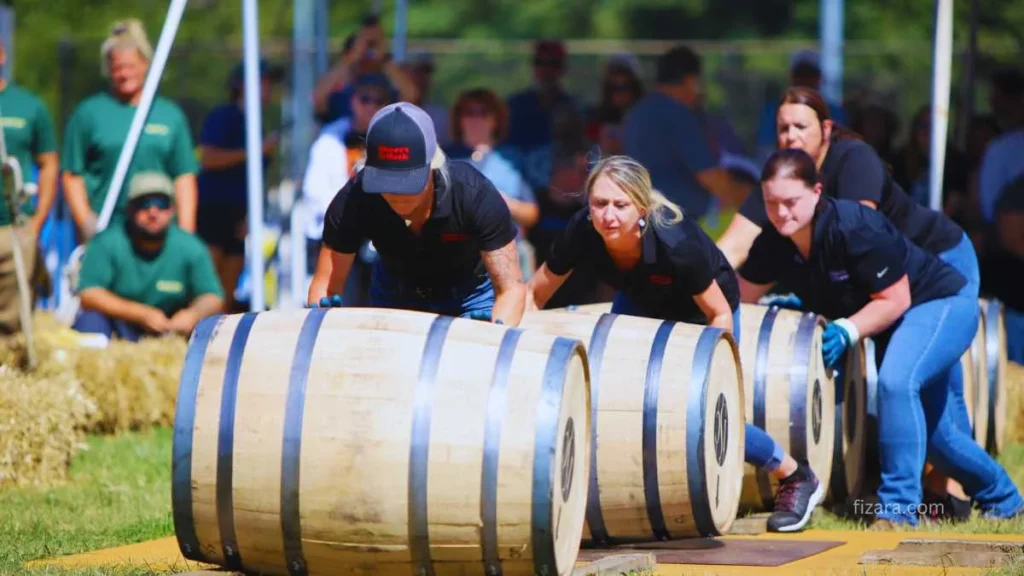
Competitive barrel rolling occupies a fascinating niche in the world of traditional sports — it is simultaneously one of the most physically demanding and most historically rooted of the outdoor competitive games that rural communities developed as both practical skill training and festive entertainment. Understanding the sport requires understanding its cultural context: barrel rolling did not emerge from sports science laboratories but from the practical reality of communities where barrels were central economic objects and the ability to handle them skillfully was both vocationally valuable and a source of community pride. The evolution from practical skill to competitive sport follows a pattern familiar from many traditional athletic traditions, and the gameplay mechanics it has developed reflect centuries of informal refinement.
The Historical Origins of Barrel Rolling as a Competitive Sport
Barrel rolling as physical recreation has documented roots in European agricultural and trading communities going back several centuries. In contexts where wooden barrels were the primary containers for wine, beer, flour, salted fish, and dozens of other commodities, workers who handled barrels developed sophisticated techniques for moving and controlling them efficiently. These skills naturally gave rise to informal competitions: who could roll a barrel fastest along a village street? Who could maintain control on a slope? Who could race a barrel around a course without losing it?
These informal village competitions became formalized over time, particularly in communities where barrel rolling was associated with specific seasonal festivals, market days, or community celebrations. The transformation from spontaneous competition to structured event followed the same path as other traditional rural sports — wrestling, stone throwing, log rolling — developing agreed-upon rules, recognized competitive categories, and community investment in identifying and celebrating champions.
How Competitive Barrel Rolling Works: Rules and Format
Modern competitive barrel rolling events vary in format depending on regional tradition, but several core competitive categories have emerged as standards:
The mental discipline required to compete in physical games like barrel rolling connects closely to the broader art of keeping composure under competitive pressure. Physical and cognitive composure are deeply linked — something explored in depth in the study of assumption-based decision making in high-stakes situations.
- Speed rolling: competitors race their barrels along a flat or gently inclined course, using controlled pushing and guiding techniques to maximize speed without losing control.
- Precision rolling: competitors navigate their barrels through a course of obstacles or gates, judged on both speed and the ability to hit specific target positions accurately.
- Uphill rolling: a particularly demanding variant in which competitors must roll loaded or weighted barrels up an inclined surface, testing both physical strength and technique.
- Team relay: multi-competitor formats in which barrel rolling skills are combined with relay race structure, requiring both individual technique and smooth handoffs between team members.
Core Techniques: What Separates Champions from Beginners
The fundamental physics of barrel rolling — the transfer of force through a circular object, the management of angular momentum, and the balance between speed and directional control — make it a technically demanding sport despite its apparent simplicity. Core techniques that competitive barrel rollers must master include:
- Initial push mechanics: the launching push determines the barrel’s trajectory and initial speed. Championship technique involves applying force precisely at the barrel’s horizontal center, angled correctly for the intended course.
- Running position: competitors who run alongside their barrel must maintain a specific body position relative to the barrel to enable precise steering touches without breaking stride.
- Steer touching: subtle directional adjustments are made through light contact with the barrel’s surface — too much force causes the barrel to rock; too little allows directional drift.
- Speed management on descent: downhill sections require active braking contact to prevent the barrel from accelerating beyond control, a technique that demands precise timing and force calibration.
- Recovery technique: all competitive barrel rollers must develop reliable techniques for recovering barrels that veer off course without losing competitive position
Physical Training for Competitive Barrel Rollers
The physical demands of competitive barrel rolling are more complex than the sport’s appearance suggests. Champions combine elements from several athletic disciplines:
Recreational sport culture, like art culture, produces its own traditions and identities. For a look at how informal culture creates lasting communities, the spontaneous joy captured in candid photography and viral moments reflects a similar spirit.
Cardiovascular fitness matters because competitive events require sustained effort at high intensity over courses that can extend across significant distances. Sprint-specific fitness is equally important for the explosive effort required at race start. Core strength and stability — particularly trunk rotation capacity — are critical for the steering and recovery movements that determine competitive precision. Hand-eye coordination, balance, and spatial awareness round out the physical profile of elite barrel rolling competitors.
The mental dimension of competitive barrel rolling deserves equal attention. Maintaining composure under competitive pressure while managing the variable behavior of a rolling barrel on an outdoor surface with changing terrain requires exactly the kind of dynamic attention and emotional regulation that distinguishes champions from talented beginners.
Cultural Significance of Barrel Rolling Traditions
Beyond its status as a sport, competitive barrel rolling carries cultural significance for the communities that maintain it. Like many traditional rural sports, it serves as a vehicle for community identity, intergenerational transmission of physical knowledge, and the celebration of skills that were once economically important. The communities that maintain barrel rolling traditions do so partly because the sport is genuinely fun and physically satisfying, and partly because competing in it is an act of cultural continuity — a way of saying “we remember where we came from and we honor the physical knowledge of our ancestors.”
This cultural dimension connects barrel rolling to the broader tradition of life lessons through physical discipline that many traditional sports embody — the recognition that physical skill cultivation produces not just athletic capability but character qualities like patience, persistence, and graceful response to failure.
Getting Started with Competitive Barrel Rolling
Newcomers interested in trying competitive barrel rolling should look for regional competitions and clubs, which exist primarily in Europe (particularly the UK, Germany, and France where the tradition has the deepest roots) and in North American communities with strong European folk festival traditions. Most introductory participants use standard wooden beer barrels or competition-spec barrels that are heavier and more durable than commercial containers.
Conclusion: The Enduring Appeal of Competitive Barrel Rolling
Competitive barrel rolling endures because it combines genuine physical challenge, deep historical roots, and community celebration into a sport that is impossible to take too seriously — yet rewards serious skill development in ways that keep practitioners coming back. Whether encountered at a regional folk festival or a dedicated barrel rolling competition, it offers spectators and participants alike a vivid connection to the physical culture of communities that found sport in the tools of their daily work.