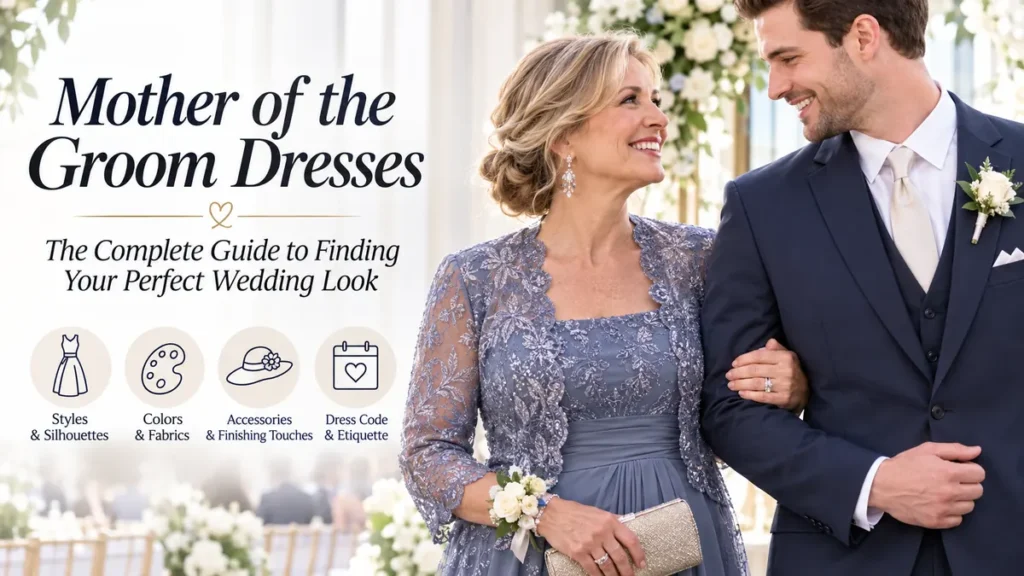
Choosing what to wear to your son’s wedding can feel surprisingly complicated. You want something memorable enough for family portraits, comfortable enough for a full day of celebrations, and polished enough to reflect your special role—without looking like a bridesmaid or competing with the bride.
Mother of the groom dresses should match the wedding’s dress code, season, venue, and color palette while remaining distinct from the bride and bridal party. Popular choices include elegant midi dresses, tea-length styles, A-line gowns, formal floor-length dresses, jacket dresses, and sophisticated pantsuits in colors such as navy, dusty blue, mauve, sage, emerald, burgundy, champagne, and plum.
The old idea that the groom’s mother has to disappear into beige is outdated. Modern wedding etiquette leaves plenty of room for personality, provided the outfit works harmoniously with the overall celebration.
This guide explains what actually matters when selecting a dress: formality, color, silhouette, season, coordination, comfort, accessories, alterations, and the small details that determine whether an outfit looks merely appropriate or beautifully considered.
What Should the Mother of the Groom Wear?
The simplest rule is this: dress for the wedding you are attending, not simply for your title.
A black-tie evening wedding and an afternoon garden ceremony call for very different outfits. The mother of the groom may be an honored member of the wedding party, but her clothing should still follow the event’s stated dress code.
Current etiquette generally favors coordination rather than matching. The outfit should relate visually to the wedding without duplicating what the mother of the bride or bridesmaids are wearing.
A useful starting point is:
| Wedding Dress Code | Appropriate Mother of the Groom Outfit |
|---|---|
| Black tie | Floor-length formal gown |
| Formal | Long gown, elegant midi or sophisticated dress |
| Black-tie optional | Long gown or elevated cocktail dress |
| Cocktail | Knee-length, tea-length or midi cocktail dress |
| Semi-formal | Midi, tea-length, A-line or wrap dress |
| Garden party | Floral, chiffon, lace or flowing midi |
| Beach formal | Lightweight maxi, midi or elegant flowing dress |
| Casual | Refined midi, simple maxi or dressy pantsuit |
These aren’t rigid rules. A beautifully tailored pantsuit, for example, can be entirely appropriate when its fabric, construction, and accessories match the occasion’s level of formality.
The real mistake is not choosing the “wrong” silhouette. It’s ignoring the dress code.
Mother of the Groom Dress Etiquette: What Still Matters?
Wedding etiquette has become more flexible, but a few traditions remain useful because they prevent awkward duplication.
Does the Mother of the Bride Choose Her Dress First?
Traditionally, yes.
The longstanding custom is for the mother of the bride to select her outfit first and then communicate the general color and level of formality to the mother of the groom. Martha Stewart’s current guidance still recognizes this convention.
Think of it as coordination rather than permission.
If the mother of the bride has selected a floor-length navy gown, that information tells you two useful things: the parents are dressing formally, and choosing the exact same navy gown probably isn’t ideal.
Modern families don’t always follow the traditional order. That’s fine. The useful part of the custom is simply having a conversation before both mothers finalize their outfits.
Should Both Mothers Match?
Usually, no.
Their dresses should look harmonious when they’re standing together, but they don’t need to be identical.
For example:
- Dusty blue can coordinate beautifully with navy.
- Mauve can work alongside champagne.
- Sage can complement taupe.
- Plum can sit naturally beside charcoal or silver.
- Burgundy can coordinate with navy or deep green.
Even the same color family can work if the shades, fabrics, or silhouettes are clearly different.
Should the Mother of the Groom Match the Bridesmaids?
Not unless the couple specifically requests it.
If the bridesmaids are wearing sage green, the groom’s mother might wear emerald, navy, champagne, plum, or another complementary shade rather than reproducing the exact sage.
The goal is to look connected to the wedding—not mistaken for another bridesmaid.
Quick Takeaway: Coordinate with the couple, wedding palette, and mother of the bride, but don’t try to create an exact match.
Best Colors for Mother of the Groom Dresses
There is no official “mother of the groom color.”
Navy remains one of the easiest choices because it works across seasons and levels of formality. Current style guides also frequently feature dusty blue, mauve, sage, champagne, burgundy, plum, emerald, lavender, taupe, slate, dove gray, and other muted or jewel-toned shades.
Navy and Midnight Blue
Navy is a dependable alternative to black.
It feels formal without looking severe, photographs well, and coordinates easily with blush, champagne, sage, burgundy, silver, dusty blue, and many other wedding palettes.
A navy chiffon midi can work for an afternoon wedding, while navy satin, crepe, lace, or an embellished floor-length gown can suit an evening celebration.
Dusty Blue and Slate
Dusty blue has a softer appearance than traditional navy.
It works particularly well for spring and summer ceremonies, although darker slate tones can transition comfortably into fall.
These shades are also useful when bridesmaids are wearing warmer colors because blue creates contrast without looking disconnected.
Mauve, Dusty Rose and Blush
Muted pink and purple-based shades offer a romantic alternative to neutrals.
Mauve and dusty rose tend to work especially well for garden weddings, spring ceremonies, romantic ballroom celebrations, and weddings built around muted floral palettes.
Be cautious with extremely pale blush if it photographs close to ivory.
Sage and Olive Green
Sage has become a popular wedding color, particularly for garden, outdoor, rustic, and nature-inspired celebrations.
For more depth, olive or forest green can work beautifully in autumn.
Emerald and Other Jewel Tones
Emerald, sapphire, amethyst, deep teal and plum create a richer appearance.
They’re particularly effective for formal evening weddings and fall or winter celebrations.
Deep colors can also showcase details such as beading, lace, velvet, jacquard, and metallic accessories more dramatically.
Burgundy and Wine
Burgundy and deep wine feel naturally suited to cooler months.
They’re strong enough to look special in formal portraits without having the visual intensity of bright red.
Champagne, Taupe and Warm Neutrals
Champagne can be elegant, but this is one area where photographs matter.
Some very pale champagne, silver, beige, or gold fabrics can appear considerably lighter under flash photography than they do in a fitting room. Current style guidance recommends caution with shades that could photograph close to bridal white.
Before committing, photograph the fabric in daylight and indoor lighting.
Black
Can the mother of the groom wear black?
Yes, in many modern weddings.
Black can look sophisticated at formal, evening, and black-tie celebrations. Contemporary etiquette no longer treats it as automatically inappropriate.
However, family and cultural expectations still matter. If you’re uncertain how the couple feels about black, ask before buying.
What Colors Should the Mother of the Groom Avoid?
White and bridal-looking ivory remain the clearest colors to approach carefully.
Unless the couple has specifically requested an all-white wedding or approved the outfit, choosing something that could be confused with bridal attire creates an unnecessary risk.
Also be cautious with:
- White and bridal ivory
- Extremely pale champagne that photographs white
- The exact bridesmaid color
- The mother of the bride’s exact shade
- Neon or highly fluorescent colors
- Extremely attention-grabbing prints
- Colors the couple has specifically asked family members to avoid
Bright red is sometimes included on “never wear” lists, but there is no universal modern prohibition. A deep wine or burgundy can be particularly elegant. Cultural traditions and the couple’s preferences should take precedence over generic internet rules.
The safest principle is simple: don’t choose an outfit whose color makes you the visual focal point of the wedding party.
Mother of the Groom Dresses by Season
Season affects much more than color. Fabric weight, sleeves, neckline, layering, footwear, and venue conditions all matter.
Spring Mother of the Groom Dresses
Spring is ideal for softer colors and lighter construction.
Consider:
- Dusty blue
- Sage green
- Lavender
- Mauve
- Dusty rose
- Champagne
- Soft silver
- Muted floral prints
Chiffon, lightweight crepe and lace work particularly well.
An A-line midi or tea-length dress is a practical choice for a daytime garden ceremony, while a floor-length chiffon gown can make the same color palette appropriate for a formal evening wedding.
For outdoor celebrations, remember that spring weather can change quickly. A matching shawl, jacket, wrap, or dress with three-quarter sleeves may be worth having.
Summer Mother of the Groom Dresses
Comfort becomes critical at summer weddings.
Chiffon, georgette, lightweight crepe and other breathable fabrics are generally more comfortable than heavy layers.
Popular summer shades include dusty blue, soft teal, mauve, seafoam, champagne, sage, coral and muted pink.
Avoid selecting a dress purely because it looks beautiful while standing still in an air-conditioned fitting room. Consider how it will feel after several hours of sitting, walking, posing for photographs and dancing.
Fall Mother of the Groom Dresses
Autumn supports richer colors and more substantial fabrics.
Strong options include:
- Burgundy
- Plum
- Forest green
- Emerald
- Navy
- Deep teal
- Bronze
- Warm taupe
- Gold-toned neutrals
Satin, lace, jacquard and heavier crepe can feel particularly appropriate.
Three-quarter sleeves and long sleeves also become practical choices rather than purely stylistic ones.
Winter Mother of the Groom Dresses
Winter weddings can carry dramatic color exceptionally well.
Navy, emerald, sapphire, charcoal, silver, burgundy, plum and deep purple all suit the season.
Formal winter venues also give you more freedom to use embellishment, beading, structured fabrics and elegant jackets.
Just remember that “winter wedding” doesn’t automatically mean heavy fabric. If the ceremony and reception are entirely indoors, an excessively warm gown can become uncomfortable surprisingly quickly.
Choosing Mother of the Groom Dresses by Venue
The invitation’s dress code comes first, but the venue provides valuable context.
Church or Traditional Ceremony
A traditional ceremony often favors polished, understated elegance.
Midi dresses, tea-length dresses, formal A-line styles, long gowns and jacket dresses can all work.
If the religious venue has expectations concerning shoulders, necklines, or overall modesty, plan accordingly.
Garden Wedding
Garden settings pair naturally with flowing silhouettes, muted colors, botanical prints, lace and chiffon.
Midi and tea-length styles also prevent the hem from dragging across grass.
One practical lesson: choose shoes for the ground, not just the dress. Thin stilettos and soft lawns rarely make a happy combination.
Beach Wedding
Beach weddings call for movement and breathable fabrics.
Chiffon, georgette and lightweight crepe generally work better than heavy structured materials.
Midi and tea-length dresses are especially practical because long hems can become difficult around sand.
Soft aqua, coral, champagne, muted blue and warm neutral shades can complement coastal surroundings without turning the outfit into resort wear.
Ballroom or Hotel Wedding
A formal ballroom allows more drama.
Floor-length gowns, satin, jacquard, tasteful beading, structured crepe, lace overlays and jewel tones all fit naturally into this environment.
Rustic or Barn Wedding
“Rustic” does not necessarily mean casual.
Read the invitation carefully. A barn wedding could be cocktail, semi-formal or even formal.
Earthy colors such as olive, forest green, wine, taupe and navy work particularly well, while midi dresses and block heels offer practical advantages on uneven ground.
Most Flattering Mother of the Groom Dress Styles
Forget the idea that a certain age requires a certain silhouette.
The best dress is determined by fit, proportions, comfort and personal style—not a number on a birthday cake.
A-Line Dresses
The A-line remains popular because of its balanced shape.
It follows the upper body before gradually widening toward the hem, giving the wearer room to move without excessive volume.
It works in:
- Midi lengths
- Tea lengths
- Full-length gowns
- Chiffon
- Lace
- Satin
- Crepe
For someone who wants a classic silhouette without a close-fitting skirt, it’s an excellent place to begin.
Empire-Waist Dresses
An empire waist sits higher on the torso and allows the fabric to fall loosely below.
It can feel comfortable for long ceremonies and receptions, particularly in soft fabrics such as chiffon.
Construction matters, though. Too much gathering directly beneath the bust can create unnecessary volume.
Fit-and-Flare Dresses
Fit-and-flare styles provide more definition through the bodice and waist before widening through the skirt.
They can work especially well at cocktail and semi-formal weddings.
Choose a skirt with enough movement to sit comfortably and dance.
Wrap Dresses
A refined wrap silhouette can be flattering for daytime, cocktail and less formal weddings.
The V-shaped neckline and adjustable waist create definition without requiring a rigidly structured bodice.
Fabric determines how formal the style appears. A casual jersey wrap dress is very different from one made in luxe crepe or satin.
Column and Sheath Dresses
A column or sheath creates a streamlined silhouette.
These styles can look exceptionally sophisticated in crepe and other fabrics with enough structure to skim rather than cling.
Movement is the detail people sometimes forget. Walk and sit in the dress before buying it.
Jacket Dresses
Jacket dresses remain useful for mothers who prefer additional arm or shoulder coverage.
The advantage is flexibility: the jacket can provide a polished appearance during the ceremony and come off during dinner or dancing.
Avoid overly boxy jackets that overwhelm the dress beneath them.
Pantsuits and Jumpsuits
A dress isn’t mandatory.
A beautifully tailored pantsuit can be just as appropriate, particularly for cocktail, daytime, contemporary or less traditional weddings. Current mother-of-the-groom guidance recognizes dressy pantsuits as suitable across several dress codes.
Look for deliberate occasionwear rather than business clothing: elegant crepe, fluid wide-leg trousers, sophisticated tailoring, draped details, embellishment or elevated accessories can make the distinction clear.
What Length Should a Mother of the Groom Dress Be?
Dress length should primarily reflect formality.
Floor-Length
Best suited to:
- Black-tie weddings
- Formal evening ceremonies
- Grand ballroom venues
- Highly formal traditional celebrations
Make sure the hem works with the actual shoes you’ll wear.
Midi
Midi dresses are among the most versatile choices.
They can work for cocktail, semi-formal, daytime, garden and many formal weddings depending on the fabric and construction.
A structured satin midi, for example, feels considerably dressier than a lightweight cotton one.
Tea-Length
Tea-length dresses fall between the knee and ankle and create a classic special-occasion look.
They’re particularly useful for traditional daytime, garden, church, spring and summer weddings.
Knee-Length
A sophisticated knee-length cocktail dress may work for less formal weddings.
At very formal evening celebrations, however, it can appear underdressed unless the design and styling are particularly elevated.
Choosing the Right Neckline and Sleeves
Coverage should be a personal choice rather than an age rule.
Popular necklines include:
- V-neck
- Boat neck
- Scoop neck
- Jewel neck
- Portrait neckline
- Off-the-shoulder
- Illusion neckline
The neckline should work with your proportions, jewelry and undergarments.
If you’re uncomfortable adjusting your dress throughout an ordinary dinner, you certainly won’t enjoy doing it during a wedding ceremony and hundreds of photographs.
Sleeves offer similar flexibility.
Cap sleeves create minimal coverage. Flutter sleeves soften the shoulder. Three-quarter sleeves balance coverage with ease of movement. Long sleeves can look sophisticated at fall and winter weddings, while sheer lace or illusion sleeves provide coverage without visual heaviness.
Fabrics That Work Well for Mother of the Groom Dresses
Fabric can transform the same silhouette from casual to formal.
Chiffon
Chiffon is light and fluid, making it useful for spring, summer, garden, beach and destination weddings.
Layering is important because chiffon itself is sheer.
Crepe
Crepe offers clean drape and usually feels more structured than chiffon.
It’s particularly effective for minimalist gowns, sheath dresses, jumpsuits and pantsuits.
Satin
Satin creates a polished surface that works beautifully for formal occasions.
Because it reflects light, photograph the dress before committing. Very pale satin can appear much brighter in flash photography.
Lace
Lace can bring texture without requiring heavy embellishment.
It works particularly well for traditional ceremonies, cocktail dresses, sleeves and overlays.
Jacquard
Jacquard uses woven patterns to create texture and visual depth.
It can be an excellent choice when you want a solid-colored dress that still feels special.
Velvet
Velvet works best for cooler-weather celebrations.
Its depth makes emerald, navy, burgundy and plum particularly rich, although it can become uncomfortable in warm indoor venues.
Mother of the Groom Dresses for Different Body Types
Instead of trying to hide your body, concentrate on proportion and tailoring.
For More Waist Definition
Try wrap dresses, fit-and-flare styles or designs with strategic ruching.
A defined waist can provide structure without requiring a tight fit.
For a Fuller Bust
Support matters more than trendy neckline rules.
V-necks and open necklines can create visual length, but the real test is whether you can wear supportive undergarments comfortably.
Bring the bra you intend to wear when trying on dresses.
For Petite Frames
Watch proportion carefully.
Excessive fabric, very wide sleeves, oversized embellishment and long jackets can overwhelm a smaller frame.
A well-proportioned midi, column or A-line often creates a cleaner line.
For Plus Sizes
Ignore the myth that darker colors or shapeless dresses are automatically more flattering.
Good construction matters far more.
Look for intentional seaming, supportive bodices, quality lining, thoughtful ruching and fabrics that drape smoothly.
The correct size can also differ considerably between formalwear brands, so focus on actual measurements rather than the number printed on the label.
How to Choose a Color That Flatters You
The wedding palette narrows your options, but your complexion should help make the final decision.
Someone with warm undertones may feel especially comfortable in olive, sage, warm taupe, burgundy, bronze or dusty rose. Cooler undertones often pair beautifully with navy, slate, dusty blue, plum, pewter and cool mauve.
Gray or silver hair can look particularly striking against navy, wine, teal, plum or slate.
These aren’t rules. They’re starting points.
A practical test works better than any color theory chart: stand beside a window with the dress near your face and take an unfiltered photograph.
Does your complexion look bright and balanced, or does the color wash you out?
Current mother-of-the-groom color guidance increasingly emphasizes choosing a shade that works with the wearer’s coloring as well as the wedding itself.
How to Coordinate Without Looking Too Matched
Family photographs are where coordination matters most.
Imagine the main group together:
Bride + groom + bridesmaids + groomsmen + mother of the bride + mother of the groom.
Your dress should feel as though it belongs in that picture.
Suppose the wedding palette includes dusty rose, sage and ivory. If bridesmaids wear sage and the mother of the bride chooses dusty rose, a navy, champagne, mauve, taupe or deeper green dress could connect naturally without duplicating anyone.
Texture also helps separate similar colors.
Two mothers can sometimes wear related shades successfully if one chooses chiffon and the other chooses jacquard, lace or crepe.
The principle is cohesion without uniformity.
How Far in Advance Should the Mother of the Groom Buy Her Dress?
Don’t leave formalwear until the final few weeks.
A sensible timeline is to begin researching several months before the wedding, once the dress code, venue and general color palette are established.
Allow extra time for:
- Ordering the correct size.
- Exchanges if the first dress doesn’t work.
- Hemming.
- Bodice or sleeve alterations.
- Finding shoes.
- Selecting undergarments.
- Coordinating accessories.
- A final fitting.
The mother-of-the-bride-first tradition can affect timing, so communicate rather than waiting indefinitely. Current appointment and etiquette guides emphasize early coordination and allowing sufficient time for fittings and alterations.
A dress that fits beautifully after tailoring will usually look more expensive and polished than a more elaborate gown with a poor fit.
How to Accessorize Mother of the Groom Dresses
Once the dress is chosen, accessories should complete the outfit rather than compete with it.
Shoes
Comfort is non-negotiable.
You’ll likely spend hours standing during photographs, greeting guests, moving between ceremony and reception spaces, and dancing.
Block heels, kitten heels, elegant flats and lower pumps can all work.
Break new shoes in before the wedding.
Jewelry
Start with the neckline.
A detailed neckline may need nothing more than earrings and a bracelet. A simple V-neck or scoop neckline leaves more room for a necklace.
One strong piece generally looks more intentional than several competing statement accessories.
Clutch
Choose something large enough for the essentials:
- Phone
- Tissues
- Lip color
- Powder
- Medication
- Safety pins
- Small stain-removal wipe
You don’t need to match your clutch and shoes exactly. Related metallic or neutral tones often look more contemporary.
Wrap or Jacket
A shawl, bolero, capelet or tailored jacket can be practical for religious ceremonies, outdoor photographs, air-conditioned ballrooms and cool evenings.
If you’re adding one after buying the dress, bring the dress—or at least a clear photograph and fabric sample—when shopping.
Common Mother of the Groom Dress Mistakes
Most unsuccessful outfits aren’t disasters. They’re simply the result of overlooking practical details.
Buying Before Knowing the Dress Code
A beautiful cocktail dress doesn’t become appropriate for black tie simply because it’s expensive.
Confirm the formality first.
Matching the Bridesmaids Exactly
Unless specifically requested, exact matching can make you look accidentally included in the bridal party rather than deliberately coordinated with it.
Choosing a Nearly White Color Without Testing It
Champagne, pale silver, blush and light gold can look darker in the store than they appear under bright photography.
Take pictures in multiple lighting conditions.
Ignoring Alterations
Formal dresses are designed around standardized measurements, not individual bodies.
A small adjustment to the hem, straps, waist or sleeve can completely change how polished a dress looks.
Sacrificing Comfort
The wedding lasts longer than the ceremony.
Sit down. Walk. Raise your arms. Bend. Dance a little in the fitting room.
If the dress pinches, slips, scratches or requires constant adjustment after ten minutes, imagine eight hours in it.
Trying to Look “Age Appropriate”
This phrase often pushes women toward clothes they don’t actually like.
A better goal is occasion appropriate and personally flattering.
You don’t have to wear sleeves, beige, a jacket, or a conservative neckline simply because you’re the groom’s mother.
A Simple Checklist for Choosing the Right Dress
When several dresses look equally appealing, evaluate them in this order:
- Dress code: Is it formal enough for the wedding?
- Couple’s preferences: Have they requested or excluded particular colors?
- Coordination: Does it work with the bridal party and mother of the bride?
- Venue: Is the fabric, length and footwear practical?
- Season: Will you be comfortable in the expected weather?
- Color: Does it flatter you and photograph well?
- Fit: Can it be tailored properly?
- Movement: Can you sit, walk and dance comfortably?
- Undergarments: Can you wear the support you need?
- Personal style: Do you actually feel like yourself in it?
That final question deserves more attention than it usually receives.
You’ll be photographed throughout an emotionally significant family event. The right outfit shouldn’t feel like a costume labeled “Mother of the Groom.”
It should feel like your style at its most polished.
Final Thoughts on Mother of the Groom Dresses
The best mother of the groom dresses balance three things: the wedding’s aesthetic, established etiquette, and the wearer’s own personality.
Start with the dress code. Coordinate with the couple and mother of the bride rather than trying to match them. Then choose a silhouette, fabric and color that work for the season, venue and your own comfort.
Navy, dusty blue, mauve, sage, champagne, emerald, burgundy, plum, taupe and sophisticated gray tones all provide strong starting points, while A-line gowns, midi dresses, tea-length styles, formal gowns, jacket dresses and tailored pantsuits give today’s mothers far more choice than traditional etiquette once allowed.
Most importantly, test the outfit in real conditions before the wedding. Photograph it in daylight, sit in it, walk in your chosen shoes, check the hem, and wear the intended undergarments during the final fitting.
When all of those details work together, you can stop thinking about the dress—and spend the wedding enjoying the reason you chose it in the first place.