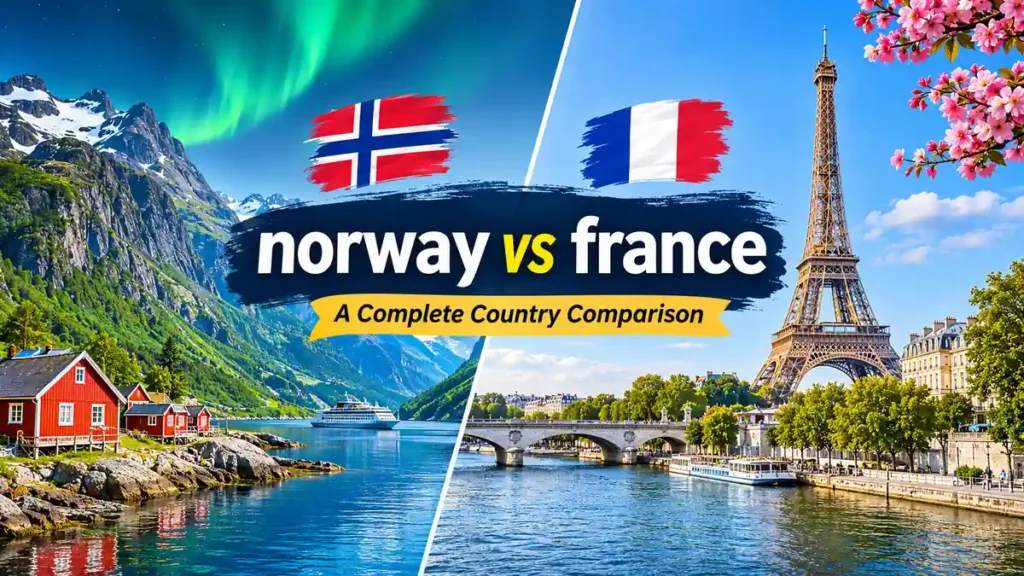
Norway and France are two of Europe’s most developed countries, yet they offer remarkably different experiences. Norway is famous for its fjords, spectacular natural landscapes, high living standards, and Nordic lifestyle. France is celebrated for its cultural heritage, historic cities, world-renowned cuisine, and economic influence.
When comparing norway vs france, the biggest differences involve population, geography, climate, cost of living, economic structure, and lifestyle. Norway is a smaller, wealthier-per-person Nordic country with extensive natural resources, while France is a larger European power with a diversified economy, a substantial population, and a globally influential culture.
Both countries provide advanced healthcare, strong educational systems, modern infrastructure, and impressive travel destinations. However, understanding their differences helps explain how geography, history, public policy, and cultural traditions shape everyday life.
norway vs france: Quick Country Comparison
The following table provides an overview of the most important differences between Norway and France.
| Feature | Norway | France |
|---|---|---|
| Official name | Kingdom of Norway | French Republic |
| Capital | Oslo | Paris |
| Region | Northern Europe | Western Europe |
| Population | Approximately 5.6 million | Approximately 68.6 million |
| Area | Approximately 385,000 km², including Svalbard and Jan Mayen | Approximately 552,000 km² in metropolitan France |
| Main language | Norwegian | French |
| Currency | Norwegian krone (NOK) | Euro (EUR) |
| Government | Constitutional monarchy | Semi-presidential republic |
| European Union | Not a member | Founding member |
| Schengen Area | Member | Member |
| NATO | Member | Member |
| Climate | Temperate coastal to subarctic | Oceanic, continental, Mediterranean, and alpine |
| Major industries | Oil, gas, fisheries, shipping, hydropower | Manufacturing, tourism, agriculture, aerospace, luxury goods |
| Famous landmarks | Norwegian fjords, northern lights, Geirangerfjord | Eiffel Tower, Louvre Museum, Palace of Versailles |
| Highest mountain | Galdhøpiggen | Mont Blanc, on the French–Italian border |
Population figures are rounded estimates, and geographic comparisons use the stated territorial definitions. France’s total area is larger when overseas territories are included.
Norway and France share European values and close diplomatic ties, but their economic and social structures differ considerably.
Geography and Natural Landscapes
Geography is one of the clearest distinctions between Norway and France. Their locations influence transportation, settlement patterns, tourism, agriculture, and even national identity.
Where Is Norway Located?
Norway occupies the western and northern portions of the Scandinavian Peninsula in Northern Europe.
It shares land borders with Sweden, Finland, and Russia. Its extensive coastline faces the North Atlantic Ocean, Norwegian Sea, and Barents Sea.
Norway is particularly famous for its fjords, deep coastal inlets created by glaciers over thousands of years.
Some of its most recognizable natural attractions include:
- Geirangerfjord, a UNESCO World Heritage Site
- Nærøyfjord, known for its dramatic mountain scenery
- Lofoten Islands, famous for fishing villages and rugged peaks
- Svalbard, an Arctic archipelago
- Jotunheimen National Park, home to Norway’s highest mountains
- Tromsø, a popular destination for viewing the northern lights
Mountains and glaciers cover substantial parts of Norway, making much of its terrain unsuitable for intensive agriculture or large urban settlements.
Where Is France Located?
Metropolitan France lies in Western Europe, bordered by Belgium, Luxembourg, Germany, Switzerland, Italy, Monaco, Spain, and Andorra.
Its coastlines extend along the Atlantic Ocean, English Channel, and Mediterranean Sea.
Unlike Norway, France contains extensive agricultural plains, major river valleys, Mediterranean coastal areas, and several mountain ranges.
Important geographic features include the Alps, Pyrenees, Massif Central, Loire Valley, and Rhône Valley.
France also has overseas departments and regions in the Caribbean, South America, and the Indian Ocean, giving the country a geographic presence far beyond continental Europe.
Which Country Is Bigger?
France is larger than Norway when comparing metropolitan France with Norway’s full commonly reported territorial area.
Metropolitan France covers approximately 552,000 square kilometers, while Norway, including Svalbard and Jan Mayen, covers approximately 385,000 square kilometers.
However, territorial definitions matter. Mainland Norway alone is approximately 324,000 square kilometers, and including France’s overseas territories increases France’s total area.
France also has a much higher population density, with major cities and agricultural regions spread across the country.
Quick takeaway: Norway is characterized by mountains, fjords, and Arctic landscapes, while France offers a wider variety of agricultural plains, Mediterranean coastlines, mountain ranges, and densely populated urban regions.
Population, Cities, and Urban Development
Population size significantly influences the economic scale, transportation networks, and urban character of both countries.
Norway’s Population and Major Cities
Norway has approximately 5.6 million residents, making it one of Europe’s less populous countries.
Its population is concentrated in southern regions and along the coast.
Major cities include Oslo, Bergen, Trondheim, Stavanger, and Tromsø.
Oslo is Norway’s capital and largest urban center. It functions as the country’s political, financial, and cultural hub.
Bergen is known for its historic waterfront and access to the western fjords, while Stavanger plays an important role in Norway’s petroleum industry.
Norway’s relatively small population contributes to its lower population density, although urban housing markets can still be expensive and competitive.
France’s Population and Major Cities
France has approximately 68.6 million residents, including its overseas territories.
Paris is the capital and the country’s dominant political, cultural, and economic center.
Other major cities include Marseille, Lyon, Toulouse, Nice, Nantes, Bordeaux, and Strasbourg.
France has a more extensive network of large metropolitan areas than Norway.
Its cities support major universities, international companies, manufacturing centers, research institutions, and transportation infrastructure.
Urban Life in Norway vs France
Norwegian cities generally emphasize proximity to nature, pedestrian-friendly neighborhoods, public transportation, and outdoor recreation.
French cities often combine historic architecture, dense residential neighborhoods, cultural institutions, cafés, and extensive public spaces.
Paris offers a particularly large concentration of museums, universities, international businesses, and cultural attractions.
Oslo, by comparison, is smaller and provides relatively easy access to forests, waterfronts, and outdoor activities.
Neither urban model is universally better. The experience depends on personal preferences, employment opportunities, housing costs, and the specific city.
Economy and GDP: Which Country Is Wealthier?
Norway and France both have advanced, high-income economies, but their sources of wealth are different.
France has a much larger economy overall, while Norway produces substantially more economic output per resident.
Norway’s Economy
Norway’s economy combines a strong public sector, competitive private businesses, and substantial natural resources.
Its most important industries include petroleum, natural gas, fisheries, aquaculture, maritime transportation, hydropower, and technology.
Oil and gas exports have played a particularly important role in building national wealth.
Norway also manages the Government Pension Fund Global, commonly known as its sovereign wealth fund. The fund invests petroleum-related government revenues internationally to support long-term public finances.
However, Norway is not economically dependent on petroleum alone. Services, manufacturing, construction, renewable energy, and digital industries also contribute to employment and economic activity.
France’s Economy
France has one of Europe’s largest and most diversified economies.
Its major industries include aerospace, automotive manufacturing, agriculture, pharmaceuticals, tourism, financial services, energy, and luxury products.
Internationally recognized French companies include Airbus, Renault, L’Oréal, LVMH, and TotalEnergies.
France also has a significant agricultural sector, producing wheat, dairy products, grapes, and other agricultural commodities.
Tourism supports hotels, restaurants, transportation services, cultural institutions, and numerous regional businesses.
Norway vs France GDP Comparison
GDP per capita, current US dollars (2025)
$0$25K$50K$75K$100KNorwayFrance
Source: World Bank, 2025. Nominal GDP per capita is not the same as average salary or disposable income.
According to World Bank figures for 2025:
| Economic indicator | Norway | France |
|---|---|---|
| Nominal GDP | $531 billion | $3.37 trillion |
| GDP per capita | $94,594 | $48,986 |
| Economic structure | Resource-rich, services-based | Diversified industrial and service economy |
| Main currency | Norwegian krone | Euro |
France’s total economy is more than six times larger, but Norway’s GDP per capita is nearly twice as high. Data+1
GDP per capita does not represent an individual’s salary or household purchasing power. Differences in prices, taxes, public services, and income distribution also affect living standards.
Cost of Living in Norway vs France
Norway is generally more expensive than France, particularly for groceries, restaurants, and several everyday consumer services.
However, the actual cost of living depends heavily on the city, household size, housing arrangement, and lifestyle.
Housing and Accommodation
Oslo, Bergen, and Stavanger can have high rental prices, particularly in central neighborhoods.
Paris is also an expensive housing market, especially for smaller apartments in desirable locations.
In both countries, accommodation outside major metropolitan areas may be substantially more affordable.
France offers a broader variety of regional housing markets, ranging from expensive central Paris neighborhoods to relatively affordable smaller towns.
Food, Transportation, and Everyday Expenses
Norwegian grocery prices tend to be higher, reflecting labor costs, transportation expenses, domestic market conditions, and agricultural policies.
France has extensive supermarket networks, agricultural production, and regional food markets that provide a range of price options.
Public transportation is well developed in both countries.
Norway’s urban networks include buses, trains, ferries, and trams, while France has high-speed trains, metro systems, regional railways, and extensive bus services.
Which Country Is More Affordable?
Eurostat’s 2025 household consumption price-level comparison provides a useful standardized measure.
Household consumption price-level index, 2025 (EU average = 100)
03570105140NorwayFrance
Norway’s overall consumer price level was approximately 16.6% higher than France’s on this measure. SSB+1
Norway’s higher wages can offset some of its higher expenses for employed residents. Nevertheless, visitors and people earning income in another currency may find France more affordable.
Climate and Weather Differences
Climate is another major distinction in the norway vs france comparison.
Norway generally experiences colder temperatures and greater seasonal daylight variation, while France has a wider range of temperate and Mediterranean climates.
Norway’s Climate
Norway’s climate varies considerably between its coastal, inland, mountainous, and Arctic regions.
The Gulf Stream’s influence helps keep much of the Norwegian coastline warmer than other locations at similar latitudes.
Western coastal cities such as Bergen typically experience mild, wet conditions, while inland regions can have much colder winters.
Northern Norway experiences extreme seasonal daylight changes.
Above the Arctic Circle, some areas experience the midnight sun during summer and polar night during winter.
The aurora borealis, or northern lights, can also be observed in northern regions when conditions are favorable.
France’s Climate
France experiences several major climate types.
Northern and western regions generally have oceanic conditions, with relatively mild temperatures and rainfall throughout the year.
Eastern areas experience stronger continental influences, including colder winters and warmer summers.
Southern France has a Mediterranean climate, characterized by hot, dry summers and comparatively mild winters.
The Alps and Pyrenees experience colder mountain conditions and seasonal snowfall.
Best Seasons for Different Activities
| Activity | Norway | France |
|---|---|---|
| Summer hiking | June–September | May–October, depending on elevation |
| Skiing | Generally December–April | Generally December–April |
| Northern lights | Often September–March in northern regions | Not a regular tourist attraction |
| Beach holidays | Limited by cooler conditions | Particularly popular in summer |
| City sightseeing | Late spring to early autumn | Spring and autumn are often comfortable |
| Midnight sun | Northern regions in summer | Not experienced |
Norway is particularly attractive for Arctic experiences and dramatic wilderness scenery. France offers more options for warm-weather tourism and Mediterranean holidays.
Education and Healthcare Systems
Both countries provide well-developed public services, although their funding arrangements and administrative structures differ.
Education in Norway
Norway operates a publicly funded education system with compulsory schooling and extensive opportunities for higher education.
Norwegian universities include the University of Oslo, Norwegian University of Science and Technology, and University of Bergen.
Public higher education is generally tuition-free for Norwegian and EU/EEA students, although semester fees and other expenses may apply.
Many students from outside the EU/EEA must pay tuition fees, subject to exemptions.
Living expenses can be a substantial consideration for international students.
Norwegian is the main language of instruction in many undergraduate programs, while English-language programs are more common at postgraduate level.
Education in France
France has an extensive network of public universities, specialized institutions, and prestigious grandes écoles.
Well-known institutions include Sorbonne University, Université Paris-Saclay, and Sciences Po.
Public universities often have comparatively moderate tuition charges for eligible students, although fees vary by nationality, program, and institution.
Some non-EU students face differentiated tuition fees.
French is the principal language of instruction, but English-taught programs are available, particularly at master’s level.
Healthcare in Norway and France
Norway provides universal healthcare coverage through a publicly organized system. Residents generally access primary care through general practitioners, with public hospitals providing specialist treatment.
Certain services involve patient co-payments, with annual limits applying to many covered expenses.
France operates a statutory health insurance system known as Assurance Maladie.
Eligible residents receive reimbursement for covered medical services, often supplemented by complementary insurance known as a mutuelle.
Neither system means that every healthcare service is completely free.
Eligibility, patient contributions, dental coverage, and access to specialist treatment vary.
Both countries have high life expectancy and well-developed medical infrastructure.
Culture, Language, and Everyday Lifestyle
Cultural differences between Norway and France reflect centuries of distinct history, geography, and social development.
Norwegian Culture and Traditions
Norwegian culture places considerable emphasis on outdoor activities, nature, social trust, and personal independence.
The concept of friluftsliv, meaning outdoor life, describes the importance of spending time in natural surroundings.
Hiking, skiing, fishing, and cabin holidays are popular activities.
Norway also celebrates Constitution Day on May 17, marked by parades, traditional clothing, and community gatherings.
The country’s historical identity includes the Viking Age, maritime traditions, and Scandinavian cultural influences.
French Culture and Traditions
France has had a profound influence on global art, literature, philosophy, architecture, fashion, and cuisine.
French cultural life is closely associated with museums, theaters, cafés, regional festivals, and historic monuments.
Bastille Day, celebrated on July 14, is France’s national holiday.
French society also places considerable cultural importance on food, public debate, and regional identity.
The traditions of Brittany, Provence, Normandy, Alsace, and other regions contribute to the country’s cultural diversity.
Language Differences
Norwegian is a North Germanic language closely related to Swedish and Danish.
Its two official written standards are Bokmål and Nynorsk.
English proficiency is widespread in Norway, especially among younger residents and in major cities.
French is a Romance language spoken throughout France and in numerous other countries.
English is commonly used in international tourism and business settings, but French remains important for daily administration, employment, and social integration.
Learning the local language is valuable for anyone planning to live in either country.
Food and Cuisine
Norwegian cuisine traditionally emphasizes seafood, potatoes, dairy products, preserved foods, and seasonal ingredients.
Popular dishes and foods include salmon, fårikål, brunost, and traditional fish preparations.
French cuisine is internationally recognized for its regional diversity.
Famous dishes include coq au vin, ratatouille, bouillabaisse, and boeuf bourguignon.
Bread, cheese, pastries, and regional culinary traditions play important roles in French food culture.
Both countries have evolving food scenes that incorporate international influences.
Tourism: Norway vs France for Travelers
Norway and France offer very different tourism experiences.
Norway is particularly well suited to nature-focused travel, while France provides an extensive combination of historic cities, cultural attractions, countryside, and coastal destinations.
Famous Places to Visit in Norway
Geirangerfjord
A spectacular UNESCO-listed fjord known for steep mountains, waterfalls, and scenic boat journeys.
Descubre qué visitar en Noruega | Guía completa
Lofoten Islands
An Arctic archipelago famous for dramatic mountain peaks, fishing villages, and coastal landscapes.
The most romantic city breaks in Europe to book for 2024
Tromsø
A northern Norwegian city popular for aurora viewing, winter activities, and Arctic experiences.
Famous Places to Visit in France
Most Beautiful Places in France – France Trip Ideas – Viator
Eiffel Tower
One of the world’s most recognizable landmarks, offering views across Paris.
Mont-Saint-Michel
A historic tidal island crowned by a medieval abbey and surrounded by remarkable coastal scenery.
French Riviera
A Mediterranean coastal region known for beaches, historic towns, and resorts such as Nice and Cannes.
Which Country Is Better for Tourism?
Norway is particularly appealing to travelers interested in hiking, fjord cruises, wildlife, Arctic exploration, and winter landscapes.
France is especially attractive for visitors interested in museums, architecture, gastronomy, vineyards, beaches, and historic cities.
Travel budgets also matter. Norway’s higher accommodation, dining, and transportation costs may make longer trips more expensive.
France generally offers a wider range of budget options, although popular destinations such as Paris and the French Riviera can be costly.
Government, International Relations, and European Membership
Norway and France are both democratic countries with strong international relationships, but their constitutional systems differ.
Norway’s Political System
Norway is a constitutional monarchy with a parliamentary democracy.
The monarch serves as head of state, while the prime minister leads the government.
The Storting is Norway’s national parliament.
Norway is not a member of the European Union. However, it participates in the European Economic Area through the EEA Agreement.
This provides access to much of the EU single market while requiring Norway to implement relevant European economic regulations.
Norway is also a member of NATO and the Schengen Area.
France’s Political System
France is a semi-presidential republic.
Its president serves as head of state, while the prime minister leads the government and is accountable within the constitutional parliamentary system.
France’s parliament consists of the National Assembly and the Senate.
France is a founding member of the European integration project and participates in the European Union, euro area, Schengen Area, and NATO.
It is also a permanent member of the United Nations Security Council.
Does Norway Belong to the European Union?
No. Norway is not an EU member, even though it participates in the EEA and Schengen Area.
This distinction matters for immigration, trade, political representation, and currency.
France uses the euro and participates directly in EU institutions, while Norway retains the Norwegian krone and does not vote on EU legislation as a member state.
Quality of Life and Work-Life Balance
Norway and France are both known for relatively high living standards, social protections, and public services.
However, quality of life involves more than national wealth.
Housing affordability, employment conditions, climate, language, family circumstances, and personal preferences all influence daily experiences.
Living in Norway
Norway is often associated with high wages, strong social trust, extensive public services, and access to outdoor recreation.
Employee protections, paid leave arrangements, and family-related benefits contribute to its social model.
Potential disadvantages include expensive consumer goods, limited winter daylight in northern areas, and a smaller employment market in some specialized industries.
Living in France
France offers extensive healthcare coverage, employee protections, cultural opportunities, and a diverse range of urban and rural lifestyles.
Its labor laws provide statutory paid leave and regulate working conditions.
The standard legal working week is 35 hours for many employees, although actual working arrangements vary.
Challenges can include administrative complexity, expensive housing in major cities, and competition for certain jobs.
Is Norway Better Than France for Living?
There is no universal answer.
Norway may appeal more to people who prioritize outdoor recreation, a smaller population, and higher average economic output per person.
France may appeal more to people seeking larger metropolitan areas, a diverse employment market, extensive cultural activities, and a wider range of climates.
A meaningful comparison should consider net income after taxes, housing costs, childcare, healthcare access, and individual employment prospects rather than GDP alone.
Environmental Sustainability and Energy
Norway and France are both important participants in European climate and energy policy, but they use different energy resources.
Norway’s Energy Model
Norway generates most of its domestic electricity from hydropower.
Wind power also contributes to electricity generation.
The country has substantial electric vehicle adoption and has developed policies supporting transport electrification.
However, Norway is also a major exporter of oil and natural gas.
This creates an important distinction between its relatively low-carbon domestic electricity system and the emissions associated with exported fossil fuels.
France’s Energy Model
France relies heavily on nuclear power for electricity generation.
Hydropower, wind, and solar energy also contribute to the electricity mix.
Nuclear generation helps France maintain a relatively low-carbon electricity system compared with countries that rely heavily on coal or natural gas.
However, nuclear energy introduces challenges involving reactor maintenance, radioactive waste management, and long-term infrastructure investment.
Both countries face environmental challenges associated with transportation, industry, biodiversity, and climate change.
Sports and National Identity
Sport is another area where Norway and France have distinctive international reputations.
Norway is particularly successful in winter sports, including cross-country skiing, biathlon, ski jumping, and alpine skiing.
Its achievements at the Winter Olympic Games reflect a long tradition of recreational and competitive skiing.
Football, handball, and cycling are also popular.
France has a broader international profile across several major sports.
Football is especially prominent, with the French national team winning the FIFA World Cup in 1998 and 2018.
Rugby union, cycling, tennis, basketball, and handball are also important.
France hosts internationally recognized sporting events, including the Tour de France and the French Open tennis tournament at Roland-Garros.
These differences partly reflect geography: Norway’s winter environment supports snow-based sports, while France’s varied terrain and larger population support a wider range of sporting traditions.
Final Verdict: norway vs france
The comparison of norway vs france shows two highly developed European countries with different strengths.
Norway stands out for its high GDP per capita, natural landscapes, hydropower resources, Arctic experiences, and outdoor-oriented culture.
France stands out for its larger and more diversified economy, extensive cultural heritage, varied climate, influential cities, and global political presence.
For nature-focused tourism and northern landscapes, Norway offers distinctive experiences. For historic architecture, cuisine, museums, and Mediterranean travel, France provides exceptional variety.
For education, employment, and long-term living, the better choice depends on individual circumstances rather than national rankings alone.
The most useful way to compare these countries is to identify what matters most—climate, affordability, professional opportunities, public services, or lifestyle—and evaluate the relevant city or region, not just the country as a whole.