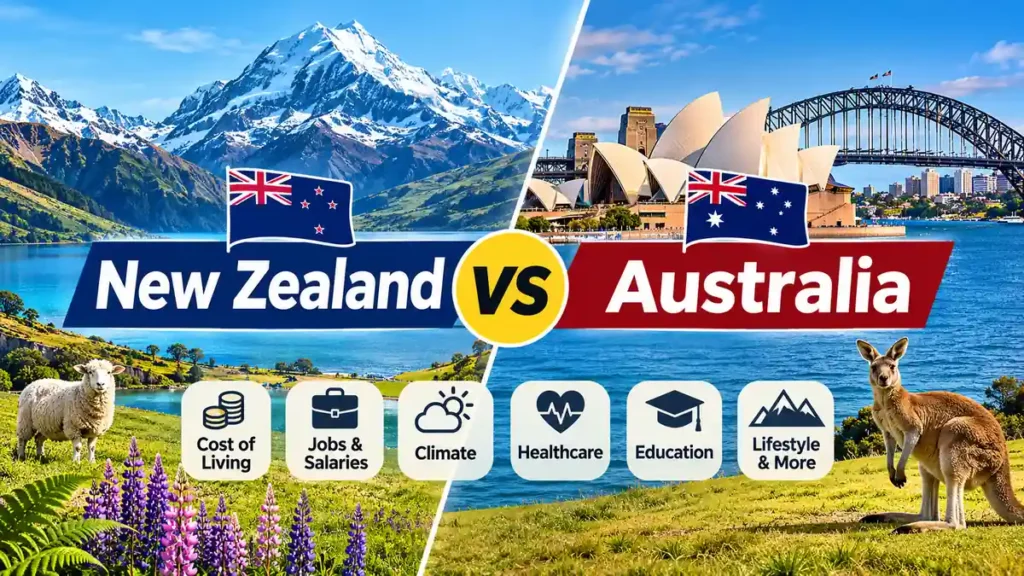
New Zealand and Australia are two of the world’s most desirable countries for living, working, studying, and traveling. They share strong cultural connections, spectacular natural environments, and high standards of living. Yet their differences in geography, population, employment opportunities, and everyday expenses can significantly affect your experience.
The new zealand vs australia comparison comes down to priorities. Australia generally offers a larger economy, higher average incomes, more major cities, and a wider employment market. New Zealand stands out for its compact geography, temperate climate, dramatic landscapes, and quieter communities. Both offer established healthcare systems, respected universities, and extensive outdoor recreation.
Understanding these differences helps explain why some people prefer Australia’s metropolitan lifestyle while others appreciate New Zealand’s smaller cities and easy access to nature.
new zealand vs australia: Quick Comparison
The following table highlights the major differences between the two countries using the latest comparable annual data available.
| Feature | New Zealand | Australia |
|---|---|---|
| Region | Oceania | Oceania |
| Capital | Wellington | Canberra |
| Largest city | Auckland | Sydney |
| Population (2025) | 5.32 million | 27.61 million |
| Land area | Approximately 268,000 km² | Approximately 7.7 million km² |
| Currency | New Zealand Dollar (NZD) | Australian Dollar (AUD) |
| Main language | English | English |
| Indigenous cultures | Māori | Aboriginal and Torres Strait Islander peoples |
| Climate | Predominantly temperate | Tropical, arid, subtropical, and temperate |
| GDP per capita (2025) | US$49,591 | US$65,130 |
| Unemployment (2025, ILO estimate) | 5.1% | 4.1% |
| Life expectancy (2024) | Approximately 82 years | Approximately 83 years |
| Major industries | Agriculture, tourism, technology, services | Mining, healthcare, finance, education, services |
| Healthcare | Publicly funded system with eligibility rules | Medicare and public hospitals with eligibility rules |
| Famous landmarks | Milford Sound, Rotorua, Aoraki/Mount Cook | Great Barrier Reef, Uluru, Sydney Opera House |
Population, GDP, unemployment, and life expectancy figures are from the World Bank’s comparable datasets. Data+1
Both nations are developed parliamentary democracies and constitutional monarchies, with close political and economic relations.
Geography and Natural Landscapes
Geography is one of the most noticeable differences between Australia and New Zealand.
New ZealandMountain ranges, fjords, lakes, and green valleys
The Best Places To Visit In The Australian Outback
AustraliaVast deserts, tropical coastlines, and diverse ecosystems
New Zealand’s Geography
New Zealand is located southeast of Australia, separated by the Tasman Sea. Its two main landmasses are the North Island and South Island, along with numerous smaller islands.
The North Island features volcanic landscapes, geothermal activity, beaches, and major urban centers such as Auckland and Wellington.
The South Island is known for the Southern Alps, alpine lakes, glaciers, and fjords. Popular destinations include Queenstown, Fiordland National Park, and Aoraki/Mount Cook.
Because the country is relatively compact, travelers can experience several types of landscapes within a shorter journey than is usually possible in Australia.
New Zealand also lies along active tectonic boundaries, making earthquakes and volcanic activity important natural hazards.
Australia’s Geography
Australia is approximately 29 times larger than New Zealand by land area. Its enormous size creates extraordinary geographical diversity.
Major natural regions include:
- The Australian Outback, featuring extensive arid and semi-arid landscapes.
- The Great Barrier Reef, the world’s largest coral reef system.
- The Great Dividing Range along eastern Australia.
- Tropical rainforests in Queensland.
- The coastal environments of New South Wales, Victoria, and Western Australia.
- Tasmania’s forests, mountains, and temperate wilderness.
Australia also has extensive deserts and remote inland areas where settlements are separated by considerable distances.
Key difference: New Zealand offers concentrated mountain and coastal scenery, while Australia provides a much greater variety of ecosystems across a significantly larger territory.
Population, Cities, and Urban Lifestyle
Australia has more than five times New Zealand’s population, influencing everything from transportation networks to entertainment and employment opportunities.
Population comparison (2025)
0 million8 million16 million24 million32 millionNew ZealandAustralia
Source: World Bank, 2025 population estimates
Major Cities in New Zealand
Auckland is New Zealand’s largest urban center and a major commercial hub. It is known for its harbors, multicultural population, and employment opportunities.
Wellington, the capital, serves as the country’s political and administrative center. It also has a notable creative and technology sector.
Christchurch is an important South Island city, while Hamilton, Tauranga, and Dunedin offer different combinations of education, business, and regional lifestyles.
New Zealand’s cities are generally smaller than Australia’s largest metropolitan areas. This can appeal to people seeking a less densely populated urban environment.
However, smaller cities may offer fewer specialized employment opportunities, entertainment options, and international flight connections.
Major Cities in Australia
Australia has several large metropolitan areas with distinct economic and cultural identities.
Sydney is a major financial and business center, famous for its harbor and beaches.
Melbourne is known for arts, sports, universities, and a diverse food culture.
Brisbane offers a subtropical climate and access to Queensland’s coastal attractions.
Perth is an important center for mining, energy, and Western Australia’s economy.
Adelaide and Canberra provide additional options for education, government employment, and metropolitan living.
Australia’s larger urban population supports extensive professional networks, major sporting events, international businesses, and specialized services.
new zealand vs australia: Cost of Living in 2026
Cost of living is one of the most frequently discussed differences between these countries.
Both have relatively expensive housing markets, particularly in their largest cities. However, living expenses vary substantially by location, household size, income, and spending habits.
Recent crowdsourced comparisons generally place Australia’s overall consumer prices above New Zealand’s, although individual categories do not always follow that pattern. Numbeo+1
Housing and Rent
Housing is a major financial consideration in both countries.
Sydney is particularly well known for expensive residential property. Melbourne, Brisbane, and Perth also have substantial housing costs, although prices vary by neighborhood and property type.
In New Zealand, Auckland and Wellington can be expensive relative to local incomes. Christchurch and some smaller regional centers may provide more affordable alternatives.
A lower rent figure does not necessarily mean better affordability. The relationship between housing costs and take-home pay matters more than rent alone.
For example, a worker earning a higher salary in Sydney might still have less disposable income than someone living in a smaller New Zealand city.
Groceries, Utilities, and Transportation
Everyday expenses differ across categories.
New Zealand’s geographic isolation and smaller domestic market can contribute to higher prices for certain imported goods.
Australia has a larger retail market and greater domestic production capacity in some sectors, which can improve competition and product availability.
Fuel prices, electricity bills, public transportation, and grocery costs vary between cities and regions.
Public transport is generally more extensive in major Australian metropolitan areas, particularly Sydney and Melbourne. Smaller communities in both countries often require a private vehicle.
Is New Zealand Cheaper Than Australia?
According to Numbeo’s November 2026 country comparison, New Zealand has a lower overall cost-of-living index than Australia.
Cost-of-living index, November 2026
020406080New ZealandAustralia
Numbeo crowdsourced index; a higher value indicates higher consumer prices. It is not a household budget or a direct measure of affordability. Numbeo
The difference does not mean every item is cheaper in New Zealand. Nor does it establish which country is more affordable relative to wages.
A useful comparison should include housing, groceries, transport, healthcare expenses, taxes, and realistic after-tax income.
Jobs, Salaries, and Economic Opportunities
Australia has a significantly larger economy, creating a broader range of employment opportunities across industries and regions.
World Bank data for 2025 places Australia’s GDP at approximately US$1.80 trillion, compared with New Zealand’s US$264 billion.
Australia also recorded higher GDP per capita and a lower modeled unemployment rate that year. Data
Employment Opportunities in Australia
Australia’s major employment sectors include healthcare, construction, mining, financial services, education, information technology, and professional services.
Sydney and Melbourne host numerous corporate headquarters and international businesses.
Western Australia offers employment opportunities associated with mining and energy, while Queensland has significant tourism, construction, and resource industries.
The country’s larger population creates greater demand for specialized professional services.
However, job availability depends on qualifications, local demand, work authorization, and economic conditions.
Employment Opportunities in New Zealand
New Zealand’s economy includes agriculture, food production, tourism, healthcare, construction, education, and technology.
Dairy production, horticulture, and agricultural exports are especially important.
Auckland provides opportunities in business, finance, technology, and logistics. Wellington has government and professional services employment, while Christchurch supports engineering, construction, and regional business activity.
New Zealand’s smaller labor market can mean fewer openings in highly specialized fields.
Nevertheless, specific industries may experience skill shortages, creating opportunities for appropriately qualified workers.
Are Salaries Higher in Australia?
Australia generally has higher average income levels, although actual salaries vary by profession and experience.
The OECD has also identified higher Australian wages as one factor contributing to competition for New Zealand’s healthcare workforce. OECD
Comparing salaries requires more than converting Australian dollars into New Zealand dollars.
Workers should consider income tax, retirement contributions, accommodation, commuting expenses, and purchasing power.
A higher gross salary is not automatically equivalent to a better standard of living.
Climate and Weather Differences
Both countries are in the Southern Hemisphere, meaning their seasons are generally opposite those of Europe and North America.
Summer occurs from December to February, while winter extends from June to August.
Despite this similarity, their climates differ considerably.
A snow covered mountain with a lake in front of it photo – Free Wallpaper 4k Image on Unsplash
New Zealand climateTemperate, maritime, and often changeable
Palm Cove Hotels: Erstklassige Angebote | MEIERS WELTREISEN
Australian climateRanges from tropical to desert and temperate
Weather in New Zealand
New Zealand has a predominantly temperate maritime climate.
Surrounding oceans moderate temperatures, although weather conditions can change rapidly.
Northern areas are generally warmer, while southern and mountainous regions experience colder winters and substantial snowfall.
Wellington is particularly known for windy conditions.
Rainfall varies significantly, with some western mountain regions receiving exceptionally heavy precipitation.
Weather in Australia
Australia’s climate is far more varied because of its size.
Northern Australia experiences tropical conditions, including distinct wet and dry seasons.
Central Australia is largely arid or semi-arid, with hot summers and limited rainfall.
Sydney has a generally temperate climate, Brisbane is subtropical, and Melbourne is known for variable weather.
Tasmania and parts of southeastern Australia experience cooler winters, while alpine regions can receive snow.
Which Country Has Better Weather?
The answer depends on personal preference.
People who enjoy cooler temperatures, green landscapes, and relatively mild summers may prefer New Zealand.
Those seeking warmer beaches, tropical destinations, or more consistently hot summers may prefer particular regions of Australia.
Both countries face environmental risks, including flooding and severe storms. Australia also experiences significant bushfire and extreme heat risks, while earthquakes and volcanic hazards are especially relevant in New Zealand.
Healthcare, Education, and Quality of Life
Australia and New Zealand both maintain publicly funded healthcare systems and established educational institutions.
However, public services, eligibility requirements, and regional accessibility differ.
Healthcare in New Zealand
New Zealand’s public healthcare system provides a range of funded medical services to eligible residents.
Health New Zealand, also known as Te Whatu Ora, plays a central role in delivering public health services.
The Accident Compensation Corporation (ACC) operates a no-fault injury cover system for eligible injuries, including many injuries involving visitors.
Not every medical service is free, and eligibility depends on individual circumstances.
General practitioner appointments, dental services, and certain treatments may involve out-of-pocket expenses.
New Zealand also faces healthcare workforce shortages and regional access challenges, as discussed in the OECD’s 2026 economic survey. OECD
Healthcare in Australia
Australia’s healthcare system combines public and private services.
Medicare helps eligible individuals access subsidized medical treatment and public hospital services.
Private health insurance may cover additional services or treatment in private facilities.
Australia has a larger network of major hospitals and specialist providers, particularly in metropolitan areas.
However, people in remote and regional communities may experience difficulties accessing healthcare.
Medicare eligibility is not automatic for every temporary resident or visitor.
Education and Universities
Both countries have compulsory school education systems, vocational training pathways, and internationally recognized universities.
Notable Australian universities include the University of Melbourne, Australian National University, University of Sydney, and University of Queensland.
New Zealand’s major institutions include the University of Auckland, University of Otago, University of Canterbury, and Victoria University of Wellington.
Australia offers a larger selection of universities and specialized programs, reflecting its greater population.
New Zealand provides a smaller higher education system with respected research institutions and strong links to regional industries.
For international students, tuition fees, living expenses, visa conditions, and post-study work eligibility depend on the institution and program.
Quality of Life
Both countries perform strongly on international quality-of-life indicators.
The World Bank reports life expectancy of approximately 82 years in New Zealand and 83 years in Australia for 2024. Data
Their quality of life is supported by public institutions, educational opportunities, natural environments, and extensive recreational activities.
Nevertheless, affordability remains a major concern.
An Ipsos survey conducted in 2025 found that inflation and the cost of living were the leading public concerns in both countries. Housing and healthcare were also prominent issues. New Zealand vs. Australia
This illustrates why national rankings alone cannot fully describe everyday living conditions.
Culture, Food, Sports, and Everyday Life
Australia and New Zealand share historical connections, English-language traditions, and strong enthusiasm for outdoor recreation.
However, their national identities and cultural histories are distinct.
Indigenous Cultures and Heritage
New Zealand’s indigenous Māori people have a central role in the country’s history, language, arts, and identity.
Te reo Māori is an official language, and the Treaty of Waitangi is a foundational document in relations between Māori and the Crown.
Traditional cultural practices include kapa haka performances, carving, weaving, and the haka.
Australia’s Aboriginal and Torres Strait Islander peoples represent numerous distinct nations, languages, and cultural traditions with histories extending back tens of thousands of years.
Indigenous Australian cultures include diverse artistic, storytelling, ceremonial, and land-management traditions.
These histories should not be treated as interchangeable simply because the countries are geographically close.
Food and Cuisine
Both countries have multicultural food scenes influenced by European, Asian, Pacific, and Indigenous traditions.
New Zealand is associated with lamb, seafood, green-lipped mussels, kiwifruit, and traditional Māori hāngī cooking.
Australia is known for barbecue culture, seafood, meat pies, and a diverse restaurant industry.
Both countries claim strong connections to pavlova, the meringue-based dessert, reflecting their long-running friendly cultural rivalry.
Coffee culture is also prominent in cities such as Melbourne, Wellington, Auckland, and Sydney.
Sports and Outdoor Activities
Rugby union is especially important to New Zealand’s sporting identity.
The national rugby team, the All Blacks, is internationally recognized, while the Black Ferns have been highly successful in women’s rugby.
Australia has a broader professional sporting landscape, with Australian rules football, rugby league, cricket, soccer, tennis, and rugby union attracting substantial audiences.
The Australian Football League (AFL) and National Rugby League (NRL) are particularly prominent domestic competitions.
Outdoor activities are popular in both countries.
New Zealand is known for hiking, skiing, mountain biking, and adventure tourism.
Australia offers surfing, snorkeling, diving, camping, and extensive coastal recreation.
Tourism: Which Country Is Better to Visit?
The choice between New Zealand and Australia depends heavily on the type of holiday.
Queenstown with Lake Wakatipu, Otago, South Island, New Zealand, Oceania.
New Zealand: Mountain scenery and road trips
New Zealand is particularly attractive for travelers interested in alpine landscapes, scenic driving, hiking, and adventure activities.
Queenstown, Rotorua, Milford Sound, and Aoraki/Mount Cook are popular highlights.
Lunenburg Opera House (2026) – Best of TikTok, Instagram & Reddit Travel Guide
Australia: Beaches, wildlife, and major cities
Australia offers tropical islands, expansive beaches, unique wildlife, deserts, and large metropolitan destinations.
Sydney, the Great Barrier Reef, Uluru, Melbourne, and Tasmania provide contrasting experiences.
Wildlife and Natural Attractions
Australia is famous for kangaroos, koalas, wombats, crocodiles, and numerous unique bird and reptile species.
Its wildlife diversity reflects the continent’s long geographic isolation and range of habitats.
New Zealand is particularly known for its endemic birds, including the kiwi, kea, and takahē.
It has no native terrestrial snakes and relatively few native land mammals, making its ecosystems notably different from Australia’s.
New Zealand’s conservation efforts are especially important because introduced predators have threatened many native species.
Travel Distances and Accessibility
New Zealand’s compact size can make multi-destination road trips easier to organize.
Australia’s scale requires more careful planning. Traveling between Sydney and Perth, for example, involves thousands of kilometers.
Domestic flights are often practical for long-distance Australian itineraries.
Travelers should also account for seasonal weather, accommodation costs, road conditions, and the remoteness of particular destinations.
Neither country is universally better for tourism: New Zealand excels in compact scenic itineraries, while Australia offers a wider geographical range.
Immigration, Work Visas, and Residency
Australia and New Zealand are popular destinations for international workers, students, and families.
Both have immigration systems that include skilled employment and family-related pathways, although requirements differ.
Immigration to Australia
Australia operates several immigration pathways, including skilled migration, employer-sponsored visas, and family visas.
Certain skilled pathways use points-based assessments, while others depend on employer sponsorship and occupation-specific requirements.
Eligibility can involve qualifications, work experience, English-language proficiency, health checks, and character requirements.
Permanent residence is not guaranteed simply because someone obtains a temporary work visa.
Immigration to New Zealand
New Zealand also offers skilled residence and employer-linked work pathways.
The Skilled Migrant Category and Accredited Employer Work Visa are important parts of its immigration framework.
Requirements depend on the specific visa and can change over time.
Applicants should verify current criteria through Immigration New Zealand rather than relying on older eligibility summaries.
Can Australians and New Zealanders Live in Each Other’s Country?
The two countries have a particularly close relationship under the Trans-Tasman Travel Arrangement.
Australian citizens and permanent residents generally have facilitated entry arrangements in New Zealand, subject to applicable conditions.
Eligible New Zealand citizens can generally live and work in Australia under special arrangements.
Since July 2023, eligible New Zealand citizens living in Australia have also had access to a direct citizenship pathway after meeting residence and other requirements. MFAT+1
These privileges do not automatically extend to every foreign national residing in either country.
Safety, Infrastructure, and Environmental Challenges
Safety and infrastructure are important when comparing everyday life.
Both countries have established legal systems, emergency services, and public institutions.
However, conditions vary by neighborhood, city, and region.
Crime and Personal Safety
Neither country is free from crime.
Urban areas can experience theft, burglary, fraud, and other offenses, while crime patterns vary considerably across locations.
National crime comparisons should account for differences in reporting practices and definitions.
For residents and travelers, local safety information is more useful than assuming an entire country is uniformly safe or unsafe.
Transportation and Infrastructure
Australia has extensive domestic aviation connections, major highways, and urban rail systems.
Sydney, Melbourne, Brisbane, Perth, and other major cities offer different levels of public transportation.
New Zealand has major highways, domestic airports, and urban bus and rail networks, although intercity rail passenger services are more limited.
Both countries have remote communities where transportation access can be challenging.
Natural Disasters
New Zealand faces earthquakes, volcanic activity, landslides, and flooding.
Australia experiences bushfires, tropical cyclones, floods, droughts, and heatwaves.
Preparedness varies by location and building type.
People planning long-term residence should consider local hazard exposure, insurance availability, and emergency management arrangements.
new zealand vs australia: Which Is Better for Different Priorities?
Neither country is the best choice for everyone. Their advantages become clearer when compared against specific priorities.
| Priority | Country with a potential advantage | Main reason |
|---|---|---|
| Larger employment market | Australia | Bigger economy and more major industries |
| Higher average income | Australia | Higher GDP per capita and generally higher earnings |
| Smaller urban environments | New Zealand | Lower population and smaller cities |
| Alpine scenery and compact road trips | New Zealand | Mountains, lakes, and relatively short travel distances |
| Tropical beaches and deserts | Australia | Greater climatic and geographic diversity |
| More university choices | Australia | Larger higher education sector |
| Rugby union culture | New Zealand | Strong national association with the sport |
| Diverse professional sporting leagues | Australia | Larger sporting market |
| Lower overall consumer-price index | New Zealand | Lower recent crowdsourced cost index |
| Greater metropolitan variety | Australia | More large cities with distinct economies |
These are broad comparisons, not guarantees about individual experiences.
Which Country Is Better for Families?
Families may value education, healthcare access, housing affordability, employment stability, and community facilities.
Both countries can offer supportive environments, but city selection matters greatly.
A family comparing Auckland and Sydney might reach a different conclusion from one comparing Christchurch and Adelaide.
School enrollment rules, childcare costs, access to specialists, and housing requirements should all be considered.
Which Country Is Better for Students?
Australia has a larger higher education sector with more universities and program choices.
New Zealand offers respected universities and a smaller national education system.
The best option depends on the intended subject, institution, tuition fees, academic requirements, and student visa conditions.
University reputation alone should not determine the choice.
Which Country Is Better for Nature Lovers?
New Zealand is especially appealing to people who enjoy mountains, hiking, glaciers, and scenic lakes.
Australia may be preferable for tropical marine environments, expansive beaches, desert landscapes, and wildlife diversity.
Both offer outstanding natural attractions, but the experiences are quite different.
Is Australia Richer Than New Zealand?
Australia has both a larger total economy and higher GDP per capita.
In 2025, World Bank figures placed Australia’s GDP per capita at approximately US$65,130, compared with New Zealand’s US$49,591. Data
However, GDP per capita is not the same as median household income, personal wealth, or disposable income.
It should be interpreted alongside living costs, income distribution, housing affordability, and public services.
Final Verdict: New Zealand or Australia?
The new zealand vs australia comparison reveals two closely connected countries with different strengths.
Australia offers a larger economy, more extensive metropolitan areas, broader career opportunities, and exceptional geographical diversity. Its higher average income levels can be attractive, although expensive housing and other living costs remain significant challenges.
New Zealand provides smaller urban communities, remarkable mountain landscapes, a temperate maritime environment, and relatively accessible outdoor recreation. Its smaller labor market and geographic isolation can present disadvantages, particularly for specialized careers.
For those prioritizing employment opportunities, major-city amenities, and industry diversity, Australia may be the stronger choice. For those who value compact geography, mountain scenery, and smaller communities, New Zealand may be more appealing.
Ultimately, the most meaningful comparison is not simply between two countries. It is between the particular cities, opportunities, expenses, and lifestyles that each can offer.