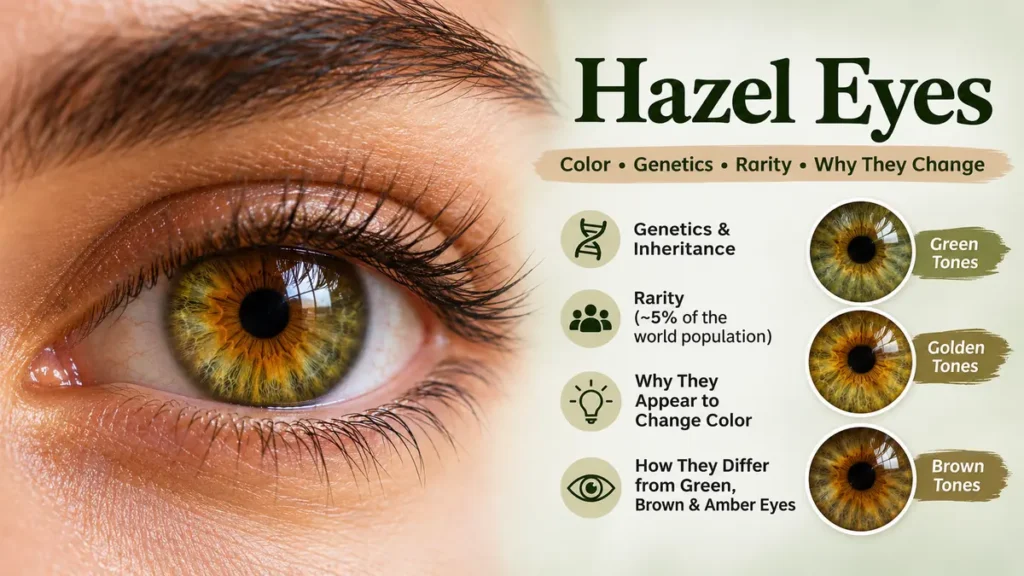
Hazel eyes can look golden in bright sunlight, green in a photograph, and light brown indoors. This shifting appearance makes them one of the most distinctive natural eye colors.
Unlike eyes with a relatively uniform iris color, hazel eyes often contain a blend of brown, green, gold, and amber tones. Their appearance depends on pigmentation, light scattering, and the way different colors are distributed across the iris.
Hazel eyes are a naturally occurring eye color characterized by a mixture of brown, green, and golden tones within the iris. Their appearance results from melanin distribution and the interaction of light with iris tissue. Although hazel eyes may seem to change color under different lighting conditions, the underlying pigmentation usually remains stable.
What Are Hazel Eyes?
Hazel eyes are a mixed-color iris pattern that typically combines brown or amber pigmentation with greenish or golden areas.
Some people have hazel eyes that look predominantly green, while others have eyes that appear mostly light brown. A defining feature is the presence of more than one visible color within the iris.
The iris is the colored, circular structure surrounding the pupil. It regulates how much light enters the eye by adjusting pupil size.
Eye color depends primarily on the amount, type, and distribution of melanin within the iris, along with the way light interacts with its tissues.
What Color Are Hazel Eyes?
Hazel eyes do not have one exact shade. Common combinations include:
- Brown and green: A brown or golden center surrounded by greenish outer areas.
- Gold and amber: Warm honey-colored tones mixed with brown or green.
- Green and gold: A predominantly green appearance with golden flecks or a brownish center.
- Light brown and olive: A muted combination that may appear greenish under natural light.
The arrangement of these colors varies between individuals. Two people with hazel eyes can have noticeably different iris patterns.
What Do Hazel Eyes Look Like?
Hazel eyes frequently have a multicolored appearance rather than a single, consistent shade.
A person might have a golden-brown ring around the pupil, a greenish middle region, and a darker outer border.
Some hazel irises also contain small speckles, streaks, or radiating patterns.
These details become easier to notice in close-up photographs taken under even, natural lighting.
Not every hazel iris has a clearly defined brown center or green outer ring. Color boundaries can be subtle, irregular, or blended.
How Rare Are Hazel Eyes?
Hazel eyes are generally considered less common than brown eyes worldwide.
A frequently repeated estimate suggests that approximately 5% of the global population has hazel eyes. However, this figure should be treated as a rough estimate rather than a precisely established worldwide prevalence.
Large, representative global eye-color surveys are limited, and researchers do not always use the same categories when distinguishing hazel, amber, green, and light brown eyes.
How Common Are Hazel Eyes Compared With Other Eye Colors?
Brown is the most common natural eye color globally. Blue eyes are less common, while green, amber, gray, and hazel are generally less prevalent.
| Eye Color | General Appearance | Worldwide Frequency |
|---|---|---|
| Brown | Light to dark brown | Most common |
| Blue | Blue or blue-gray | Less common than brown |
| Hazel | Mixed brown, green, and gold | Uncommon |
| Green | Predominantly green | Uncommon |
| Amber | Relatively uniform golden or copper | Uncommon |
| Gray | Gray or silver-toned | Uncommon |
Precise rankings among the less common eye colors are difficult because classification methods differ.
Where Are Hazel Eyes Most Common?
Hazel eyes occur in populations around the world, including people with European, Middle Eastern, North African, South Asian, and mixed ancestry.
They are often reported in populations with diverse eye-color pigmentation.
However, reliable population-level comparisons are limited, and ancestry alone cannot determine whether someone will have hazel eyes.
Hazel eye color is a human variation, not a reliable indicator of nationality or ethnic background.
What Causes Hazel Eyes?
Hazel eyes develop through a combination of genetic influences, melanin pigmentation, and the optical properties of the iris.
The two main mechanisms are pigment distribution and light scattering.
Melanin and Iris Pigmentation
Melanin is a natural pigment that contributes to the color of the eyes, skin, and hair.
Within the iris, melanin is particularly important in the anterior border layer and stroma.
Brown eyes generally have more melanin in the front layers of the iris, while blue eyes have relatively little.
Hazel eyes often have intermediate or unevenly distributed pigmentation, allowing brown, golden, and greenish regions to appear together.
The relationship is not simply a matter of having a fixed percentage of melanin. Pigment location, tissue structure, and genetic variation all contribute.
Why Hazel Eyes Can Look Green
Greenish tones can emerge when light interacts with iris tissue containing relatively little brown pigment.
Shorter wavelengths of light are scattered by the iris, while underlying pigmentation influences the resulting appearance.
This combination can produce a greenish appearance without requiring a separate green pigment.
The same broad optical principles help explain why blue and green eye colors can occur despite the absence of a dedicated blue or green iris pigment.
Why Hazel Eyes Have Golden or Brown Centers
Some hazel eyes have stronger brown or golden pigmentation near the pupil.
This pattern can make the center of the iris appear warmer than the outer region.
A prominent difference between the inner and outer iris is sometimes described as central heterochromia.
However, not every hazel eye with a brown center has a distinct form of central heterochromia. Natural hazel pigmentation can also produce gradual transitions between colors.
Hazel Eyes vs. Green, Brown, and Amber Eyes
Hazel eyes are sometimes confused with green, amber, or light brown eyes.
The differences become clearer when comparing their overall color distribution.
| Feature | Hazel Eyes | Green Eyes | Amber Eyes | Brown Eyes |
|---|---|---|---|---|
| Main appearance | Mixed brown, green, gold | Predominantly green | Golden, honey, copper | Predominantly brown |
| Color variation | Often pronounced | Usually less pronounced | Often relatively uniform | Variable brown shades |
| Brown center | Common but not required | May occur | Usually not defining | Often blends with rest of iris |
| Green areas | Common | Dominant | Usually absent | Usually absent |
| Lighting effects | Can strongly affect perceived shade | Can affect brightness | Can affect warmth | Can affect shade |
These are descriptive distinctions rather than rigid medical classifications.
Hazel Eyes vs. Green Eyes
The most noticeable difference is the presence of substantial brown or golden pigmentation in many hazel eyes.
Green eyes generally appear predominantly green across the iris, although they may contain gold or brown details.
Hazel eyes tend to show a more obvious mixture of colors.
If an iris appears green overall but contains a prominent brown center, it may be described as hazel or green with central heterochromia, depending on the pattern.
Hazel Eyes vs. Amber Eyes
Amber eyes usually have a more uniform golden-yellow, copper, or honey-brown appearance.
Hazel eyes more commonly contain distinct greenish regions alongside their warmer tones.
An iris that looks consistently golden in different lighting conditions may be described as amber rather than hazel.
Hazel Eyes vs. Light Brown Eyes
Light brown eyes can have warm honey or golden undertones, making them resemble hazel eyes.
The distinction is often the presence of visible greenish or olive regions.
A uniformly light brown iris is usually classified as brown, even when it appears golden in sunlight.
Why Do Hazel Eyes Appear to Change Color?
One of the most frequently noticed characteristics of hazel eyes is their changing appearance.
A person may describe their eyes as green one day and brown the next.
In most cases, the actual iris pigmentation has not changed. Instead, lighting, pupil size, and visual contrast alter how the existing colors are perceived.
Natural Sunlight
Sunlight can make golden and greenish details more visible.
Direct or indirect daylight may illuminate the iris differently from indoor lighting, revealing patterns that are less obvious in dim conditions.
The angle and intensity of the light also influence the appearance.
Indoor and Artificial Lighting
Warm indoor lighting can emphasize brown, amber, and golden tones.
Cooler lighting may make greenish regions more noticeable.
The color temperature of a light source can therefore influence how someone describes the same pair of eyes.
Clothing and Makeup
Clothing and makeup do not physically alter iris pigmentation.
However, surrounding colors can influence perceived contrast.
For example, purple or plum eyeshadow may make greenish tones more noticeable, while bronze or copper shades can emphasize warm golden details.
These effects vary depending on the individual’s iris pattern, skin tone, and lighting.
Pupil Size
The pupil expands in dim lighting and contracts in brighter conditions.
As its size changes, the iris stretches or compresses slightly.
This can alter how pigment patterns are displayed, making certain colors appear more or less prominent.
Pupil changes do not normally create new iris pigmentation.
Do Hazel Eyes Change Color With Mood?
Emotions can influence pupil size through the autonomic nervous system.
Excitement, stress, and changes in attention may affect pupil diameter, which can subtly change the appearance of the surrounding iris.
However, there is no established evidence that ordinary mood changes directly transform hazel iris pigment from brown to green or vice versa.
A perceived change during an emotional moment is more likely related to pupil size, lighting, or visual contrast.
Can Hazel Eyes Permanently Change Color?
Eye color can change during infancy and early childhood as iris pigmentation develops.
Subtle changes may also occur with aging.
However, a sudden, persistent, or pronounced change in eye color during adulthood deserves medical attention.
Certain medications, eye inflammation, injury, and other conditions can affect iris pigmentation or appearance.
If one eye changes color unexpectedly, particularly with pain, redness, blurred vision, or light sensitivity, an eye-care professional should evaluate it.
The Genetics Behind Hazel Eyes
Hazel eye color is inherited through a complex interaction of multiple genes.
The older explanation that brown eyes are simply dominant and blue eyes are recessive does not adequately describe human eye-color inheritance.
Eye color is a polygenic trait, meaning that numerous genetic variants contribute to the final appearance.
The Role of OCA2 and HERC2
Two important genes associated with eye-color variation are OCA2 and HERC2, located on chromosome 15.
OCA2 influences melanin production and pigmentation.
Certain variants within HERC2 affect the regulation of OCA2 expression, contributing to differences in iris color.
These genes are particularly important in studies of brown and blue eye-color variation.
Hazel and green eye colors involve additional genetic complexity.
Other pigmentation-related genes, including SLC24A4, SLC45A2, TYR, and IRF4, have also been associated with variation in human eye color.
No single gene reliably determines whether a person will have hazel eyes.
Can Two Brown-Eyed Parents Have a Hazel-Eyed Child?
Yes.
Because eye color is influenced by multiple genes, two brown-eyed parents can have a child with hazel eyes.
The combination of genetic variants inherited from both parents may produce a different balance of iris pigmentation.
Likewise, parents with hazel eyes are not guaranteed to have children with hazel eyes.
Simple inheritance charts cannot reliably predict every possible outcome.
Can Hazel-Eyed Parents Have Blue-Eyed Children?
Yes, this is genetically possible.
The probability depends on the particular variants inherited by each parent and how those variants interact.
Eye-color inheritance is more complicated than a single dominant-recessive gene model.
Are Hazel Eyes Genetic Mutations?
Hazel eyes are a normal variation in human pigmentation.
Genetic variants influence how melanin is produced and distributed, but having hazel eyes does not indicate a disease or harmful mutation.
The term mutation is sometimes used loosely in discussions of eye-color genetics, but common inherited variants are a more accurate explanation for most natural differences.
Hazel Eyes and Central Heterochromia
Hazel eyes and central heterochromia can look similar, but they are not exactly the same thing.
Hazel describes the overall color appearance of an iris.
Central heterochromia describes a particular arrangement of color in which the region around the pupil differs noticeably from the surrounding iris.
What Is Central Heterochromia?
Central heterochromia occurs when the inner iris has a different color from the outer iris.
For example, someone may have a brown ring around the pupil surrounded by a predominantly green iris.
This creates a distinct two-tone appearance.
Some people with central heterochromia have eyes that are classified as hazel, while others have eyes classified as green, blue, or another color.
Are All Hazel Eyes Central Heterochromia?
No.
Hazel eyes can contain blended colors without a sharply defined central ring.
Central heterochromia generally refers to a more recognizable difference between inner and outer iris pigmentation.
The distinction can be subjective when the color transition is gradual.
Other Types of Heterochromia
Heterochromia is commonly described in three patterns:
- Complete heterochromia: One eye has a different overall color from the other.
- Sectoral heterochromia: A section of one iris differs in color from the rest.
- Central heterochromia: The inner iris differs from the surrounding region.
Many cases are congenital and harmless, but newly developing heterochromia should be assessed by an eye-care professional.
Are Hazel Eyes More Sensitive to Sunlight?
Eye pigmentation can influence how light interacts with the eye, but eye color alone does not reliably determine an individual’s sensitivity to sunlight.
People with lighter-colored irises may experience greater glare or discomfort in bright conditions, although individual differences are substantial.
Hazel Eyes and Light Sensitivity
Hazel eyes often have less visible brown pigmentation than dark brown eyes.
That does not automatically mean someone with hazel eyes will experience photophobia, the medical term for light sensitivity.
Photophobia can have many causes, including dry eye, migraine, corneal irritation, inflammation, and certain neurological conditions.
Persistent or severe light sensitivity should not be attributed to eye color without an appropriate examination.
Do Hazel Eyes Need Special UV Protection?
Everyone benefits from protecting their eyes against ultraviolet radiation, regardless of iris color.
Sunglasses labeled UV400 or offering 99–100% UVA and UVB protection help reduce UV exposure.
A wide-brimmed hat can provide additional protection outdoors.
Dark lenses without adequate UV protection are not a substitute for properly rated sunglasses.
Are Hazel Eyes Associated With Eye Diseases?
Natural hazel eye color is not itself a disease.
Researchers have investigated associations between iris pigmentation and certain eye conditions, including uveal melanoma and age-related macular degeneration.
Some studies have found differences in risk across eye-color groups, but findings depend on the population studied and other factors.
Eye color alone cannot determine whether someone will develop an eye disease.
Family history, age, environmental exposure, and other medical factors are important.
Regular comprehensive eye examinations remain more useful than judging eye health from iris color.
How to Tell If You Have Hazel Eyes
Determining whether your eyes are hazel can be surprisingly difficult when they fall between green, amber, and light brown.
A consistent observation method can help.
Step 1: Look at Your Eyes in Natural Light
Stand near a window with indirect daylight.
Avoid looking directly at the sun or exposing your eyes to uncomfortable brightness.
Natural light can make the different colors within the iris easier to distinguish.
Step 2: Identify the Main Colors
Look for visible combinations of brown, green, gold, or olive.
If your eyes contain a noticeable mixture rather than one dominant uniform shade, hazel may be an appropriate description.
Step 3: Examine the Area Around the Pupil
Notice whether the inner iris is brown, amber, or golden.
Then compare it with the outer iris.
A brown center surrounded by greenish regions is a common hazel pattern, although it is not required.
Step 4: Compare Different Lighting Conditions
Observe your eyes under daylight and ordinary indoor lighting.
Hazel eyes may appear warmer or greener depending on the environment.
This comparison can help reveal colors that are less noticeable under a single light source.
Step 5: Avoid Relying on Camera Filters
Smartphone cameras can alter color through automatic white balance, exposure, and image processing.
Filters and enhanced photographs may exaggerate green or golden tones.
For a more accurate impression, use unfiltered images taken in neutral lighting and compare them with direct observation.
There is no universally standardized boundary between hazel and nearby eye-color categories. If your eyes sit between two descriptions, either label may reflect the subjective nature of color classification.
Interesting Facts About Hazel Eyes
Several features make hazel eyes especially interesting from a biological and visual perspective.
Each Hazel Iris Has a Distinct Pattern
The arrangement of pigmentation, iris crypts, furrows, and other structural details varies between individuals.
Even two people with similarly colored hazel eyes will not have identical iris patterns.
These differences are part of the reason iris texture can be used in biometric identification systems.
Hazel Eyes Can Look Different in Photographs
Camera exposure, flash intensity, white balance, and surrounding colors can dramatically influence how hazel eyes appear in pictures.
A photograph that makes an iris look bright green does not necessarily mean its natural classification is green.
Hazel Eyes Occur Across Different Ancestries
Hazel eyes are not exclusive to one country, ethnicity, or geographic region.
They occur in diverse populations and reflect the complex inheritance of human pigmentation.
Hazel Eyes Do Not Determine Personality
Claims that people with hazel eyes are naturally adventurous, mysterious, independent, or unusually creative are cultural stereotypes rather than established scientific findings.
There is no reliable evidence that having hazel eyes determines personality, intelligence, or emotional characteristics.
Hazel Eyes Are Not Necessarily More Attractive
Eye-color preferences vary among individuals and cultures.
Attractiveness is subjective, and no eye color is inherently more beautiful than another.
The visual appeal often associated with hazel eyes comes from their varied tones and changing appearance under different lighting conditions.
What Makes Hazel Eyes Unique?
Hazel eyes stand out because their appearance combines multiple pigment tones with the optical effects of iris tissue.
Rather than presenting a single uniform color, they can display brown, gold, green, and amber in different proportions.
Their appearance can vary with lighting, pupil size, and surrounding colors without any actual change in iris pigmentation.
Genetics also makes hazel eyes difficult to predict using simple inheritance rules.
The most useful way to understand hazel eyes is as a natural spectrum of mixed iris pigmentation rather than one precisely defined shade.
Final Thoughts on hazel eyes
Hazel eyes are an uncommon and visually varied natural eye color, typically combining brown, green, and golden tones.
Their appearance results from complex genetic influences, melanin distribution, and light scattering within the iris. Although they may appear to change color throughout the day, the underlying pigmentation usually stays the same.
If you are unsure whether your eyes are hazel, examine them in indirect natural daylight and look for a combination of colors rather than relying on a single photograph.
Understanding these characteristics makes it easier to distinguish hazel eyes from green, amber, and light brown eyes while appreciating the natural diversity of human eye color.