
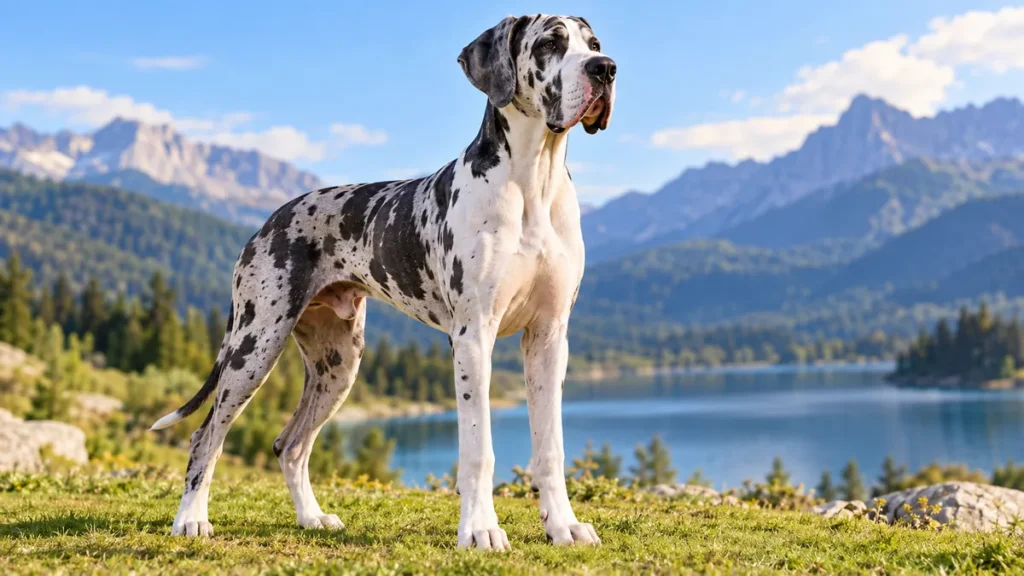
Few dogs make a first impression quite like the great dane. Exceptionally tall, powerful, and elegant, this giant breed can look intimidating from across the room. Spend a little time with one, though, and the reputation of the “gentle giant” starts to make sense.
A Great Dane is a giant German dog breed known for its exceptional height, short coat, affectionate temperament, and strong attachment to people. Adults commonly stand about 28–32 inches at the shoulder and weigh roughly 110–175 pounds. Despite their imposing appearance, well-socialized Great Danes are typically friendly, patient, dependable companions. American Kennel Club
Owning one is different from owning an average-sized dog. Food, veterinary treatment, transportation, training, beds, crates, and even simple household space become bigger considerations. Great Danes also have several important health risks that prospective owners should understand before bringing one home.
Great Dane at a Glance
| Characteristic | Typical Great Dane |
|---|---|
| Breed size | Giant |
| Height | About 28–32 inches |
| Weight | About 110–175 pounds |
| Lifespan | Around 7–10 years |
| Coat | Short and smooth |
| Temperament | Friendly, patient, dependable |
| Exercise needs | Moderate daily activity |
| Grooming | Relatively low maintenance |
| Trainability | Generally responsive with consistent training |
| Family suitability | Often good with proper training and supervision |
| Major health concern | Gastric dilatation-volvulus (GDV/bloat) |
Individual dogs can fall outside these ranges. Genetics, sex, nutrition, health, and breeding lines all influence adult size and behavior. American Kennel Club
What Is a Great Dane?
The Great Dane is a giant working breed distinguished by its height, balanced build, deep chest, long legs, and powerful but elegant appearance.
The American Kennel Club places the breed in its Working Group and describes Great Danes as friendly, patient, and dependable. Males can reach around 32 inches at the shoulder, making the breed taller than most dogs. American Kennel Club
That size sometimes creates the wrong impression.
Modern Great Danes are generally companion-oriented dogs rather than constantly aggressive guardians. They can be alert and protective of their homes, but the desired temperament emphasizes confidence and stability rather than unnecessary aggression.
A well-bred, properly socialized Dane should combine physical power with a manageable temperament.
Why Are Great Danes Called Gentle Giants?
The nickname comes from the contrast between their enormous bodies and typically affectionate personalities.
Great Danes often want to remain close to their families. Many behave as though they are much smaller than they really are, leaning against people or attempting to occupy furniture designed for humans rather than 100-plus-pound dogs.
However, “gentle giant” should never be interpreted as “requires no training.”
An enthusiastic adult Dane can accidentally knock over a child, elderly person, furniture, or another pet simply because of its size. Good manners are essential.
Great Dane Size: How Big Do They Get?
Size is one of the first things prospective owners need to consider.
Great Danes commonly stand approximately 28–32 inches tall at the shoulder, while typical adult weights fall around 110–175 pounds. Males are generally larger than females. American Kennel Club
Some individual dogs exceed those figures, but extreme size should not automatically be viewed as desirable.
Healthy structure, movement, body condition, and temperament matter more than producing the largest possible dog.
Great Dane Growth
Great Dane puppies grow remarkably quickly.
That rapid development makes appropriate nutrition and controlled exercise particularly important during puppyhood. More food does not necessarily produce a healthier or better-developed dog.
Keeping a growing Dane lean and following veterinary guidance on nutrition can help avoid unnecessary stress on developing bones and joints.
Owners should also remember that physical maturity takes time. The AKC recommends waiting until around two years of age before regularly using a Dane as a jogging or strenuous hiking companion because its growing joints need time to develop. American Kennel Club
Quick takeaway: A Great Dane puppy may look sturdy enough for intense exercise long before its skeletal system is ready for it.
Great Dane Temperament and Personality
A typical Great Dane combines confidence with affection.
Common breed tendencies include:
- Strong attachment to family
- Friendly behavior toward familiar people
- Patience
- Alertness
- Moderate playfulness
- Desire for human companionship
- Willingness to learn
- Some watchdog instincts
The official breed ideal emphasizes a dog that is spirited, courageous, friendly, and dependable rather than timid or aggressive. American Kennel Club
Breed tendencies are only part of the picture, however.
Genetics, early environment, socialization, training, previous experiences, and individual personality can all influence behavior. Two Great Danes from different backgrounds may behave very differently.
Are Great Danes Aggressive?
Aggression should not be considered a normal defining characteristic of a properly bred and socialized Great Dane.
Their historic roles included hunting and guarding, but modern breeding has placed much greater emphasis on stable companion temperament. American Kennel Club
Any giant dog nevertheless deserves careful socialization.
Fear, poor breeding, inadequate training, pain, resource guarding, or negative experiences can contribute to behavioral problems in individual dogs. Because a Dane is so powerful, problems that might be manageable in a small dog can become serious very quickly.
Early prevention matters.
Are Great Danes Good Family Dogs?
They can be excellent family companions in suitable households.
Great Danes are commonly affectionate and patient with children, especially when they have been socialized appropriately. Their desire to spend time around people is one reason the breed has remained popular despite the practical challenges associated with its enormous size. American Kennel Club
Size is the major caution.
A friendly Dane can accidentally knock over a toddler simply by turning around quickly or wagging its tail enthusiastically. Interactions between dogs and young children should therefore be supervised.
Children should also learn appropriate behavior around dogs: no climbing on them, disturbing them while eating or sleeping, pulling ears, or treating them like toys.
Can Great Danes Live With Other Dogs?
Many can.
Proper introductions and early socialization make a substantial difference. Great Danes raised around other dogs often become comfortable canine companions.
Compatibility still depends on the individual animals.
What About Cats and Smaller Pets?
Great Danes can sometimes live successfully with cats, particularly when introduced carefully or raised with them.
However, individual prey drive varies. Smaller animals should not automatically be assumed safe simply because the Dane is friendly with people.
Controlled introductions and supervision are the safer approach.
Great Dane Training: Start Before the Dog Becomes Giant
Training is not optional with this breed.
A puppy pulling on a leash may be annoying. A 150-pound adult doing exactly the same thing can be extremely difficult to control.
Begin teaching household manners immediately.
Useful early skills include:
- Walking calmly on a loose leash.
- Coming reliably when called.
- Sitting before receiving attention.
- Keeping four paws on the floor instead of jumping.
- Waiting calmly at doors.
- Settling on a bed or designated place.
- Allowing handling of paws, ears, mouth, and body.
- Remaining calm around unfamiliar people and dogs.
Early puppy classes and structured socialization are particularly valuable. The AKC specifically recommends early socialization and obedience training because of the breed’s eventual size and strength. American Kennel Club
What Training Method Works Best?
Consistency matters more than intimidation.
Reward desirable behavior, establish clear boundaries, and make the same rules apply every day. Short, focused training sessions are often more productive than prolonged drilling.
Socialization should also be thoughtful rather than overwhelming.
Expose a puppy gradually to different surfaces, sounds, people, vehicles, environments, grooming procedures, veterinary handling, and well-behaved animals while keeping those experiences controlled and positive.
The goal is not to make the dog interact with everyone. It is to teach the dog to remain confident and manageable in ordinary situations.
How Much Exercise Does a Great Dane Need?
Great Danes require regular exercise, but they do not necessarily need nonstop high-intensity activity.
Healthy adults generally benefit from daily walks, play, training, and opportunities to explore safely. The AKC suggests brisk walks two or three times daily can be sufficient for many Danes. American Kennel Club
Individual requirements vary substantially with age and health.
A young adult may enjoy considerably more activity than an older Dane with arthritis or another medical condition.
Exercise for Great Dane Puppies
Puppies require a different approach.
Their bodies are growing rapidly, so repeatedly forcing long runs or strenuous repetitive exercise is unnecessary and potentially problematic.
Instead, concentrate on age-appropriate walks, free movement, training games, exploration, and controlled play.
Avoid turning a young Dane into a long-distance running partner simply because it appears energetic enough to continue.
Great Dane Lifespan
One difficult reality of this breed is its relatively short life expectancy.
A typical Great Dane lifespan is approximately 7–10 years, although individual dogs may live shorter or longer lives. Giant breeds generally have shorter lifespans than smaller dogs. PetMD
Genetics, body condition, nutrition, preventive veterinary care, disease, environment, and simple individual variation all influence longevity.
This shorter lifespan is something prospective owners should consider emotionally as well as financially.
Routine veterinary examinations become especially important as the dog ages. Giant breeds can enter their senior years earlier than many smaller dogs.
Great Dane Health Problems Owners Should Understand
Great Danes can experience many of the same diseases as other dogs, but several conditions deserve particular attention.
The Great Dane Club of America recommends health screening for breeding dogs that includes hips, heart, thyroid, and eyes. The AKC lists the same four evaluations among the national breed club’s recommended health tests. Great Dane Club of America
Important concerns include:
Gastric Dilatation-Volvulus (GDV or Bloat)
GDV is one of the most important medical risks for Great Dane owners to understand.
During GDV, the stomach becomes distended and rotates. This can interfere with circulation and rapidly progress to shock. It is a life-threatening emergency requiring immediate veterinary treatment. Large, deep-chested dogs such as Great Danes are particularly susceptible. Merck Veterinary Manual
Warning signs can include:
- Repeated unsuccessful attempts to vomit
- Restlessness
- Excessive drooling
- A swollen or painful abdomen
- Rapid or difficult breathing
- Weakness
- Collapse
Do not wait to see whether suspected GDV improves.
A dog displaying these signs requires immediate emergency veterinary care.
Risk-management strategies discussed in veterinary guidance include feeding multiple smaller meals instead of one large daily meal and avoiding strenuous activity around meals. Owners can also discuss preventive gastropexy with their veterinarian. Gastropexy helps prevent the stomach from twisting, although it does not prevent the stomach from becoming distended with gas. Merck Veterinary Manual
Dilated Cardiomyopathy
Dilated cardiomyopathy, or DCM, is another concern in Great Danes.
The disease affects the heart’s ability to pump effectively and is among the reasons cardiac evaluation is recommended for breeding animals.
The Great Dane Club of America recommends cardiac monitoring and notes the importance of echocardiograms for adult breeding Danes. Great Dane Club of America
Hip and Joint Problems
A giant dog’s musculoskeletal system carries substantial weight throughout life.
Hip dysplasia and other orthopedic problems can affect mobility and comfort. Responsible growth management, healthy body condition, appropriate exercise, and health-screened breeding stock all matter.
Thyroid Disease
Autoimmune thyroiditis and hypothyroidism occur within the breed, which is why thyroid evaluation forms part of recommended health screening. Great Dane Club of America
Eye Problems
Eye examinations are also recommended for breeding Great Danes. Conditions reported within the breed include cataracts and eyelid abnormalities. Great Dane Club of America
Quick takeaway: When evaluating a Great Dane puppy, appearance and color should come after health and temperament. Documented health testing of the parents provides much more useful information than claims that a breeder’s dogs are simply “healthy.”
Feeding a Great Dane
Nutrition deserves special attention because Great Danes develop from relatively small puppies into giant adults very quickly.
A growing puppy should receive a complete diet appropriate for giant-breed growth rather than simply being given as much food as it will eat.
The goal is controlled, healthy development, not maximum growth speed.
The correct amount depends on the dog’s age, body condition, activity, health, and the calorie density of the food. Feeding instructions can provide a starting point, but portions often need adjustment.
Your veterinarian can help determine whether growth and body condition are appropriate.
Adult Feeding
Adult Danes also need a complete, balanced diet while remaining at a healthy weight.
Extra body fat increases the load placed on joints and makes movement more difficult. Owners sometimes mistake a lean, athletic body condition for being underweight, so learning how to assess body condition is useful.
Splitting food into multiple meals rather than giving one enormous meal is also commonly recommended in discussions of GDV risk. Merck Veterinary Manual
Great Dane Grooming
Compared with maintaining the coat of many long-haired breeds, grooming a Great Dane is straightforward.
The short, smooth coat benefits from regular brushing to remove loose hair and distribute natural oils. The AKC recommends weekly brushing during normal periods, with more frequent brushing when shedding increases. American Kennel Club
Routine care should also include:
- Nail trimming
- Dental care
- Ear checks
- Occasional bathing
- Skin inspection
- Checking paws and pads
There is one practical detail people sometimes overlook: even modest shedding becomes noticeable when the hairs come from a very large dog.
And then there is drool.
Not every Great Dane drools constantly, but owners should be prepared for some saliva, particularly after drinking or eating.
Great Dane Colors and Coat Patterns
Great Danes appear in several striking colors and patterns.
Commonly recognized examples include:
- Fawn
- Brindle
- Black
- Blue
- Harlequin
- Mantle
- Merle
Harlequin is particularly recognizable, with irregular black patches against a white background.
Color can be visually appealing, but prospective owners should avoid making it their primary selection criterion. Health, temperament, responsible breeding, and suitability for the household are considerably more important.
Where Did the Great Dane Come From?
Despite the name, the modern breed is closely associated with Germany rather than Denmark.
Ancestors of the breed were developed for demanding work, particularly hunting wild boar. German nobles valued powerful dogs capable of confronting dangerous game, and later generations increasingly served as estate guardians and companions.
The English name is connected with the French term grand Danois, meaning “big Danish.” The AKC notes that there is no known reason to connect Denmark with the actual development of the modern breed. American Kennel Club
As hunting requirements changed, breeders increasingly selected for more manageable temperament.
The result is the modern dog: still imposing and athletic, but much more closely associated with companionship than boar hunting.
Can a Great Dane Live in an Apartment?
Possibly—but square footage alone does not answer the question.
Great Danes can be relatively calm indoors once their exercise needs have been met. However, owners still need enough room for the dog to stand, turn, sleep, eat, and move without constantly colliding with furniture.
Consider practical details such as:
- Stair access
- Elevator size
- Secure outdoor exercise areas
- Flooring traction
- Space for a giant dog bed
- Vehicle size
- Landlord restrictions
- Neighbors
- Emergency transportation
A calm 140-pound dog may require less frantic indoor activity than a much smaller high-energy breed, but its physical footprint is enormous.
A house does not automatically make someone a suitable Great Dane owner, either. Time, training, exercise, companionship, and financial preparation matter just as much.
How Much Does Great Dane Ownership Really Require?
The purchase or adoption fee is only one part of ownership.
Nearly everything scales upward with a giant breed.
Owners should budget for larger quantities of food, giant beds and crates, sturdy collars and harnesses, professional training when necessary, preventive medications dosed according to weight, and veterinary care.
Transportation also deserves thought before an emergency occurs.
Ask yourself whether your vehicle can safely carry a large Dane—and whether you could move a sick or injured 120–170-pound dog if it could not walk.
Those practical questions are easy to ignore when looking at an eight-week-old puppy.
They become very real later.
Choosing a Healthy Great Dane Puppy
A responsible breeder should be willing to discuss much more than coat color and puppy availability.
Ask about temperament, longevity, GDV, cardiac disease, orthopedic problems, thyroid disease, eye conditions, and other health issues in the family.
Most importantly, ask for verifiable health-screening results.
Recommended Great Dane breeding evaluations include:
| Screening | Why It Matters |
|---|---|
| Hip evaluation | Screens breeding stock for hip problems |
| Cardiac examination | Evaluates heart health |
| Thyroid evaluation | Screens for thyroid abnormalities |
| Ophthalmologist evaluation | Identifies relevant eye problems |
These tests are recommended by the Great Dane Club of America and reflected in AKC breed-health guidance. Great Dane Club of America
The Orthopedic Foundation for Animals maintains searchable health records, allowing prospective owners to research testing recorded for breeding dogs and relatives. OFA
Testing cannot guarantee that a puppy will never become ill.
It does demonstrate that breeders are using available tools to make more informed breeding decisions.
Is a Great Dane Good for First-Time Owners?
A committed first-time owner can successfully live with a Great Dane, but this is not necessarily the easiest breed for learning through trial and error.
Their temperament can be wonderfully manageable. Their size makes mistakes less forgiving.
A first-time owner needs to be prepared for early obedience training, socialization, substantial food and veterinary expenses, daily exercise, large equipment, possible drooling, emergency planning, and the realities of giant-breed health.
Waiting until a behavioral problem appears in a 140-pound adult is far harder than teaching the correct behavior when the dog is still a puppy.
Who Is a Great Dane Best Suited For?
A Great Dane may fit particularly well with someone who wants an affectionate, imposing companion and understands the responsibilities associated with a giant breed.
Good owners generally have:
- Time for daily companionship
- A realistic training plan
- Enough physical space
- Suitable transportation
- Financial capacity for giant-breed care
- Patience for puppy development
- Access to veterinary services
- Willingness to research health history
- Realistic expectations about lifespan
The breed may be a poor match for someone looking for a cheap, low-effort pet or a dog that can routinely be ignored for long periods.
Living Successfully With a Great Dane
The most useful Great Dane care advice is surprisingly simple: prepare for the adult dog before bringing home the puppy.
Teach leash manners while the puppy is manageable. Establish household boundaries immediately. Introduce grooming and veterinary handling early. Socialize thoughtfully. Keep the dog at a healthy body condition. Learn the warning signs of GDV. Arrange emergency transportation before you ever need it.
Above all, choose temperament and health over exaggerated size or unusual appearance.
The great dane earns its gentle-giant reputation through a remarkable combination of power, elegance, affection, and companionship. But its enormous body brings equally large responsibilities. For owners prepared for thoughtful training, preventive healthcare, appropriate exercise, significant expenses, and a comparatively short 7–10-year lifespan, this distinctive German giant can become an exceptionally devoted member of the family.


