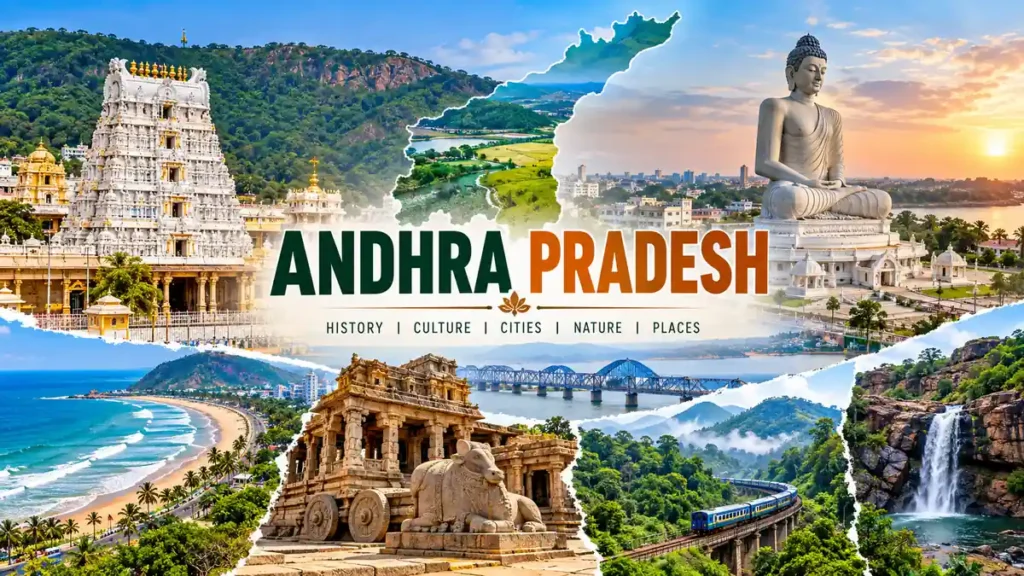
Stretching from fertile river deltas to the Eastern Ghats and a long Bay of Bengal coastline, andhra pradesh is one of southern India’s most geographically and culturally diverse states. Ancient Buddhist sites, major Hindu pilgrimage centers, Telugu traditions, coastal cities, agricultural plains and distinctive regional cuisine all shape its identity.
Andhra Pradesh is a state in southeastern India with Amaravati as its capital and Visakhapatnam as its largest city. Telugu is its principal language. The state is known for the Krishna and Godavari river systems, Tirupati, Kuchipudi dance, long coastline, rice cultivation, historic temples, Buddhist heritage and spicy Telugu cuisine. AP CRDA
Andhra Pradesh at a Glance
| Feature | Information |
|---|---|
| Country | India |
| Region | South India |
| Capital | Amaravati |
| Largest city | Visakhapatnam |
| Major language | Telugu |
| Coast | Bay of Bengal |
| Major rivers | Godavari, Krishna and Penna/Pennar |
| Major city centers | Visakhapatnam, Vijayawada, Guntur, Tirupati, Kurnool |
| Famous for | Tirupati, beaches, temples, Telugu culture, Kuchipudi, agriculture |
| Major landscapes | Coastal plains, river deltas, Eastern Ghats, Rayalaseema plateau |
| Current districts | 28 |
| Best-known cuisine | Andhra meals, pickles, seafood and spicy regional dishes |
The number of districts deserves particular attention because older sources may show different figures. Andhra Pradesh expanded from 13 districts to 26 in April 2022, and another reorganization effective December 31, 2025 increased the total to 28 districts. Alluri Sitharamaraju District
Where Is Andhra Pradesh?
Andhra Pradesh lies along India’s southeastern side, facing the Bay of Bengal.
Its location gives the state an unusual combination of coastal plains, river valleys, hills, forests and drier inland landscapes. The Eastern Ghats run through parts of the state, while extensive agricultural areas developed around its major river systems.
The state’s neighbors include Telangana, Odisha, Chhattisgarh, Karnataka and Tamil Nadu. The Union Territory of Puducherry also has the Yanam enclave within the broader Godavari delta region. Government educational material describes Andhra Pradesh as including portions of the eastern Deccan Plateau and Eastern Ghats. JnanaBhumi
How large is Andhra Pradesh?
Modern Andhra Pradesh covers roughly 163,000 square kilometers.
Care is needed when researching this figure online. Statistics published before the creation of Telangana in 2014 may describe the much larger undivided Andhra Pradesh rather than the present state.
The same issue affects older population, district, forest, agricultural and economic statistics. Always check whether a dataset refers to Andhra Pradesh before or after the 2014 reorganization.
Coastline and Natural Geography
The coastline is one of the defining features of Andhra Pradesh.
Government sources commonly place its length at roughly 970–975 kilometers, running along the Bay of Bengal. This coastal position has influenced fishing, aquaculture, ports, trade, agriculture and settlement for generations. DRYSRHUP
Away from the coast, the landscape changes considerably.
The Eastern Ghats create elevated terrain in parts of northern and central Andhra Pradesh. Areas around Araku and the adjoining hill country offer a dramatic contrast to the flat agricultural deltas farther south.
Broadly, travelers encounter three very different environments:
- fertile coastal and delta plains;
- forested hills and valleys associated with the Eastern Ghats;
- drier interior landscapes, particularly toward Rayalaseema.
This diversity is one reason a single trip can combine beaches, green valleys, temples, caves and rocky historical landscapes.
Rivers of Andhra Pradesh
Water has played a central role in the state’s settlement and agricultural development.
Three particularly important river systems are the Godavari, Krishna and Penna/Pennar, all of which ultimately drain toward the Bay of Bengal. Official state material identifies these among the state’s major river basins. DRYSRHUP
Godavari River
The Godavari is among India’s great rivers.
Its delta supports highly productive agricultural land, settlements, wetlands and aquaculture. The wider Godavari region is closely associated with paddy cultivation, coconut landscapes and waterways.
Krishna River
The Krishna is another major source of water and fertile agricultural land.
Its basin has played an important role in irrigation and the development of settlements around Vijayawada, Guntur and surrounding areas.
Penna River
The Penna, also called Pennar, drains areas farther south.
Although it receives less international attention than the Godavari and Krishna, it remains an important part of Andhra Pradesh’s physical geography.
Amaravati: Capital of Andhra Pradesh
Amaravati is the capital of Andhra Pradesh.
After Andhra Pradesh was bifurcated in 2014 and Telangana was created, the successor state needed a new capital. Amaravati was planned as a greenfield capital in the Andhra Pradesh Capital Region.
The Andhra Pradesh Capital Region Development Authority says the capital city was officially named Amaravati in April 2015. Its development involved a large land-pooling program in which landowners contributed land in exchange for developed plots. AP CRDA
But Amaravati’s importance predates the modern capital project by many centuries.
Ancient Amaravati
The area has a significant Buddhist past.
Government material notes that Amaravati was an important center of Buddhism and was associated with an ancient stupa and monastery. It also has connections with the Satavahana period. AP CRDA
This creates an unusual overlap: modern capital development exists alongside one of southern India’s historically significant Buddhist landscapes.
Major Cities in Andhra Pradesh
The state is not dominated by a single urban center. Different cities perform different economic, cultural, religious and administrative roles.
Visakhapatnam
Visakhapatnam, commonly called Vizag, is the largest city in Andhra Pradesh.
Its location between hills and the Bay of Bengal gives it one of the most recognizable urban settings on India’s eastern coast. It is important for industry, maritime activity, education and tourism.
For visitors, Visakhapatnam also works as a base for beaches and trips toward the Eastern Ghats.
Vijayawada
Vijayawada is a major commercial and transportation center situated near the Krishna River.
Its road and railway connections make it an important gateway for travel through central Andhra Pradesh and the capital region.
The city is also closely associated with the Kanaka Durga Temple, an important religious landmark.
Tirupati
Tirupati is internationally known as a pilgrimage destination.
The city provides access to Tirumala and the Sri Venkateswara temple complex, drawing enormous numbers of pilgrims and making religious tourism central to the local economy.
Guntur
Guntur sits within an agriculturally important region and is particularly associated with the trade and cultivation of chillies.
Its location also places it within reach of Amaravati and Vijayawada.
Kurnool
Kurnool is an important urban center in the Rayalaseema region.
Its surrounding area combines religious sites, historical locations and distinctive rocky landscapes. India’s official tourism portal includes Kurnool among the state’s notable destinations. Incredible India
History of Andhra Pradesh
The history of Andhra Pradesh cannot be reduced to the history of the modern state boundary.
The wider Telugu-speaking region has been shaped by numerous dynasties, religious traditions and trading networks over many centuries.
Buddhism flourished at places such as Amaravati. Later eras brought the influence of major southern Indian kingdoms and dynasties, leaving temples, forts, sculptures and literary traditions across the region.
Formation of Andhra State
A major turning point arrived in the twentieth century.
Andhra State was created on October 1, 1953, primarily from Telugu-speaking districts that had belonged to Madras State. Kurnool served as its capital. Wikipedia
In 1956, Andhra State was combined with Telugu-speaking areas of the former Hyderabad State as part of India’s wider reorganization of states.
The resulting state was known as Andhra Pradesh.
Creation of Telangana in 2014
Another fundamental change occurred on June 2, 2014, when Telangana became a separate state.
That division created the present-day geographical form of Andhra Pradesh and triggered the requirement for a new state capital.
This historical distinction matters whenever older statistics are used. Census 2011 tables, for example, were compiled before bifurcation and can contain districts that are now part of Telangana. The Census of India database itself shows the historical 2011 geography in its Andhra Pradesh tables. Census India
Telugu Language and Identity
Telugu is fundamental to the cultural identity of Andhra Pradesh.
It is used throughout everyday life, literature, cinema, education, music and religious traditions. Regional speech varies, however, so Telugu spoken in coastal districts may sound noticeably different from varieties heard in Rayalaseema or northern areas.
English is widely encountered in higher education, business, tourism and administration.
The Telugu script is distinctive, with rounded characters and a long literary tradition.
Culture of Andhra Pradesh
Andhra culture developed through a mixture of agricultural traditions, religious centers, royal patronage, village customs, literature and coastal trade.
That heritage remains visible in festivals, dance, music, crafts, temple architecture and food.
Kuchipudi
Perhaps the state’s best-known contribution to Indian classical performing arts is Kuchipudi.
The dance tradition originated in Andhra Pradesh and developed around dance-drama performances before evolving into the classical form seen on modern stages.
India’s official tourism portal highlights Kuchipudi among the cultural traditions associated with the state. Incredible India
Traditional crafts
Andhra Pradesh has numerous regional craft traditions.
Examples include Kondapalli toys, Kalamkari textile art, woodwork, handloom weaving and other forms of decorative craftsmanship.
Kalamkari is especially recognizable for its detailed textile designs and traditional production techniques.
Festivals in Andhra Pradesh
Religious and agricultural calendars shape many celebrations.
Ugadi, the Telugu New Year, is among the most culturally significant festivals. Families traditionally prepare special foods, visit temples and mark the beginning of a new year according to the regional calendar.
Sankranti is particularly important in agricultural communities. Celebrations frequently include family gatherings, decorated homes, traditional foods and activities associated with the harvest season.
Other widely observed occasions include:
- Dasara;
- Deepavali;
- Sri Rama Navami;
- Vinayaka Chavithi;
- Maha Shivaratri;
- local temple festivals and jatras.
Celebrations vary considerably by district and community.
Andhra Pradesh Food and Cuisine
Andhra cuisine has a reputation for bold flavors, chilli heat, tangy pickles and generous use of spices.
But calling all Andhra food simply “very spicy” misses its regional variety.
Coastal Andhra cuisine
Coastal cooking benefits from rice cultivation and access to seafood.
Rice forms the base of many meals, accompanied by dal, vegetable preparations, chutneys, pickles, curd and curries.
Fish and prawns are particularly common in coastal areas.
Rayalaseema cuisine
Rayalaseema has its own culinary identity, often characterized by robust seasoning and dishes suited to the region’s drier environment.
Millets and meat preparations have historically played a larger role in some local diets than in the delta regions.
Famous Andhra foods
Travelers may encounter dishes and foods such as:
- pulihora;
- pesarattu;
- gongura preparations;
- pappu;
- avakaya pickle;
- pootharekulu;
- bobbatlu;
- spicy fish curry;
- prawn dishes.
Gongura, with its distinctive sour flavor, is particularly closely associated with Telugu cuisine.
Agriculture and the “Rice Bowl” Identity
Andhra Pradesh is strongly associated with agriculture, particularly the productive deltas of the Krishna and Godavari.
India’s official tourism portal describes the state as India’s “Rice Bowl,” connecting the name with the fertile river basins and extensive rice cultivation. Incredible India
Rice is only part of the agricultural picture.
Depending on region and growing conditions, farmers produce chillies, groundnuts, mangoes, bananas, maize, pulses, sugarcane, coconut and numerous horticultural crops.
Agriculture and allied activities continue to have major economic and social importance. State agricultural planning documents emphasize the importance of the Krishna, Godavari and Penna river basins as well as the productive deltaic soils associated with them. DRYSRHUP
Aquaculture
The long coast and extensive waterways have also encouraged aquaculture.
Fish and shrimp production is economically important in several coastal districts, making fisheries part of both local livelihoods and broader food-processing activity.
Best Places to Visit in Andhra Pradesh
Andhra Pradesh works especially well for travelers interested in combining pilgrimage, history and natural scenery.
1. Tirupati and Tirumala
Tirupati is the state’s most prominent pilgrimage destination.
Most visitors come for Sri Venkateswara Swamy Temple at Tirumala, but the wider region contains additional temples and natural attractions.
2. Visakhapatnam
Visakhapatnam offers a mixture of urban tourism and coastal scenery.
Beaches, hill viewpoints and religious sites can be combined with excursions into the Eastern Ghats.
3. Araku Valley
Araku Valley provides a very different experience from the coastal plains.
Its elevated terrain, green hills and tribal cultural landscape make it a popular escape from Visakhapatnam.
The journey into the hills can be as memorable as the destination itself.
4. Borra Caves
Borra Caves are among the best-known natural attractions of the Eastern Ghats region.
The limestone cave system contains dramatic formations created through long-term geological processes.
Araku Valley and Borra Caves are commonly combined in the same itinerary.
5. Amaravati
Amaravati is worthwhile for travelers interested in both ancient history and the development of modern Andhra Pradesh.
Its Buddhist heritage distinguishes it from many conventional capital-region attractions.
6. Lepakshi
Lepakshi is particularly valuable for architecture and history enthusiasts.
The Veerabhadra Temple is famous for Vijayanagara-style architecture, painted and sculptural details, its celebrated hanging pillar and the nearby monolithic Nandi. India’s official tourism portal highlights these features as defining attractions of Lepakshi. Incredible India
7. Gandikota
Gandikota is known for its fort and spectacular gorge landscape.
The Pennar River cuts through rocky terrain beneath the historic fort, creating one of Andhra Pradesh’s most striking natural-historical combinations.
8. Srisailam
Srisailam combines pilgrimage with forested landscapes.
The Mallikarjuna temple is an important Hindu religious site, while the surrounding Nallamala landscape gives the destination a strong natural dimension.
9. Vijayawada
Vijayawada can be explored for its temples, river setting and role as a major commercial center.
It also provides convenient access to other destinations in the Krishna-Guntur-Amaravati region.
Beaches of Andhra Pradesh
With hundreds of kilometers of Bay of Bengal coastline, Andhra Pradesh has plenty of coastal destinations beyond Visakhapatnam.
Popular beach areas include Ramakrishna Beach, Rushikonda, Yarada, Suryalanka and several smaller stretches of coastline.
Conditions differ significantly between beaches.
Some are developed urban recreation areas, while others are comparatively quiet. Sea conditions on India’s east coast can also become dangerous, especially during rough weather, so local warnings and swimming restrictions should always be followed.
Wildlife and Natural Areas
Andhra Pradesh’s natural environment extends far beyond beaches.
The Eastern Ghats, Nallamala forests, river systems, wetlands and coastal habitats support varied wildlife.
Bird watchers may find wetlands and sanctuaries particularly rewarding, while hill areas offer opportunities for scenic travel and nature-based tourism.
Rollapadu Wildlife Sanctuary is among the state’s recognized wildlife destinations, and the official national tourism portal also highlights nature and wildlife as a significant part of Andhra Pradesh tourism. Incredible India
Climate and Best Time to Visit Andhra Pradesh
There is no single perfect month for every part of Andhra Pradesh because the state stretches across coastal, hilly and inland climatic zones.
For general sightseeing, November through February is often the most comfortable period. Temperatures are usually easier for walking around temples, forts and urban attractions.
March through May can become intensely hot, particularly inland.
The monsoon period brings greener scenery but also greater potential for heavy rainfall and travel disruption.
The state receives rainfall from both the southwest and northeast monsoons, although their influence varies geographically. Agricultural planning documents indicate that the southwest monsoon contributes the majority of normal annual rainfall, with the northeast monsoon providing another significant share. DRYSRHUP
For hill destinations such as Araku Valley, seasonal conditions can feel very different from those along the hot coastal plains.
How to Reach Andhra Pradesh
Andhra Pradesh is well connected with the rest of India by air, rail and road.
By air
Important aviation gateways include:
- Visakhapatnam International Airport;
- Vijayawada International Airport;
- Tirupati Airport.
These three are also identified as key airports for reaching the state by India’s official tourism portal. Incredible India
Depending on the destination, travelers may also find airports in neighboring states useful.
By train
Rail is one of the most practical ways to travel both to and within Andhra Pradesh.
Major stations and railway corridors connect cities such as Visakhapatnam, Vijayawada, Guntur, Tirupati and other district centers with metropolitan areas elsewhere in India.
By road
National and state highways connect Andhra Pradesh with Telangana, Tamil Nadu, Karnataka, Odisha and other neighboring areas.
Buses are especially useful for reaching destinations without direct rail connections.
How Many Days Do You Need?
A short visit of three or four days is enough for one specific area, but it is not enough to meaningfully cover the entire state.
For example, a traveler could spend several days around Visakhapatnam, Araku and Borra Caves without going anywhere near Tirupati or Gandikota.
A more realistic approach is to organize the trip geographically:
3–4 days: Choose one destination cluster.
5–7 days: Combine a major city with nearby cultural and natural attractions.
10–14 days: Explore several regions without spending most of the trip in transit.
Trying to cover Visakhapatnam, Amaravati, Tirupati, Gandikota, Lepakshi and other distant attractions in just a few days usually creates more travel time than sightseeing time.
Andhra Pradesh Population and Census Data
Population statistics for Andhra Pradesh require careful interpretation because the state’s boundaries changed after Census 2011.
India’s official Census population finder currently provides detailed 2011 data, including population, rural and urban residence, age groups, work status and other indicators. Census India
However, historical Census tables labeled “Andhra Pradesh” can include territory that later became Telangana. For current comparisons, researchers should verify whether a dataset has been adjusted to the post-2014 boundaries before treating it as representative of today’s state. Census India
This distinction prevents a common error: comparing an old undivided-state population figure directly with statistics for present-day Andhra Pradesh.
Economy of Andhra Pradesh
The state’s economy reflects its geography.
Agriculture remains highly visible, but Andhra Pradesh also has major activity in fisheries and aquaculture, food processing, manufacturing, ports, logistics, information technology, pharmaceuticals, energy and services.
Visakhapatnam’s maritime and industrial role gives the northern coast particular economic significance, while the Krishna-Godavari region benefits from intensive agriculture and related industries.
The Government of Andhra Pradesh continues to publish annual budgets and socioeconomic surveys containing updated economic and fiscal information. The Finance Department currently provides the 2024–25 Socio Economic Survey and Budget 2026–27 materials for official reference. AP Finance
What Makes Andhra Pradesh Unique?
Andhra Pradesh is difficult to define through one attraction.
Its identity comes from contrasts.
The same state contains internationally significant pilgrimage centers and ancient Buddhist sites. Fertile delta landscapes exist alongside dry interior terrain. Large coastal cities sit within traveling distance of forested Eastern Ghats.
Its strongest defining features include the Telugu language, Krishna and Godavari river systems, long Bay of Bengal coastline, agricultural traditions, Kuchipudi, temple heritage, distinctive cuisine and historical sites ranging from Amaravati to Lepakshi.
For travelers, that diversity means Andhra Pradesh can support very different trips: pilgrimage, heritage exploration, beach holidays, food tourism or journeys through hill landscapes.
For anyone studying modern India, the state is equally interesting because its present identity has been shaped by linguistic state formation, the 2014 bifurcation, changing administrative boundaries and the ongoing development of Amaravati.
Ultimately, understanding andhra pradesh means looking beyond a map or a list of tourist attractions. Its rivers, Telugu heritage, religious centers, agriculture, cuisine, coastline, cities and layered history all contribute to a state whose character changes noticeably from one region to the next.