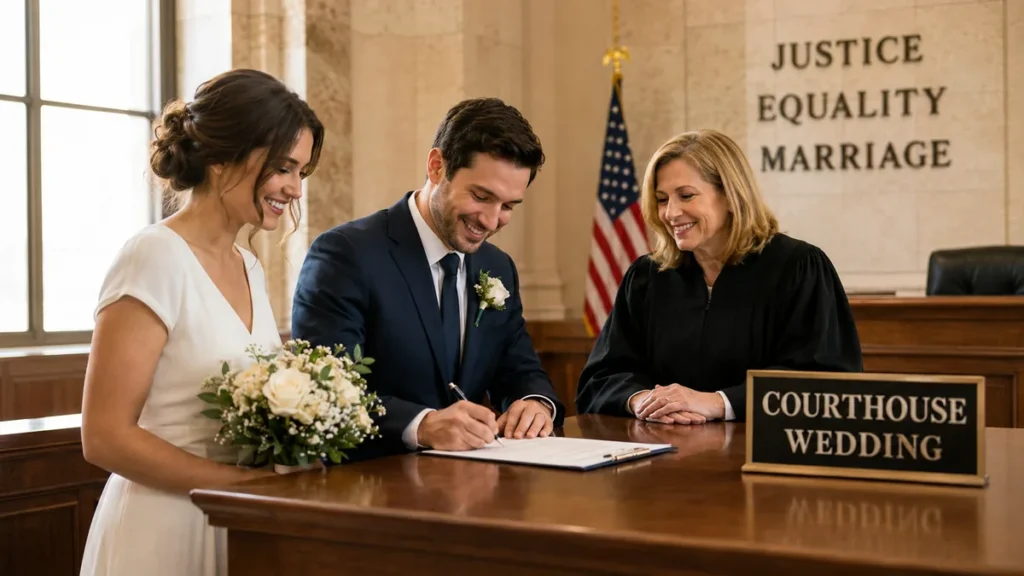
A courthouse wedding can strip marriage back to what matters most: two people making a legal commitment without months of venue hunting, seating charts, or complicated wedding-day logistics. But “simple” does not mean you can necessarily walk into any courthouse and get married immediately.
A courthouse wedding is a legally recognized civil marriage ceremony, typically performed by a judge, magistrate, clerk, justice of the peace, or another authorized civil officiant. Couples generally obtain a marriage license first, satisfy any local waiting period, complete the ceremony, sign the required paperwork with witnesses where applicable, and have the marriage officially recorded.
Because marriage laws are primarily controlled by states and local jurisdictions in the United States, exact requirements vary. Some offices allow same-day ceremonies, while others require appointments, specific identification, witnesses, or separate visits for the license and ceremony.
What Is a Courthouse Wedding?
A courthouse wedding is a civil wedding ceremony conducted under government authority rather than as a religious ceremony. It may take place inside a courthouse, county clerk’s office, city hall, marriage bureau, recorder’s office, or another government facility.
The term is somewhat informal. Your local government might call the service a:
- Civil marriage ceremony
- City hall wedding
- Clerk-performed ceremony
- Justice of the peace wedding
- Civil wedding
- Marriage bureau ceremony
Whatever the name, the central purpose is the same: to complete the legal requirements needed to establish a valid marriage.
A courthouse marriage is not legally “less married” than someone who held a large church, hotel, beach, or destination wedding. Once the applicable legal requirements have been met and the completed marriage record has been properly filed, the marriage has the same civil status.
One misconception is that obtaining a marriage license automatically means you are married. A license normally authorizes the marriage; the required ceremony or solemnization still has to occur. King County, Washington, for example, expressly explains that obtaining a license alone does not make a couple married.
How Does a Courthouse Wedding Work?
The exact process varies, but most couples move through the same basic sequence.
1. Check the rules where you want to marry
Start with the official website of the county clerk, city clerk, recorder, probate court, marriage bureau, or other agency handling marriages in your intended ceremony location.
Confirm:
- Where marriage licenses are issued
- Whether appointments are required
- Whether that office actually performs ceremonies
- Identification requirements
- Marriage license fees
- Ceremony fees
- Waiting periods
- License expiration dates
- Witness requirements
- Guest limits
- Payment methods
- Rules for previously married applicants
This step matters because not every office issuing marriage licenses also performs civil ceremonies.
Even within the same country, procedures can be quite different. Orange County, California, currently requires couples seeking its civil ceremony service to obtain their marriage license through the Orange County Clerk-Recorder and schedule the ceremony through its online system.
2. Apply for a marriage license
The marriage license is generally the legal authorization permitting the ceremony to take place.
Couples commonly need to provide valid government-issued photo identification, such as a driver’s license, state ID, or passport. Some jurisdictions may request additional information relating to previous marriages or identity.
Online applications are increasingly common, although completing an online form does not always eliminate the need for an appointment.
For example, New York City’s marriage-license system allows applicants to begin the application online, but both prospective spouses must then complete the process through an appointment with the Office of the City Clerk.
Orange County currently requires couples applying in person to appear together and present valid, non-expired government-issued photo identification.
3. Observe any waiting period
Do not assume that receiving the license means you can immediately hold the ceremony.
Some jurisdictions impose a mandatory waiting period between issuance of the marriage license and the wedding. Others have no waiting period.
Washington provides a good example of why couples need to check local regulations: a Washington marriage license becomes usable after a three-day waiting period and remains valid for a limited period afterward.
If your location has a waiting period, build it into your courthouse wedding timeline before booking travel, photography, accommodation, or a celebration.
4. Schedule the civil ceremony
Some courthouse weddings operate by appointment only. Others provide walk-in availability during specified hours.
Do not assume a judge will simply be available when you arrive.
The officiant could be a:
- Judge
- Magistrate
- Justice of the peace
- Deputy clerk
- Marriage commissioner
- Other legally authorized civil officiant
The exact title depends on the jurisdiction.
Orange County, for instance, states that its civil marriage ceremonies are conducted by County Deputy Clerks. King County District Court separately allows couples to arrange ceremonies directly with participating judges.
5. Bring everything required on the wedding day
Your local office should provide an official checklist. Common requirements include your marriage license, identification, appointment confirmation, payment, and required witnesses.
Arrive early rather than walking through the doors at the exact appointment time. Government offices may require security screening, check-in, document verification, or additional paperwork.
6. Complete the ceremony
The actual civil ceremony is normally brief.
The officiant confirms the couple’s intention to marry, conducts the legally required declaration or vows, pronounces the marriage, and completes the appropriate paperwork.
You may be able to exchange rings or personal vows, but customization depends entirely on the office and the time available.
A courthouse wedding can therefore feel very different from a traditional ceremony. There may be no processional, music, wedding party, elaborate decorations, or extended readings.
That simplicity is exactly what many couples want.
7. Sign and file the marriage documents
After the ceremony, the required parties sign the marriage paperwork. Depending on local law, signatures may include those of:
- Both spouses
- The officiant
- One or more witnesses
The completed record then has to be returned or filed with the appropriate government authority.
For example, King County explains that after a Washington ceremony, the couple, officiant, and at least two witnesses sign the license and the officiant is responsible for returning the marriage certificate for recording.
Courthouse Wedding Requirements and Documents
Requirements can change significantly between jurisdictions, so there is no universal U.S. courthouse wedding checklist.
Still, certain documents appear frequently.
Government-issued identification
Expect to bring current photo identification.
A passport is particularly useful when a driver’s license is unavailable, although each issuing office decides which identification documents it accepts.
Marriage license
If your courthouse requires you to obtain the license before the ceremony, bring the original paperwork exactly as instructed.
Do not substitute a photocopy unless the office specifically says one is acceptable.
Previous-marriage documentation
If either person was previously married, the marriage-license application normally asks how and when the previous marriage ended.
Some jurisdictions require supporting documentation under particular circumstances.
Orange County, for example, currently requires certain recently divorced applicants to provide a divorce decree and applicants whose spouse recently died to provide a certified death certificate.
Payment
Confirm the accepted payment methods before arriving.
A courthouse may accept cash, cards, checks, cashier’s checks, money orders, or only certain combinations. License and ceremony fees may also be charged separately.
Witnesses
Witness rules are especially easy to overlook.
Some jurisdictions require one witness. Others require two. Certain types of marriage licenses may have different rules.
Orange County currently requires at least one witness for a ceremony using a public marriage license and states that the department will not provide the witness.
King County judges instruct couples to bring two adult witnesses for their ceremonies.
Quick Takeaway: Never rely on a generic online checklist for the final legal details. Use it for preparation, then verify every requirement through the official government agency issuing your marriage license.
How Much Does a Courthouse Wedding Cost?
One of the biggest advantages of a courthouse wedding is that the legal ceremony itself can be comparatively inexpensive.
Your total will depend on where you marry and which extras you choose.
Typical expenses can include:
| Expense | What it covers |
|---|---|
| Marriage license | Legal authorization to marry |
| Civil ceremony | Courthouse or clerk ceremony fee |
| Certified marriage certificate | Official copies needed for records or name changes |
| Photography | Optional professional coverage |
| Clothing | Anything from everyday formalwear to traditional wedding attire |
| Rings | Optional wedding bands |
| Flowers | Bouquet or boutonniere |
| Meal or reception | Optional celebration afterward |
| Travel and parking | Transportation to the government office |
Current U.S. planning resources generally place basic courthouse-related legal costs far below the cost of a conventional wedding, although fees vary substantially by location. One nationwide cost guide estimates the combined license and civil-ceremony portion from roughly tens to a few hundred dollars depending on jurisdiction and services.
Actual government fees illustrate the variation. Orange County currently lists its civil non-sectarian wedding ceremony fee at $28, separate from the marriage license.
Rather than budgeting around a national average, check the current fee schedule from the exact government office where you intend to marry.
Do You Need an Appointment for a Courthouse Wedding?
Sometimes.
Appointments are common, particularly in large cities and popular wedding locations. Some locations also allow walk-ins, but ceremony availability may be limited.
The safest sequence is:
- Identify the government office that performs marriages.
- Complete any required online application.
- Obtain or arrange your marriage license.
- Reserve the civil ceremony.
- Save written confirmation of the date and time.
Do this before booking anything nonrefundable.
A courthouse may issue marriage licenses Monday through Friday but conduct ceremonies only during certain hours. A judge who performs weddings may have an entirely separate schedule.
King County, for example, says couples must contact an individual participating District Court judge to schedule a ceremony, and ceremonies through those judges are by appointment.
Can You Get Married at a Courthouse the Same Day?
In some places, yes. In others, no.
Same-day marriage depends mainly on three factors: the marriage-license waiting period, office availability, and ceremony scheduling rules.
A jurisdiction with no waiting period may permit couples to obtain their license and marry the same day if a ceremony slot is available.
A jurisdiction with a mandatory waiting period cannot normally offer that sequence unless the law provides an applicable exception or waiver.
This is why “Can we just go to the courthouse and get married?” does not have one nationwide answer.
Check the official marriage-license rules before assuming that a spontaneous walk-in wedding is possible.
How Long Does a Courthouse Wedding Take?
The ceremony itself is usually short. The full visit may take considerably longer.
Document checks, security screening, waiting for the officiant, completing forms, taking photographs, and signing paperwork can extend the appointment beyond the actual ceremony.
A practical approach is to avoid scheduling another important commitment immediately afterward.
If photographs matter to you, also check whether photography is permitted inside the courtroom, ceremony room, corridors, staircase, or government building.
Some couples keep the legal ceremony short and spend more time afterward taking photographs outside the courthouse or at another meaningful location.
What Should You Wear to a Courthouse Wedding?
There is no universal courthouse wedding dress code beyond any normal government-building rules.
You can wear a traditional wedding dress, tailored suit, jumpsuit, cocktail dress, separates, cultural attire, or simply well-presented everyday clothing.
A useful rule is to dress for the experience you want to remember rather than for the size of the ceremony.
For a classic city-hall look, couples often choose structured, relatively easy-to-move-in clothing because courthouse weddings may involve security lines, stairs, walking between buildings, and outdoor photographs.
Comfortable footwear can be surprisingly useful.
You can also bring a second pair of shoes if you want more formal footwear for photographs.
Can You Have Guests at a Courthouse Wedding?
Usually, but the number may be restricted.
Small ceremony rooms and courthouse security policies can limit attendance. Your witnesses may also count toward the guest limit.
Never invite a group before confirming the maximum capacity with the office.
Orange County currently allows up to 20 guests for specified clerk-performed wedding ceremonies, demonstrating that some government offices accommodate more than just the couple and witnesses.
Other locations may allow only a handful of people.
If you want dozens of friends and relatives involved, consider having the legal courthouse ceremony privately and hosting a reception, dinner, vow celebration, or symbolic ceremony afterward.
Can You Exchange Personal Vows and Rings?
Often, but not always.
Civil ceremonies generally contain legally necessary language, leaving limited time for customization.
Some officiants permit couples to exchange rings and add brief personal vows. Other government offices use a standard ceremony and keep appointments tightly scheduled.
Ask beforehand rather than surprising the officiant during the ceremony.
Remember that rings are culturally meaningful but generally are not what makes the marriage legally valid. The legal requirements revolve around eligibility, licensing, solemnization, declarations or consent where required, signatures, and proper recording under the relevant jurisdiction.
Marriage License vs. Marriage Certificate
These two documents are easy to confuse.
A marriage license generally authorizes you to get married.
A marriage certificate or certified marriage record provides evidence that the marriage was completed and recorded.
The general flow looks like this:
Application → Marriage license → Ceremony → Signed paperwork → Official filing → Certified marriage record
You may need certified copies later for insurance, immigration matters, benefits, financial accounts, or name-related record updates.
Do not assume that the decorative document sometimes handed to couples immediately after a ceremony is the certified government record required by other agencies.
Ask the issuing office when the official marriage record will become available and how to order certified copies.
What Happens After a Courthouse Wedding?
Once the ceremony is over, make sure the completed marriage paperwork is properly submitted.
Depending on local procedure, the officiant may file it automatically, or you may have responsibilities of your own.
After the marriage is recorded, consider ordering certified copies.
You may need them when dealing with:
- Social Security or equivalent government records
- Driver’s license or state identification
- Passport records
- Employer benefits
- Health insurance
- Banking
- Property records
- Immigration documentation
- Tax and estate records
Marriage itself does not necessarily change your surname automatically across every institution.
If either spouse plans to change their name, investigate the rules before completing the license application. Some jurisdictions incorporate the intended married name into the marriage-license process.
Orange County, for example, instructs applicants who want a qualifying name change to select the intended name when completing the marriage license and notes that couples are not required to change their names.
Courthouse Wedding vs. Elopement
These terms overlap but are not identical.
A courthouse wedding describes where or how the legal marriage ceremony occurs.
An elopement describes a small, intentionally intimate style of wedding, often involving just the couple or a few guests.
You can elope at a courthouse, but you can also elope on a beach, in a park, in the mountains, at a hotel, or somewhere else with a legally authorized officiant where local law permits.
Likewise, a courthouse wedding does not have to be secret or spontaneous. Some couples schedule it months in advance and invite close family members.
Courthouse Wedding vs. Traditional Wedding
Neither option is inherently better.
| Courthouse wedding | Traditional wedding |
|---|---|
| Usually small | Often larger |
| Short civil ceremony | Ceremony may be longer and personalized |
| Limited venue choices | Broad venue selection |
| Usually lower legal-event cost | Often substantially higher overall cost |
| Minimal décor required | Décor may be a major element |
| Guest capacity may be restricted | Guest capacity depends on venue |
| Less planning required | Usually requires more coordination |
The main limitation of a courthouse wedding is flexibility. You may have little control over the room, ceremony time, officiant, decorations, music, guest count, or ceremony length.
The advantage is simplicity.
A couple can still create a deeply personal wedding day around a short civil ceremony.
How to Make a Courthouse Wedding Feel Special
A legal ceremony does not have to feel like an administrative errand.
Choose a few details that genuinely matter to you instead of reproducing an entire traditional wedding on a smaller scale.
You might write private letters to exchange that morning, buy flowers from a local florist, wear meaningful jewelry, book a photographer for an hour, take portraits around city landmarks, invite immediate family, reserve a favorite restaurant, cut a small wedding cake, or spend the evening somewhere significant to your relationship.
You can also hold a larger reception weeks or months later.
Another option is to complete the legal marriage at the courthouse and later hold a symbolic ceremony where you exchange longer personal vows in front of friends and family.
There is no requirement that the legal paperwork and the emotional celebration have to look like the same event.
Common Courthouse Wedding Mistakes to Avoid
Most courthouse wedding problems happen before the ceremony, not during it.
Couples frequently assume that the license and ceremony happen automatically in one visit, forget that the license has a validity period, overlook witness requirements, arrive without acceptable identification, or invite more guests than the room permits.
Another mistake is relying on a general wedding article instead of checking the government website for the actual jurisdiction.
Local rules can differ even between neighboring counties.
Check again shortly before the wedding, particularly if you arranged the ceremony months earlier. Office locations, fees, appointment systems, and operating hours can change.
Also confirm who is responsible for returning the signed license after the ceremony. A beautiful ceremony does little good administratively if required paperwork is never properly recorded.
Courthouse Wedding Checklist
A few days before the ceremony, make one final review. Confirm the date, time, office address, parking or transportation plan, identification, marriage license, witnesses, payments, guest limit, photography rules, and any documents relating to a previous marriage.
Then check the license itself.
Make sure it will be valid on the ceremony date and that all required names and information are correct.
If you’re planning lunch, dinner, photography, flowers, or another celebration afterward, leave enough time between the courthouse appointment and your next reservation. Government-office schedules are not always predictable.
Is a Courthouse Wedding Right for You?
A courthouse wedding works particularly well for couples who value simplicity, privacy, flexibility, or a smaller budget and who care more about becoming legally married than hosting a large ceremony.
It can also make sense when the legal marriage and larger celebration need to happen on different dates.
The trade-off is that courthouse ceremonies usually provide less control over the setting, schedule, guest capacity, and personalization than a private wedding venue.
For many couples, that is not a drawback at all.
The most important part is getting the legal details right. Verify the current marriage-license rules with the government office where you plan to marry, assemble the required documents and witnesses, confirm your ceremony appointment, and understand how the signed marriage record will be filed afterward.
Once those essentials are handled, the rest of your courthouse wedding can be as simple—or as meaningful—as you want it to be.