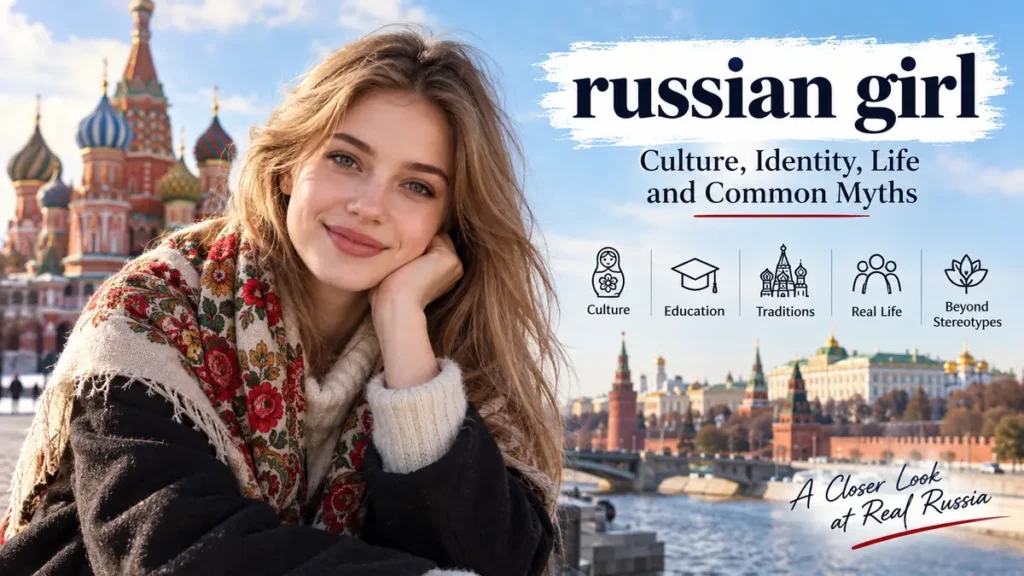
Search for russian girl online and you may encounter a confusing mixture of cultural information, fashion photos, social-media trends, dating stereotypes, memes, and exaggerated claims. Those images can make it difficult to understand what the phrase actually means and what everyday life for girls and young women in Russia is really like.
A russian girl simply refers to a girl or, informally, a young woman from Russia or with Russian cultural heritage. It does not describe one appearance, personality, lifestyle, or set of values. Russia’s enormous geographic, ethnic, linguistic, religious, and social diversity means individual experiences vary considerably.
That distinction matters. Popular culture often compresses millions of people into a handful of recognizable stereotypes. Real life is considerably more complicated.
What Does russian girl Mean?
In its most literal sense, russian girl means a female child or young woman from Russia.
The word “Russian,” however, can describe nationality, citizenship, language, culture, or ethnic background depending on the context. Someone may be a citizen of the Russian Federation without being ethnically Russian, while another person may identify culturally or ethnically as Russian while living outside the country.
There is also a language issue worth recognizing. In informal English, people sometimes use “girl” for a young adult woman. In more formal contexts, Russian woman is normally more appropriate when referring to an adult.
Russian nationality and ethnicity are not exactly the same
Russia is a multiethnic country spanning Eastern Europe and northern Asia. Someone from Russia might identify with one of many ethnic and cultural communities.
The country includes people with Russian, Tatar, Bashkir, Chechen, Chuvash, Avar, Sakha and numerous other backgrounds. These communities have their own histories, languages, traditions, religions, foods, and social customs.
This is one reason there cannot be a universal “Russian look.”
A girl growing up in central Moscow may have a substantially different experience from someone living in Kazan, Yakutsk, a village in Siberia, or the North Caucasus.
What Is Everyday Life Like for a russian girl?
There is no single answer because everyday life depends heavily on age, location, family, education, income, interests, and personal circumstances.
Life in Moscow or St. Petersburg can resemble that of young people in many large international cities. School or university, work, cafés, shopping, public transportation, music, fitness, entertainment, messaging apps, and online communities can all form part of ordinary routines.
Life in smaller towns and rural communities may look quite different.
Climate matters too. Russia covers an enormous territory and contains dramatically different environments. Winter clothing and transportation, for example, can be a significant part of everyday planning in colder regions.
Family traditions can also vary considerably.
Some households maintain relatively traditional expectations around family roles. Others are more individualistic. Generational differences can be substantial, especially between young adults and parents or grandparents who grew up during the Soviet period.
The practical takeaway is simple: nationality provides cultural context, but it does not provide a personality profile.
Russian Culture and Identity
Understanding a russian girl requires looking beyond internet stereotypes and considering the cultural environment in which people grow up.
Russian culture has been shaped by centuries of history, literature, religion, Soviet society, post-Soviet economic and social change, migration, and regional traditions.
Those influences do not affect everyone in exactly the same way.
Language is an important part of identity
Russian is the country’s dominant language and one of the world’s major languages. It uses the Cyrillic alphabet.
A few familiar Russian words and expressions include:
| Russian | Transliteration | English meaning |
|---|---|---|
| Привет | Privet | Hi |
| Спасибо | Spasibo | Thank you |
| Пожалуйста | Pozhaluysta | Please / You’re welcome |
| Да | Da | Yes |
| Нет | Net | No |
| Доброе утро | Dobroye utro | Good morning |
Knowing Russian can provide access to literature, films, music, humor, online culture, and everyday expressions that lose some nuance in translation.
Russia is multilingual, however, and Russian is not necessarily every citizen’s only language.
Literature and the arts
Russian cultural identity has long been associated internationally with literature, classical music, ballet, theater, and visual art.
Writers such as Leo Tolstoy, Fyodor Dostoevsky, Anton Chekhov, and Alexander Pushkin remain internationally recognized. Russian ballet and classical music also have long-established global reputations.
Modern youth culture is naturally broader.
Young Russians may follow contemporary music, television, gaming, fashion, internet creators, international entertainment, and online communities alongside traditional cultural influences.
Culture is therefore not frozen in the nineteenth century—or even the Soviet era.
Family and Social Life in Russia
Family can occupy an important place in Russian social life, although the strength and character of family relationships vary enormously.
Grandparents may remain closely involved with children and grandchildren. In some households, several generations maintain frequent contact even when they do not live together.
Hospitality is another recognizable feature of traditional social culture.
Visiting someone’s home can involve food, tea, extended conversation, and a host insisting that guests eat more than they originally intended. Celebrations such as birthdays and New Year’s gatherings may bring extended family and friends together.
But these are cultural tendencies, not rules.
A young woman living independently in Moscow may organize her life very differently from someone living with a large extended family elsewhere.
Friendship and communication
Foreign visitors sometimes interpret reserved public behavior as coldness.
That interpretation can be misleading.
Norms around smiling, small talk, friendliness, privacy, and emotional expression vary between cultures. Someone who does not immediately smile at strangers or engage in enthusiastic small talk is not necessarily unfriendly.
Personal relationships may become warmer after familiarity and trust develop.
This is a useful principle in almost any intercultural situation: observe the individual rather than trying to decode every action through nationality.
Education, Careers and Modern Life
Another persistent internet stereotype depicts Russian women mainly through beauty, romance, or family roles. That leaves out enormous parts of ordinary life.
Girls and women participate across education, professional careers, science, technology, medicine, business, academia, arts, sports, and other fields.
University life can be particularly significant for young adults in major Russian cities.
Modern Russian women also encounter debates around career expectations, family life, gender roles, personal independence, and traditional values. These questions cannot accurately be reduced to a single national viewpoint.
Age matters as well.
Someone who came of age during the Soviet period experienced a fundamentally different social environment from a person born after 2000.
Quick takeaway: Russian women should not be understood through a fixed template of “traditional” or “modern.” Both influences can exist simultaneously, and individual attitudes differ substantially.
russian girl Beauty Standards: Reality vs. Internet Image
Beauty is one of the most visible themes associated with the keyword russian girl.
Search engines and social media frequently surface highly styled photographs—models, influencers, celebrities, fashion content, and carefully edited images. This creates selection bias.
Ordinary people are less likely to become internationally visible precisely because they are ordinary.
Are all Russian girls naturally glamorous?
No.
Russia contains the same diversity of faces, body types, fashion preferences, and attitudes toward appearance found in other large populations.
Some women enjoy elaborate beauty routines. Others prefer minimal makeup or none. Some follow fashion closely, while others prioritize comfort, sport, alternative styles, or practicality.
The “everyone looks like a model” image largely reflects selective media representation rather than population reality.
Why is Russian beauty culture associated with polished appearance?
There is nevertheless a cultural history behind some perceptions.
In certain Russian social settings, personal presentation has traditionally carried considerable importance. Clothing, styled hair, cosmetics, manicures, and carefully selected accessories may be interpreted as signs of self-care or being properly prepared for public life.
Historical accounts of Russian fashion also show that attention to presentation existed even when consumer choices were much more restricted during the Soviet era.
This evolved considerably after the Soviet Union dissolved, when international fashion and consumer goods became more widely accessible.
But generational and regional differences remain significant.
A contemporary teenager following streetwear trends should not be expected to dress like someone whose fashion habits developed decades earlier.
Beauty standards can create pressure
The glamorous stereotype also has a less attractive side.
Strict expectations concerning weight, femininity, grooming, skin, clothing, and youth can create social pressure. Russian women themselves have publicly challenged unrealistic beauty expectations.
The Russian #SoMnoyVsyoTak, or #AllIsFineWithMe, social-media campaign, for example, encouraged people to share less idealized images and challenge pressure surrounding acne, cellulite, body shape, hair loss, and other normal physical characteristics.
Research has also examined how language, advertising, femininity, and beauty ideals interact in Russian society.
Beauty culture is therefore better understood as something negotiated by individuals rather than a rule followed by every Russian woman.
Common russian girl Stereotypes and What They Miss
Internet discussions about Russian women frequently repeat several claims as though nationality determines behavior.
It does not.
“Russian girls all look the same”
This is perhaps the easiest myth to correct.
Russia is geographically enormous and ethnically diverse. Hair color, eye color, skin tone, height, facial features, and body type vary substantially.
The familiar international image of a fair-haired, light-eyed Slavic woman represents only one appearance among many.
“Russian women always wear makeup and heels”
Some do. Many do not.
High heels became particularly associated with post-Soviet Russian fashion, contributing to an international stereotype of Russian women dressing formally even for ordinary activities. Historical fashion commentary shows how this image developed, but it should not be treated as a description of every woman.
Contemporary fashion is much more varied.
Sneakers, boots, casual clothing, sportswear, minimalist outfits, streetwear, and practical winter clothing are all normal.
“Russian women are all traditional”
There is no universal position on gender roles.
Views about marriage, work, children, religion, independence, and relationships vary according to generation, family, region, education, personal beliefs, and other factors.
Trying to predict someone’s values from nationality alone is unreliable.
“Russian women want foreign husbands”
This is one of the most persistent online stereotypes.
Academic research involving Russian women who immigrated to the United States found that participants encountered labels including the “mail-order bride” stereotype. The researchers described how these stereotypes affected women’s experiences and adaptation after immigration.
International relationships certainly exist, but they do not justify treating millions of women as though they share one romantic objective.
“Russian women have one personality type”
Descriptions such as “serious,” “strong,” “feminine,” “reserved,” or “family-oriented” regularly appear in online discussions.
Any of those characteristics may describe an individual.
None defines Russian women collectively.
Personality develops through family, temperament, friendships, education, experiences, community, and countless other influences that cannot be reduced to a passport.
Social Media and the Modern russian girl Image
TikTok, Instagram, YouTube, and other online platforms have transformed how people outside Russia encounter Russian culture.
They have also made stereotypes easier to amplify.
A short video showing one person’s outfit, apartment, accent, breakfast, university routine, or relationship may receive millions of views. Viewers can then unconsciously treat one creator’s experience as representative of an entire country.
Algorithms intensify the effect.
Highly unusual, beautiful, controversial, humorous, or visually distinctive content tends to attract more engagement than ordinary daily life. Consequently, the version of Russia that travels internationally may be very different from everyday reality.
Some Russian creators actively joke about these stereotypes. Others explain regional customs, language, food, family traditions, fashion, and ordinary routines.
The best approach is to consume content from multiple people rather than treating one viral creator as a cultural authority.
Russian Names and Naming Traditions
Russian names provide another useful window into culture.
A traditional full Russian name commonly contains three elements:
- Given name
- Patronymic
- Family name
A patronymic is formed from the father’s given name and traditionally indicates family relationship.
For example, a woman’s full name might contain a given name, a feminine patronymic, and a surname.
Names can also have affectionate or diminutive forms.
For instance, Alexander may become Sasha, while Alexandra can also be called Sasha. Someone unfamiliar with Russian naming conventions might therefore incorrectly assume that Sasha always indicates one gender.
The appropriate form of someone’s name depends on familiarity and context.
Clothing and Fashion in Russia
Russian fashion cannot be separated completely from geography.
A glamorous social-media photograph from Moscow provides little information about what someone wears during an extremely cold winter elsewhere in the country.
Layering, insulated coats, boots, hats, scarves, and practical winter accessories can be necessities rather than style choices.
Large cities also have diverse fashion scenes.
You may encounter luxury fashion, European-inspired tailoring, minimalist clothing, streetwear, sportswear, vintage pieces, and experimental styles within the same urban environment.
The idea of a single “Russian girl style” is therefore mostly a simplification.
Traditional Russian clothing
Historical Russian clothing is different from ordinary contemporary fashion.
Traditional garments and folk costumes vary by region and historical period. One internationally recognizable item is the sarafan, traditionally associated with women’s dress.
Folk clothing may now appear at cultural events, performances, museums, festivals, or historical celebrations rather than functioning as standard everyday clothing.
Confusing traditional costume with modern Russian dress would be similar to assuming that people elsewhere routinely wear museum-era national clothing.
Food, Celebrations and Home Culture
Food is another part of Russian culture that outsiders often encounter.
Well-known dishes include borscht, pelmeni, blini, pirozhki, and various soups, salads, breads, and preserved foods.
But even here, cultural boundaries are complicated.
Many dishes eaten across Russia have histories shared with Ukraine, Central Asia, the Caucasus, Eastern Europe, and other neighboring regions. Food traditions reflect centuries of migration and cultural exchange.
Tea also has an established place in Russian social life.
Sharing tea, sweets, snacks, or a full meal can accompany long conversations with relatives and friends.
New Year celebrations
New Year is a major secular celebration in Russia.
Families and friends may gather for meals and celebrations around December 31 and January 1. Ded Moroz, usually translated as Grandfather Frost, and Snegurochka, the Snow Maiden, are recognizable figures associated with New Year traditions.
Orthodox Christmas is observed by many on January 7, though religious participation varies.
As with every cultural practice discussed here, not every household celebrates in exactly the same way.
Russian Girls, Women and Sports
Russian girls and women participate in recreational and competitive sports ranging from athletics and swimming to tennis, gymnastics, figure skating, skiing, martial arts, and team sports.
Figure skating and gymnastics have particularly strong associations with Russian sporting history.
Physical activity at the everyday level is naturally broader than elite competition. Gyms, running, dance, yoga, outdoor activities, and recreational sports form part of modern urban life just as they do elsewhere.
Again, internationally famous athletes should not become another template for imagining ordinary Russian women.
How to Communicate Respectfully With Someone From Russia
Cross-cultural communication becomes easier when you approach nationality as background information rather than a personality test.
You do not need a special formula for talking to a Russian person.
A few basic principles work well:
- Treat the person as an individual rather than asking them to represent Russia.
- Avoid opening conversations with stereotypes about beauty, marriage, alcohol, politics, or “Russian temperament.”
- Learn the correct pronunciation of their name when possible.
- Do not assume ethnicity, religion, language, or political views from citizenship.
- Ask genuine questions about personal experiences rather than telling someone what Russians supposedly believe.
Simple curiosity is usually more useful than memorizing cultural stereotypes.
Why Stereotypes About Russian Women Persist
Stereotypes survive because they simplify something complicated.
Russia contains more cultural, geographic, and social variation than a handful of recognizable images can communicate. International audiences, however, frequently encounter the country through movies, fashion photography, social media, news, tourism, and entertainment.
Those sources naturally emphasize memorable images.
A glamorous model is more likely to circulate globally than an ordinary university student commuting to class.
A fictional spy is more memorable than an accountant.
An international marriage story attracts more attention than millions of ordinary relationships.
Once those images repeat often enough, people begin treating them as cultural facts.
Research into the experiences of Russian women abroad demonstrates that stereotypes can have consequences beyond harmless jokes. Women interviewed in one study described being assigned identities such as “mail-order bride” or “secret agent” based largely on their Russian background.
Recognizing that mechanism makes it easier to separate entertainment from reality.
Understanding russian girl Beyond the Search Term
The most accurate way to understand russian girl is also the simplest: the phrase identifies a geographic, national, ethnic, or cultural connection, not a predetermined type of person.
Russian girls and women can come from Moscow, St. Petersburg, Siberia, the Volga region, the North Caucasus, the Russian Far East, and countless communities in between. They may speak one language or several. Their families may be religious or secular, traditional or unconventional. Their interests can range from literature and ballet to programming, gaming, science, fashion, sports, music, and thousands of other pursuits.
Beauty standards, family customs, Russian language, food, fashion, education, and historical traditions can all help someone understand the broader cultural context. They cannot tell you who an individual person is.
That is the central point worth remembering whenever you encounter the term russian girl online: learn about the culture, question the stereotypes, and leave room for individual identity.