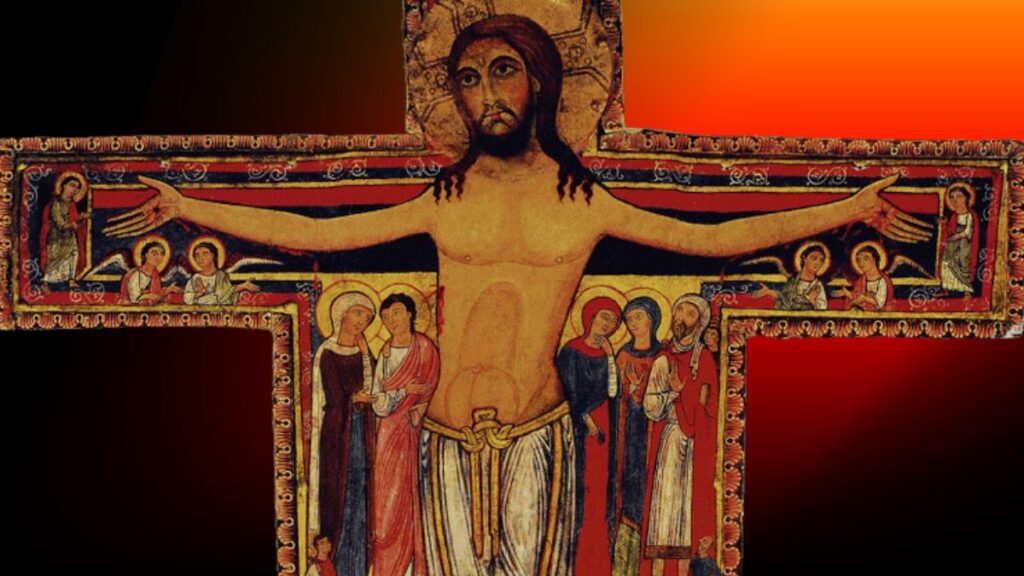
The San Damiano Cross is one of the most recognizable and theologically rich artifacts in Catholic devotional tradition — a 12th-century icon that has profoundly shaped the Franciscan Order’s spirituality and continues to serve as an object of meditation and veneration for millions of Christians worldwide. More than a religious symbol, it is a masterpiece of Byzantine iconography that rewards close visual and theological study. Created in the Romanesque religious art tradition of Umbria, Italy, the cross that reportedly spoke to St. Francis of Assisi is now housed at the Basilica of Saint Clare in Assisi — where it has been venerated for over 800 years. This article examines the cross’s artistic construction, theological content, historical narrative, and enduring significance in contemporary faith life.
Origins and History of the San Damiano Cross
The original cross was painted in Umbria — likely sometime between 1000 and 1100 CE — by an unknown artist working in the Byzantine icon style that characterized religious art across the Mediterranean world during this period. It was installed in the small, ruined chapel of San Damiano outside Assisi, which had fallen into serious disrepair by the early 13th century. It was before this cross that the young Francis Bernardone — not yet known as St. Francis of Assisi — had the famous mystical experience that initiated his religious conversion.
The symbolic language of the San Damiano Cross shares deep roots with other sacred art traditions. The way meaning is encoded in visual symbol — rather than stated in text — connects this cross to the broader history of ancient artistic symbolism and to the intricate pattern-based heritage found in ceremonial textile art from across cultures.
According to Franciscan accounts, Francis was praying before the San Damiano cross around 1206 CE when he heard the image of Christ speak to him: “Francis, go and repair my house, which, as you see, is falling into ruin.” Francis initially interpreted this literally, embarking on physical restoration of the chapel. He later understood the mandate in its deeper sense: the restoration of the Church as a living community. This dual interpretation — the literal and the spiritual — is itself characteristically Franciscan in its embrace of material and mystical together.
Byzantine Iconography: Reading the Visual Language of the Cross
The San Damiano cross is not a standard crucifix. It is an icon — a painted sacred image within the specific Eastern Christian tradition of devotional imagery in which every visual element carries theological significance. Understanding Byzantine iconography is essential to reading what the artist intended to communicate.
The composition of the San Damiano cross includes:
- Christ depicted with eyes open — distinctive in medieval Christian art, this emphasizes Christ’s divinity and triumph over death even while on the cross
- No visible signs of suffering or anguish on Christ’s face — again emphasizing the theological reality of Resurrection glory present within the Passion event
- Figures gathered at the cross including the Virgin Mary, St. John, Mary Magdalene, and other witnesses, rendering the Crucifixion as a communal rather than solitary event
- Angels surrounding the top of the cross, connecting the earthly event to the heavenly reality it participates in
- A figure of Christ in glory at the very top of the cross, visually enacting the Resurrection as the completion of the Crucifixion’s meaning
Theological Meaning: What the San Damiano Cross Communicates
The theological program of the San Damiano cross is sophisticated and intentional. It presents not a suffering savior but a reigning king — the Christus triumphans (triumphant Christ) iconographic type that was dominant in early and medieval Christian art before the Christus patiens (suffering Christ) tradition gained prominence in later Gothic and Baroque religious imagery. This choice reflects the Eastern Christian theological emphasis on Resurrection as the central Christian reality, within which the Passion is understood as the path to — not the contradiction of — divine victory.
For those exploring religious and cultural visual heritage more broadly, the spiritual dimension of faith-based celebratory imagery offers another perspective on how devotion is expressed through visual form.
For St. Francis, whose spirituality was intensely centered on the humanity of Christ and the reality of Christ’s suffering, the San Damiano cross offered a paradox worth meditating on throughout his life: the cross that defeated death still shows its wounds, but those wounds glow rather than bleed. The intersection of suffering and glory — of human pain and divine redemption — is precisely the theological territory that Franciscan spirituality has explored with greatest depth across eight centuries. This richness of spiritual imagery in art is a thread visible across many devotional traditions.
The Cross’s Role in the Franciscan Order
The San Damiano cross quickly became central to the Franciscan movement’s identity. The Order of Poor Ladies — now the Poor Clares — which St. Clare founded with Francis’s support, took up residence at San Damiano chapel, and Clare kept the original cross with her community until her death in 1253. The cross was moved to the Basilica of Saint Clare in Assisi after Clare’s canonization, where it remains today.
Reproductions of the San Damiano cross became widely circulated devotional art from the early days of the Franciscan movement, functioning as a portable icon for communities and individuals who could not travel to Assisi. Today, high-quality reproductions are produced in Italy and distributed globally, present in Franciscan churches, retreat centers, homes, and hospitals across every continent. The cross’s image has become sufficiently recognized that it functions as a Franciscan brand mark — immediately identifiable to anyone with familiarity with Catholic religious art.
Artistic Features: The Craft of the San Damiano Icon
As a work of ancient art history and craft, the San Damiano cross is remarkable for its compositional sophistication and technical execution. Painted in tempera on linen-covered wood, it measures approximately 5 feet tall and 3.5 feet wide — large enough to function as a focal point for communal prayer while being small enough to have survived intact for centuries. The gold-toned background characteristic of Byzantine icons creates a timeless, otherworldly atmosphere that removes the image from historical specificity and locates it in eternal, sacred time.
The figures are rendered with the elongated proportions and schematic facial features typical of Romanesque religious art — a visual language deliberately different from naturalistic representation, emphasizing spiritual reality over physical accuracy. Contemporary viewers sometimes find this aesthetic alien, but it is worth understanding that its very foreignness to naturalist expectations is part of the theological point: this is not a historical document but a window into sacred reality.
Visiting the Original San Damiano Cross in Assisi
The original San Damiano cross can be viewed at the Basilica of Saint Clare in Assisi, Italy — a UNESCO World Heritage pilgrimage destination that receives millions of visitors annually. The cross is housed in a dedicated chapel within the basilica, where it can be venerated in a context of prayerful silence. Assisi itself, a remarkably well-preserved medieval hill town in Umbria, offers an extraordinary immersive experience of the Franciscan tradition, with multiple sites connected to Francis and Clare accessible within walking distance of each other.
Conclusion: The Enduring Power of the San Damiano Cross
The San Damiano cross endures because it addresses perennially central questions about suffering, meaning, death, and divine love with visual intelligence and theological depth that rewards returning to across a lifetime of faith. As a work of Byzantine iconography within the Romanesque tradition, it is a masterpiece. As the catalyst for one of Christianity’s most beloved saints, it is historically irreplaceable. As a contemporary devotional image, it remains — eight centuries after it reportedly spoke to a young man outside Assisi — a powerful vehicle for the encounter between human seeking and divine presence.