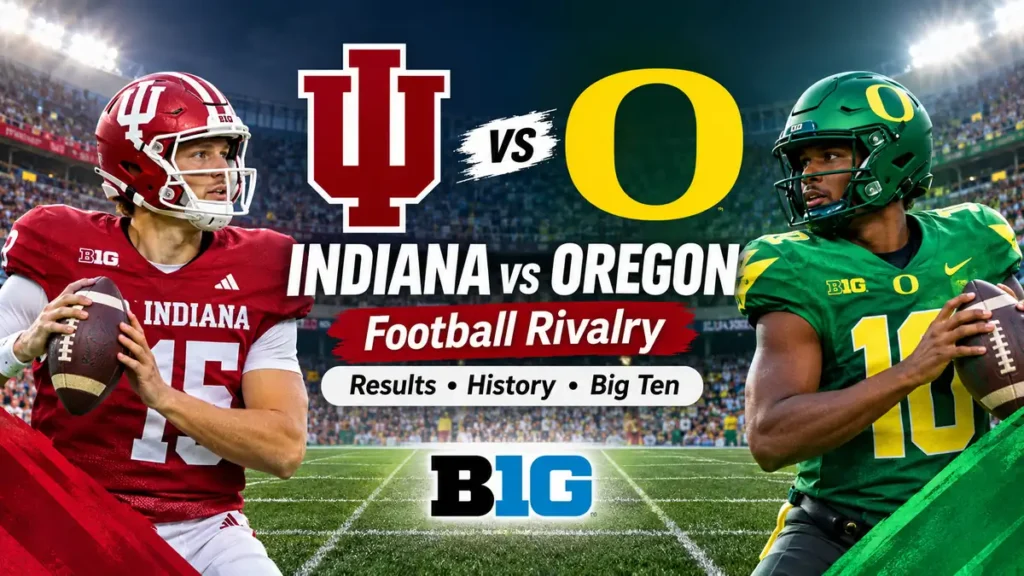
Indiana and Oregon have become two of the most intriguing programs to compare in modern college football. Their contrasting football histories, changing national expectations, and shared membership in the Big Ten Conference have created a matchup with implications beyond a single game.
The indiana vs oregon football matchup brings together the Indiana Hoosiers and Oregon Ducks, two NCAA Division I Football Bowl Subdivision programs competing in the Big Ten. Their meetings highlight different paths to national relevance, contrasting offensive identities, and the growing importance of conference standings, playoff rankings, and championship opportunities.
indiana vs oregon: Understanding the Matchup
Indiana University Bloomington and the University of Oregon represent two programs with very different historical profiles.
Oregon built its modern reputation through explosive offenses, distinctive uniforms, major recruiting investments, and repeated appearances in nationally significant games.
Indiana, traditionally better known for its basketball heritage, has experienced periods of football success alongside long stretches of inconsistency. Its more recent development has challenged assumptions about the program’s competitive ceiling.
Both universities now compete in the Big Ten, making their football meetings particularly important in the conference’s expanded national landscape.
| Category | Indiana Hoosiers | Oregon Ducks |
|---|---|---|
| University | Indiana University Bloomington | University of Oregon |
| Location | Bloomington, Indiana | Eugene, Oregon |
| Conference | Big Ten | Big Ten |
| Football subdivision | NCAA Division I FBS | NCAA Division I FBS |
| Home stadium | Memorial Stadium | Autzen Stadium |
| Team colors | Cream and crimson | Green and yellow |
| Mascot identity | Hoosiers | Ducks |
| Traditional football profile | Historically inconsistent, with emerging national ambitions | Established modern national contender |
| Conference history | Longtime Big Ten member | Joined Big Ten in 2024 |
The most meaningful comparison is not simply which program has won more games historically. It is how each team performs against comparable competition, develops players, manages difficult road environments, and responds to championship expectations.
indiana vs oregon Head-to-Head History
The two programs have played five football games through November 2026. Indiana leads the all-time series 3–2, with three consecutive victories.
Their history began in 1963, but the matchup gained considerably more national significance during the 2025 season.
Complete Head-to-Head Results
| Date | Winner | Score | Location |
|---|---|---|---|
| November 16, 1963 | Oregon | 28–22 | Portland, Oregon |
| November 14, 1964 | Oregon | 29–21 | Bloomington, Indiana |
| September 11, 2004 | Indiana | 30–24 | Eugene, Oregon |
| October 11, 2025 | Indiana | 30–20 | Eugene, Oregon |
| January 9, 2026 | Indiana | 56–22 | Atlanta, Georgia |
Indiana’s official athletics records confirm the 3–2 series advantage, including its victory in the College Football Playoff semifinal in January 2026. Indiana University Athletics+1
How the Series Changed
Oregon won the first two meetings in the 1960s, establishing an early advantage.
Indiana responded with a six-point victory in Eugene in 2004. That result remained the most recent meeting for more than two decades.
The series resumed in October 2025, when Indiana defeated Oregon on the road. Just three months later, the programs met again in the College Football Playoff, where Indiana delivered the most decisive victory in their head-to-head history.
The recent results have transformed what was once an occasional intersectional matchup into a nationally relevant Big Ten contest.
The October 2025 Matchup: Indiana 30, Oregon 20
No. 7 Indiana topples No. 3 Oregon 30-20 in tight battle – NBC Sports
West Coast Win – Indiana University Athletics
10
On October 11, 2025, No. 7 Indiana visited No. 3 Oregon at Autzen Stadium in one of the most closely watched games of the college football season.
Both teams entered undefeated, and the matchup attracted ESPN’s College GameDay to Eugene. The contest also marked their first meeting as Big Ten opponents.
Indiana won 30–20, demonstrating that its rise was supported by performances against elite competition rather than simply a favorable early schedule. Indiana University Athletics+1
How Indiana Won
Indiana established an early lead and entered halftime ahead 13–10. Oregon remained competitive, but Indiana controlled enough of the decisive moments to secure the road victory.
October 11, 2025 — Final score
30
Indiana
–
20
Oregon
| Quarter | Indiana | Oregon |
| 1st | 10 | 7 |
| 2nd | 3 | 3 |
| 3rd | 7 | 3 |
| 4th | 10 | 7 |
Source: Big Ten Conference official box score. Big Ten Conference
Quarterback Fernando Mendoza threw for 215 yards, while running back Roman Hemby contributed 70 rushing yards. Wide receiver Elijah Sarratt produced 121 receiving yards.
For Oregon, quarterback Dante Moore passed for 186 yards, and Jordon Davison led the rushing attack with 59 yards. Indiana University Athletics
Indiana’s victory also ended Oregon’s 22-game home winning streak at Autzen Stadium, making the result especially significant.
Why the Result Mattered
The win was Indiana’s first road victory over a top-five opponent and only its second victory against a top-five team in program history.
It also strengthened the Hoosiers’ position in the Big Ten championship race and demonstrated that they could compete in one of college football’s most challenging road environments. Indiana University Athletics
For Oregon, the defeat exposed the consequences of offensive inconsistency against a disciplined opponent capable of controlling possessions and limiting scoring opportunities.
The January 2026 Peach Bowl: Indiana 56, Oregon 22
College Football Playoff Semifinal – Chick-fil-A Peach Bowl: Oregon v Indiana
Indiana dominates Oregon at Peach Bowl, advances to face Miami in national title game
College Football Playoff Semifinal – Chick-fil-A Peach Bowl: Oregon v Indiana
11
The most consequential meeting in the series occurred on January 9, 2026, at Mercedes-Benz Stadium in Atlanta.
Indiana and Oregon faced each other in the College Football Playoff semifinal at the Chick-fil-A Peach Bowl.
Indiana entered as the No. 1 seed, while Oregon was seeded fifth. The Hoosiers won 56–22 to advance to the national championship game. College Football Playoff+1
A Decisive First Half
Indiana took control early, opening the game with a defensive touchdown.
Defensive back D’Angelo Ponds returned an interception 25 yards for a score, giving the Hoosiers an immediate advantage.
Oregon responded with a touchdown pass from Dante Moore to Jamari Johnson, but Indiana’s offense continued to produce.
By halftime, the Hoosiers led 35–7.
January 9, 2026 — CFP semifinal
56
Indiana
–
22
Oregon
| Quarter | Indiana | Oregon |
| 1st | 14 | 7 |
| 2nd | 21 | 0 |
| 3rd | 7 | 8 |
| 4th | 14 | 7 |
Source: Official Big Ten Peach Bowl box score. Big Ten Conference
Standout Performers
Fernando Mendoza was named the game’s offensive Most Valuable Player, while D’Angelo Ponds received defensive MVP honors.
Their performances reflected the balance of Indiana’s victory: productive quarterback play combined with defense that generated immediate scoring opportunities. Indiana University Athletics
The result also gave Indiana its largest winning margin against Oregon, 34 points.
What the Peach Bowl Revealed
The semifinal showed the importance of several fundamentals in high-stakes college football:
- Turnover impact: An early defensive touchdown changed the game’s momentum.
- Quarterback efficiency: Indiana converted offensive opportunities into sustained scoring.
- Complementary football: Defensive plays and offensive execution reinforced one another.
- Game management: Indiana maintained control after establishing a substantial lead.
The 56-point performance was not simply an offensive achievement. It illustrated how efficiently coordinated units can overwhelm even a highly ranked opponent.
Indiana Hoosiers Football: From Underdog to National Champion
Indiana’s football history is often overshadowed by the university’s celebrated basketball tradition.
For decades, the Hoosiers struggled to sustain success against established Big Ten powers such as Ohio State, Michigan, and Penn State.
The arrival of head coach Curt Cignetti ahead of the 2024 season marked a major turning point.
The Curt Cignetti Transformation
Cignetti brought an emphasis on preparation, accountability, roster development, and consistent execution.
Indiana’s rapid improvement challenged the assumption that a program needed decades of elite recruiting history to compete nationally.
The Hoosiers reached the College Football Playoff during the 2024 season, establishing a foundation for an even more successful 2025 campaign.
The Historic 2025 Season
Indiana completed a remarkable unbeaten 16–0 season, defeating Ohio State 13–10 in the Big Ten Championship Game and Alabama 38–3 in the Rose Bowl quarterfinal.
After eliminating Oregon in the Peach Bowl, Indiana defeated Miami 27–21 in the national championship game on January 19, 2026.
That victory secured the program’s first national football championship. The Big Ten’s official season results document Indiana’s postseason victories. Big Ten Conference
The achievement fundamentally changed Indiana’s standing in college football.
Rather than being viewed solely as a developing contender, the Hoosiers had demonstrated that they could navigate an entire championship season without a defeat.
Indiana’s Competitive Identity
Indiana’s successful approach has emphasized disciplined offensive execution, physical defense, and situational awareness.
Against Oregon, these qualities proved particularly valuable.
The Hoosiers did not need to rely exclusively on spectacular individual plays. Their ability to capitalize on mistakes, maintain structure, and produce under pressure made them difficult to defeat.
Oregon Ducks Football: A Modern College Football Power
Oregon’s rise to national prominence predates its move to the Big Ten.
The Ducks developed a recognizable identity through innovative offensive systems, recruiting success, and sustained investment in football facilities and player development.
Under former head coach Chip Kelly, Oregon became closely associated with high-tempo offenses and reached the national championship game following the 2010 season.
The program later reached another national championship game following the 2014 season, reinforcing its reputation as a major contender.
Dan Lanning’s Impact
Head coach Dan Lanning continued Oregon’s development by emphasizing recruiting, defensive improvement, and a balanced offensive approach.
The Ducks entered the Big Ten in 2024 and immediately won the conference championship.
Oregon finished that regular season undefeated and defeated Penn State 45–37 in the Big Ten Championship Game, earning the No. 1 seed in the expanded College Football Playoff. University of Oregon Athletics+1
That accomplishment established Oregon as a serious competitor within its new conference.
Oregon’s 2025 Campaign
Oregon remained a national contender during the 2025 season.
Despite its October defeat against Indiana, the Ducks advanced to the College Football Playoff and earned victories over James Madison and Texas Tech.
Their postseason run ended with the Peach Bowl semifinal loss to Indiana.
Oregon’s ability to reach the semifinal demonstrated its overall strength, even though the two defeats against the Hoosiers revealed areas requiring improvement. College Football Playoff+1
Indiana vs Oregon: Offensive and Defensive Comparison
The contrast between these programs becomes clearer when examining their football identities rather than focusing exclusively on final scores.
Offensive Philosophy
Oregon has historically been associated with speed, spacing, and explosive plays.
Its modern offense combines passing concepts with a rushing attack designed to exploit defensive positioning.
Indiana’s championship-winning approach demonstrated the value of efficient quarterback decisions, complementary rushing production, and disciplined execution.
Neither style is inherently superior. Success depends on personnel, offensive line performance, defensive matchups, and the ability to adjust during a game.
Quarterback Performance
Quarterback play was central to the 2025 meetings.
Fernando Mendoza provided Indiana with accurate passing, decision-making, and leadership during its championship season.
Dante Moore gave Oregon a talented passer capable of attacking defenses at multiple levels.
The October meeting demonstrated that passing yardage alone does not determine the winner. Protection, turnovers, third-down execution, and scoring efficiency can be more consequential.
Defensive Performance
Indiana’s defense played a defining role in both victories.
The Hoosiers limited Oregon to 20 points during the regular-season meeting and generated an early defensive touchdown in the playoff semifinal.
Oregon’s defense, meanwhile, faced the challenge of containing an opponent capable of combining patient drives with sudden scoring opportunities.
A useful way to evaluate these defenses is through several measures:
- Points allowed per possession
- Third-down conversion percentage allowed
- Red-zone touchdown prevention
- Sacks and quarterback pressures
- Takeaways and turnover margin
- Explosive plays surrendered
These statistics provide more meaningful context than total yardage alone.
Special Teams and Field Position
Special teams often receive less attention than offense and defense, but they can determine the outcome of closely contested games.
Field goals, punt coverage, kickoff returns, and starting field position all influence scoring opportunities.
In a matchup between highly ranked teams, a single blocked kick or long return can shift momentum.
The broader lesson from Indiana’s success against Oregon is that complete team performance matters more than having one statistically impressive unit.
Why Big Ten Membership Changed This Matchup
Oregon officially joined the Big Ten in 2024 as part of a major conference expansion that also included Washington, USC, and UCLA.
This changed the competitive relationship between Indiana and Oregon.
Previously, meetings were rare nonconference events. Now, both programs operate within the same conference structure, competing for standings position, championship opportunities, and national recognition.
Conference Championship Implications
Big Ten results can affect which teams qualify for the conference championship game.
With established programs such as Ohio State, Michigan, and Penn State competing alongside emerging contenders, the margin for error can be small.
Indiana’s October 2025 victory over Oregon carried additional weight because it was a conference result between nationally ranked opponents.
College Football Playoff Implications
The expanded College Football Playoff creates opportunities for multiple Big Ten teams to reach the postseason.
Conference records, strength of schedule, head-to-head results, and overall team performance influence the selection and seeding process.
The 2025 season illustrated this clearly: Indiana and Oregon both reached the playoff despite their earlier regular-season meeting.
Their semifinal rematch demonstrated that conference opponents can encounter one another again with a national championship opportunity at stake.
Travel and Home-Field Advantage
Indiana and Oregon are separated by a substantial geographic distance.
Travel between Bloomington and Eugene introduces scheduling, preparation, and logistical considerations that were less common in the Big Ten’s earlier regional structure.
Autzen Stadium is particularly well known for its intense atmosphere, while Indiana’s Memorial Stadium provides a familiar home environment for the Hoosiers.
Indiana’s 2025 road victory demonstrated that even a strong home-field advantage can be overcome through disciplined performance.
What Determines the Winner in Future Meetings?
Predicting future Indiana–Oregon games requires more than comparing historical records.
Both programs operate in a changing college football environment shaped by recruiting, the transfer portal, player development, coaching decisions, and roster turnover.
1. Offensive Line Play
The offensive line influences nearly every aspect of an offense.
Effective protection gives quarterbacks time to identify receivers, while strong run blocking creates opportunities for sustained drives.
If either team controls the line of scrimmage, it can reduce the opposing defense’s ability to dictate the game.
2. Turnover Margin
Turnovers are especially costly against opponents capable of scoring quickly.
Indiana’s early interception return in the 2026 Peach Bowl provides a clear example.
An interception or fumble can eliminate one team’s scoring opportunity while creating an immediate advantage for the other.
3. Red-Zone Efficiency
Moving the ball between the 20-yard lines is useful, but finishing drives is essential.
A team that consistently scores touchdowns inside the opponent’s 20-yard line can overcome disadvantages in total yardage.
Red-zone performance becomes particularly important when both defenses limit explosive plays.
4. Coaching Adjustments
Successful coaches adapt to changing circumstances.
A defensive strategy that works in the first quarter may become less effective once the opposing offense identifies its weaknesses.
Similarly, offensive play-calling must respond to pressure packages, coverage changes, and personnel substitutions.
Curt Cignetti and Dan Lanning have demonstrated the ability to build competitive programs, making coaching preparation a meaningful part of this matchup.
5. Roster Development and Depth
The transfer portal and modern recruiting environment allow programs to change significantly between seasons.
That means results from 2025 should not automatically determine expectations for future games.
The availability of experienced linemen, reliable defensive backs, productive receivers, and capable backup players can alter a team’s competitive outlook.
Is Indiana Better Than Oregon in Football?
The answer depends on the period being evaluated.
Historically, Oregon has the stronger modern record of sustained national prominence, major bowl appearances, and conference championships.
However, Indiana has the superior head-to-head record through November 2026 and won both meetings associated with the 2025 season.
Most importantly, Indiana captured the 2025-season national championship, while Oregon’s playoff campaign ended in the semifinal.
| Comparison | Advantage |
|---|---|
| All-time head-to-head record | Indiana, 3–2 |
| Most recent meeting | Indiana |
| 2025 regular-season meeting | Indiana |
| 2025-season national championship | Indiana |
| 2024 Big Ten championship | Oregon |
| Sustained modern national prominence before 2025 | Oregon |
| Longest current series winning streak | Indiana, three games |
These distinctions matter because historical prestige and current competitive success are not the same thing.
Indiana’s recent victories demonstrate that the program has moved beyond its traditional underdog status.
Oregon’s longer record of national contention remains relevant when comparing the programs across multiple decades.
Is Indiana vs Oregon a Traditional Rivalry?
Indiana and Oregon do not have the extensive shared history associated with traditional college football rivalries.
They have met only five times, and there is no longstanding rivalry trophy associated with the matchup.
However, the competitive significance has increased sharply.
Their October 2025 regular-season contest featured two undefeated, highly ranked teams. Their January 2026 rematch took place with a national championship appearance on the line.
Those circumstances have created a meaningful recent competitive history.
A traditional rivalry generally develops through frequent meetings, memorable outcomes, geographic or conference connections, and sustained competition.
Indiana and Oregon now share conference membership and have already experienced multiple nationally consequential games.
Whether the matchup develops into an enduring rivalry will depend on future scheduling and results.
What Comes Next for Indiana and Oregon?
The programs’ recent meetings offer several lessons about the changing structure of college football.
Indiana’s rise demonstrates how quickly a program can improve through effective coaching, roster construction, and institutional commitment.
Oregon’s continued postseason appearances illustrate the value of maintaining competitive standards across coaching cycles and conference changes.
Both teams must also adapt to an expanded Big Ten in which travel, scheduling difficulty, and the number of credible championship contenders have increased.
Future comparisons should consider updated rosters, injury reports, conference standings, and official game statistics rather than relying entirely on previous outcomes.
For fans reviewing the series, the official athletics websites of Indiana University and University of Oregon provide verified historical results.
Final Thoughts on indiana vs oregon
The indiana vs oregon matchup illustrates how dramatically college football’s competitive landscape can change.
Oregon entered the expanded Big Ten with an established reputation as a national power. Indiana subsequently produced one of the sport’s most remarkable transformations, defeating Oregon twice during its undefeated national championship season.
Through November 2026, Indiana leads the series 3–2, including a 30–20 road victory in October 2025 and a 56–22 College Football Playoff semifinal win in January 2026.
Oregon’s historical achievements remain substantial, but Indiana’s recent performances have reshaped the comparison.
The central takeaway is that both programs now belong in conversations about high-level Big Ten football. Their future meetings will offer another measure of how effectively each adapts, develops talent, and competes for championships.