
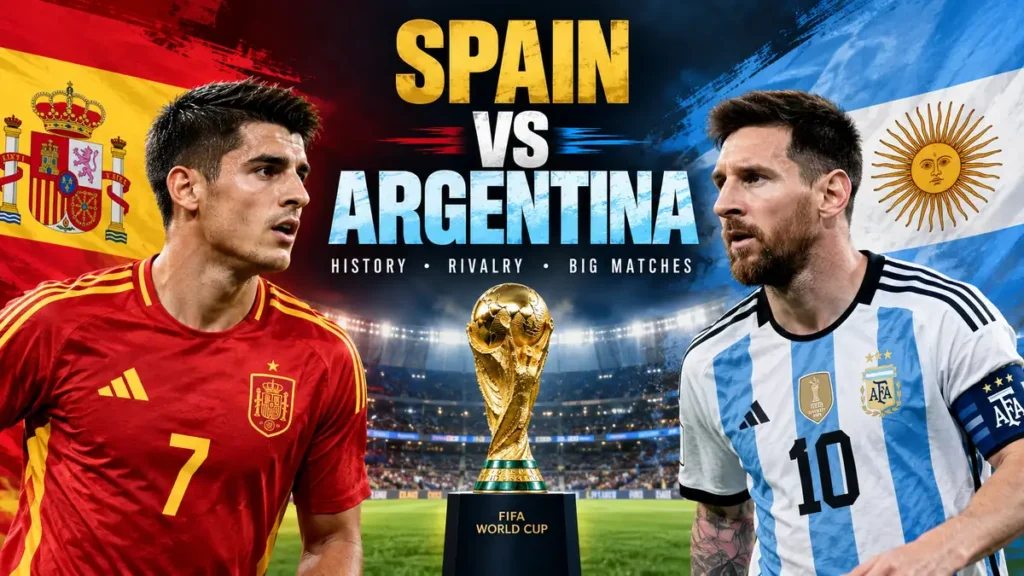
Few international football matchups bring together as much pedigree as spain vs argentina. Both nations have produced World Cup-winning generations, iconic midfielders, legendary forwards, and styles of football that have influenced the sport far beyond their borders.
The matchup gained fresh significance in 2026. After a planned Finalissima between the European and South American champions was cancelled, Spain and Argentina eventually met on the biggest stage of all: the 2026 FIFA World Cup final. Spain won 1-0 after extra time, moving ahead in their overall head-to-head record.
Spain and Argentina have now met 15 times at senior international level. Spain lead the overall series with seven victories to Argentina’s six, while two matches have ended in draws. Their latest meeting came in the 2026 FIFA World Cup final, where Spain defeated Argentina 1-0 after extra time.
spain vs argentina Head-to-Head Record
The overall record shows just how closely matched these two football nations have been.
| Head-to-head statistic | Spain | Argentina |
|---|---|---|
| Total meetings | 15 | 15 |
| Wins | 7 | 6 |
| Draws | 2 | 2 |
| World Cup titles after 2026 | 2 | 3 |
| Confederation | UEFA | CONMEBOL |
| Traditional nickname | La Roja | La Albiceleste |
FIFA’s updated history following the 2026 World Cup final lists Spain with seven victories, Argentina with six and two draws from 15 meetings.
For decades, there was remarkably little separating them. Before the 2026 final, their record stood level at six wins apiece with two draws.
Spain’s victory in New Jersey therefore did more than decide a World Cup. It also broke the long-standing tie in their head-to-head series.
spain vs argentina All-Time Results
The rivalry stretches back more than seven decades and includes friendlies, historical cup matches and two FIFA World Cup encounters.
Some of the most important results include:
| Date | Match | Result | Competition |
|---|---|---|---|
| 7 Dec 1952 | Spain vs Argentina | 0-1 | Friendly |
| 5 Jul 1953 | Argentina vs Spain | 1-0 | Friendly |
| 24 Jul 1960 | Argentina vs Spain | 2-0 | Friendly |
| 11 Jun 1961 | Spain vs Argentina | 2-0 | Friendly |
| 13 Jul 1966 | Argentina vs Spain | 2-1 | FIFA World Cup |
| 11 Oct 1972 | Spain vs Argentina | 1-0 | International |
| 12 Oct 1974 | Argentina vs Spain | 1-1 | International |
| 12 Oct 1988 | Spain vs Argentina | 1-1 | Friendly |
| 20 Sep 1995 | Spain vs Argentina | 2-1 | Friendly |
| 17 Nov 1999 | Spain vs Argentina | 0-2 | Friendly |
| 11 Oct 2006 | Spain vs Argentina | 2-1 | Friendly |
| 14 Nov 2009 | Spain vs Argentina | 2-1 | Friendly |
| 7 Sep 2010 | Argentina vs Spain | 4-1 | Friendly |
| 27 Mar 2018 | Spain vs Argentina | 6-1 | Friendly |
| 19 Jul 2026 | Spain vs Argentina | 1-0 AET | FIFA World Cup Final |
FIFA’s historical record confirms the series through the 2026 final.
One thing immediately stands out: most Spain-Argentina meetings have been friendlies or other non-World Cup internationals.
That makes their two World Cup encounters particularly significant.
Spain vs Argentina at the FIFA World Cup
For two countries with such rich World Cup histories, Spain and Argentina have met surprisingly few times at the tournament.
Argentina 2-1 Spain — 1966 World Cup
Their first World Cup encounter took place on July 13, 1966, at Villa Park in Birmingham, England.
Argentina won 2-1 during the group stage.
It remained their only World Cup meeting for 60 years.
The result also carried historical significance because Argentina maintained its early advantage in the rivalry. At that point, Spain had struggled to consistently overcome La Albiceleste.
Spain 1-0 Argentina — 2026 World Cup Final
The second World Cup encounter could hardly have been bigger.
Spain and Argentina met in the 2026 FIFA World Cup final at New York/New Jersey Stadium, commonly known as MetLife Stadium, on July 19, 2026.
The match remained goalless through 90 minutes before Ferran Torres scored in the 106th minute. Spain held on for a 1-0 victory after extra time, winning its second men’s World Cup title.
The result also gave Spain its first World Cup victory over Argentina and moved La Roja ahead in the overall head-to-head series.
World Cup head-to-head
After the 2026 final, their World Cup record stands at:
- Matches: 2
- Spain wins: 1
- Argentina wins: 1
- Draws: 0
Argentina took the first World Cup meeting in 1966. Spain answered exactly six decades later in the 2026 final.
What Happened in the 2026 Spain vs Argentina Final?
The 2026 final produced a very different game from Spain’s famous 6-1 victory in 2018.
This time Argentina kept the match scoreless through regulation, but Spain controlled much of the ball and created considerably more attacking pressure.
According to match statistics reported by Sky Sports, Spain finished with 65.1% possession compared with Argentina’s 34.9%. Spain registered 20 shots and 12 on target, while Argentina recorded only two shots and none on target.
Neither team scored during the opening 90 minutes.
The breakthrough finally arrived in extra time.
Ferran Torres scores the winner
Ferran Torres entered the match as a substitute and scored in the 106th minute, with Nico Williams providing the assist.
That single goal separated the teams.
Spain won 1-0 after extra time and secured another World Cup trophy, adding the global title to the UEFA Euro 2024 championship it had already won.
The match also featured disciplinary drama. Enzo Fernández was sent off in stoppage time at the end of regulation, leaving Argentina facing extra time at a numerical disadvantage.
Why Was Spain vs Argentina Expected to Happen Before the World Cup?
The World Cup final was not originally expected to be the defining Spain-Argentina meeting of 2026.
The two nations had already qualified for the Finalissima, the match designed to bring together the reigning champions of Europe and South America.
Spain qualified by winning UEFA Euro 2024.
Argentina qualified as the 2024 Copa América champion.
The match was scheduled for March 27, 2026, in Qatar.
It never happened.
Why was the 2026 Finalissima cancelled?
UEFA announced in March 2026 that the Finalissima had been cancelled after the original Qatar plan became unworkable because of the political and security situation in the region and the parties could not agree on an alternative arrangement.
Various alternatives were discussed, including Madrid and a neutral European venue.
UEFA and CONMEBOL/AFA subsequently published accounts emphasizing different aspects of the unsuccessful rescheduling negotiations. UEFA said agreement could not be reached with Argentina over an alternative date, while CONMEBOL and the Argentine Football Association emphasized disagreements over timing after Qatar became unavailable.
The cancellation initially appeared to have denied fans a rare competitive meeting between the two continental champions.
Four months later, they met in the World Cup final instead.
Spain 6-1 Argentina: The Famous 2018 Match
Before 2026, the match most closely associated with spain vs argentina in the modern era was Spain’s extraordinary 6-1 victory in Madrid on March 27, 2018.
It was only a friendly, but the scoreline made it unforgettable.
Spain overwhelmed Argentina with quick combinations, midfield control and clinical finishing.
The defeat became one of Argentina’s heaviest international losses.
There was an important qualification when interpreting the result: Lionel Messi did not play. He watched from the stands because of injury concerns.
That matters when comparing the match with the strongest possible Argentina side.
Even so, a 6-1 result between two elite national teams was remarkable.
It also continued Spain’s strong run against Argentina in meetings played in Spain.
Argentina 4-1 Spain: The 2010 Response
The rivalry has produced major wins in both directions.
On September 7, 2010, Argentina defeated Spain 4-1 in Buenos Aires.
The timing made the result especially striking.
Spain had just won the 2010 FIFA World Cup in South Africa and arrived in Argentina as the newly crowned world champion.
Argentina nevertheless produced a dominant attacking performance.
Lionel Messi, Gonzalo Higuaín and Carlos Tévez were among the central figures as La Albiceleste punished Spain’s defensive mistakes.
The result remains one of Argentina’s most memorable modern victories over La Roja.
It is also a useful reminder that friendly results between elite teams can swing dramatically depending on lineups, preparation, venue and motivation.
Lionel Messi’s History Against Spain
Lionel Messi gives the Spain-Argentina matchup an unusual personal dimension.
Although Argentine, Messi spent the defining years of his club career in Spain with FC Barcelona. He knew Spanish football, its players and its tactical culture intimately.
Messi scored against Spain from the penalty spot in the 2009 friendly at the Vicente Calderón, although Spain eventually won 2-1 after Xabi Alonso scored twice.
He was absent from Argentina’s 6-1 defeat in 2018.
By the time the teams met again in the 2026 World Cup final, Messi’s career had become inseparable from Argentina’s modern international resurgence.
That made the final especially notable: the defending world champions faced the reigning European champions with another global trophy at stake.
Spain and Argentina’s Different Football Identities
Comparing the teams requires more than looking at trophies or individual stars.
Their identities have evolved considerably across different generations.
Spain: possession, structure and technical control
Modern Spanish football is closely associated with positional play, technically secure midfielders and an emphasis on controlling space through possession.
The peak expression came between 2008 and 2012.
Spain won:
- UEFA Euro 2008
- FIFA World Cup 2010
- UEFA Euro 2012
Players such as Xavi Hernández, Andrés Iniesta, Sergio Busquets, Xabi Alonso, David Villa, Iker Casillas and Sergio Ramos formed the core of that historic generation.
Spain later rebuilt around a younger group and won Euro 2024 before adding the 2026 World Cup.
Players including Rodri, Pedri, Nico Williams and other technically gifted members of the newer generation helped maintain Spain’s preference for controlling matches through the ball.
Argentina: technique, intensity and adaptability
Argentina has traditionally combined elite individual technique with a more flexible tactical identity.
Different generations have been built around figures such as Diego Maradona and Lionel Messi, but Argentina’s successful teams have rarely depended on creativity alone.
The country’s strongest sides have also featured aggressive defenders, hard-working midfielders and tactically adaptable supporting players.
Argentina’s 2022 World Cup-winning team demonstrated that balance particularly well.
Lionel Scaloni’s side could dominate possession when necessary but was equally comfortable defending compactly, counterattacking or changing its formation during matches.
Spain vs Argentina: Major International Trophies
Both countries belong to international football’s most successful group of nations.
| Competition | Spain | Argentina |
|---|---|---|
| FIFA World Cup | 2 | 3 |
| Major continental championship | UEFA European Championship | Copa América |
| Confederation | UEFA | CONMEBOL |
| World Cup meeting wins | 1 | 1 |
Spain won its first World Cup in 2010 and its second in 2026.
Argentina’s World Cup victories came in 1978, 1986 and 2022.
Their continental histories are harder to compare directly because the UEFA European Championship and Copa América have different formats, histories and frequencies.
Raw trophy totals therefore do not provide a complete measure of the teams’ relative strength in a particular era.
Spain vs Argentina: UEFA and CONMEBOL Styles
Another reason the fixture attracts attention is the Europe-versus-South-America dimension.
Spain represents UEFA, while Argentina competes in CONMEBOL.
These confederations contain many of international football’s historically dominant teams, yet their leading national sides do not meet regularly outside World Cups and occasional friendlies.
That scarcity increases interest in events such as the Finalissima.
The competition was revived through cooperation between UEFA and CONMEBOL to bring the European and South American champions together. Argentina won the 2022 edition 3-0 against Italy at Wembley.
Spain’s Euro 2024 victory and Argentina’s Copa América 2024 triumph created the prospect of another high-profile intercontinental contest, although the planned 2026 edition was ultimately cancelled.
Which Team Has the Better Head-to-Head Record?
Spain currently holds the numerical advantage.
After the 2026 World Cup final, the record is:
Spain: 7 wins
Argentina: 6 wins
Draws: 2
That advantage is extremely narrow.
Context matters as well.
A large majority of their meetings have not been World Cup games. Results such as Spain’s 6-1 victory in 2018 and Argentina’s 4-1 win in 2010 came in friendlies, while their two World Cup meetings carry much greater competitive significance.
Those World Cup encounters are perfectly split at one victory each.
What Is the Biggest Spain vs Argentina Win?
Spain’s 6-1 victory in 2018 is the largest winning margin in the modern head-to-head series.
Argentina’s standout recent victory was the 4-1 win in Buenos Aires in 2010.
Those two matches demonstrate how misleading it can be to assume this matchup consistently follows one pattern.
Home advantage, squad availability, tactical approach and the competitive importance of the game have all influenced individual results.
How Often Do Spain and Argentina Play?
Not very often.
Unlike European national teams that regularly encounter each other through UEFA qualifying, the Nations League and European Championships, Spain and Argentina belong to different confederations.
Argentina plays its continental competitions and World Cup qualifying in CONMEBOL. Spain does the same within UEFA.
Their paths therefore usually cross through:
- FIFA World Cup matches
- International friendlies
- Intercontinental competitions such as the Finalissima
Long gaps between meetings are normal.
For example, Spain’s 6-1 victory in March 2018 remained their latest encounter for more than eight years before the 2026 World Cup final.
Why the Spain vs Argentina Rivalry Matters
Spain and Argentina do not share the frequency or geographical tension associated with traditional rivalries such as Argentina-Brazil or Spain-Portugal.
Their matchup has a different appeal.
It brings together two of football’s most influential cultures.
There are also deep connections between Argentine players and Spanish club football. Generations of Argentine stars have played in La Liga, while clubs such as Barcelona, Real Madrid, Atlético Madrid, Valencia and Sevilla have helped create countless links between the two football systems.
Lionel Messi’s legendary Barcelona career is the most famous example.
Diego Maradona also played for Barcelona and Sevilla, while numerous other Argentine internationals have spent major portions of their careers in Spain.
As a result, national-team meetings often feature players who know each other’s styles extremely well.
Quick Takeaway: Spain vs Argentina in Numbers
For anyone looking for the essential facts, the matchup can be summarized simply:
- Spain and Argentina have played 15 senior internationals.
- Spain have won seven.
- Argentina have won six.
- Two ended in draws.
- Their first World Cup meeting was in 1966, won 2-1 by Argentina.
- Their second was the 2026 World Cup final, won 1-0 after extra time by Spain.
- Spain’s biggest modern victory was 6-1 in 2018.
- Argentina defeated the newly crowned world champions Spain 4-1 in 2010.
- The planned 2026 Finalissima was cancelled before the World Cup.
Final Thoughts on spain vs argentina
The history of spain vs argentina is unusually balanced for a matchup involving two national teams with such different competitive pathways.
Argentina controlled the earliest years of the series, Spain became increasingly successful in later meetings, and spectacular results such as Argentina’s 4-1 victory in 2010 and Spain’s 6-1 win in 2018 added another layer to the history.
The 2026 World Cup final changed the picture again. Ferran Torres’ extra-time goal gave Spain a 1-0 victory, a second World Cup title and a 7-6 advantage over Argentina in the all-time series.
Yet the broader record remains extremely close. Their two World Cup encounters are split one apiece, their overall head-to-head is separated by only one victory, and both countries remain central to the history of international football.
That combination of rarity, competitive pedigree and contrasting football traditions is what makes Spain against Argentina such a compelling international matchup whenever their paths cross.


