
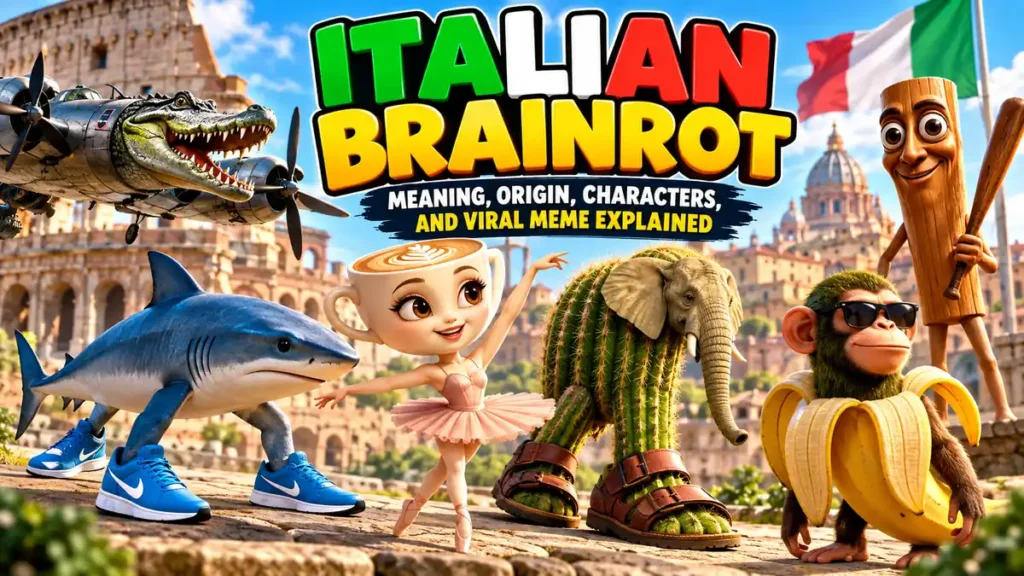
A three-legged shark wearing sneakers. A crocodile fused with a bomber plane. A ballerina with a cappuccino cup for a head. None of this is supposed to make much sense—and that is precisely why italian brainrot became such a recognizable form of internet humor.
The trend exploded across short-form social media in 2025, combining surreal AI-generated creatures, rhythmic pseudo-Italian names, synthetic narration, and intentionally ridiculous stories. Tralalero Tralala is generally identified as the character that launched the format, followed by figures such as Bombardiro Crocodilo, Lirili Larila, Ballerina Cappuccina, and Chimpanzini Bananini. Know Your Meme
Italian brainrot is an internet meme genre built around bizarre AI-generated characters—often animals fused with objects—given catchy Italian-sounding names and absurd AI voiceovers. The format emerged on TikTok in early 2025 and rapidly expanded into videos, remixes, fictional lore, games, merchandise, and countless community-created characters. Know Your Meme
What Does Italian Brainrot Mean?
The phrase combines two ideas: an Italian-inspired presentation and the internet slang term “brain rot.”
“Brain rot” was selected as Oxford’s Word of the Year for 2024. The term refers broadly to a perceived decline in a person’s intellectual or mental state associated with consuming excessive amounts of trivial or unchallenging material, and it can also describe that kind of content itself. euronews
Italian brainrot turns that concept into a recognizable meme format.
A typical video contains several ingredients:
- An AI-generated animal, person, food, or object hybrid
- A strange but memorable name
- Italian or Italian-sounding narration
- Text-to-speech or synthetic audio
- Rhymes and repetitive sounds
- A bizarre miniature backstory
- Surreal imagery with little concern for logic
Imagine a normal nature documentary introducing a newly discovered animal. Now replace that animal with an elephant-cactus hybrid wearing footwear and replace the factual narration with rhythmic nonsense.
That contrast captures much of the joke.
The term does not mean that all of the words used in these memes are genuine Italian. Some are real words, some are distorted versions of recognizable words, and others are invented primarily because they sound rhythmic or vaguely Italian. DocumentaryTube
Where Did Italian Brainrot Come From?
The recognizable meme format emerged on TikTok in early 2025.
Know Your Meme traces the beginning of the trend to Tralalero Tralala, an AI-generated shark wearing Nike sneakers accompanied by Italian voice narration. The format subsequently spread through TikTok and other short-form platforms as creators produced their own creatures using the same basic formula. Know Your Meme
This origin matters because later characters are sometimes mistakenly described as the creators of the entire phenomenon.
Tralalero Tralala Started the Viral Formula
Tralalero Tralala is depicted as a blue shark with three legs—or fin-like legs—wearing Nike sneakers.
The character’s ridiculous visual design was only part of its appeal. The accompanying audio had the repetitive rhythm that would become one of the defining characteristics of Italian brainrot.
The original audio was not simply innocent nonsense. Reporting and meme documentation note that versions associated with the early character contained profanity and religiously offensive language. That context is easily lost when the image or character name is reposted without the original narration. Know Your Meme
Once Tralalero Tralala became recognizable, the formula was extremely easy to imitate.
Creators could generate another impossible creature, invent a rhyming name, add synthetic narration, and publish a new entry into the emerging meme universe.
There was no requirement for continuity.
That flexibility helped the trend grow rapidly.
Why Are the Names So Strange?
Names are arguably the most memorable feature of italian brainrot.
Examples include:
Tralalero Tralala
Bombardiro Crocodilo
Ballerina Cappuccina
Chimpanzini Bananini
Lirili Larila
Brr Brr Patapim
Their appeal comes largely from sound.
Endings such as -ini, -ino, -ina, and -ila create a playful rhythm that English-speaking audiences may associate with Italian words, even when the complete phrase is not correct Italian.
Some names contain recognizable references.
“Ballerina Cappuccina,” for example, combines the familiar idea of a ballerina with cappuccino imagery, matching a character whose head is a coffee cup.
“Chimpanzini Bananini” immediately suggests the visual joke: a chimpanzee combined with a banana.
Other names are much harder—or impossible—to translate literally because they were designed primarily for rhythm and absurdity rather than linguistic accuracy. DocumentaryTube
Is Italian Brainrot Actually Italian?
Partly.
The earliest viral format prominently used Italian-language or Italian-sounding synthetic narration, but the wider phenomenon quickly became international.
That distinction is especially important with Tung Tung Tung Sahur.
It is frequently grouped with Italian brainrot characters, yet its origins are Indonesian rather than Italian. “Sahur” refers to the pre-dawn meal eaten before fasting during Ramadan, while the repeated “tung” evokes the sound associated with beating a drum or similar instrument to wake people for sahur. The character became integrated into the broader brainrot meme ecosystem after emerging in 2025. Italian Brainrot Maker: Rotino
So “Italian brainrot” increasingly describes an internet style rather than a strict nationality or language.
Most Famous Italian Brainrot Characters
There is no universally authoritative roster.
That is worth understanding before trying to find a “complete” list.
Italian brainrot is an open meme ecosystem. Users continually invent new characters, variations, spellings, relationships, powers, and backstories. Different fan databases consequently report different totals and disagree about which characters belong to the core genre. Brainrotify
Still, several characters appear consistently across documentation of the trend.
| Character | Basic appearance | Notable feature |
|---|---|---|
| Tralalero Tralala | Shark wearing sneakers | Early viral character |
| Bombardiro Crocodilo | Crocodile-bomber hybrid | Military aircraft body |
| Lirili Larila | Elephant-cactus hybrid | Desert-like surreal design |
| Ballerina Cappuccina | Ballerina with coffee-cup head | Ballet and cappuccino combination |
| Chimpanzini Bananini | Chimpanzee-banana hybrid | Animal-fruit combination |
| Brr Brr Patapim | Forest-like creature | Plant and animal features |
| Cappuccino Assassino | Coffee-cup assassin | Coffee and fighter combination |
| Boneca Ambalabu | Frog-like hybrid | Indonesian-associated brainrot |
| Tung Tung Tung Sahur | Wooden humanoid holding a bat | Indonesian origin |
| Trippi Troppi | Appears in multiple hybrid forms | Rhyming name and changing depictions |
The fluidity is part of the format. There is no central studio maintaining a canonical universe.
Tralalero Tralala
Tralalero Tralala remains one of the foundational figures.
The basic visual is wonderfully simple: an impossible shark walking around in sneakers.
Its significance comes less from elaborate lore and more from establishing the pattern that other creators copied—surreal AI imagery, an instantly repeatable name, and synthetic narration. Know Your Meme
Bombardiro Crocodilo
Bombardiro Crocodilo is typically depicted as a crocodile fused with a military bomber aircraft.
The creature demonstrates how effectively the format works visually. You can understand the central joke before hearing a second of narration: two unrelated things have been merged into one absurd organism.
Some associated audio and interpretations have also generated controversy because of references to bombing and real-world conflict. That is an important reminder that the broader meme ecosystem is not uniformly child-friendly simply because the characters look cartoonish. euronews
Ballerina Cappuccina
Ballerina Cappuccina is a ballet dancer with a cappuccino cup for a head.
She became one of the trend’s highly visible characters. Euronews, reporting with AP in September 2025, noted that content featuring the character had accumulated tens of millions of TikTok views during the first half of that year. euronews
The design also illustrates why these characters are memorable.
“Ballerina” tells you one half of the image.
“Cappuccina” hints at the other.
The result can be understood almost instantly without knowing any fictional backstory.
Chimpanzini Bananini
Chimpanzini Bananini combines a chimpanzee with a banana.
Know Your Meme traces a viral version to a March 13, 2025 TikTok featuring several monkey-fruit hybrids. The video accumulated millions of interactions as the character spread across social platforms. Know Your Meme
The name is another example of sound doing much of the work.
Chimpanzee.
Banana.
Chimpanzini Bananini.
It is deliberately silly and unusually easy to remember.
Lirili Larila
Lirili Larila is generally represented as an elephant-cactus hybrid, often shown walking through a desert landscape in oversized footwear.
It pushes the basic formula further by combining several unrelated visual concepts rather than simply attaching one animal to one object.
The resulting image resembles something from a dream where individual elements are recognizable but their combination makes no logical sense.
Brr Brr Patapim
Brr Brr Patapim is another prominent early character, commonly represented as a strange forest creature incorporating plant and animal characteristics.
Its name illustrates another branch of the naming formula: pure rhythmic sound can matter more than translation.
The audience does not need a dictionary to participate.
They simply need to recognize the sound.
Cappuccino Assassino
Cappuccino Assassino takes the coffee theme in a different direction, portraying a cappuccino-like character as an armed assassin or ninja.
The visual joke comes from contrast: something ordinary and harmless—a cup of coffee—is transformed into an exaggerated action character.
Tung Tung Tung Sahur
Tung Tung Tung Sahur deserves separate treatment because calling it simply “Italian” obscures its actual context.
The character is usually shown as an anthropomorphic wooden figure carrying a bat. Its name and concept originated in Indonesian meme culture and reference sahur, the pre-dawn Ramadan meal. It subsequently became grouped with the wider Italian brainrot cast as the meme format crossed linguistic and national boundaries. Italian Brainrot Maker: Rotino
This cross-pollination became a major part of brainrot culture.
How Italian Brainrot Videos Work
Despite looking chaotic, successful examples tend to follow a surprisingly consistent formula.
1. Start With an Impossible Character
Take two or more unrelated concepts:
shark + sneakers
crocodile + bomber
chimpanzee + banana
ballerina + cappuccino
Then combine them using generative AI.
The visual should be understandable immediately while still being strange enough to interrupt someone’s scrolling.
2. Give It a Rhythmic Name
The character needs a name people can repeat.
That explains why rhyme, alliteration, repetition, and pseudo-Italian suffixes appear so frequently.
The name effectively becomes an audio logo.
3. Add Synthetic Narration
An AI or text-to-speech voice introduces the creature, often in an exaggeratedly dramatic style.
The narration may combine actual Italian, pseudo-Italian, invented words, profanity, bizarre claims, or completely unrelated ideas. Know Your Meme identifies this synthetic Italian narration as a central feature of the original format. Know Your Meme
4. Keep the Logic Loose
Traditional characters usually need motivation, history, personality, and consistent behavior.
Brainrot characters do not.
A crocodile can become an aircraft because somebody thought it looked funny.
A coffee cup can become an assassin.
A banana can become a chimpanzee.
Trying to rationalize everything can actually weaken the joke.
5. Let the Audience Build the Lore
Once a character becomes recognizable, other users create battles, romances, family relationships, transformations, rankings, arrest videos, songs, games, and alternate versions.
This turns an isolated meme into participatory folklore.
For example, the later “No, la Polizia” format placed familiar brainrot characters into arrest scenarios, showing how easily the original cast could be reused in entirely new jokes. Know Your Meme
Why Did Italian Brainrot Become So Popular?
Calling the trend “random” does not fully explain its success.
Its structure fits modern short-form platforms remarkably well.
The Characters Are Instantly Recognizable
A normal fictional character may require context.
A shark in sneakers does not.
The viewer sees the contradiction immediately.
That matters on TikTok, Instagram Reels, and YouTube Shorts, where content often has only moments to capture attention.
Repetition Makes the Names Memorable
“Tralalero Tralala” has a musical quality.
So does “Chimpanzini Bananini.”
The words behave almost like jingles. You may remember the sound even when you have forgotten the actual video.
AI Makes Variations Easy to Produce
Generative AI dramatically lowers the effort required to visualize a ridiculous idea.
Creators do not need to construct a realistic three-dimensional model of an elephant-cactus hybrid. They can generate an image, animate or edit it, add synthetic audio, and rapidly experiment with variations.
This makes the format highly replicable.
One successful creature can inspire hundreds of descendants.
It Creates an In-Group Language
Memes often become more entertaining when outsiders do not understand them.
Italian brainrot does this particularly well.
To someone encountering the trend for the first time, phrases such as “Brr Brr Patapim” or “Tralalero Tralala” sound meaningless.
To people familiar with the memes, those sounds instantly reference specific characters and jokes.
Reporting on the phenomenon has highlighted its particular popularity among tweens and Generation Alpha audiences, for whom recognizing the characters can function as a shared cultural reference. euronews
The Nonsense Is the Point
One of the easiest mistakes is searching for a profound hidden meaning behind every character.
Usually, there isn’t one.
Italian brainrot belongs to a long tradition of absurd internet humor in which incongruity itself creates the joke.
A crocodile bomber does not necessarily symbolize something.
Sometimes it is funny because somebody made a crocodile into a bomber.
As AI animator Fabian Mosele told AP in reporting carried by Euronews, the appeal lies substantially in the fact that the content is nonsense. euronews
Is Italian Brainrot AI-Generated?
Generative AI is fundamental to the aesthetic, but saying every single piece of Italian brainrot is entirely AI-generated would be too broad.
The original format became known for AI-generated imagery and synthetic voiceovers. Creators subsequently began making their own animations, illustrations, edits, physical recreations, games, and other interpretations.
So it is more accurate to say that Italian brainrot is an AI-native meme genre.
AI enabled its signature look and rapid production cycle, while human participation expanded it into a much larger culture.
This is also why the trend is frequently discussed alongside “AI slop,” a critical term for cheaply or rapidly produced generative-AI material. The two concepts overlap, but they are not perfect synonyms: “AI slop” can describe many kinds of low-effort generated content, whereas Italian brainrot refers to a recognizable meme aesthetic.
Italian Brainrot and Generation Alpha
Italian brainrot became strongly associated with Generation Alpha, generally referring to the generation following Gen Z.
That does not mean only children watch it. The memes spread far beyond any single age group.
Still, their combination of short videos, repeated phrases, surreal characters, remix culture, and intentionally confusing humor fits the online media environment in which younger users participate.
Euronews/AP described the trend as particularly popular with tweens and noted that its incomprehensibility to many adults can itself add to the appeal. euronews
There is a familiar generational pattern here.
Older audiences have repeatedly struggled to understand younger generations’ entertainment, from comic books and television to earlier internet memes.
Italian brainrot adds generative AI to that cycle.
From TikTok Meme to Games and Pop Culture
The characters did not remain confined to short videos.
By 2025, Italian brainrot had moved into games, merchandise, music, fan-made stories, physical recreations, and branded internet culture.
Wired Italia reported on dedicated games inspired by characters such as Bombardiro Crocodilo and Tralalero Tralala in May 2025. Wired Italy
The broader phenomenon also became intertwined with gaming culture.
One particularly important example is Steal a Brainrot, a Roblox experience built around collecting and stealing brainrot-inspired characters. Reporting on the trend noted how the game helped extend these memes beyond passive viewing and into interactive play. euronews
The crossover continued. By 2026, brainrot characters had also appeared in the wider Fortnite ecosystem, illustrating how a meme that began with strange AI images had developed recognizable intellectual and commercial value. Forbes
This transition follows a familiar internet cycle:
meme → remixes → fandom → games → merchandise → mainstream recognition
What makes Italian brainrot unusual is the speed at which the cycle happened.
Does Italian Brainrot Have Official Lore?
Not in the traditional sense.
You can find elaborate descriptions online explaining who married whom, which character defeated another, who belongs to a particular family, and what supernatural abilities everyone possesses.
Treat those claims carefully.
There is no single authoritative creator controlling one canonical Italian brainrot universe.
Different creators and communities develop different storylines. Fan sites and games may formalize their own versions, but those versions should not automatically be treated as the original history of the meme.
This explains why one website may describe a character as heroic while another presents the same creature as a villain.
Both can exist because meme culture does not require continuity.
The distinction is useful:
Documented origin means there is evidence connecting a character or meme to an identifiable early post or creator.
Fan lore means the community subsequently invented stories around that character.
Mixing the two makes Italian brainrot history unnecessarily confusing.
Are All Italian Brainrot Memes Kid-Friendly?
No.
Their cartoonish appearance can make them look like children’s entertainment, but the source material is inconsistent.
Some early voiceovers contain profanity, blasphemous language, violent imagery, or references to sensitive real-world subjects. The original Tralalero Tralala audio, for instance, has been documented as containing offensive language, while Bombardiro Crocodilo material has generated controversy over war-related references. Know Your Meme
Later reposts often separate characters from those original audios.
As a result, a child may encounter a harmless-looking toy, game character, or edited video without encountering the original material at all.
Parents and educators therefore should evaluate the specific video or audio, rather than assuming every appearance of a particular character carries identical content.
Is Italian Brainrot Real Italian?
The best answer is: sometimes, but not reliably.
The genre borrows Italian vocabulary, pronunciation patterns, cultural references, food terms, suffixes, and synthetic Italian narration.
But it also uses invented language.
A phrase that sounds Italian in an Italian brainrot video should therefore not automatically be treated as correct Italian vocabulary or grammar.
The names function more like wordplay.
Their purpose is to sound memorable.
This distinction also prevents another misunderstanding: the meme is not a reliable representation of Italian language or culture. It is an international internet format built around a deliberately exaggerated Italian-inspired aesthetic.
Why the Meme Matters Beyond the Joke
Italian brainrot is easy to dismiss because it is intentionally ridiculous.
Yet its growth illustrates several important changes in internet culture.
First, generative AI has become a meme-production tool, not merely a technology for polished artwork. Its mistakes and surreal combinations can actually make content funnier.
Second, memes are becoming increasingly multimodal.
The image alone is not the entire joke. Neither is the audio. The recognizable character, synthetic voice, rhythm, caption, remix history, and audience response work together.
Third, online fictional universes no longer necessarily need central creators.
A meme character can emerge from one account and then acquire dozens of contradictory stories created by unrelated users.
Finally, language itself becomes material for remixing.
Italian brainrot names are designed to be heard, repeated, altered, and remembered. Literal translation is often secondary.
Italian Brainrot Is Internet Absurdity Built for the AI Era
Italian brainrot began as a bizarre collection of AI-generated creatures with Italian or Italian-sounding narration, but it rapidly developed into something larger: a shared vocabulary of characters, sounds, jokes, games, remixes, and community-created lore.
Tralalero Tralala helped establish the recognizable format in early 2025. Bombardiro Crocodilo, Ballerina Cappuccina, Lirili Larila, Chimpanzini Bananini, Brr Brr Patapim, and many others expanded it. Characters from outside Italy, particularly Tung Tung Tung Sahur, were subsequently absorbed into the wider brainrot ecosystem. Know Your Meme
There is no master storyline to memorize and no definitive list that stays definitive for long. That instability is part of what makes the phenomenon work.
The images are impossible. The names are infectious. The lore contradicts itself.
And the less sense it makes, the more accurately you’ve understood the joke.


