The latest netherlands vs morocco meeting delivered one of the dramatic knockout matches of the 2026 FIFA World Cup. The Netherlands appeared to be heading through after Cody Gakpo broke the deadlock, but Morocco equalized in stoppage time before winning the penalty shootout.
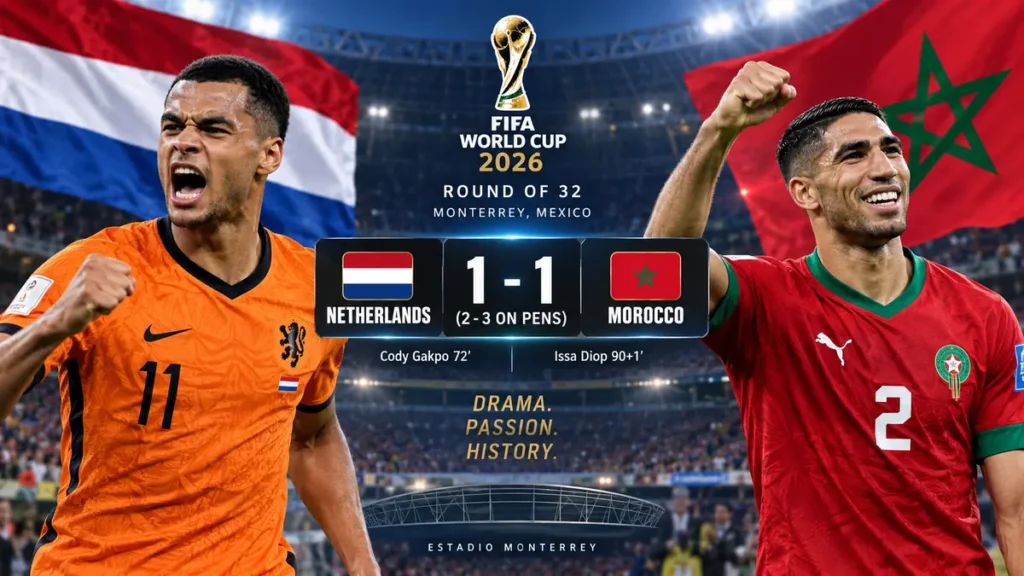
Quick answer: Netherlands and Morocco drew 1-1 after extra time in their FIFA World Cup Round of 32 match on June 30, 2026. Cody Gakpo scored for the Netherlands in the 72nd minute, Issa Diop equalized in stoppage time, and Morocco won the subsequent penalty shootout 3-2 to advance.
The result added another memorable chapter to a surprisingly limited head-to-head history between the two national teams. It also highlighted Morocco’s ability to control possession, create chances and remain composed when the knockout tie reached penalties.
Netherlands vs Morocco Match Result at a Glance
The 2026 World Cup encounter took place at Estadio Monterrey in the Monterrey metropolitan area of Mexico. After a goalless first half, the Netherlands took the lead through Gakpo. Morocco continued pushing and finally found its reward when Diop scored in the 91st minute.
Neither team scored during extra time, sending the match to penalties. Morocco prevailed 3-2 in the shootout.
| Match detail | Netherlands | Morocco |
|---|---|---|
| Score after extra time | 1 | 1 |
| Goalscorer | Cody Gakpo, 72′ | Issa Diop, 90+1′ |
| Penalty shootout | 2 | 3 |
| Shots | 6 | 12 |
| Shots on target | 3 | 6 |
| Result | Eliminated | Advanced |
The official match data also recorded an attendance of 51,243.
One distinction matters when reading head-to-head statistics: the game finished 1-1 after extra time, while Morocco won the shootout. Some statistical databases record knockout advancement separately from the official match result, so H2H win/draw totals can vary depending on whether shootouts are treated as wins.
How the Netherlands vs Morocco Match Unfolded
Morocco controlled much of the ball
The opening phase immediately established the tactical contrast.
The Netherlands were willing to defend without dominating possession, while Morocco circulated the ball confidently and looked for openings around the Dutch defensive structure. Competition statistics listed Morocco with substantially more possession and a higher passing accuracy.
Concacaf’s match statistics recorded 70% possession for Morocco compared with 30% for the Netherlands, while Morocco completed passes at 92% accuracy compared with 79% for the Dutch. Morocco also produced five big chances to the Netherlands’ one.
Those numbers tell an important part of the story. Morocco were not simply surviving against a traditionally strong European national team; they were able to dictate significant portions of the contest.
The Netherlands stayed dangerous
Possession alone did not decide the match.
With Virgil van Dijk involved at the back and Frenkie de Jong operating in midfield, the Netherlands still possessed players capable of changing the game quickly. Cody Gakpo provided exactly that breakthrough in the second half.
Gakpo scored in the 72nd minute, putting the Netherlands 1-0 ahead and suddenly leaving Morocco with little time to rescue their World Cup campaign.
For a team that had spent long periods without the ball, taking the lead represented an opportunity to defend deeper and protect the advantage.
Morocco had other ideas.
Issa Diop’s stoppage-time equalizer changed everything
As regulation time approached its end, Morocco continued attacking.
Their pressure finally paid off in the first minute of stoppage time. Issa Diop scored in the 90+1st minute, cancelling out Gakpo’s opener and forcing the knockout match toward extra time.
It was the defining turning point.
A Netherlands team that had been minutes away from progressing suddenly had to reset mentally for another 30 minutes. Morocco, meanwhile, entered extra time with renewed momentum.
Why Morocco Won the Penalty Shootout
After the score remained 1-1 through extra time, the Round of 32 tie had to be settled from the penalty spot.
Goalkeeper Yassine Bounou again became central to Morocco’s success in a major international shootout. He saved Crysencio Summerville’s attempt, while other penalties were missed during a tense sequence from both teams. Ismael Saibari eventually converted the decisive kick to complete Morocco’s 3-2 shootout victory.
The shootout sequence included attempts from players such as Teun Koopmeiners, Justin Kluivert, Wout Weghorst, Quinten Timber and Summerville for the Netherlands. Morocco’s takers included Neil El Aynaoui, Soufiane Rahimi, Chemsdine Talbi, Achraf Hakimi and Saibari.
Bounou’s involvement carried particular historical significance. Morocco had also won a World Cup penalty shootout against Spain in the Round of 16 at Qatar 2022. Following the Netherlands match, Opta noted that Morocco had won both World Cup shootouts they had contested.
Netherlands vs Morocco penalty shootout result
The final shootout score was:
Netherlands 2-3 Morocco
Saibari supplied the decisive conversion after Summerville’s attempt was saved.
For the Netherlands, it continued an uncomfortable World Cup relationship with penalty shootouts. Opta reported after the match that the Dutch had been eliminated on penalties at consecutive World Cups.
Netherlands vs Morocco Match Statistics Explained
The underlying statistics make Morocco’s performance particularly interesting.
Concacaf recorded the expected-goals figures at 0.23 xG for the Netherlands and 1.4 xG for Morocco. Morocco also led 5-1 in big chances and 5-2 in shots on goal in that dataset.
That suggests Morocco’s territorial control produced more than harmless possession. They generated better scoring opportunities while limiting the Dutch attack.
| Statistic | Netherlands | Morocco |
|---|---|---|
| Possession | 30% | 70% |
| Expected goals | 0.23 | 1.40 |
| Big chances | 1 | 5 |
| Shots on goal* | 2 | 5 |
| Pass accuracy | 79% | 92% |
| Fouls | 18 | 15 |
*Statistics can differ slightly between data providers because of different event-classification methods. The figures above use Concacaf’s match-statistics dataset.
The contrast is striking. The Netherlands managed to take the lead despite producing relatively little attacking volume, while Morocco had to wait until stoppage time to turn their statistical superiority into a goal.
What did Morocco do effectively?
Morocco’s biggest strength was patience.
Rather than abandoning their structure after falling behind, they continued moving the ball and creating opportunities. Players including Achraf Hakimi, Noussair Mazraoui, Azzedine Ounahi, Bilal El Khannouss, Neil El Aynaoui and Brahim Díaz gave Morocco multiple ways to progress possession and attack.
The 92% passing accuracy recorded by Concacaf illustrates how effectively Morocco retained the ball.
That control eventually forced the Netherlands to spend considerable time defending.
Why did the Netherlands struggle?
The Dutch approach produced very little attacking volume.
Opta recorded only six Netherlands shots worth 0.23 expected goals across 120 minutes. Gakpo nevertheless found the breakthrough, demonstrating the individual finishing quality available to the Oranje.
The Netherlands also changed personnel as the match progressed. Wout Weghorst replaced Brian Brobbey, Teun Koopmeiners came on for Nathan Aké, and later substitutions included Quinten Timber, Jorrel Hato, Marten de Roon and Justin Kluivert.
Those changes were not enough to preserve the lead or settle the contest during extra time.
Netherlands vs Morocco Lineups
The starting lineups contained established European-club players alongside a younger generation emerging for both countries.
Netherlands starting lineup
Bart Verbruggen started in goal.
The Dutch lineup included Jan Paul van Hecke, Virgil van Dijk, Nathan Aké, Denzel Dumfries and Micky van de Ven, with Ryan Gravenberch and Frenkie de Jong among the midfield options. Cody Gakpo, Brian Brobbey and Crysencio Summerville provided the attacking threat.
Morocco starting lineup
Morocco started Yassine Bounou in goal, with Achraf Hakimi, Noussair Mazraoui, Issa Diop and Chadi Riad among the defensive players.
The lineup also featured Ayyoub Bouaddi, Azzedine Ounahi, Ismael Saibari, Bilal El Khannouss, Neil El Aynaoui and Brahim Díaz.
Morocco’s depth became useful later in the match, with Soufiane Rahimi and Chemsdine Talbi among the substitutes introduced before the contest reached penalties.
Cody Gakpo’s Importance for the Netherlands
Even in defeat, Cody Gakpo strengthened his record at major international tournaments.
His 72nd-minute strike was his ninth goal across World Cups and European Championships, according to Opta. At the time of the match, only Dennis Bergkamp had scored more major-tournament goals for the Netherlands, while Gakpo’s six World Cup goals placed him behind only Johnny Rep among Dutch players in that competition.
That record helps explain why Gakpo remained one of the Netherlands’ primary attacking threats.
His goal against Morocco was also an example of how knockout football can differ from the statistical picture. Morocco controlled possession and created the greater volume of quality chances, yet one decisive Dutch attack nearly determined the entire tie.
Yassine Bounou’s Role for Morocco
Bounou’s reputation in high-pressure matches received another boost.
The Moroccan goalkeeper had already played a central role in his country’s historic 2022 World Cup campaign, including the shootout victory over Spain. Four years later, he was again involved in eliminating a major European opponent from a World Cup on penalties.
Against the Netherlands, his save from Summerville became one of the critical moments of the shootout.
Goalkeeping in a penalty shootout involves more than reaction speed. Reading a player’s approach, anticipating placement, staying within the laws governing movement on the goal line and maintaining concentration after previous penalties all matter.
Bounou delivered when Morocco needed the decisive intervention.
Netherlands vs Morocco Head-to-Head History
The two countries have not played each other frequently at senior international level.
Their meetings include World Cup matches and international friendlies, with results split across different eras.
| Date | Competition | Result |
|---|---|---|
| June 29, 1994 | FIFA World Cup | Morocco 1-2 Netherlands |
| April 28, 1999 | International friendly | Netherlands 1-2 Morocco |
| May 31, 2017 | International friendly | Morocco 1-2 Netherlands |
| June 30, 2026 | FIFA World Cup | Netherlands 1-1 Morocco; Morocco won 3-2 on penalties |
Historical match databases list those four senior meetings, although databases may classify the 2026 shootout outcome differently when calculating overall wins and draws.
Netherlands vs Morocco at the 1994 World Cup
Before 2026, the teams’ previous World Cup encounter came during the 1994 FIFA World Cup in the United States.
The Netherlands won that match 2-1.
That made the 2026 Round of 32 meeting only their second encounter at a men’s World Cup.
The difference between those two World Cup meetings is significant. The 1994 encounter came in the group stage, whereas the 2026 fixture was an elimination match. Once the later contest reached penalties, there was no possibility of both sides simply accepting a draw and moving forward.
Morocco’s 1999 victory
Morocco recorded a 2-1 friendly victory over the Netherlands in April 1999.
Although friendlies do not carry the stakes of World Cup matches, the result remains part of the senior head-to-head record and prevents the rivalry from being a one-sided historical matchup.
Netherlands’ 2017 victory
The teams met again in Morocco on May 31, 2017.
The Netherlands won 2-1, producing the same scoreline as the 1994 World Cup meeting.
Nearly nine years then passed before their next senior meeting at the 2026 World Cup.
What Made the 2026 Meeting Different?
The 2026 game represented a very different competitive setting from the teams’ previous meetings.
First, it was a knockout fixture. One team had to leave the tournament.
Second, Morocco entered the game with substantially more recent experience of going deep into a World Cup. Their historic 2022 run had demonstrated that the Atlas Lions could compete successfully against leading European national teams on the sport’s biggest stage.
Third, the expanded 2026 World Cup format included a Round of 32, creating an additional knockout stage. The Netherlands-Morocco encounter took place at this stage rather than the traditional Round of 16.
Finally, the match developed in an unusual tactical direction. Morocco controlled 70% of possession according to the competition statistics, while the Netherlands relied much more heavily on defending and attacking efficiently with fewer opportunities.
The Tactical Battle
Dutch defensive structure
The Netherlands used a defensive setup that differed from their more familiar recent approach.
Opta noted that the Dutch started with a back five for the first time since March 2024.
That choice reflected the threat Morocco could create through technical midfielders and attacking full-backs.
Virgil van Dijk remained the central defensive reference point, while Bart Verbruggen was busy in goal. Verbruggen made five saves according to Opta, including an important extra-time intervention against Soufiane Rahimi.
The strategy almost succeeded. The Netherlands protected their lead until stoppage time.
Morocco’s control through possession
Morocco approached the game differently.
With Hakimi capable of progressing from wide areas and midfielders comfortable receiving under pressure, Morocco could keep the Netherlands defending for long stretches.
Their passing accuracy and possession advantage allowed them to repeatedly recycle attacks rather than forcing low-percentage passes.
The key lesson is that possession mattered because Morocco turned it into chances. A team can hold 70% of the ball without threatening the opponent, but Morocco combined that possession with higher xG and more big chances.
Quick takeaway: Morocco’s advantage was not simply having more of the ball. They paired possession with superior chance creation, eventually converting their pressure through Diop before Bounou and the penalty takers completed the job.
Key Players Who Shaped the Match
Several players had an outsized influence on the final result.
Cody Gakpo supplied the Netherlands’ only goal and nearly sent his country through.
Issa Diop produced the late equalizer that kept Morocco’s tournament alive.
Yassine Bounou delivered a crucial penalty save.
Ismael Saibari scored the decisive shootout penalty.
Bart Verbruggen made several saves that prevented Morocco from winning during open play.
Achraf Hakimi remained an important component of Morocco’s structure, even though his shootout attempt went off target.
The outcome therefore cannot be reduced to one player’s performance. Morocco needed Diop’s equalizer, Bounou’s goalkeeping and Saibari’s composure to complete the comeback.
Did the Match Officially Finish as a Draw?
This is one of the most common points of confusion when reading football results.
Yes, for conventional statistical purposes, a knockout match decided by penalties is generally recorded according to the score after extra time, with the shootout determining which team advances.
Here, that means the match score was Netherlands 1-1 Morocco after extra time, followed by Morocco winning 3-2 on penalties. Match pages from Sky Sports, Sofascore, beIN Sports and other providers display the result in this format.
This distinction explains why different websites can appear to disagree about head-to-head totals. One may describe Morocco as the winner because they advanced; another may place the game in the draw column while separately showing the penalty-shootout victory.
Both presentations can describe the same event, provided the shootout is clearly identified.
What Happened After Netherlands vs Morocco?
Morocco’s victory sent them into the World Cup last 16 and eliminated the Netherlands.
The Dutch had come within minutes of progressing before Diop’s equalizer dramatically changed the direction of the tie.
For Morocco, the result continued a notable sequence of World Cup knockout performances against European opposition. Their experience in pressure situations again proved valuable once the contest reached penalties.
Sky Sports reported that Morocco’s victory set up a last-16 meeting with co-host Canada.
For the Netherlands, the defeat brought another World Cup campaign to an end through a shootout.
What the Netherlands vs Morocco Result Tells Us
The netherlands vs morocco match showed why knockout football is difficult to judge from reputation or possession alone.
The Netherlands scored first despite creating relatively few chances. Morocco controlled more of the game but needed a stoppage-time goal to survive. Once the contest moved through extra time and into penalties, individual execution became decisive.
Morocco ultimately advanced after a 1-1 draw and 3-2 penalty-shootout victory, with Issa Diop, Yassine Bounou and Ismael Saibari playing decisive roles.
For anyone checking the result or historical record, the simplest summary is this: the Netherlands and Morocco were level after 120 minutes, but Morocco held their nerve in the shootout and moved on in the 2026 FIFA World Cup.