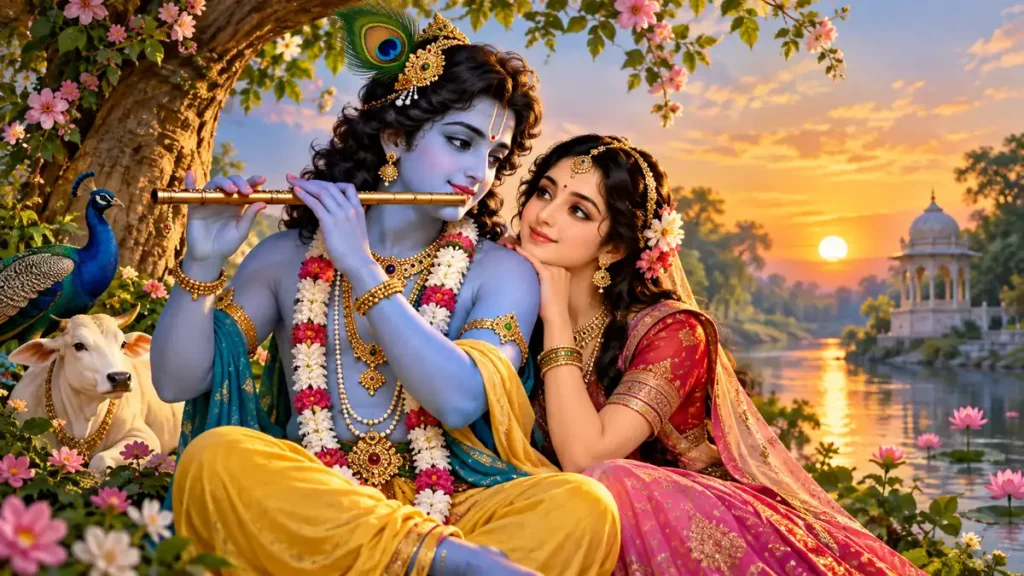
Few images in Hindu devotional culture are as instantly recognizable as Radha standing beside Krishna as he holds or plays his flute. Their story has inspired poetry, temple worship, music, dance, miniature painting, festivals, and generations of bhakti practitioners.
radha krishna represents divine love expressed through devotion: Krishna is understood as the divine beloved, while Radha embodies profound, selfless love and devotion toward him. Their longing, separation, and reunion have therefore been interpreted in many devotional traditions as symbols of the human soul’s longing for and relationship with the Divine.
Yet their significance is richer than the familiar description of a “love story.” Different Vaishnava traditions understand Radha and Krishna in distinct theological ways, while poets and artists have used their relationship to explore devotion, longing, joy, surrender, separation, and spiritual union.
Who Are radha krishna?
Krishna is one of the most widely worshipped deities in Hinduism and is traditionally regarded as an avatar of Vishnu; in Krishna-centered traditions, he may be worshipped as the Supreme Being himself.
Radha is Krishna’s beloved and, in several Krishnaite traditions of Vaishnavism, is understood as his divine feminine counterpart or shakti. Together, Radha and Krishna form the Divine Couple and occupy a particularly important position in devotional traditions centered on Krishna.
Their stories are closely associated with Braj, the cultural and sacred landscape encompassing places such as Mathura, Vrindavan, Barsana, Nandgaon, Gokul, Govardhan, and Radha Kund.
Krishna
Krishna appears throughout Hindu religious literature in different roles: a divine child, cowherd, flute player, friend, protector, teacher, warrior, and deity.
His childhood and youthful pastimes are especially associated with Gokul and Vrindavan, while Mathura is traditionally identified with his birth.
The Krishna of the Bhagavad Gita teaches Arjuna about dharma, action, knowledge, devotion, and liberation. The Krishna celebrated alongside Radha is most strongly associated with the pastoral world of Braj—the forests, the Yamuna, cows, cowherds, gopis, music, and rasa.
Radha
Radha is traditionally associated especially with Barsana and the Braj region.
Within devotional theology she is far more than simply a romantic character. She can represent perfect devotion, divine love, Krishna’s spiritual potency, and the devotee’s deepest longing for God.
This theological importance explains why devotees frequently address her reverentially as Radharani, Srimati Radharani, or Radha Rani.
In some traditions, understanding Krishna’s divine love is considered incomplete without understanding Radha.
What Is the radha krishna Love Story?
The radha krishna story unfolds primarily within the devotional landscape of Braj.
Krishna grows up among cowherds and cowherd women, or gopis, and becomes celebrated for his enchanting flute playing and divine pastimes. Among the gopis, later devotional and literary traditions give Radha an exceptional position.
Their relationship is portrayed through meetings in forest groves, playful exchanges, music, dancing, moments of jealousy, longing during separation, reconciliation, and joyous reunion.
One of the best-known literary presentations of these emotions is Jayadeva’s Gita Govinda, composed in Sanskrit in the 12th century.
The poem presents Radha and Krishna through episodes of attraction, separation, longing, anger, reconciliation, and reunion. The Indira Gandhi National Centre for the Arts describes the work as operating simultaneously on human and divine levels, using familiar emotions to communicate divine love.
The Royal Collection similarly explains that their separations and reunions can function as metaphors for the separation of the soul from the Divine and its ultimate union with the Divine.
Why Is Separation So Important in Their Story?
At first, separation may seem like an unfortunate interruption to a love story. Within bhakti traditions, however, longing itself can possess spiritual meaning.
When the beloved is absent, remembrance becomes intense.
The devotee thinks constantly about God.
This devotional mood of separation is often called viraha or vipralambha. Rather than suggesting that divine love has failed, separation can reveal how completely the heart has become focused upon the beloved.
That is why Radha’s longing for Krishna became such a powerful devotional image.
Quick takeaway: The emotional movement from meeting to separation and reunion allows the Radha-Krishna tradition to express something difficult to describe philosophically—the overwhelming desire of a devotee for closeness to God.
What Does radha krishna Symbolize?
The simplest interpretation is that Radha represents loving devotion while Krishna represents its divine object.
But there is no single interpretation accepted identically across every Hindu tradition.
A useful way to understand the symbolism is through several interconnected ideas.
| Symbol or Theme | Common Spiritual Interpretation |
|---|---|
| Radha | Loving devotion and divine feminine power |
| Krishna | The divine beloved and supreme reality in Krishna-centered traditions |
| Krishna’s flute | The attraction or call of the Divine |
| Radha’s longing | The devotee’s longing for God |
| Separation | Intensified remembrance and devotion |
| Reunion | Spiritual fulfillment and closeness |
| Rasa dance | Divine participation and devotional joy |
| Vrindavan | Sacred landscape of Krishna’s pastoral pastimes |
| Yamuna | Sacred setting connected with Krishna’s Braj traditions |
| Radha and Krishna together | Divine love and the relationship between lover and beloved |
The Smithsonian’s National Museum of Asian Art notes that Radha’s longing for Krishna has often been interpreted as a metaphor for the soul’s longing for God.
That interpretation helps explain why apparently romantic poetry can simultaneously function as religious poetry.
Radha as Hladini Shakti
A particularly important theological concept in Gaudiya Vaishnavism is hladini shakti—the divine potency associated with spiritual bliss and love.
Within this framework, Radha is understood as the fullest embodiment of Krishna’s bliss or loving potency rather than merely an independent human admirer.
This produces a profound theological idea: Radha loves Krishna completely, yet the capacity for that divine love is itself inseparable from Krishna’s divine nature.
The language of two lovers can therefore communicate an underlying spiritual unity.
Did Radha and Krishna Marry?
This is one of the most frequently asked questions about their story, but it cannot be answered responsibly by treating all Hindu texts and traditions as one continuous biography.
Accounts of Radha and Krishna developed across different scriptures, poetic traditions, regional communities, and theological schools.
Some traditions emphasize their eternal divine union rather than an ordinary historical marriage. The Nimbarka Sampradaya, for example, regards Radha as Krishna’s eternal consort and places the unified Divine Couple at the center of worship.
Other devotional interpretations place greater emphasis on love beyond conventional social relationships.
That distinction matters because the central religious question for many devotees is not simply, “Did they have a wedding?” It is what their relationship teaches about prema, devotion, surrender, and the soul’s relationship with God.
Claims that there is one universally accepted version of every detail should therefore be approached carefully.
Where Does the Story of Radha and Krishna Come From?
The tradition cannot be reduced to one book.
Krishna’s religious and literary history spans numerous Hindu texts, while Radha’s prominence develops especially through later devotional literature and theological traditions.
Bhagavata Purana
The Bhagavata Purana, particularly Book 10, is foundational to Krishna bhakti.
It narrates Krishna’s childhood and youthful activities in Braj, including his relationships with the gopis and the celebrated rasa episodes.
Radha is not developed there as an extensively named central character in the way she is in later poetry. Later theological traditions, however, identify her with Krishna’s especially favored gopi.
This distinction is worth remembering because popular retellings sometimes combine material from different periods and texts into a single narrative.
Gita Govinda
Jayadeva’s Gita Govinda was enormously influential in establishing Radha and Krishna as one of India’s great devotional and artistic themes.
Composed in the late 12th century, it consists of 24 songs and centers on their love, separation, emotional tension, and reunion.
Its influence moved well beyond literature.
The text inspired traditions of:
- temple performance
- devotional music
- classical and regional dance
- manuscript illustration
- miniature painting
- poetry
- religious interpretation
The IGNCA notes that Gita Govinda themes were depicted across major Indian painting traditions, including schools associated with Basohli, Kangra, Guler, Mewar, Bundi, Jaipur, and other regions.
Later Bhakti Literature
As Krishna bhakti expanded, poets and theologians developed Radha’s spiritual importance more explicitly.
Traditions associated with figures such as Nimbarkacharya and Chaitanya Mahaprabhu, alongside later Vaishnava teachers and poets, gave Radha-Krishna devotion sophisticated theological expression.
The result is not one perfectly uniform doctrine but a family of devotional traditions sharing a profound focus on divine love.
radha krishna and the Bhakti Tradition
Bhakti broadly refers to loving devotion toward the Divine.
Radha-Krishna devotion became one of its most emotionally expressive forms because it presents spiritual life not merely as obedience or abstract philosophical knowledge, but as relationship.
A devotee can remember, praise, serve, sing to, long for, and love God.
This allows ordinary human emotions to become a vocabulary for spiritual experience.
Madhurya Bhava
Madhurya bhava describes approaching God through the devotional mood of intimate or beloved love.
It does not mean that the relationship is understood simply as ordinary human romance. Rather, romantic language becomes an analogy for complete spiritual intimacy and devotion.
Prema
Prema means profound love.
In devotional contexts it can refer to a love that is increasingly free from selfish motivation. Radha becomes an especially powerful representation of such love because her attention is portrayed as completely directed toward Krishna.
Rasa
Rasa can broadly mean flavor, essence, taste, or aesthetic experience.
In devotional traditions, it helps describe different relationships through which devotees experience the Divine.
The Radha-Krishna tradition is particularly associated with the sweetness and intimacy of devotional love.
Major Vaishnava Traditions and radha krishna
Radha and Krishna are revered across multiple Vaishnava communities, but theological explanations vary.
Gaudiya Vaishnavism
Gaudiya Vaishnavism developed around the devotional movement associated with Chaitanya Mahaprabhu in the 16th century.
Radha occupies an exceptionally high theological position in this tradition. Radha and Krishna are understood as intimately united divine realities, while Radha embodies Krishna’s loving and bliss-giving potency.
The tradition strongly emphasizes ecstatic bhakti, Krishna’s names, Vrindavan, the gopis, and the spiritual significance of longing.
The Hare Krishna movement, formally the International Society for Krishna Consciousness (ISKCON), emerged from the Gaudiya Vaishnava lineage and helped make Radha-Krishna worship familiar internationally.
Nimbarka Sampradaya
The Nimbarka Sampradaya is another major tradition centered on the Divine Couple.
Its philosophy is commonly described as Dvaitadvaita, or duality and non-duality. In this framework, souls and the universe are related to God through both distinction and dependence.
The tradition gives joint worship of Radha and Krishna a central place and understands them as the supreme divine couple.
Radha Vallabha Tradition
The Radha Vallabha Sampradaya, historically associated with Vrindavan, places extraordinary emphasis on Radha.
Its devotional culture contributes to the distinctive Radha-centered religious identity of Braj.
Other Krishna-oriented traditions—including Pushtimarg, Haridasi traditions and regional forms of Vaishnavism—have also contributed to the broader religious and cultural world in which Radha and Krishna are celebrated.
Quick takeaway: There is no need to force every school into one interpretation. Their differences show how deeply the Divine Couple has been explored within Vaishnava philosophy and devotional practice.
Vrindavan, Barsana, Mathura, and the Sacred Geography of Braj
The radha krishna tradition is inseparable from Braj.
For devotees, this is not merely the background scenery of old stories. Its towns, forests, hills, ponds, riverbanks, and pilgrimage routes form a sacred geography associated with divine lila, or sacred play.
Vrindavan
Vrindavan is among the most important centers of Krishna devotion.
It is traditionally connected with Krishna’s youthful pastimes, his flute, the gopis, and the rasa tradition.
The wider sacred landscape around Vrindavan includes Mathura, Govardhan, Gokul, Nandgaon, and Barsana, all closely associated with Radha-Krishna worship.
Barsana
Barsana has an especially strong association with Radha.
It is one of the principal pilgrimage destinations for Radha devotees and becomes particularly prominent during Radhashtami and the distinctive Braj celebrations of Holi.
Mathura
Mathura is traditionally revered as Krishna’s birthplace and is one of Hinduism’s major sacred cities.
Together, Mathura and the surrounding Braj region provide the geographical framework for many stories remembered in Krishna devotion.
Govardhan and Radha Kund
Govardhan Hill is connected with Krishna’s protection of the people of Braj, while Radha Kund holds special significance in Radha-Krishna devotional traditions.
Pilgrims often undertake parikrama, or sacred circumambulation, at important Braj sites.
Why Does Krishna Always Have a Flute?
Krishna’s bansuri, or flute, is among his most recognizable attributes.
In narrative tradition, its music enchants the residents of Braj and draws the gopis toward Krishna.
Devotional interpretation gives the flute a deeper meaning. Its call can symbolize the Divine attracting the soul away from distraction and toward spiritual love.
There is another popular symbolic reading: a flute is hollow and produces music only when the musician breathes through it. Devotional teachers sometimes use this as an analogy for surrender—the ego becomes quiet so that divine purpose can flow through a person.
This interpretation should be understood as devotional symbolism rather than a single universally binding scriptural definition.
The Rasa Lila and Its Spiritual Meaning
The rasa lila is one of the most celebrated and sometimes misunderstood elements of Krishna tradition.
It concerns Krishna’s divine dance with the gopis of Braj.
At a superficial level, the imagery may appear to describe an extraordinary pastoral dance. Within bhakti interpretation, however, the gopis’ complete attraction to Krishna represents wholehearted devotion to God.
The narrative is prominently associated with the Bhagavata Purana’s accounts of Krishna and the gopis and later became central to literature, visual art, music, and performance traditions.
Radha’s special place within the wider devotional tradition gives the rasa imagery an even more intimate dimension.
Rather than treating it as ordinary romance, traditional devotional readings understand the rasa lila through concepts such as divine play, bhakti, surrender, and spiritual love.
radha krishna in Art, Music, Poetry, and Dance
The cultural influence of Radha and Krishna extends far beyond temples.
Their relationship became one of the great subjects of Indian visual and performing arts.
Painting
Artists have repeatedly depicted:
- Krishna playing the flute
- Radha waiting for Krishna
- Radha and Krishna meeting in forest bowers
- the Divine Couple beside the Yamuna
- Radha surrounded by sakhis
- Krishna with the gopis
- Holi celebrations
- monsoon scenes
- separation and reunion
The Metropolitan Museum of Art holds works depicting Krishna and Radha inspired by the Gita Govinda, including North Indian paintings in which their love provides both an aesthetic and spiritual subject.
A circa-1665 Mewar painting attributed to the artistic tradition of Sahibdin, for example, visually translates the rich forest imagery surrounding Radha’s journey to meet Krishna.
Later Pahari and Kangra painting became particularly famous for lyrical portrayals of Krishna, Radha, the gopis, forests, moonlit landscapes, and romantic devotion.
Poetry
The Gita Govinda stands among the best-known examples, but Radha-Krishna themes continued through regional bhakti poetry.
Poets used familiar human experiences—waiting, jealousy, longing, hope, reunion—to communicate ideas about divine love that abstract theological language could struggle to express.
Music and Kirtan
Names such as Radha, Krishna, Govinda, Gopala, and Shyam occur throughout devotional singing.
Bhajan and kirtan transform remembrance into a communal activity. Instead of simply reading theology, devotees sing divine names and narratives.
The greetings “Radhe Radhe” and the mantra associated with Hare Krishna traditions similarly show how sacred names become part of everyday devotional culture.
Dance and Performance
Radha-Krishna narratives appear in several Indian performance traditions.
The expressive possibilities are particularly rich because the stories contain joy, playfulness, devotion, jealousy, longing, sorrow, and reunion.
The performer can therefore communicate theology through movement, music, facial expression, costume, and storytelling rather than explanation alone.
Major radha krishna Festivals
The devotional calendar brings many Radha-Krishna stories into public religious life.
Krishna Janmashtami
Janmashtami celebrates Krishna’s birth.
Temples and households may observe fasting, devotional singing, scripture recitation, decorated images, and midnight worship.
Mathura and Vrindavan are especially closely associated with the celebration because of their connection with Krishna’s life.
Radhashtami
Radhashtami celebrates Radha’s appearance and is especially important in Radha-centered devotional communities.
Barsana is one of the principal locations associated with the festival.
The observance occurs on the eighth lunar day of the bright fortnight of Bhadrapada, so its Gregorian date changes from year to year.
Holi
Braj gives Holi a particularly strong Radha-Krishna character.
The colorful celebrations evoke Krishna’s playful interactions with Radha and the gopis.
Lathmar Holi, associated especially with Barsana and Nandgaon, is one of the region’s most distinctive traditions.
Jhulan Yatra
During Jhulan Yatra, Radha and Krishna are placed on beautifully decorated swings.
The festival is associated with the monsoon season, flowers, songs, temple decoration, and the playful sweetness of the Divine Couple.
Sharad Purnima
In Braj traditions, Sharad Purnima has a close connection with the maha rasa or rasa lila.
The full-moon setting has consequently become a recurring image in Krishna poetry, painting, and performance.
Govardhan Puja
Govardhan Puja recalls Krishna lifting Govardhan Hill to protect the people of Braj.
Although the story focuses directly on Krishna, it forms part of the larger sacred landscape and annual devotional cycle surrounding Radha-Krishna worship.
Famous radha krishna Temples and Sacred Places
Thousands of temples contain Radha-Krishna deities, but the Braj region remains the geographical heart of their devotional culture.
Banke Bihari Temple, Vrindavan
The Banke Bihari Temple is one of Vrindavan’s most famous Krishna temples.
Its distinctive devotional atmosphere reflects the intimate Braj approach to Krishna worship.
Radha Raman Temple
The Radha Raman Temple is another historically important Vrindavan shrine and has strong associations with the Gaudiya Vaishnava tradition.
Radha Damodar Temple
The Radha Damodar Temple is traditionally associated with Jiva Goswami and dates to the 16th century. It is counted among the important historic Goswami temples of Vrindavan.
Radha Vallabh Temple
The Radha Vallabh Temple represents the Radha Vallabha devotional tradition and reflects the exceptional theological prominence given to Radha in Vrindavan.
ISKCON Krishna-Balaram Mandir
The Krishna-Balaram Mandir in Vrindavan is closely associated with the international expansion of Gaudiya Vaishnavism through ISKCON.
Its worship includes Radha-Krishna deities alongside other sacred forms central to the tradition.
Radha Rani Temple, Barsana
Barsana’s celebrated temple dedicated to Radha stands at one of the most important Radha pilgrimage sites.
For visitors seeking to understand why Radha occupies such a powerful position in Braj culture, Barsana provides important religious and geographical context.
How Are radha krishna Worshipped?
Practices differ by sampradaya, temple, family, and region, but Radha-Krishna devotion commonly emphasizes remembrance and loving service.
Typical forms of worship include:
- Darshan — respectfully seeing and being in the presence of sacred images or deities.
- Puja — offering lamps, incense, flowers, water, food, and prayers according to one’s tradition.
- Nama-japa — repetition of divine names or mantras.
- Kirtan — congregational devotional singing.
- Bhajan — devotional songs expressing love, surrender, and remembrance.
- Scripture and poetry — reading Krishna narratives and devotional literature.
- Seva — service performed as an expression of devotion.
- Festival observance — participating in Janmashtami, Radhashtami, Holi, Jhulan Yatra, and other sacred days.
- Pilgrimage — visiting Vrindavan, Barsana, Mathura, Govardhan, Radha Kund, and related Braj sites.
For someone encountering the tradition for the first time, the most useful principle is respect for its diversity. A household practice in one region may differ considerably from formal temple worship in another sampradaya.
Why Are Radha and Krishna Often Shown Together?
Their paired image communicates theology visually.
Krishna alone may represent the Divine, but Radha and Krishna together allow artists and devotees to portray divine love as a relationship.
One represents the beloved; the other expresses the fullest response of love.
Yet some theological traditions go further and see them not as two ultimately independent realities but as inseparable aspects of one divine truth.
This helps explain an interesting feature of their iconography: although two figures stand before the viewer, the devotional emphasis frequently falls upon their unity.
Why Is Radha So Important If Krishna Is God?
This question reaches the heart of Radha-Krishna theology.
If God is the object of devotion, what does perfect devotion itself look like?
Radha supplies the answer for many Krishna-centered traditions.
She embodies love directed completely toward Krishna.
This makes her important not merely because Krishna loves her, but because she represents the highest possibilities of bhakti itself.
For devotees, Radha can therefore function simultaneously as:
- Krishna’s beloved
- divine feminine power
- the embodiment of prema
- the ideal devotee
- a compassionate spiritual intercessor
- the personification of Krishna’s bliss potency in certain theological systems
That combination gives her a theological position much deeper than the label “Krishna’s lover” suggests.
Common Misunderstandings About radha krishna
Modern summaries often compress centuries of theology and literature into a few sentences. That creates several recurring misunderstandings.
“It Is Just a Romantic Love Story”
Romance is certainly part of the literary language surrounding Radha and Krishna, particularly in works such as the Gita Govinda.
But museums, scholars, poets, and devotional traditions have long recognized additional spiritual dimensions. Radha’s longing can represent the soul’s longing for the Divine, while reunion expresses spiritual fulfillment.
Reading the tradition only as romance misses much of its religious meaning.
“Every Hindu Tradition Tells Exactly the Same Story”
They do not.
Hindu traditions developed across different historical periods, languages, philosophical schools, regions, and textual traditions.
Details about Radha’s identity, relationship with Krishna, and theological status can consequently vary.
“Radha Has Exactly the Same Role in Every Krishna Tradition”
Her importance is exceptionally high in Gaudiya Vaishnavism, the Nimbarka tradition, Radha Vallabha devotion, and several other communities.
Other Hindu traditions may focus on different forms or relationships of Krishna.
“The Bhagavad Gita Tells the Radha-Krishna Love Story”
It does not.
The Bhagavad Gita is a philosophical and spiritual dialogue between Krishna and Arjuna on the battlefield of Kurukshetra.
The pastoral and devotional world associated with Radha, the gopis, and Vrindavan is encountered through other Krishna traditions and texts, especially the Bhagavata Purana and later devotional literature.
Recognizing that difference prevents several common textual misconceptions.
What Can the radha krishna Story Teach?
People approach sacred narratives differently, so the lessons drawn from Radha and Krishna depend partly on one’s tradition.
Still, several themes recur.
Love without constant calculation: Radha’s devotion is celebrated precisely because it is portrayed as deeply self-giving rather than transactional.
Remembrance matters: Separation repeatedly turns into remembrance. Spiritually, absence becomes a reason to deepen attention rather than abandon devotion.
The sacred can be approached through emotion: Bhakti does not require a person to suppress every feeling. Longing, joy, music, friendship, beauty, and affection can become languages of devotion.
Divine love is more than possession: Radha-Krishna poetry frequently refuses to reduce love to ownership. Its emphasis is on the quality and intensity of devotion.
Beauty can carry spiritual meaning: Flowers, forests, moonlight, monsoon clouds, music, dance, the Yamuna, and Krishna’s flute are not incidental decorations. In devotional art, they create a world in which beauty itself directs attention toward the sacred.
The Lasting Meaning of radha krishna
The enduring power of radha krishna comes from the way their tradition connects theology with recognizable human emotion.
Radha longs. Krishna plays his flute. The lovers meet, separate, remember one another, and reunite. Poets transform those experiences into bhakti; painters turn them into forests, moonlight, color, and gesture; musicians make them audible through bhajan and kirtan; devotees encounter them through worship, pilgrimage, festivals, and sacred names.
The Gita Govinda helped make this relationship one of the most influential themes in Indian devotional art and literature, while Vaishnava traditions such as Gaudiya Vaishnavism and the Nimbarka Sampradaya developed sophisticated theological understandings of the Divine Couple.
That is why Radha and Krishna cannot be understood adequately as characters in an ordinary romance. For millions of devotees and across centuries of Hindu devotional culture, their relationship provides a language for bhakti, prema, longing, surrender, divine beauty, and the soul’s search for closeness to God.