A great beard is not defined by how much facial hair you can grow. Shape, proportion, clean transitions, and the way the beard complements your face usually matter far more.
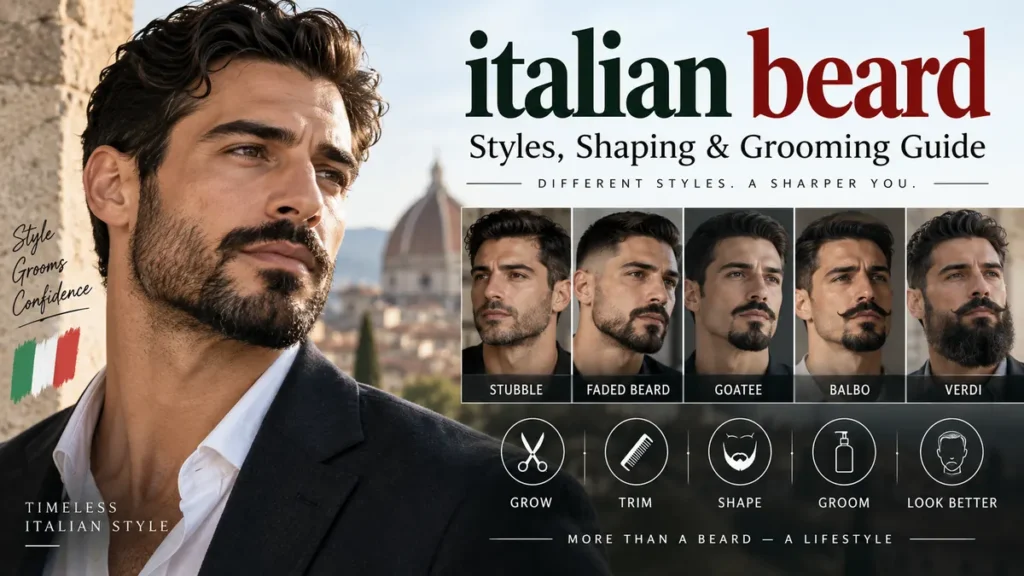
The italian beard is best understood as an Italian-inspired approach to facial-hair styling rather than one universally standardized beard shape. Modern interpretations emphasize controlled length, clean cheek and neck boundaries, deliberate sideburn transitions, and visual weight around the moustache, chin, and jaw. Variations range from designer stubble and short sculpted beards to the Balbo, Verdi, goatee, and fuller Mediterranean looks.
That flexibility is exactly why the style can look very different from one man to another. The goal is not to copy a rigid template. It is to create a beard whose proportions look intentional on your face.
What Is an italian beard?
Search for an italian beard and you will quickly encounter conflicting definitions. Some grooming guides describe a connected moustache-and-chin beard with clean cheeks. Others use the term more broadly for short, structured Mediterranean-inspired facial hair with faded sideburns and sharply maintained boundaries. Current Italian coverage also emphasizes graduated sideburns, increasing length toward the moustache and chin, and clean contours around the cheeks and neck.
That tells us something useful: italian beard is not a formally standardized barbering classification.
Instead, several characteristics commonly create the Italian-inspired appearance:
- Controlled rather than uncontrolled volume
- Defined cheek and neckline boundaries
- Shorter or graduated sideburns
- Greater visual weight toward the jaw and chin
- A deliberately groomed moustache
- Balanced symmetry
- Smooth transitions between different lengths
- A shape selected according to facial proportions and natural beard density
The finished result should appear polished without looking artificially drawn onto the face.
This distinction matters when visiting a barber. Saying only “give me an Italian beard” leaves room for interpretation. A reference photo plus instructions about your desired length, cheek line, moustache, fade, and chin shape communicates far more accurately.
Why the Modern italian beard Looks So Distinctive
The modern italian beard works through proportion.
Instead of treating the entire beard as one uniform mass of facial hair, the barber controls individual areas differently. The sideburns might be relatively short, the cheeks slightly fuller, and the chin longer. Alternatively, the cheeks can be shaved while the moustache and chin remain prominent.
The resulting geometry can change how the face appears.
Clean cheek lines create structure
The cheek line forms the upper boundary of the beard. Cleaning obvious stray hairs above it makes the beard look intentional almost immediately.
That does not mean everyone needs an extremely low, razor-straight cheek line.
If your natural cheek coverage is strong, retaining a relatively natural boundary can make the beard appear fuller. Cutting the line unnecessarily low removes useful density and can create a narrow-looking beard.
Controlled sideburns prevent excessive width
Modern Italian-inspired grooming frequently incorporates shorter sideburns or a beard fade. GQ Italia’s 2026 discussion of the trend specifically highlights reduced sideburns, increasing lengths toward the moustache and chin, and clearly maintained cheek and neck contours.
This graduation can make the lower beard appear more prominent without requiring excessive length.
Chin length changes facial proportions
Leaving more hair around the chin creates vertical emphasis. That can visually lengthen a broad or round face.
The reverse is also true. Someone with an already long face may look better with a shorter chin and more presence toward the sides.
This is why blindly copying somebody else’s guard settings often fails. The correct proportions matter more than the numbers printed on the trimmer guards.
Popular italian beard Styles
There is no need to limit yourself to a single interpretation. Italian-inspired grooming includes everything from subtle stubble to historically recognizable styles such as the Verdi and Balbo.
Italian Designer Stubble
Designer stubble is the simplest entry point.
The hair remains short across the lower face, but the cheek and neck areas are deliberately cleaned. Unlike accidental stubble after several days without shaving, the length is relatively consistent and the boundaries are controlled.
It works particularly well when:
- You prefer minimal facial-hair length
- Your beard becomes visibly patchy when grown longer
- You want your natural jawline to remain visible
- You are willing to trim frequently
The exact millimeter setting is less important than consistency.
Short facial hair exposes differences in length easily, so missed patches become surprisingly noticeable.
Short Sculpted Italian Beard
A short sculpted beard retains more coverage than stubble while staying close to the face.
The moustache is tidy, cheek lines are controlled, and the lower edge follows a deliberate silhouette around the jaw. This is one of the easiest interpretations to adapt because you can change the proportions without completely changing the style.
Men with dense growth can create very crisp outlines. If your coverage is lighter, slightly softer boundaries often look more natural.
Faded Italian Beard
The beard fade uses a gradual transition between shorter hair near the sideburn and greater length farther down the face.
A successful fade should look like a transition—not separate horizontal bands.
This is one area where professional barber work can make a noticeable difference. Removing too much hair from one section creates a visible step that can take days or weeks to blend back into the surrounding growth.
The technique is especially useful when you want to reduce visual width around the upper cheeks while retaining a stronger chin and jaw.
Italian Goatee
A goatee concentrates facial hair around the mouth and chin while removing much or all of the cheek coverage.
Different versions may connect the moustache to the chin beard or leave the sections separated.
This makes the style useful for men whose strongest growth occurs around the moustache and chin but whose cheeks remain comparatively sparse.
A goatee can also create vertical emphasis, although making the chin extremely long or pointed can exaggerate an already narrow face.
Balbo Beard
The Balbo is one of the beard styles frequently associated with Italian facial-hair history. It typically combines a moustache with hair across the chin and lower jaw while keeping the sideburn area disconnected.
Its name is historically associated with Italian military and political figure Italo Balbo. Today, the term is primarily used as a description of the facial-hair configuration rather than an indication of political meaning.
Visually, the important feature is negative space: the clean-shaven areas separate parts of the facial hair and make the moustache and lower beard stand out.
The Balbo works best when its edges remain deliberate. Once stray cheek and sideburn growth fills those spaces, its recognizable structure begins disappearing.
Verdi Beard
The Verdi takes its name from Italian composer Giuseppe Verdi and represents the fuller end of Italian-inspired beard styling.
It generally features a substantial rounded beard accompanied by a prominent, carefully groomed moustache.
Unlike short designer stubble, the Verdi relies on enough growth to create volume and shape. Consequently, beard density becomes more important.
The moustache is also a focal point rather than an afterthought. Depending on the interpretation, it may be styled outward or allowed to stand distinctly against the fuller beard.
Full Italian Beard
A full beard can still have an Italian-inspired appearance.
The difference is maintenance.
Instead of allowing every area to grow equally, the beard is shaped around facial proportions. Excessive bulk is removed where necessary, the lower silhouette is controlled, and the moustache, cheek line, neckline, and sideburn transitions remain intentional.
This produces a fuller, more natural result without turning the beard into an uncontrolled mass.
Which italian beard Suits Your Face Shape?
Face shape is a useful starting point, but it should not become a rigid rule. Natural growth pattern, hair density, jaw structure, hairstyle, and personal preference matter too.
A practical approach is to decide what visual proportion you want the beard to create.
| Face shape | Useful beard adjustment | Usually avoid if balance is the goal |
|---|---|---|
| Round | Shorter sides, more chin definition | Excessive width at the cheeks |
| Oval | Balanced sides and chin | Unnecessary extreme proportions |
| Square | Controlled sides, softer lower corners | Overly rigid square outline |
| Rectangular/long | More side presence, compact chin | Very long pointed beard |
| Heart | Controlled fullness around chin and jaw | Excessive upper-face emphasis |
| Diamond | Moderate jaw/chin volume | Extremely narrow sides |
Round Faces
For a round face, the usual objective is to create more vertical direction.
Keep the upper sides relatively controlled while retaining slightly greater length toward the chin. A subtle fade can support the same effect.
Avoid making the beard equally wide from the cheeks through the jaw if you do not want to emphasize facial width.
Oval Faces
Oval faces give you considerable freedom because their proportions are already relatively balanced.
Short stubble, a sculpted beard, goatee, Balbo, or fuller style can all work. Instead of trying to alter facial proportions dramatically, focus on your strongest areas of natural growth and the maintenance level you prefer.
Square Faces
A square face already has strong angles.
You can reinforce them with a boxed beard or soften them using a slightly rounded lower edge. Neither approach is inherently better.
If your jaw is particularly broad, removing a little bulk from the sides while keeping moderate chin length can produce a more tapered silhouette.
Long or Rectangular Faces
The common mistake here is adding too much chin length.
A long pointed beard makes the entire face appear longer. Instead, keep the chin relatively compact and preserve some width toward the sides.
A substantial moustache can also add horizontal visual interest.
Heart and Diamond Faces
Both shapes can benefit from strategic lower-face volume.
A heart-shaped face often has a narrower chin, so additional controlled fullness around the chin and jaw can create balance.
With diamond faces, avoid making the sides unnecessarily tight if doing so causes the cheekbones to appear dramatically wider than the lower face.
Quick Takeaway: Choose beard proportions before choosing a style name. Shorter sides plus a longer chin create vertical emphasis; more side volume and a compact chin create width.
How to Grow an italian beard
Start by giving yourself enough facial hair to see your actual growth pattern.
Do not shape aggressively after the first few days. Early growth can be misleading because different areas grow at different rates.
1. Let the beard establish its coverage
Allow the beard to grow long enough for you to identify:
- Dense areas
- Thin areas
- Natural cheek height
- Moustache-to-beard connection
- Chin density
- Jaw coverage
- Direction of hair growth
Your strongest growth should influence your final style.
If your cheeks are sparse but your chin and moustache are dense, forcing a full high-cheek beard may create unnecessary maintenance. A goatee or Balbo-inspired configuration can use the stronger growth instead.
2. Choose the silhouette first
Before reaching for the trimmer, decide whether you want the beard to make your face look:
- Longer
- Wider
- More angular
- Softer
- Fuller
- More defined
Then distribute the length accordingly.
This simple decision prevents the common mistake of trimming every area to one guard setting and expecting a sculpted result.
3. Establish your main length
Trim conservatively.
Start longer than your intended final length. You can always remove another millimeter; you cannot immediately replace one.
Work gradually and compare both sides frequently.
4. Build the sideburn transition
If you want a faded italian beard, shorten the hair progressively as you approach the sideburns.
Avoid jumping abruptly from extremely short hair to a much longer beard.
Use intermediate lengths to soften the transition. Work over a small area at a time and stop regularly to inspect the beard from a normal viewing distance.
5. Define the cheek line
First look at your natural cheek boundary.
Remove isolated hairs above the main growth rather than immediately carving a dramatically lower line.
A natural-looking line with minor cleanup is often more forgiving as the beard grows back. Very sharp cheek lines can look excellent, but they also reveal regrowth faster.
6. Establish a clean neckline
One of the fastest ways to make a good beard look unfinished is allowing neck hair to merge indefinitely into the beard.
The neckline should support the beard’s lower shape rather than sit directly on the visible edge of the jaw.
A common mistake is shaving too high under the chin. From the front, the beard may initially look neat, but from the side it can expose the underside of the jaw and make a full beard appear thin.
Keep enough hair beneath the jaw to preserve visual depth.
7. Shape the moustache
Decide whether the moustache should blend into the beard or remain visually distinct.
Trim hairs that continually fall over the upper lip. For longer moustaches, comb before trimming so you can see the actual length.
If you are creating a Verdi-inspired beard, the moustache can become a major stylistic feature. With short stubble, keeping it closer to the surrounding length usually produces greater visual consistency.
How to Trim an italian beard at Home
The basic toolkit is straightforward:
- Beard trimmer with adjustable guards
- Detail trimmer or precision attachment
- Beard comb
- Scissors for isolated longer hairs
- Razor or shaver for clean areas
- Two mirrors if you need a better side view
Begin with a clean, dry beard unless your specific trimmer is designed for wet use.
Comb longer facial hair into its natural position. Trim the bulk before attempting detailed lines. Once the overall silhouette is balanced, refine the sideburn transition, cheek boundaries, moustache, and neckline.
Finish by checking the beard from the front and both profiles.
This matters because symmetry viewed straight-on does not guarantee that the beard has the same projection and lower line on each side.
Quick Takeaway: Bulk first, details second. Trying to perfect the cheek line before establishing the beard’s overall shape makes it much easier to over-trim.
italian beard Maintenance: What Actually Works
Precision styles generally require more maintenance than natural beards because regrowth quickly changes their boundaries.
Trim according to the style
Stubble needs frequent attention because even a small amount of growth changes its appearance.
A longer beard gives you more tolerance between major trims, although stray hairs and boundaries may still need occasional cleanup.
Do not automatically run the same guard across the entire beard. If the original shape depends on shorter sides and a longer chin, uniform trimming gradually destroys those proportions.
Wash without overdoing it
Facial hair collects sweat, skin oil, food particles, and grooming products.
Wash as necessary based on your skin, beard length, activity, and product use. Longer facial hair may benefit from a cleanser intended for the beard or a gentle facial cleanser rather than repeatedly using harsh products that leave the underlying skin uncomfortable.
Keep the skin underneath comfortable
A beard does not replace skincare.
Dryness, irritation, and accumulated dead skin can become noticeable beneath dense facial hair. Regular cleansing and suitable moisturizing help maintain the skin supporting the beard.
Beard oil can improve softness and reduce the dry feel of longer facial hair, but it does not create new follicles or magically turn genetically sparse areas into dense beard growth.
Comb before judging the shape
Longer beard hairs naturally move in different directions.
Before assuming one side needs trimming, comb the beard into its normal position. Otherwise, you may remove healthy length simply because several hairs were sitting incorrectly.
Use balm or wax selectively
Beard balm can provide light control for longer facial hair.
Moustache wax is more useful when the moustache itself is intentionally styled, particularly with fuller classic looks such as the Verdi.
Products should support the shape rather than compensate for an uneven haircut.
italian beard vs Goatee vs Balbo vs Full Beard
The terminology surrounding these styles can become confusing because modern grooming websites sometimes use overlapping names.
| Style | Cheeks | Moustache | Chin/Jaw | Main characteristic |
|---|---|---|---|---|
| Modern italian beard | Controlled or clean | Usually prominent | Structured | Precision and proportion |
| Goatee | Usually shaved | Connected or separate | Concentrated at chin | Facial hair centered around mouth/chin |
| Balbo | Mostly clean | Distinct | Chin and lower jaw | Intentional separation |
| Verdi | Full | Prominent/styled | Full rounded beard | Fuller classic silhouette |
| Designer stubble | Short coverage | Short | Short | Uniform short growth with clean boundaries |
| Full beard | Covered | Integrated | Full coverage | Maximum natural facial-hair coverage |
The table also explains why there is no contradiction when two barbers describe an “Italian beard” differently.
One may be talking about a specific modern shape. Another may be referring to the broader Italian-inspired grooming aesthetic.
Can You Wear an italian beard With Patchy Growth?
Yes—provided the style is designed around where your facial hair actually grows.
This is one of the advantages of structured facial hair.
If cheek growth is weak but moustache and chin coverage are strong, a goatee or Balbo-style beard removes the weakest area intentionally. What looked like an incomplete full beard can suddenly look like a deliberate design.
If density varies slightly across the cheeks, shorter facial hair can sometimes make the contrast less obvious.
Avoid repeatedly cutting a strong side down to “match” a noticeably weaker side unless the resulting shape still looks good overall. Perfect follicle-for-follicle symmetry is unrealistic.
Facial hair density is influenced substantially by genetics and androgen-related biology. Grooming can change the appearance of density, but trimming itself cannot manufacture new beard follicles.
Common italian beard Shaping Mistakes
The most damaging mistakes usually happen during detailing rather than initial growth.
Taking the cheek line too low: You lose useful density and may end up with an unnaturally narrow strip of facial hair.
Shaving the neckline too high: This removes the visual foundation beneath the jaw and can make the beard look shallow from the side.
Creating a harsh beard fade: Visible steps between guard lengths make the transition look unfinished.
Making both sides identical without considering growth: Natural facial-hair patterns are rarely perfectly symmetrical. Aim for visual balance rather than mathematical duplication.
Choosing style before checking density: Your growth pattern should help determine the style—not fight it.
Over-lengthening a long face: A dramatic pointed chin can exaggerate vertical proportions.
Leaving too much side volume on a round face: This can make the lower face appear broader when the intended effect was definition.
Using too much product: Heavy oils, balms, and waxes can make a short beard appear greasy instead of polished.
What Should You Tell Your Barber?
A photograph remains more useful than a style name.
Show the barber a front-facing reference and, ideally, a side view. Then explain what elements you actually want.
For example, specify that you want controlled sideburns, a gradual beard fade, additional chin length, a natural or sharp cheek line, and a clean neckline while retaining sufficient depth underneath the jaw.
Also tell the barber how frequently you realistically intend to maintain it.
There is little benefit in choosing an extremely precise design that requires near-daily edge work if you prefer trimming once every week or two.
A skilled barber can adapt the concept rather than merely reproduce the photograph.
How Often Does an italian beard Need Trimming?
There is no universal schedule because short and long styles behave differently.
Designer stubble may need attention every few days to retain a deliberately short appearance. A sculpted short beard can usually tolerate more growth between full trims, while a longer beard may need only periodic reshaping with smaller maintenance sessions between them.
Your boundaries often need attention before your overall length does.
That means you do not necessarily need to shorten the whole beard whenever the cheek or neckline becomes untidy.
Clean the boundary and leave the main shape alone when it still looks balanced.
Is the italian beard Right for You?
The strongest reason to choose an italian beard is adaptability.
You do not need exceptionally long facial hair, and you do not need one specific face shape. What matters is having enough usable growth for the variation you choose and being willing to maintain its defining proportions.
Choose stubble if you want minimal length. Use a sculpted short beard for versatile everyday grooming. Consider a faded beard when you want stronger transitions and less upper-face bulk. A goatee or Balbo can make excellent use of strong moustache and chin growth, while the Verdi and fuller Italian-inspired shapes suit men who have enough density for substantial volume.
Most importantly, do not treat the italian beard as one mandatory template. Contemporary sources themselves use the term for several related looks, while Italian grooming coverage emphasizes the broader principles of graduated lengths, clean contours, controlled sideburns, and stronger definition toward the moustache and chin.
Start with your natural growth pattern, choose the proportions that complement your face, and maintain the cheek line, neckline, moustache, and transitions consistently. That combination—not a particular trimmer setting—is what gives an Italian-inspired beard its polished, intentional character.