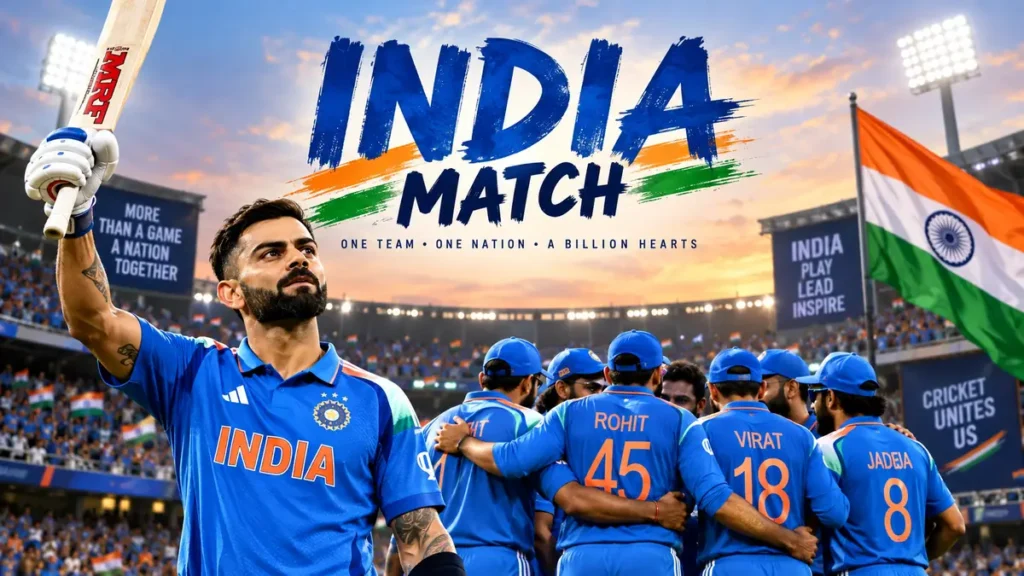
Searching for an india match usually means one thing: you want the next fixture without digging through outdated schedules. As of September 6, 2026, India’s men’s cricket team is preparing for a three-match T20I series against Afghanistan, followed later in September by international fixtures against Japan and the West Indies.
The next India men’s international cricket match is Afghanistan vs India, the 1st T20I on Sunday, September 13, 2026, at Arun Jaitley Stadium in Delhi. The match is scheduled to begin at 7:00 PM IST. It opens a three-match T20I series, with the other games scheduled for September 15 and September 17.
This guide covers the next India match, upcoming schedule, recent results, formats, players to follow, and the simplest ways to understand live scores and match updates.
india match: When Is India’s Next Cricket Match?
India’s next men’s international fixture is against Afghanistan on September 13, 2026.
Here are the essential match details:
| Match detail | Information |
|---|---|
| Match | Afghanistan vs India |
| Format | T20 International |
| Series | Afghanistan vs India T20I Series 2026 |
| Date | September 13, 2026 |
| Day | Sunday |
| Start time | 7:00 PM IST |
| Venue | Arun Jaitley Stadium, Delhi |
| Match number | 1st T20I |
The published schedule lists all three matches of the series at Arun Jaitley Stadium. The second T20I is set for September 15 and the third for September 17, both at 7:00 PM IST.
That makes the series particularly straightforward for fans: same city, same scheduled starting time and only one rest day between matches.
What Time Does the India Match Start?
The first Afghanistan vs India T20I is scheduled for 7:00 PM Indian Standard Time on September 13.
For international viewers, always check the local conversion shortly before the game. Cricket schedules can occasionally be revised, and daylight-saving changes in some countries can affect local conversions even when the IST start remains unchanged.
The toss would normally take place shortly before play, but match-day updates are the safest source for confirmed toss timing, playing XIs and any weather-related delays.
India vs Afghanistan T20I Series 2026 Schedule
The immediate focus for India’s men’s team is the three-match T20I series against Afghanistan.
| Match | Date | Time | Venue |
|---|---|---|---|
| Afghanistan vs India, 1st T20I | Sep 13, 2026 | 7:00 PM IST | Arun Jaitley Stadium, Delhi |
| Afghanistan vs India, 2nd T20I | Sep 15, 2026 | 7:00 PM IST | Arun Jaitley Stadium, Delhi |
| Afghanistan vs India, 3rd T20I | Sep 17, 2026 | 7:00 PM IST | Arun Jaitley Stadium, Delhi |
The schedule is consistent across multiple current fixture listings.
Why the Afghanistan Series Matters
Afghanistan are no longer a side that stronger teams can approach casually in T20 cricket. Their rise has been built around quality spin bowling, aggressive batting and players with substantial franchise-cricket experience.
For India, a short three-match series is useful for testing combinations. T20 teams need more than a strong starting XI. They need flexible opening options, finishers, wicket-taking bowlers, all-rounders and players capable of adapting quickly to different match situations.
The Delhi setting adds another tactical dimension. Captains have to judge conditions on the day rather than relying only on a venue’s historical reputation.
India’s Squad and Selection Talking Points
The squad announced for the Afghanistan T20Is is led by Shreyas Iyer, while Sanju Samson has returned to the setup. Young batter Vaibhav Suryavanshi has also been included, adding another potential option near the top of the order.
Selection discussions have also focused on player fitness. Reports around the squad have highlighted the availability of Jasprit Bumrah, Washington Sundar, Nitish Kumar Reddy and Harshit Rana as being linked to fitness assessments.
This makes the final playing XI worth watching. A squad announcement tells us who is available for selection; it does not guarantee that every named player will appear in the first match.
India Cricket Match Schedule After Afghanistan
Fans searching for the next india match are often interested in more than one fixture. India’s schedule remains busy after the Afghanistan T20I series.
Current fixture listings show a one-off T20I against Japan on September 22, followed by a home ODI series against the West Indies beginning on September 27.
The immediate schedule is:
| Date | Fixture | Format | Scheduled time |
|---|---|---|---|
| Sep 13 | Afghanistan vs India | 1st T20I | 7:00 PM IST |
| Sep 15 | Afghanistan vs India | 2nd T20I | 7:00 PM IST |
| Sep 17 | Afghanistan vs India | 3rd T20I | 7:00 PM IST |
| Sep 22 | Japan vs India | One-off T20I | 9:30 AM IST |
| Sep 27 | India vs West Indies | 1st ODI | 2:00 PM IST |
The Japan fixture is currently listed for the Sano International Cricket Ground in Sano, while the first West Indies ODI is listed for Thiruvananthapuram.
Schedules further into the future are more susceptible to changes, so dates, venues and start times should always be rechecked as match day approaches.
India Match Today: How to Check Whether India Are Playing
A common search is simply, “Is there an India match today?”
As of September 6, 2026, India’s senior men’s side does not have an international fixture scheduled for today. Its next listed match is the first T20I against Afghanistan on September 13.
There is an important distinction, however: “India match today” can refer to several different teams.
It could mean:
- India men’s senior cricket team
- India women’s cricket team
- India A
- India Under-19
- an Indian team at a multi-sport event
- an IPL or domestic team
- the Indian national football team
This distinction matters especially during major tournaments.
For example, India’s women’s cricket team is currently involved in the Women’s T20 Asia Cup 2026. India defeated Pakistan after bowling them out for 55 and successfully chasing the target, remaining unbeaten in the tournament.
So a search for “India match today” may produce women’s international cricket results even when the senior men’s side is not playing.
Latest India Cricket Match Results
Looking at recent results provides useful context before the next series.
India’s men’s team recently toured Sri Lanka for a two-Test series. The first Test in Galle ended in a 165-run victory for India, while the second Test in Colombo was drawn.
Recent men’s results include:
| Match | Result |
|---|---|
| Sri Lanka vs India, 2nd Test | Draw |
| Sri Lanka vs India, 1st Test | India won by 165 runs |
| Zimbabwe vs India, 3rd T20I | India won by 35 runs |
| Zimbabwe vs India, 2nd T20I | India won by 90 runs |
| Ireland vs India, 2nd T20I | Ireland won by 1 run |
| Ireland vs India, 1st T20I | Ireland won by 34 runs |
These results illustrate why looking only at a team’s ranking can be misleading.
India can dominate one opponent and then encounter completely different problems against another. Venue, pitch, format, squad rotation, injuries and individual form all influence international cricket.
India’s Current ICC Standing
Current team-profile data lists India at No. 1 in ODIs and T20Is and No. 4 in Tests.
Rankings provide a useful long-term picture, but they should not be treated as a match prediction. A T20I can swing dramatically in a handful of deliveries, while Tests reward sustained performance over several days.
India Match Formats Explained
India play international cricket in three primary formats: Tests, One Day Internationals and Twenty20 Internationals.
Understanding the differences makes schedules and scorecards much easier to follow.
Test Matches
Test cricket can last up to five days, with each side normally having two innings.
Rather than focusing only on scoring quickly, teams must manage batting time, wickets, pitch deterioration and bowling workloads. Draws are possible if neither side completes the required innings before time expires.
India’s recent drawn second Test against Sri Lanka is a useful reminder that a Test does not have to produce a winner.
One Day Internationals
An ODI gives each team up to 50 overs.
The format sits between Test cricket and T20 cricket. Batters have time to build an innings, but teams still need to maintain a competitive scoring rate.
India’s next scheduled ODI assignment begins against the West Indies on September 27.
T20 Internationals
A T20I gives each team a maximum of 20 overs.
That creates a far faster match. Powerplay batting, boundary hitting, death bowling, fielding and matchups between individual batters and bowlers become especially influential.
The Afghanistan series consists entirely of T20Is.
Quick Takeaway: If you’re following the next India men’s match, focus on T20 terminology and tactics. The September 13 game against Afghanistan is a T20I, so each team receives a maximum of 20 overs unless the match is shortened.
How to Read an India Match Live Score
Cricket scorecards can look confusing to new fans, but the basic information is simple once you understand the notation.
Suppose India are shown as:
IND 175/7 (20 overs)
That means India scored 175 runs, lost seven wickets, and completed 20 overs.
If the chasing team needs 176 to win and reaches 176/4, it wins with six wickets remaining.
Understanding Overs
An over normally consists of six legal deliveries.
So:
10.3 overs
does not mean 10.3 overs in decimal form. It means 10 completed overs plus three legal balls of the next over.
Run Rate
The run rate measures how quickly a team is scoring.
If a team makes 100 runs in 10 overs, its run rate is:
100 ÷ 10 = 10 runs per over
During a chase, you may also see the required run rate, which tells you the average scoring rate needed from the remaining overs to reach the target.
Wickets
A batting team normally has ten wickets available because an innings ends when ten of its eleven players have been dismissed, assuming everyone is able to bat.
Seeing 120/2 and 120/7 therefore tells two very different stories despite the identical run total.
The first batting side has substantial resources left. The second is under much greater pressure.
Players to Watch in India’s Upcoming Matches
India’s depth means selection itself can become one of the biggest stories surrounding a series.
Shreyas Iyer
Shreyas Iyer is set to lead India in the Afghanistan T20I series. Captaincy in T20 cricket involves constant tactical decisions: bowling changes, field placement, matchups and deciding when to attack or protect a total.
His own batting role will be equally significant, particularly if India lose early wickets.
Sanju Samson
Sanju Samson’s return gives India another experienced wicketkeeping and batting option.
The key question is where he fits into the batting order. T20 selection is often less about choosing the eleven most famous players and more about constructing a balanced combination.
Vaibhav Suryavanshi
The inclusion of Vaibhav Suryavanshi brings youth into the squad and creates further competition for batting positions.
Young players can change a team’s tactical possibilities, particularly when they bring aggressive intent at the top of the order.
Washington Sundar
Washington Sundar offers the valuable combination of spin bowling and batting ability.
His fitness has attracted attention ahead of the series, with former India captain Kris Srikkanth publicly questioning whether he had enough competitive match preparation following injury issues.
That illustrates a broader point about cricket squads: being named in the group and being fully match-ready are not necessarily the same thing.
Jasprit Bumrah
Whenever available, Jasprit Bumrah gives India a specialist fast-bowling option capable of influencing multiple phases of a T20 innings.
His role is particularly valuable because modern T20 bowling requires different skills during the powerplay and death overs.
What Could Decide India vs Afghanistan?
The Afghanistan series should not be reduced to rankings alone.
1. Powerplay Performance
The first six overs of a T20 innings can establish the entire match.
India will want early boundaries without losing too many wickets. Afghanistan, meanwhile, can use early breakthroughs to expose India’s middle order before it has settled.
2. Spin Bowling
Spin is likely to be one of the most interesting tactical areas.
Afghanistan have built an international reputation around high-quality spin resources, while Indian batters generally have extensive experience facing spin in domestic and international cricket.
That creates a matchup where execution matters more than reputation.
3. Middle-Overs Scoring
Teams often lose momentum after the powerplay.
The strongest T20 sides keep rotating the strike while identifying the right deliveries to attack. Dot-ball pressure can rapidly push the required scoring rate upward.
4. Death Overs
The final four or five overs can completely change a match.
A side sitting at 130 after 15 overs could finish around 160 or surge well beyond 180 depending on wickets, boundary hitting and death-bowling execution.
5. Team Balance
India’s selectors must balance specialist batting with bowling depth.
Playing too many batters can leave the captain short of bowling alternatives. Packing the XI with bowlers can create a vulnerable lower order.
All-rounders become especially valuable because they help solve both problems.
India Match Venue: Arun Jaitley Stadium
The three India-Afghanistan T20Is are scheduled at Arun Jaitley Stadium in Delhi.
Venue conditions can affect team selection, but historical trends should never be treated as guarantees.
The actual playing surface, weather, dew and boundary dimensions on match day matter. Teams usually inspect conditions before finalizing their XI.
This is also why generic claims such as “this is always a batting pitch” can be misleading. Different strips at the same ground can behave differently.
For night matches, captains may also consider whether dew could make gripping the ball harder later in the evening.
How India Match Results Are Decided
Most limited-overs matches are straightforward: the team scoring more runs wins.
But cricket has several special situations.
Successful Run Chase
If India chase a target of 180 and reach 181/5, the result is expressed as a five-wicket victory because five wickets remained.
Defending a Total
If India score 190 and their opponent reaches only 170, India win by 20 runs.
Tie
If both teams finish with the same score in a T20I, tournament or series regulations may provide for a Super Over to determine the winner.
No Result
Bad weather or other interruptions can prevent enough cricket from being played to produce a result.
Limited-overs matches affected by rain may use the Duckworth-Lewis-Stern (DLS) method to calculate a revised target when the necessary conditions are met.
Test Draw
Tests can finish as draws when the allotted match time expires before a result is achieved.
This is different from a tie, where both completed scores are exactly level under the relevant circumstances.
Why India’s Cricket Schedule Changes So Often
Fans sometimes save an India cricket schedule only to discover that a venue or starting time has changed.
International schedules involve several organizations, including national cricket boards, broadcasters, host venues and the International Cricket Council (ICC) for relevant events.
Changes can happen because of venue availability, logistics, weather considerations, security arrangements, tournament qualification or broadcasting requirements.
For that reason, there is a useful rule when following any india match:
Check the fixture again on match day.
This is particularly important for games several months away.
A fixture listed today may be correct based on the current schedule but still be revised before the teams actually arrive at the ground.
India Men’s and Women’s Matches Should Be Distinguished
Search results increasingly mix men’s and women’s cricket because both teams maintain busy international schedules.
India’s women’s team has been competing in the 2026 Women’s T20 Asia Cup in Dubai. On September 5, India defeated Pakistan after dismissing them for 55, with India completing the chase comfortably.
Earlier in the tournament, Smriti Mandhana scored 124 from 64 balls against Hong Kong as India won by 137 runs. The innings also took Mandhana past Mithali Raj to become the leading run-scorer in women’s international cricket, according to Reuters.
Other prominent names in India’s women’s setup include Harmanpreet Kaur, Shafali Verma and Deepti Sharma.
This distinction is especially useful when searching for live scores. Always check the team label, tournament and format before assuming a result belongs to the men’s senior side.
How to Follow an India Match Accurately
Live cricket information changes ball by ball, so accuracy depends heavily on the source and timestamp.
For any upcoming game, check these details first:
- Date — confirm the match has not been rescheduled.
- Start time — distinguish local time from IST.
- Venue — grounds can occasionally change.
- Toss — this confirms which side bats or bowls first.
- Playing XI — do not assume the full squad represents the final XI.
- Live score — check runs, wickets and overs together.
- Target — in the second innings, identify exactly what is required to win.
- Match status — look for rain delays, innings breaks, abandoned matches or completed results.
Official cricket boards, the ICC for its competitions, and established live-score services are preferable when confirming time-sensitive details.
One practical mistake is searching an old fixture and assuming its scorecard is live. Always check the year and match status before reading the score.
India’s Major Cricket Achievements
India’s position in international cricket has been built over decades and across formats.
India’s major men’s ICC titles include the 1983 and 2011 Cricket World Cups, the 2007 and 2024 T20 World Cups, and the 2013 and 2025 Champions Trophy titles.
Those achievements span very different eras of Indian cricket.
The 1983 World Cup transformed expectations around the national side. The 2007 T20 World Cup victory arrived during the early development of international Twenty20 cricket, while later successes reflected India’s growing depth and the enormous influence of its domestic cricket structure.
The Board of Control for Cricket in India (BCCI) administers Indian cricket, while ICC tournaments place India within the broader international competition structure.
Domestic competitions and the Indian Premier League (IPL) have also expanded the pool of players accustomed to high-pressure limited-overs cricket.
What to Expect From India’s Next Match
The next India men’s fixture offers several storylines beyond the final score.
The first question is team selection. With experienced internationals and younger options competing for roles, India’s final XI should reveal how the team wants to structure its batting and bowling.
The second is Afghanistan’s spin challenge. India may have the stronger overall ranking, but T20 cricket gives specialized bowling attacks an opportunity to dictate short phases of a match.
Finally, watch how India approach the powerplay and death overs. Those two phases frequently determine modern T20 games because the scoring rate can change dramatically in only a few deliveries.
Quick Takeaway: India’s next men’s international is the 1st T20I against Afghanistan on September 13, 2026, at Arun Jaitley Stadium, Delhi, scheduled for 7:00 PM IST. The teams meet again on September 15 and September 17 before India’s later September fixtures against Japan and the West Indies.
Final Word on the Next india match
For anyone searching india match for the latest men’s fixture, the date to remember is Sunday, September 13, 2026. India face Afghanistan in the first of three T20Is at Arun Jaitley Stadium in Delhi, with play scheduled to start at 7:00 PM IST.
The Afghanistan series is followed by further international cricket later in September, including the currently scheduled Japan T20I and the start of the West Indies ODI series. Because cricket fixtures can change, check the confirmed match-day schedule, toss and playing XI before play begins. That gives you the most reliable picture of who is playing, when the match starts and what to expect once the first ball is bowled.