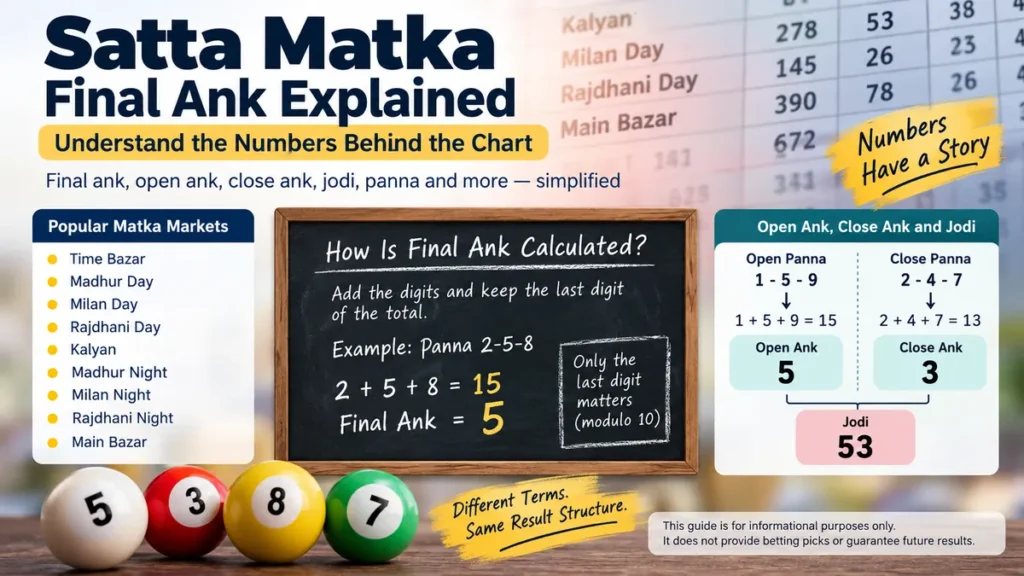
If you have ever looked at a Satta Matka chart, you have probably seen terms such as final ank, open ank, close ank, jodi, panna, Kalyan, Milan Day, Rajdhani Day, and Main Bazar. They can make a simple results table look much more complicated than it actually is.
The key is understanding how the numbers relate to one another.
final ank is a single digit from 0 to 9 associated with the numerical result of a Matka market. Depending on how a chart or website labels its data, it may refer to a final/closing digit or a digit derived from a displayed result. It should not be confused with a prediction or guaranteed future number.
This guide explains the terminology and arithmetic behind these charts for informational purposes. It does not provide betting picks, “sure” numbers, or strategies for winning.
What Is final ank?
The word ank essentially means a digit or number in this context. A final ank is therefore a single-digit value, normally ranging from 0 through 9, displayed in connection with a completed Matka result.
Current Matka-related pages commonly show final-ank information alongside markets such as:
- Time Bazar
- Madhur Day
- Milan Day
- Rajdhani Day
- Kalyan
- Madhur Night
- Milan Night
- Rajdhani Night
- Main Bazar
For example, a results board might display a full result consisting of panna and jodi numbers and then separately show a one-digit final value.
One reason the terminology becomes confusing is that websites do not always describe “final ank” in exactly the same way. Some explain it as the last digit obtained from a panna sum, while others describe it in relation to the completed jodi.
That makes it useful to understand open, close, panna and jodi before interpreting any final-ank chart.
How Is final ank Calculated?
The basic arithmetic used throughout Matka notation is simple: add the relevant digits and retain the last digit of the total.
For example:
| Digits | Sum | Last Digit |
|---|---|---|
| 1, 2, 3 | 6 | 6 |
| 2, 5, 8 | 15 | 5 |
| 4, 6, 9 | 19 | 9 |
| 7, 8, 9 | 24 | 4 |
If the relevant panna were 258, the arithmetic would be:
2 + 5 + 8 = 15
The resulting ank is therefore:
5
A current Final Ank explainer gives the same type of example: a panna of 2-5-8 totals 15, leaving 5 as its single-digit value.
Another current chart guide explains the general principle with a total of 28, where the last digit—and therefore the associated ank—is 8.
Why Only the Last Digit Matters
The output must remain a single digit between 0 and 9.
So:
- Total 10 → ank 0
- Total 11 → ank 1
- Total 15 → ank 5
- Total 19 → ank 9
- Total 24 → ank 4
- Total 28 → ank 8
Mathematically, this is equivalent to taking the total modulo 10.
That arithmetic is deterministic. What is not deterministic is using old numbers to forecast a future random result.
Understanding Open Ank and Close Ank
A conventional Matka result has an open side and a close side.
Each side can be associated with a three-digit panna. Adding the three digits and keeping the final digit produces the corresponding single-digit ank.
Consider a simplified example:
Open panna: 1-5-9
1 + 5 + 9 = 15
Open ank = 5
Now suppose the close panna is:
Close panna: 2-4-7
2 + 4 + 7 = 13
Close ank = 3
The two single digits can then be represented together as a jodi:
53
This is why open, close, panna and jodi should not be treated as unrelated values. They are different parts or representations of the same result structure.
Open vs. Close vs. Final
Terminology can vary from site to site, so check the headings of the specific chart you are reading.
In general:
| Term | What It Represents |
|---|---|
| Open panna | Three-digit opening result |
| Open ank | Last digit of the open-panna sum |
| Close panna | Three-digit closing result |
| Close ank | Last digit of the close-panna sum |
| Jodi | Two-digit open-and-close combination |
| Final ank | Single-digit final value as defined by the chart |
This distinction matters because calling every one-digit number “final ank” can lead to misreading historical records.
final ank and Jodi: What Is the Difference?
A jodi normally contains two digits, whereas an ank contains one.
Suppose a chart has:
Jodi: 47
Here:
- 4 = first/open digit
- 7 = second/close digit
- 47 = complete jodi
Some explanatory pages also use a further “final ank” or “total ank” convention based on adding the two jodi digits and retaining the last digit.
Using that convention:
4 + 7 = 11
The last digit is:
1
A recent explainer describes final ank in precisely this jodi-based way and also notes that it may be called a total ank or berij.
This illustrates an important point: the label can depend on the publisher’s chart convention. Always determine whether a page is referring to the close ank, a panna-derived digit, or a jodi-derived total.
Understanding Panna or Panel Numbers
A panna, sometimes written as panel, is a three-digit number.
Examples include:
- 123
- 258
- 367
- 470
- 690
The digits are added to obtain the corresponding single-digit ank.
For 367:
3 + 6 + 7 = 16
Ank = 6
For 470:
4 + 7 + 0 = 11
Ank = 1
For 690:
6 + 9 + 0 = 15
Ank = 5
This relationship explains why historical Matka tables often contain both panna and single-digit information rather than displaying just one number.
Panna Example Table
| Panna | Calculation | Ank |
|---|---|---|
| 123 | 1 + 2 + 3 = 6 | 6 |
| 258 | 2 + 5 + 8 = 15 | 5 |
| 367 | 3 + 6 + 7 = 16 | 6 |
| 470 | 4 + 7 + 0 = 11 | 1 |
| 690 | 6 + 9 + 0 = 15 | 5 |
Once you understand this arithmetic, reading a historical panel chart becomes much easier.
How to Read a Complete Matka Result
A result may appear in a format such as:
223-70-244
Rather than treating that as one long number, break it into three components:
223 | 70 | 244
These represent a first panna, a two-digit jodi, and a second panna.
Current result pages use this same general three-part presentation for markets including Kalyan, Milan Day, Rajdhani Day and Main Bazar.
Check the arithmetic.
For the first panna:
2 + 2 + 3 = 7
For the second panna:
2 + 4 + 4 = 10
Last digit = 0
That corresponds to the jodi:
70
So the complete notation can be understood as:
| Component | Value |
|---|---|
| Open panna | 223 |
| Open ank | 7 |
| Jodi | 70 |
| Close ank | 0 |
| Close panna | 244 |
This is one of the easiest ways for a newcomer to understand how a Matka result is structured.
What Is Kalyan final ank?
Kalyan is one of the market names commonly encountered on Matka result websites. Current results pages list Kalyan alongside markets such as Milan Day, Rajdhani Day, Madhur Day and Main Bazar.
Consequently, “Kalyan final ank” generally means the final-ank information associated with the Kalyan market rather than an entirely different mathematical concept.
The same basic vocabulary appears:
panna → ank → jodi → completed result
The market name identifies which results table is being discussed.
Other Common Market Names
Someone researching final ank may also encounter:
Time Bazar: Commonly displayed as a daytime market on results boards.
Madhur Day: Another daytime result category.
Milan Day: Frequently appears beside Kalyan in historical records.
Rajdhani Day: Typically presented separately from Rajdhani Night.
Madhur Night: The night counterpart found on many daily boards.
Milan Night: A separate night-market listing.
Rajdhani Night: Another night result category.
Main Bazar: Commonly shown among the later market listings.
These are market labels. They do not change basic single-digit arithmetic.
What Is a final ank Chart?
A final ank chart is generally a table or record showing single-digit values or related Matka results across dates and markets.
Historical tables may contain:
- Date
- Day
- Market
- Panna
- Open digit
- Jodi
- Close digit
- Final value
Some websites maintain several weeks or months of records. Current pages for this query, for example, publish dated Final Ank records for markets including Time Bazar, Madhur Day, Milan Day and Rajdhani Day.
From an informational perspective, these charts are useful for understanding historical notation and checking how previously published numbers were recorded.
They should not be mistaken for evidence that a future number can be reliably determined.
Historical Results vs. Predictions
This is the most important distinction when reading final ank websites.
A historical result describes something that has already been declared.
A prediction claims or suggests what may happen next.
Those are fundamentally different kinds of information.
Many Matka pages use terms such as:
- guessing
- tips
- golden ank
- expert picks
- prediction
- passing record
- fix game
These labels can create an impression that historical patterns reveal the next outcome.
They do not establish that.
One current Final Ank site explicitly states that its guessing chart carries no guarantee of passing or failing and says it has no “fix,” “solid,” or leaked number.
Another explainer similarly acknowledges that an exact future final ank cannot reliably be predicted because prediction is not the same thing as a declared result.
Quick Takeaway
Calculation and prediction are separate. You can correctly calculate the ank associated with an already known panna because the underlying digits are known. That does not provide a mathematical method for knowing which panna or digit will appear in a future result.
final ank vs. Golden Ank
Another common source of confusion is the phrase Golden Ank.
On Matka-related sites, “final ank” and “Golden Ank” may appear close together, but they should not automatically be treated as synonyms.
A final ank is associated with result notation or a defined calculation.
A Golden Ank is commonly presented as a guess or suggested number before a result. For example, one prominent page explicitly distinguishes its declared Final Ank from its expert-provided Golden Ank guesses.
The practical difference is:
| final ank | Golden Ank |
|---|---|
| Associated with result data/calculation | Usually presented as a prediction |
| Can relate to completed data | Refers to an unknown future outcome |
| Arithmetic can be checked | Accuracy cannot be guaranteed |
| Historical records can verify it | Past success does not prove future success |
That distinction is especially useful when evaluating websites that mix live results with prediction content.
Can Old final ank Records Predict the Next Number?
No historical chart can make the next number certain merely because a pattern appears in previous results.
Suppose a sequence contains:
2, 5, 5, 8, 1, 5
Seeing 5 appear repeatedly may make it feel more significant. But frequency in a small historical sample does not by itself prove that 5 is more likely to occur next.
This is a classic problem when humans interpret random or uncertain sequences: we are extremely good at noticing patterns, even when those patterns do not have predictive power.
The Gambler’s Fallacy
A related concept is the gambler’s fallacy.
Imagine a random outcome has avoided a particular digit for several rounds. Someone might think:
“That number hasn’t appeared recently, so it must be due.”
That reasoning does not follow unless the underlying mechanism actually changes probabilities based on previous outcomes.
The opposite mistake also happens:
“This digit keeps appearing, so it is hot and will appear again.”
Again, past repetition alone is not enough to establish what happens next.
Historical records tell you about history. They do not transform an uncertain future result into a predictable one.
Why Different final ank Websites May Show Different Information
People comparing several Matka websites sometimes notice different values, timestamps, schedules or terminology.
There are several possible reasons.
1. Different Update Times
One website may have refreshed its page while another is still showing an earlier entry.
2. Different Market Coverage
A page may cover Kalyan and Milan Day while another includes dozens of morning, day and night markets.
3. Result vs. Guessing Data
One number may be a declared historical result while another is explicitly a guess or “Golden Ank.”
4. Different Definitions
As noted earlier, publishers sometimes use final ank for different single-digit calculations or result components.
5. Errors or Unverified Data
A third-party results website can publish an incorrect number. A professional-looking chart does not independently prove that its information is authoritative.
For research purposes, check the page’s date, market name, heading and whether the number is labeled as a result or a prediction before comparing it with another source.
Common Mistakes When Reading final ank Data
The arithmetic is straightforward, but terminology causes plenty of confusion.
Mistake 1: Confusing panna with ank.
Panna normally contains three digits; ank is a single digit.
Mistake 2: Confusing jodi with ank.
Jodi combines two single digits into a two-digit value.
Mistake 3: Treating Golden Ank as a declared result.
Prediction-oriented labels are different from completed result data.
Mistake 4: Assuming old charts guarantee future outcomes.
Historical patterns do not create certainty.
Mistake 5: Ignoring the market name.
Kalyan, Milan Day, Rajdhani Day and Main Bazar are separate listings.
Mistake 6: Ignoring dates and update times.
Live-result pages can change throughout the day.
Mistake 7: Assuming every website defines final ank identically.
Check the publisher’s calculation method before interpreting the number.
A Simple Way to Understand the Number Structure
For informational study, remember four basic concepts:
- Panna/Panel: a three-digit result.
- Ank: a single digit obtained from the relevant digit sum.
- Jodi: a two-digit combination of open and close ank.
- final ank: the final single-digit value according to the chart’s stated convention.
For example:
Open panna: 159
1 + 5 + 9 = 15 → 5
Close panna: 247
2 + 4 + 7 = 13 → 3
Therefore:
Open ank = 5
Close ank = 3
Jodi = 53
Once those relationships are clear, even a dense historical Matka chart becomes considerably easier to interpret.
Is final ank Guaranteed or Fixed?
No credible mathematical explanation can turn an unknown future final ank into a guaranteed number simply by analyzing old charts.
Terms such as fixed ank, sure ank, 100% accurate number, guaranteed jodi, leak or similar claims deserve particular skepticism.
A calculation performed after the underlying numbers are known can be exact. For example:
2 + 5 + 8 = 15 → ank 5.
But predicting beforehand that 258—or any other particular panna—will be the result is an entirely different proposition.
That distinction prevents a common misunderstanding:
A reliable formula for converting known numbers does not equal a reliable formula for predicting unknown numbers.
Why final ank Searches Can Be Confusing
The current search landscape mixes several types of pages under the same query.
Some primarily publish live market results. Others provide historical Final Ank records. Some explain the calculation, while others prominently feature “guessing,” Golden Ank, Jodi or panel predictions.
That mixture explains why two pages can appear to answer the same search while actually serving very different purposes.
For someone trying simply to understand the terminology, the safest approach is to separate the subject into three layers:
Terminology: What do ank, panna, jodi, open and close mean?
Arithmetic: How is a single digit obtained from known numbers?
Prediction: Is someone claiming that historical data reveals an unknown future result?
The first two can be explained and verified. The third involves uncertainty and should never be presented as guaranteed.
final ank Explained in Plain English
The simplest way to understand final ank is as a single digit within the numerical structure used by Satta Matka charts.
Three-digit panna values are reduced to single digits by adding their digits and retaining the last digit of the total. Open and close digits can form a two-digit jodi. Some publishers then use “final ank” for a closing digit, while others calculate a final or total digit from the completed jodi.
So when reading any final ank chart, first identify exactly what that particular publisher means by the term.
Then distinguish declared results from guesses.
That one habit makes the charts easier to understand and prevents historical calculations, Golden Ank predictions, and future-number claims from being mistaken for the same thing.