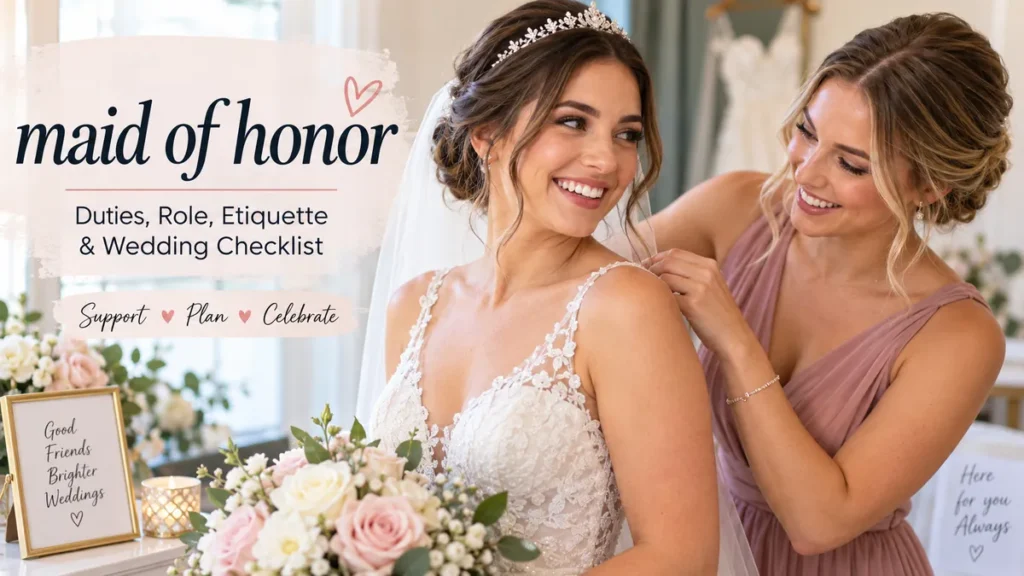
Being chosen as a maid of honor feels exciting, but the title can quickly raise a bigger question: What am I actually supposed to do? The role involves much more than standing beside the bride during the ceremony.
A maid of honor is traditionally the bride’s lead wedding attendant and one of her closest sources of practical and emotional support. She commonly helps coordinate bridesmaids, assists with pre-wedding events, supports the bride during planning, handles several wedding-day details, and often gives a reception speech. Exact responsibilities should always be agreed on rather than assumed.
The job can be meaningful and fun without becoming a second full-time occupation. The key is understanding which tasks normally belong to the role, which are optional, and where reasonable boundaries should be set.
What Is a maid of honor?
The maid of honor is typically the principal or lead attendant in the bridal party. Traditionally, the title refers to an unmarried woman chosen by the bride, often a sister, best friend, cousin, or another person with whom she has a particularly close relationship.
The equivalent traditional title for a married woman is matron of honor. The difference is primarily terminology based on marital status; the core responsibilities are essentially the same.
Modern weddings are much more flexible. A bride may have:
- One maid of honor
- A maid and matron of honor
- Two or more co-maids of honor
- A man of honor
- A person or honor attendant using a gender-neutral title
There is no requirement that the person filling the role must be a woman, unmarried, or even part of a traditionally structured bridal party.
maid of honor vs. bridesmaid
A bridesmaid is a member of the wedding party. A maid of honor generally takes on a leadership role within that group.
| Role | Bridesmaid | Maid of Honor |
|---|---|---|
| Supports the bride | Yes | Yes |
| Attends wedding events | Usually | Usually |
| Coordinates bridesmaids | Not normally | Often |
| Helps plan bachelorette party | May help | Often leads |
| Bridal shower involvement | May help | Often helps organize |
| Wedding-day problem solving | Some | Usually more |
| Holds bouquet during ceremony | Usually no | Often |
| Gives reception speech | Optional | Common |
| Acts as main bridal-party contact | Usually no | Often |
The maid of honor should not, however, be treated as an unpaid wedding planner. A professional planner, venue coordinator, photographer, caterer, florist, and other vendors remain responsible for their own work.
maid of honor Duties Before the Wedding
Most maid of honor responsibilities begin well before the wedding day.
The amount of involvement can vary dramatically. One bride may want help with nearly every decision, while another may need little more than companionship and occasional coordination.
The smartest first move is therefore simple: have an expectations conversation.
1. Discuss expectations with the bride
Ask what support would actually be useful.
Clarify issues such as:
- Which events the bride expects you to attend
- Whether you will organize the bridal shower
- Who is responsible for the bachelorette party
- How much communication with bridesmaids you should handle
- Expected travel
- Clothing and beauty costs
- Whether the bride has a wedding planner
- What she specifically wants help with on the wedding day
Clear expectations prevent the most common source of wedding-party tension: one person assuming something that another person never agreed to.
2. Help keep the bridesmaids organized
One of the most common maid of honor duties is acting as the communication link between the bride and the rest of the bridal party.
This can include reminding bridesmaids about:
- Dress ordering deadlines
- Alterations
- Rehearsal times
- Hair and makeup schedules
- Travel plans
- Ceremony arrival times
- Bridal shower arrangements
- Bachelorette details
Avoid becoming the group’s constant messenger for every tiny decision. A shared group chat, spreadsheet, or wedding itinerary can eliminate dozens of repetitive messages.
3. Support wedding dress shopping when requested
Many brides invite their maid of honor to wedding dress appointments, fittings, or accessory shopping.
Your job is not simply to praise every dress.
Useful support means giving thoughtful feedback when the bride asks for it while remembering that her preferences matter more than your personal style.
You might also attend a final fitting to learn practical details such as how to:
- Fasten complicated buttons
- Arrange the train
- Secure a bustle
- Position the veil
- Adjust detachable sleeves or accessories
Knowing those details can save significant time on the wedding day.
4. Help with bridesmaid attire
The maid of honor often helps make sure everyone understands the chosen dress, color palette, shoes, jewelry, or styling requirements.
You do not necessarily need to choose these items yourself.
Instead, focus on preventing avoidable problems such as someone ordering too late or misunderstanding the dress code.
5. Help organize the bridal shower
Traditionally, the maid of honor or bridal party may host or help organize the bridal shower, although modern etiquette allows friends and family members to host as well.
Possible responsibilities include:
- Choosing a date
- Coordinating with family
- Creating the guest list with the bride
- Selecting a venue
- Planning food and activities
- Managing invitations
- Tracking RSVPs
- Setting up decorations
- Recording gifts
Never assume that being maid of honor means paying for the entire bridal shower yourself. Hosting responsibilities and the budget should be discussed beforehand.
How Does the maid of honor Plan the Bachelorette Party?
The bachelorette party is one of the responsibilities most strongly associated with the maid of honor.
Typically, she helps coordinate the event with the rest of the bridal party.
Start by asking the bride what kind of celebration she actually wants.
A successful bachelorette event does not need to involve expensive travel or nightlife. It might be:
- A dinner
- A spa day
- A weekend trip
- A beach day
- A sleepover
- A concert
- A cooking class
- A casual house party
- A destination weekend
Build the plan around the group’s real budget
Money is one of the easiest ways to create resentment within a wedding party.
Before booking anything, determine what guests can realistically afford. Share estimated costs before requesting deposits.
Separate expenses into categories such as:
| Expense | Examples |
|---|---|
| Travel | Flights, fuel, trains |
| Accommodation | Hotel or rental |
| Food | Restaurants, groceries |
| Activities | Tours, shows, classes |
| Transportation | Rideshares, rentals |
| Bride’s expenses | Only if the group agrees |
| Decorations | Optional |
| Gifts/favors | Optional |
Do not assume every bridesmaid can afford an expensive destination weekend.
A thoughtful celebration built around the bride’s personality usually matters more than how much everyone spends.
Quick Takeaway
The best maid of honor plans the celebration people can comfortably enjoy—not the most elaborate event social media can display.
Emotional Support Is Part of the maid of honor Role
Wedding planning can involve deadlines, family expectations, financial decisions, vendor issues, and strong opinions from multiple people.
The maid of honor often becomes someone the bride can talk to when things feel stressful.
That does not mean agreeing with everything she says.
Good support may involve:
- Listening without immediately offering solutions
- Helping her prioritize
- Giving calm, practical advice
- Reminding her what actually matters
- Helping resolve minor bridal-party misunderstandings
- Redirecting unnecessary drama
The goal is not to absorb every wedding problem personally.
You are a trusted friend, not the bride’s therapist, assistant, wedding planner, chauffeur, and crisis manager rolled into one.
maid of honor Duties During the Wedding Week
As the wedding approaches, your role usually shifts from planning support to execution.
Review the timeline
Get a copy of the wedding-day schedule from the bride, wedding planner, or venue coordinator.
Know the approximate timing for:
- Hair and makeup
- Getting dressed
- Photography
- Transportation
- Ceremony
- Cocktail hour
- Reception entrance
- Speeches
- Dinner
- Special dances
- Cake cutting
- Couple’s exit
You do not need to manage every vendor. You simply need enough awareness to help the bridal party stay where they are supposed to be.
Attend the rehearsal
The rehearsal establishes practical ceremony details such as:
- Processional order
- Where everyone stands
- Who carries what
- Recessional order
- Timing
- Bouquet handoff
Traditionally, the maid of honor often enters near the end of the wedding-party processional, immediately before the bride, although ceremony order can be customized.
Pay attention during rehearsal. The wedding day is not the ideal time to discover that nobody knows where to stand.
Prepare a simple emergency kit
A small wedding-day kit can solve common wardrobe and grooming problems.
Useful items include:
- Safety pins
- Fashion tape
- Tissues
- Bobby pins
- Hair ties
- Stain-removal wipes
- Bandages
- Mints
- Sewing kit
- Phone charger
- Blotting papers
The goal is preparedness, not carrying a suitcase filled with solutions to every imaginable emergency.
maid of honor Duties on the Wedding Day
On the wedding day, the maid of honor becomes one of the bride’s main support people.
The most useful approach is to stay calm, watch the timeline, and solve minor problems without unnecessarily bringing them to the bride’s attention.
Help everyone stay on schedule
Getting-ready rooms can become chaotic.
Someone cannot find an earring. Another bridesmaid is still doing her hair. Food arrives. The photographer needs the dresses. Someone’s phone disappears.
Keep an eye on the schedule and gently move things forward.
You do not need to become a drill sergeant.
A calm reminder usually works better than creating more stress.
Help the bride get dressed
Depending on the gown, the bride may need help with:
- Buttons
- Zippers
- Jewelry
- Shoes
- Veil
- Train
- Bustle
Keep drinks, makeup, and anything that might stain the dress away from the gown while she gets ready.
Make sure the bride eats and drinks
This sounds minor until the ceremony starts and everyone realizes the bride has eaten almost nothing since breakfast.
Keep water nearby and encourage her to eat something during preparation.
Hold the bride’s bouquet
During many ceremonies, the maid of honor temporarily holds the bride’s bouquet while vows or rings are exchanged.
The exact timing should be established during rehearsal.
Adjust the train or veil
Once the bride reaches the ceremony area, check whether her train or veil needs straightening before the ceremony begins.
Do this quickly and discreetly so attention remains on the couple.
Keep personal items safe
The bride may hand you items such as:
- Phone
- Lipstick
- Tissues
- Small handbag
Agree in advance on where these belongings will stay.
Avoid becoming responsible for passports, large sums of money, expensive jewelry, marriage documents, or other high-value items unless that responsibility has been specifically discussed.
Help with the bustle
If the wedding dress has a bustle, learn how it works before the reception.
Take a picture or video during the final fitting if necessary.
Trying to decipher six hidden loops beneath layers of fabric while guests are waiting for the couple’s entrance is not ideal.
What Should a maid of honor Speech Include?
The maid of honor commonly delivers a toast during the wedding reception or, in some weddings, at the rehearsal dinner.
A strong speech does not need to be complicated.
A simple structure works well:
- Introduce yourself briefly.
- Explain your connection to the bride.
- Share one meaningful story.
- Say something positive about the bride’s partner.
- Reflect on the couple together.
- Offer warm wishes.
- Invite everyone to raise a glass.
Keep the focus on the couple
One common mistake is spending most of the speech telling stories about your own friendship with the bride.
Your relationship provides context, but the wedding celebrates the couple.
Choose a story that reveals something meaningful about the bride’s personality, values, humor, kindness, or relationship.
What should you avoid in a maid of honor speech?
Leave out:
- Stories involving ex-partners
- Humiliating memories
- Private relationship information
- Sexual jokes that might embarrass the couple
- Family disputes
- Inside jokes nobody understands
- Complaints about wedding planning
- Stories requiring a long explanation
Humor is welcome when it is affectionate rather than humiliating.
Current wedding guidance similarly emphasizes keeping the toast heartfelt, relatively brief, and focused on the couple rather than turning it into a performance about the speaker.
maid of honor vs. Matron of Honor
The difference between a maid of honor and matron of honor is straightforward.
Traditionally:
- Maid of honor: unmarried lead attendant
- Matron of honor: married lead attendant
Their responsibilities are otherwise essentially identical, and neither role automatically outranks the other.
Can you have both a maid and matron of honor?
Yes.
A bride can have one of each or multiple honor attendants.
For example, she might choose her unmarried sister as maid of honor and her married best friend as matron of honor.
When two people share the role, divide responsibilities clearly.
One might manage bridesmaid communication while the other organizes the bridal shower. One might take primary responsibility for the bachelorette party while the other handles wedding-day items.
What matters is avoiding vague shared responsibility where everyone assumes somebody else is handling the task.
Can you have two maids of honor?
Yes.
Modern weddings regularly include co-maids of honor or multiple lead attendants.
There is no universal etiquette rule limiting a bride to one.
The bride should simply determine:
- Who stands closest during the ceremony
- Processional order
- Who holds the bouquet
- Whether both give speeches
- How planning duties will be divided
Clear logistics matter much more than traditional ranking.
Who Should Be Chosen as maid of honor?
The obvious choice is not always the best choice.
A maid of honor is often the bride’s sister or best friend, but relationship titles alone should not determine the decision.
Look for someone who is:
- Trusted
- Dependable
- Supportive
- Organized enough for the role
- Comfortable communicating
- Able to remain calm
- Genuinely happy for the couple
Availability matters too.
A deeply loved friend who lives overseas, has demanding family responsibilities, or cannot afford extensive travel can still be an excellent maid of honor—but expectations may need adjusting.
Does your maid of honor have to be your best friend?
No.
There is no requirement that the maid of honor must be the bride’s single closest friend.
She can be a:
- Sister
- Cousin
- Childhood friend
- College friend
- Close relative
- Future sister-in-law
- Longtime family friend
Choose based on trust and the relationship itself rather than what looks traditional.
How Much Does a maid of honor Pay For?
There is no universal amount a maid of honor must spend.
Costs vary significantly depending on the wedding, location, travel requirements, attire, and pre-wedding celebrations.
Possible expenses can include:
- Bridesmaid dress or attire
- Alterations
- Shoes
- Travel
- Hotel
- Wedding gift
- Bridal shower contribution
- Bachelorette expenses
- Hair and makeup if not covered by the couple
The maid of honor is not automatically responsible for paying for the entire bridal shower or bachelorette party.
Costs should be discussed openly.
The bride should also consider the financial reality of the person she chooses. Being given an honorary role should not create pressure to take on debt.
A practical rule for money
Never book a group expense before everyone knows the approximate price and has agreed to participate.
That single habit prevents many wedding-party conflicts.
What a maid of honor Is Not Responsible For
Many online checklists make the role sound endless.
Some expectations simply go too far.
Unless specifically agreed upon, the maid of honor should not be expected to:
- Plan the entire wedding
- Negotiate vendor contracts
- Pay for major wedding expenses
- Solve every family dispute
- Be available every day
- Run the reception
- Clean the venue alone
- Constantly answer bridesmaid questions that vendors should answer
- Sacrifice work or family responsibilities without discussion
Professional responsibilities should remain with the appropriate professionals.
If there is a wedding planner or coordinator, let that person coordinate vendors.
The maid of honor’s role is primarily personal support and bridal-party leadership.
Common maid of honor Mistakes to Avoid
Even well-intentioned attendants can make the role harder than necessary.
Taking over the wedding
Helping does not mean deciding.
Give opinions when requested, but remember whose wedding it is.
Creating an expensive bachelorette plan without checking
Never assume that the bridal party can comfortably afford a destination trip.
Ask first.
Waiting until the reception to write the speech
A thoughtful speech deserves preparation.
Writing it earlier gives you time to remove weak jokes, shorten unnecessary stories, and practice speaking naturally.
Becoming the source of bridal-party drama
If two people disagree about dresses, travel, money, or schedules, do not make the situation bigger.
Focus on practical solutions.
Trying to solve everything yourself
Delegate.
Bridesmaids can help with shower setup, transportation, decorations, bachelorette planning, and other tasks.
Being lead attendant does not mean doing every job personally.
A Practical maid of honor Checklist
Here is a simple timeline covering the responsibilities most likely to matter.
After being asked
- Talk about expectations
- Discuss wedding dates and major events
- Clarify financial commitments
- Meet or connect with bridesmaids
- Save important deadlines
During wedding planning
- Attend dress shopping when requested
- Help coordinate bridesmaid attire
- Support the bride with selected tasks
- Help organize the bridal shower
- Plan or coordinate the bachelorette party
- Keep bridal-party communication organized
One month before the wedding
- Review the wedding timeline
- Confirm travel plans
- Check bridesmaid logistics
- Start or finish your speech
- Confirm ceremony responsibilities
- Learn how the bride’s bustle works
Wedding week
- Attend rehearsal
- Review the processional
- Pack an emergency kit
- Practice your speech
- Confirm getting-ready times
- Check transportation arrangements
Wedding day
- Help the bride get ready
- Keep the bridal party on schedule
- Make sure the bride eats and stays hydrated
- Help with veil, train, and bustle
- Hold the bouquet when required
- Assist during photographs
- Give your speech
- Help resolve minor problems calmly
After the reception
Some brides may ask the maid of honor to help confirm that personal belongings, cards, gifts, or clothing make it to the right person after the reception. This is a common post-wedding responsibility, but it should be coordinated in advance rather than improvised at the end of the night.
How to Be a Great maid of honor Without Burning Out
Being excellent at the role is not about completing the longest checklist.
It comes down to three things: communication, reliability, and perspective.
Communicate early when something is unclear.
Follow through when you agree to handle a task.
And remember that the objective is not to create a flawless wedding. It is to support someone you care about during an important life event.
Set realistic boundaries when necessary. If you cannot afford a trip, say so early. If your work schedule prevents you from attending an appointment, communicate that. If responsibilities have become overwhelming, ask the bridal party to divide them.
A dependable maid of honor who handles five agreed-upon responsibilities well is far more valuable than someone who volunteers for twenty and becomes exhausted.
Final Thoughts on the maid of honor Role
A maid of honor is the bride’s lead attendant and trusted supporter before, during, and often immediately after the wedding. Typical duties include coordinating the bridal party, helping with the bridal shower and bachelorette celebration, assisting with wedding-day logistics, standing beside the bride during the ceremony, and giving a reception toast.
But traditions are guidelines, not a fixed job contract.
Every wedding, friendship, budget, and bridal party is different. The most effective approach is to discuss expectations early, divide responsibilities clearly, respect financial and personal boundaries, and focus on the part of the role that matters most: showing up for the bride as a calm, dependable person she trusts.