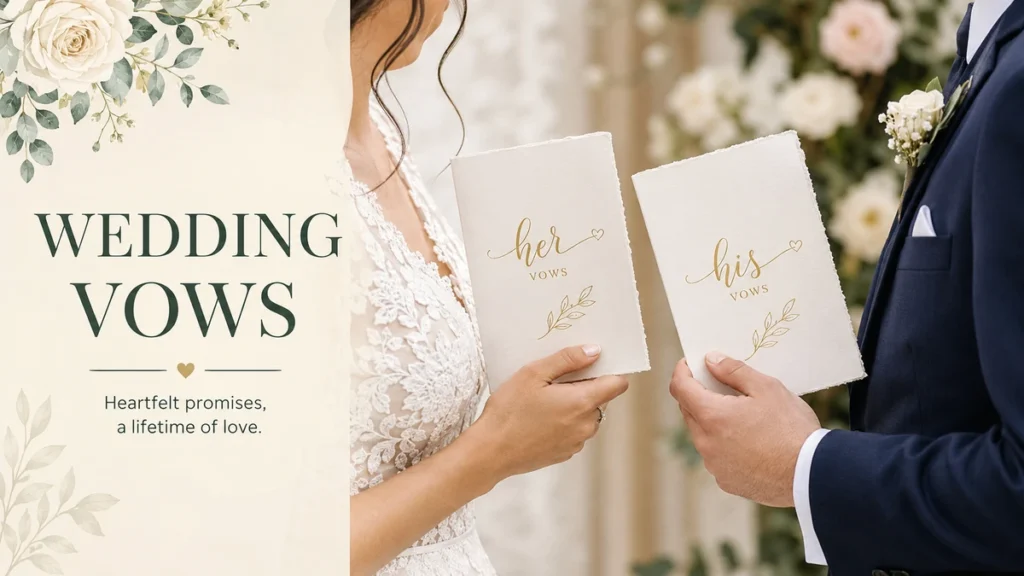
Wedding vows can feel surprisingly difficult to write. You may know exactly how much you love your partner, yet putting that love into a few meaningful sentences—then saying them aloud in front of everyone you care about—is another matter entirely.
The best wedding vows are not the most poetic or dramatic. They are sincere promises about the marriage you intend to build. They usually express love, acknowledge your relationship, make specific commitments, and look toward your shared future. Traditional vows use established wording, while personal vows let couples tell their own story and choose promises that reflect their relationship.
Whether you want traditional wedding vows, romantic promises, something short and simple, or completely personalized vows, understanding what vows are supposed to accomplish makes writing them much easier.
What Are Wedding Vows?
Wedding vows are promises two people make to each other during their wedding ceremony. They express commitment and describe how each partner intends to love, support, respect, and remain faithful to the other throughout married life.
The vow exchange is different from simply saying, “I do.”
During many ceremonies, the officiant first asks a declaration-of-intent question such as whether each person freely chooses the other as a spouse. The couple answers affirmatively. The vows then express the promises behind that decision.
Some couples repeat established words after their wedding officiant. Others memorize or read personal vows they have written themselves. A ceremony may also combine traditional language with original promises.
At their heart, marriage vows answer three questions:
- Why am I choosing you?
- What am I promising you?
- What kind of life do I want us to build together?
Everything else—stories, humor, quotations, religious language, and romantic details—supports those central ideas.
Why Wedding Vows Matter
Flowers disappear, dinner ends, and photographs capture only pieces of the day. Your vows are different because they describe what comes after the celebration.
That is why strong vows focus on marriage rather than simply the wedding.
“I love you” matters, but a vow goes further. It says what that love will look like when life is ordinary, stressful, joyful, uncertain, or changing.
Promises such as listening carefully, encouraging your partner’s ambitions, protecting time together, communicating honestly, sharing responsibilities, and staying present during difficult seasons turn an emotion into a commitment.
That distinction is what gives vows their weight.
Traditional Wedding Vows and Their Meaning
Many familiar English-language traditional wedding vows have roots in Christian marriage liturgy and the Book of Common Prayer. The 1549 edition associated with Thomas Cranmer, Archbishop of Canterbury, helped establish wording that influenced English wedding ceremonies for centuries.
Phrases such as “to have and to hold,” “for better, for worse,” “for richer, for poorer,” and “in sickness and in health” became especially recognizable.
Modern ceremonies use numerous variations, and the wording depends on religious tradition, denomination, culture, officiant, and local requirements.
A familiar traditional-style version might read:
I take you to be my spouse, to share my life with you from this day forward. I promise to stand beside you in happiness and hardship, in abundance and difficulty, in sickness and in health, loving and cherishing you for all the days of our lives.
The power of traditional vows comes partly from their simplicity. Instead of describing one couple’s individual love story, they identify enduring responsibilities of marriage.
What the Classic Promises Actually Mean
“To have and to hold” expresses companionship and belonging to a shared life.
“For better, for worse” recognizes that marriage includes both celebration and difficulty.
“For richer, for poorer” acknowledges that financial circumstances can change without changing the commitment.
“In sickness and in health” promises care when either partner becomes vulnerable.
“To love and to cherish” goes beyond feeling affection. Cherishing someone means treating that person as valuable through attention, respect, and care.
“Till death do us part” traditionally expresses lifelong commitment.
The wording is old, but the underlying promises—presence, loyalty, care, resilience, and partnership—remain relevant to modern relationships.
Religious and Cultural Traditions Are Not Interchangeable
There is no single universal set of traditional wedding vows.
Catholic, Protestant, Anglican, Eastern Orthodox, Jewish, Hindu, Muslim, Quaker, interfaith, secular, civil, and other wedding traditions can approach marriage promises very differently. Some include spoken vows; others place greater emphasis on blessings, declarations, contracts, prayers, rituals, or prescribed liturgical language.
For example, Jewish ceremonies traditionally center important elements such as the ketubah, blessings, ring exchange, and other customs rather than simply reproducing familiar Christian-style vows. Hindu weddings may incorporate promises connected with the Saptapadi, or seven steps, depending on the tradition and ceremony.
This matters when planning your own ceremony.
If religion or cultural heritage is important to you, speak with your officiant, clergy member, celebrant, or knowledgeable family members before adapting ceremonial language. Some religious communities require specific wording or particular elements for a marriage ceremony to follow their tradition.
Traditional vs. Personal Wedding Vows
Neither approach is inherently more meaningful.
Traditional vows connect your ceremony with words spoken by generations of couples. Personal wedding vows give you freedom to describe your specific relationship.
The right choice depends on what you want the moment to feel like.
| Traditional Wedding Vows | Personal Wedding Vows |
|---|---|
| Established wording | Written by the couple |
| Usually concise | Length can be customized |
| Formal and timeless | Personal and conversational |
| Often connected to religious or cultural tradition | Can be religious or secular |
| Less writing pressure | Requires preparation |
| Partners usually make matching promises | Each person can express different memories and promises |
You do not necessarily have to choose one or the other.
A couple might repeat formal marriage vows during the ceremony and then exchange personal promises afterward. Another option is to preserve the structure of classic vows while rewriting the language in a voice that feels natural.
Should You Write Your Own Wedding Vows?
Personal vows work particularly well when you want the ceremony to reveal something genuine about your relationship.
Consider writing your own if you want to:
- explain what your partner means to you;
- include meaningful moments from your relationship;
- make promises specific to your shared life;
- use language that sounds like the way you actually speak;
- incorporate gentle humor or inside references;
- acknowledge the journey that brought you to marriage.
Traditional vows may be a better fit if public speaking makes you uncomfortable, your faith uses prescribed language, you prefer a formal ceremony, or you simply find established vows more meaningful.
Using traditional words is not taking an easier or less personal route. Sometimes centuries-old language says exactly what a couple wants to promise.
How to Write Wedding Vows That Sound Like You
A blank document makes writing vows seem harder than it needs to be.
Do not begin by trying to produce a perfect speech. Start by collecting memories and promises. Editing comes later.
A reliable process looks like this:
- Agree on expectations with your partner.
- Write down meaningful memories.
- Identify what you admire about your partner.
- Decide what marriage means to you.
- Choose several genuine promises.
- Organize everything into a simple structure.
- Edit for clarity and length.
- Read the vows aloud.
- Prepare a clean final copy.
1. Agree on the Basics Before Writing
You do not need to show each other your actual vows, but you should agree on their general shape.
Discuss the approximate length, tone, level of humor, religious references, and whether stories or private details are appropriate.
This prevents an awkward mismatch where one partner prepares a deeply emotional five-minute speech and the other brings six funny sentences.
You can preserve the surprise while agreeing on the framework.
2. Brainstorm Before You Draft
Think about your relationship without worrying about elegant wording.
Ask yourself:
- When did I realize this relationship was different?
- What quality do I admire most in my partner?
- How has this person changed my life?
- When has my partner supported me?
- What ordinary moments make our relationship special?
- What have we already overcome together?
- What am I excited to experience with this person?
- What kind of spouse do I want to be?
- Which promises will matter five, ten, or thirty years from now?
Specific memories are usually more powerful than generic praise.
“You make me happy” is sincere but broad.
“You somehow make even our Sunday grocery run feel like time I want to remember” tells the listener something about the relationship.
3. Start With What Your Partner Means to You
Your opening does not need to sound like literature.
Say something true.
You might describe your partner as your closest friend, safest place, favorite adventure companion, greatest supporter, or the person who makes ordinary life more meaningful.
For example:
You have taught me that a good life does not need to be perfect. It needs laughter, patience, honesty, and someone who will sit beside you when the plan falls apart.
That sounds personal because it communicates a point of view rather than relying only on romantic adjectives.
4. Include One Meaningful Story
A short story gives emotional context to your promises.
You could mention your first meeting, an unexpected trip, a difficult period you navigated together, the moment you knew you wanted to marry, or a tiny everyday memory that captures your relationship.
Keep it brief.
Your wedding vows are not the complete history of your relationship. One carefully chosen memory is usually stronger than a chronological account of every milestone.
5. Make Actual Promises
This is the part people sometimes forget.
A love letter explains how you feel. A wedding vow explains what you promise to do with that love.
Include several commitments that you can realistically keep.
Meaningful wedding promises might include:
- listening before reacting;
- communicating honestly;
- supporting each other’s goals;
- protecting your partnership during difficult periods;
- celebrating each other’s successes;
- making room for individual growth;
- sharing responsibilities;
- approaching disagreements with respect;
- continuing to make time for each other;
- choosing curiosity instead of assumptions;
- offering comfort when life becomes difficult;
- keeping laughter in your home.
Promises can be emotional and practical.
In fact, combining both often produces the strongest vows.
“I promise to support your dreams” has emotional weight.
“I promise to make coffee when you’ve had a terrible night’s sleep” brings that commitment into everyday life.
6. Look Toward Your Future
After explaining the relationship you have today, acknowledge the marriage you are beginning.
You might talk about growing older, creating a home, raising a family if that is part of your plans, traveling, building traditions, surviving uncertainty, or simply continuing to discover who each of you becomes.
Avoid promising that everything will always be easy.
A mature vow recognizes that neither person can predict the future. The promise is to meet that future together.
7. Finish With a Clear Commitment
Your final line should feel definitive.
Something simple often works best:
Whatever changes around us, I promise to keep choosing the life we are building together.
Or:
Today I choose you as my partner, and I will keep choosing you through every season that comes next.
The ending does not need another story or dramatic flourish. Let the commitment land.
A Simple Wedding Vows Template
If you are still staring at an empty page, use this framework:
Part 1: Address Your Partner
Begin naturally with their name or a simple statement about what the moment means.
Part 2: Describe Your Relationship
Explain what you love or admire about them.
Part 3: Include a Specific Memory
Choose one moment that demonstrates why the relationship matters.
Part 4: Make Your Promises
Include roughly three to six commitments. Mix serious promises with one or two details that reflect your real life together.
Part 5: Describe the Future
Say what you hope to build, experience, or protect together.
Part 6: End With Commitment
Close with one strong sentence expressing your choice and love.
Put together, the structure becomes:
[Name], you are ________.
I knew ________ when ________.
You have taught me ________.
I promise to ________.
I promise to ________.
I promise to ________.I cannot know everything our future will bring, but I know ________.
Today and throughout our marriage, I choose you.
Treat this as scaffolding rather than a fill-in-the-blank formula. Once your ideas are on the page, rewrite the sentences until they sound like something you would genuinely say.
Wedding Vows Examples for Different Styles
Examples are useful for discovering structure and tone, but your final vows should reflect your own relationship.
Instead of copying someone else’s emotional language, notice why a particular example works. Then apply the technique to your own story.
Romantic Wedding Vows Example
You are the person I want beside me when something wonderful happens and the person I look for when everything goes wrong. Loving you has made my life bigger, warmer, and more honest.
I promise to listen to you, encourage you, and respect the person you are still becoming. I promise to celebrate your victories without competition and meet your difficult days with patience. I will protect the trust between us and never treat your love as something I am simply entitled to.
I cannot promise a perfect life, but I can promise that you will not have to face it alone. Today I choose you, and I will continue choosing you through every version of the future we create.
Notice that the promises are not limited to declarations of love. They describe behaviors: listening, encouraging, respecting, celebrating, and protecting trust.
Short Wedding Vows Example
I choose you as my partner and my closest friend. I promise to respect you, listen to you, laugh with you, and stand beside you when life becomes difficult. I will celebrate who you are today while supporting who you become tomorrow. I love you, and I choose our life together.
Short wedding vows can still feel complete when they contain affection, promises, and commitment.
Simple Wedding Vows Example
You make my life happier simply by sharing it with me. I promise to be honest with you, patient with you, and present for you. I promise to support your dreams and ask for your support when I need it. Through the easy days and the difficult ones, I will keep working with you to build a marriage based on love, trust, friendship, and respect.
Simple language often sounds more authentic aloud than complicated metaphors.
Heartfelt Wedding Vows Example
Before you, I thought love was mostly about finding the right person. You taught me that lasting love is also about how two people choose to treat each other every day.
I promise to keep learning how to love you well. I will listen when you need to be heard, make space for your dreams, apologize when I am wrong, and remember that we are on the same team even when we disagree.
I promise to notice the ordinary moments because I know those moments will become most of our life. I am grateful that I get to share them with you.
The strongest line here is not necessarily the most romantic one. Promising to apologize and remember that you are on the same team gives the vow substance.
Funny Wedding Vows Example
I knew I had found my person when I realized you were the only human being I could happily spend an entire weekend doing absolutely nothing with.
I promise to love you when you steal the blankets, support your ambitious plans, pretend not to notice when you take food from my plate, and tell you when there is something in your teeth.
More seriously, I promise to make our home a place where you can always be yourself. I will listen, communicate, and stand beside you when life is far less funny than we hoped.
You are my favorite person to laugh with, and I cannot wait to spend a lifetime finding new reasons to laugh together.
Funny wedding vows work when humor reveals affection rather than turning the vow exchange into a comedy routine.
Modern Wedding Vows Example
I do not promise to complete you, because you are already whole. I promise instead to be your partner.
I will respect your independence while protecting the life we share. I will encourage your ambitions, tell you the truth with kindness, and give our relationship the attention it deserves.
As we grow and change, I promise to remain curious about who you are becoming rather than assuming I already know everything about you. I choose a marriage where both of us can grow individually and still keep growing together.
Modern vows often emphasize equality, partnership, individual identity, communication, and mutual growth.
How Long Should Wedding Vows Be?
For many ceremonies, about one to two minutes per person is enough to communicate something meaningful without turning the vow exchange into a speech.
There is no universal rule.
What matters more is that both partners agree on approximately the same length. Your officiant may also have recommendations based on the ceremony format.
Read your draft aloud with a timer.
Speaking emotionally and pausing naturally takes longer than silently reading words on a screen. If you repeatedly stumble over a paragraph, shorten it instead of trying to memorize a complicated sentence.
The best test is simple: Does every line contribute something?
If removing a sentence changes nothing, remove it.
What Should You Promise in Wedding Vows?
The strongest promises combine universal commitments with personal ones.
Foundational Promises
These are the commitments that support a healthy partnership:
- honesty;
- loyalty;
- respect;
- compassion;
- communication;
- emotional support;
- patience;
- shared responsibility;
- commitment during hardship.
Personal Promises
These make the vows recognizably yours:
- protecting a weekly ritual you both love;
- continuing to travel together;
- encouraging a particular dream;
- making space for a beloved hobby;
- keeping a specific family tradition;
- dancing in the kitchen;
- bringing snacks on road trips;
- making your partner laugh when they are overwhelmed.
Personal details create intimacy, but they should support rather than replace meaningful marriage promises.
A vow made entirely of inside jokes may entertain your guests while saying surprisingly little about your commitment.
How to Make Wedding Vows Personal Without Oversharing
Personal does not have to mean private.
A good test is to imagine your partner hearing the story in front of grandparents, friends, coworkers, and family members.
Would they feel loved—or exposed?
Avoid mentioning something merely because it will surprise the audience. Sensitive family issues, previous relationships, private arguments, embarrassing stories, financial problems, intimate details, or unresolved conflicts rarely belong in public vows.
When in doubt, ask:
Does this detail honor my partner?
If the answer is uncertain, save it for a private letter.
Consider Private Vows
Some couples exchange personal vows privately before the ceremony and use traditional or shorter promises during the public ceremony.
This can be especially meaningful for people who dislike public speaking or want to discuss experiences too intimate for an audience.
Private vows also allow you to speak freely without worrying about timing or guests.
Mistakes That Make Wedding Vows Less Effective
Beautiful vows rarely fail because someone is not a skilled writer. Problems usually come from trying too hard to make the moment impressive.
Turning Vows Into a Biography
Your guests do not need your complete relationship timeline.
Choose one or two moments that reveal something important.
Making Only Statements, Not Promises
“You’re kind, beautiful, intelligent, and funny” is affectionate praise.
It is not yet a vow.
Follow admiration with commitment:
Your kindness has changed how I understand love, and I promise to return that kindness in the way I speak to you and care for you.
Using Too Many Quotations
A favorite poem, book, film, song, or piece of literature can inspire your writing, but another person’s words should not dominate your vows.
Your partner wants to hear you.
If you use copyrighted material, especially song lyrics or contemporary writing, remember that publishing or reproducing substantial portions can also raise copyright issues. Paraphrasing an idea and explaining why it matters to your relationship is often more personal anyway.
Promising the Impossible
Avoid promises such as “I will never disappoint you,” “we will never fight,” or “I will make you happy every day.”
Marriage involves imperfect people.
Promise actions you can actually practice: honesty after a mistake, respect during disagreements, willingness to repair conflict, patience during difficult periods, and continued effort.
Using Humor at Your Partner’s Expense
Teasing works only when the person being teased enjoys it too.
Avoid jokes about appearance, family, money, ex-partners, insecurities, habits your partner genuinely dislikes, or reluctance to marry.
The audience should laugh with your partner, not at them.
Trying to Sound Like Someone Else
A sentence can be beautiful on paper and still sound unnatural coming from you.
If you would never normally say “my soul has wandered the universe seeking yours,” do not suddenly become that person at the altar.
Simple sincerity is stronger than borrowed grandeur.
How to Edit Your Wedding Vows
The first draft is for discovering what you want to say. The second is where good vows usually emerge.
Read your draft aloud and edit anything that feels unnatural.
Remove Repetition
If three paragraphs communicate that your partner makes you feel safe, keep the strongest one.
Replace Generic Language With Specific Details
Instead of:
You always support me.
Try:
You are the person who reminds me what I am capable of when I have forgotten it myself.
The idea remains universal, but the expression feels personal.
Check the Balance
A complete vow usually contains some combination of:
past: what brought you here;
present: what your partner means to you;
promise: what you commit to doing;
future: what you hope to build together.
You do not need equal space for all four, but having each element creates a satisfying emotional arc.
Cut Anything Written for the Audience
The vow is addressed to your partner.
Guests are witnesses, not the primary audience.
When you edit, remove lines included mainly because you expect them to produce laughter, applause, or tears.
That single change often makes vows considerably more intimate.
How to Practice Wedding Vows Without Making Them Sound Rehearsed
Practice is not about memorizing every word.
It is about becoming familiar enough with the language that you can focus on your partner rather than decoding your handwriting.
Read the vows aloud several times before the wedding.
Pay attention to sentences where you run out of breath or consistently stumble. Those sentences are probably too long.
Mark natural pauses.
Slow down.
Emotion makes people speed up, especially when speaking in front of guests.
If you become emotional during the ceremony, stop for a moment. There is no need to apologize. Take the time you need and continue when you are ready.
Should You Memorize Your Wedding Vows?
You can, but you do not have to.
Reading your vows is completely normal, and having the text in front of you reduces pressure.
Even if you plan to memorize them, keep a written copy nearby. Wedding-day emotions can make familiar words suddenly disappear.
A vow booklet or neatly printed card is easier to manage than reading from a phone. It also avoids notifications, screen-lock problems, low batteries, and awkward scrolling during the ceremony.
Give a backup copy to your officiant or another trusted person.
Wedding Vows for Different Kinds of Ceremonies
Your vows should fit the ceremony around them.
Religious Ceremonies
Ask your clergy member or officiant whether specific language is required.
Some traditions allow personal vows alongside formal liturgical promises. Others maintain prescribed wording. Do not rewrite religious vows until you understand what your particular ceremony permits.
Civil and Secular Ceremonies
Civil ceremonies may offer more flexibility, although legal requirements vary by jurisdiction.
Your officiant or marriage authority can explain whether a particular declaration must be spoken for the marriage to be legally recognized. Personal vows can then be incorporated around any required wording.
Interfaith Ceremonies
Interfaith couples often combine traditions carefully rather than treating them as interchangeable.
Discuss which rituals, blessings, promises, and terminology genuinely represent each person’s beliefs. An experienced interfaith officiant can help create a coherent ceremony that respects both backgrounds.
LGBTQ+ Wedding Vows
Wedding vows do not need gendered roles unless the couple wants them.
Words such as “partner” or “spouse” can replace “husband” and “wife,” and traditional language can often be adapted to reflect an equal partnership.
What matters is that the wording accurately represents the people making the promises.
Vow Renewals
Vow renewal promises can acknowledge a history that newlyweds do not yet share.
Rather than speaking only about hopes for the future, couples can reflect on promises already tested by time—raising children, career changes, illness, moves, loss, achievements, ordinary routines, and years of companionship.
A renewal can ask a different question:
Not simply “What do I promise?” but “After everything we have experienced, what do I choose again?”
Should Both Partners’ Vows Match?
They do not need identical words.
In fact, personal vows usually sound better when each person writes independently.
What should match is the general scale of the moment.
Agree beforehand on:
- approximate speaking time;
- serious versus humorous tone;
- whether religious language will be included;
- whether you will mention stories;
- whether private jokes are acceptable;
- whether you will make a similar number of promises.
You can ask your officiant or a trusted friend to review both sets without revealing them to either partner. That person can flag a major imbalance while preserving the surprise.
What Makes Wedding Vows Truly Memorable?
Memorable wedding vows are rarely memorable because they contain a perfect quotation.
They stay with people because they sound unmistakably true.
The strongest vows tend to share five qualities.
They are specific.
They could not simply be copied and addressed to anyone.
They contain promises.
The speaker commits to actions, not only feelings.
They sound natural aloud.
The language resembles the speaker’s real voice.
They recognize reality.
They acknowledge that marriage will include difficult as well as joyful seasons.
They focus on the partner.
They are written for the person standing across from you rather than the audience watching.
That is also why an ordinary detail can sometimes carry more emotional weight than an elaborate metaphor.
A promise to make space for your partner’s dreams, sit beside them during hard days, keep talking when communication becomes uncomfortable, or continue a tiny ritual you both treasure tells us what your love actually looks like.
A Final Checklist Before the Ceremony
Before calling your wedding vows finished, check that they do the following:
- explain why your partner matters to you;
- include at least one specific detail;
- contain genuine marriage promises;
- acknowledge your shared future;
- sound like your natural speaking voice;
- avoid embarrassing your partner;
- fit the agreed length;
- complement the tone of the ceremony;
- respect any religious or legal requirements;
- have been practiced aloud;
- exist in a readable final copy;
- have a backup copy with someone trustworthy.
Then stop editing.
There comes a point when polishing every sentence starts removing the personality that made the vows meaningful in the first place.
Final Thoughts on Wedding Vows
Wedding vows do not need to prove how romantic, funny, creative, or eloquent you are. Their purpose is much simpler and more significant: to tell your partner what you are choosing and what you promise to bring to your marriage.
Traditional vows accomplish this through enduring language about love, loyalty, hardship, health, and lifelong commitment. Personal wedding vows accomplish it through your own memories, values, promises, and hopes.
If you are writing yours from scratch, begin with the person rather than the performance. Remember one meaningful moment. Say what you admire. Make promises you can genuinely live by. Look toward the future. Then read everything aloud and remove any sentence that does not sound like you.
Your wedding vows do not have to be perfect.
They have to be yours.