So, you’ve spent your nights sweating through high-energy Charleston kicks and rhythmic triple steps, but lately, you’ve been eyeing that other side of the ballroom. You know the one, where the music is a bit moodier, the movements are buttery smooth, and nobody seems to be hopping.
Transitioning from Lindy Hop to West Coast Swing dance is one of the most common “cross-training” paths in the swing world. On paper, they share a family tree. In practice? It feels like trying to speak French with a Spanish accent. You have the vocabulary, but the inflection is all wrong.
If you’re ready to trade your vintage Keds for some suede-soled Westie boots, here is how to bridge the gap without losing your mind (or your rhythm).
The Culture Shock: Bounce vs. Flow
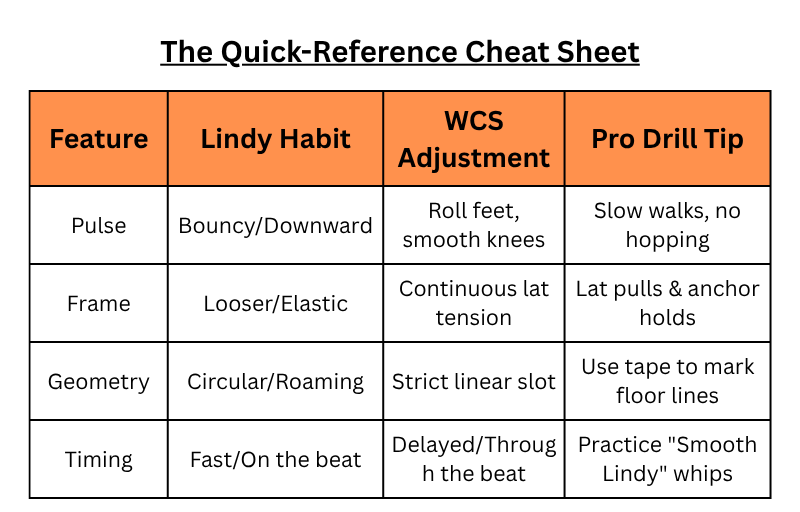
The biggest hurdle for any Lindy Hop veteran is the “pulse.” In Lindy, the dance is driven by a rhythmic, hip-downward bounce that mirrors the “swing” of jazz music. It’s grounded, athletic, and joyful.
West Coast Swing dance, however, lives in a linear world of “rolling” through the floor. If Lindy is a bouncy ball, West Coast is a sliding drawer.
How to Adjust Your Footwork
To make the switch, you have to stop jumping. Instead of that downward driving pulse, focus on rolling through the full foot (heel-to-toe).
- The Drill: Practice walking across your living room without your head changing height. Think “and-a-one-ee-and-uh-two-ee.”
- The Feel: You want to bend your knees on the “&” counts to create a smooth weight transfer. It should feel like you are walking through honey, not jumping over puddles.
Connection: From “Looser Frame” to “Continuous Tension”
In Lindy Hop, the connection is often elastic and explosive. You might have a slightly looser frame to allow for those wild swivels or aerials.
In West Coast Swing dance, the connection is more surgical. It relies on a constant, refined tension, specifically in your lat muscles. You aren’t “holding” your partner as much as you are “weight-sharing” with them.
Posture Tweaks
- The Slot: Lindy is circular; you roam the floor like you’re in a blender. West Coast happens in a “slot”, a 10-to-12-foot linear path.
- The Anchor: This is the Westie “Holy Grail.” While Lindy dancers often finish a move and immediately “go” again, West Coast followers must learn to “anchor” their left hip back, settling into their triple step before the next move begins. Don’t rush the exit!
Mastering the “Slot” Discipline
Leaders, this one is on you. In a Lindy Hop circle or swing-out, you can go almost anywhere. In West Coast Swing dance, you are the gatekeeper of a very narrow hallway.
You must stay linear. Every signal for a direction change happens within that 180-degree plane. If you start leading diagonals, your partner will feel like they’re being tossed off a cliff. Think of it as a conversation on a tightrope rather than a party in a park.
Timing: The Music Shift
Lindy is fast. It’s “Sing, Sing, Sing” at 200 BPM. You step on the beat because if you don’t, you’re left behind.
West Coast Swing dance is often danced to slower R&B, pop, or blues. This means you have to learn the art of the “delay.” You aren’t just hitting the beat; you are dancing through the beat. This “melodic flow” is what gives West Coast its sexy, laid-back aesthetic.
How Long Does the “Switch” Take?
Don’t get discouraged if you feel “clunky” for the first few weeks. Most dancers find that it takes about 4 to 8 weeks of consistent practice to strip away the Lindy bounce and replace it with the Westie roll.
The good news? Your knowledge of “Whips” in Lindy Hop gives you a massive head start on the mechanics of a West Coast Whip. You already know how the rotation works; you just need to “smooth out the edges.”
Your Next Step
Try a “Smooth Lindy” drill tonight. Put on a slow blues track and dance your standard Lindy patterns, but try to keep your head perfectly level. No bouncing, no hopping… just pure, slotted movement.