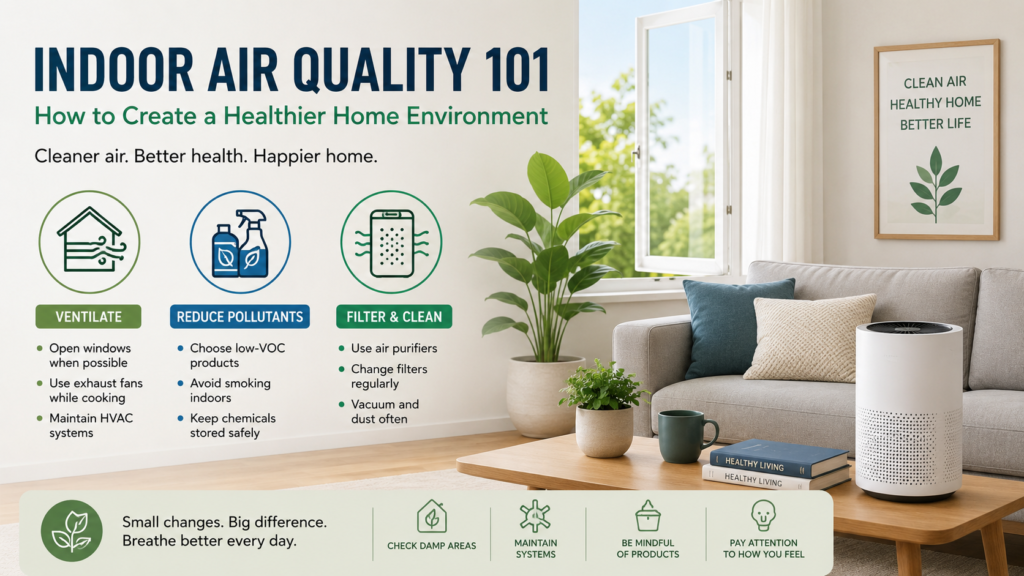
Most of us spend the vast majority of our time indoors, yet give very little thought to the air we’re actually breathing. If your allergies seem to flare up at home, or a room feels stale no matter how often you clean it, indoor air quality could be the culprit. Addressing it usually calls for a layered approach — better ventilation, cutting down on pollutant sources, and adding filtration tools like an air purifier to your broader home care routine. What follows is a practical framework for understanding what shapes indoor air and what you can realistically do to improve it.
Understanding Indoor Air Quality
Indoor air quality (IAQ) describes the condition of the air inside a building and its effect on the health and comfort of the people living there. Three main factors drive it: pollutant sources, how effectively the space is ventilated, and the everyday habits of its occupants.
Poor IAQ doesn’t always announce itself with a noticeable smell or any visible sign. Common indoor pollutants fall into three broad categories:
- Particulate matter — dust, pet dander, pollen, and smoke particles that remain suspended in the air and can be inhaled.
- Gaseous pollutants — volatile organic compounds (VOCs) off-gassed by paints, cleaning products, and adhesives, along with combustion byproducts from cooking or heating.
- Biological contaminants — mold spores, bacteria, and dust mites that thrive wherever spaces are damp or poorly ventilated.
Public health and environmental agencies note that pollutant levels can vary considerably from one home to the next, depending on building materials, location, and daily habits — everything from cooking methods to the use of scented products.
Key takeaway: Most homes contain a mix of particles, gases, and biological contaminants — often generated by entirely ordinary, everyday activities.
How Poor Air Quality Can Affect You
The short-term effects of poor IAQ tend to be non-specific: irritated eyes, nose, or throat, persistent headaches, fatigue, or a noticeable worsening of asthma and allergy symptoms. Many things can cause these same complaints, but if your symptoms reliably improve when you leave the house and return once you’re back inside, the air in your home is worth a closer look.
Research associated with reputable health organizations suggests that long-term exposure to certain indoor pollutants — particularly fine particles and some chemical gases — may contribute to more serious respiratory and cardiovascular concerns over time. Sensitive groups, including children, older adults, and anyone with an existing respiratory condition, are generally at greater risk. It’s worth noting that this article provides general information only and is not a substitute for advice from a qualified healthcare professional.
Spotting Potential Problems at Home
Several observable clues can point to an air quality issue: a persistent musty odor, visible mold growth, frequent condensation on windows, dust that seems to accumulate unusually fast, or recurring respiratory discomfort tied to a particular room. Consider a family in a damp ground-floor apartment who notices mold near the window frames and finds that one household member’s cough eases whenever they spend time elsewhere — that’s a meaningful signal worth following up on.
When there’s genuine doubt, bringing in a qualified professional for a mold inspection or HVAC evaluation is a sensible move. Specialists can measure specific pollutants and assess ventilation performance in ways that simply aren’t possible through observation alone.
Practical Strategies for Cleaner Air
No single fix covers everything when it comes to indoor air quality. The most effective approach weaves together three complementary strategies.
Source control is the most impactful place to start. Not smoking indoors, choosing low-emission paints and cleaning products, keeping gas appliances properly maintained, and storing chemicals in ventilated areas away from living spaces all reduce the volume of pollutants entering the air before they become a problem.
Ventilation helps dilute what remains. Opening windows when outdoor air quality allows, running the kitchen exhaust fan while cooking, and airing out rooms after using strong cleaning products are straightforward habits that add up quickly. Where mechanical ventilation systems exist, they should be maintained and used consistently.
Filtration and cleaning complete the picture. Changing HVAC filters on schedule, vacuuming with a quality filter, damp-dusting rather than dry-dusting, and washing bedding regularly all help keep particles and allergens from building up. Portable filtration devices can be a useful complement to these habits — though they work best as part of a broader routine rather than as a standalone solution.
Practical tip: Run your kitchen exhaust fan every time you cook, even for low-heat meals. Cooking is one of the most significant sources of indoor particulate matter in the average home.
Making Your Home Air a Priority
A household that has just renovated a bathroom, for instance, may notice new odors from sealants or adhesives — a natural prompt to revisit ventilation habits and give the space extra airflow for several weeks. In the same way, new carpeting, a new pet, or a new baby can all shift a home’s IAQ profile in ways worth paying attention to.
Improving indoor air quality is best treated as an ongoing habit rather than a one-time project. Periodically checking for damp spots, scheduling routine system maintenance, and reviewing the products you use around the home takes relatively little time, but the benefits compound meaningfully over months and years.
A good place to start is one or two manageable changes — committing to regular filter replacements, for example, or making a habit of using the extractor fan every time you cook. Pay attention to how you and the rest of your household feel in different rooms and at different times of day. When evaluating products, planning renovations, or considering professional services, lean on evidence-based guidance from reputable health and environmental organizations.
Healthy indoor air isn’t about achieving perfection. It’s about understanding where the common sources of pollution in your home come from and making informed, sustainable choices that support the comfort and well-being of everyone under your roof.