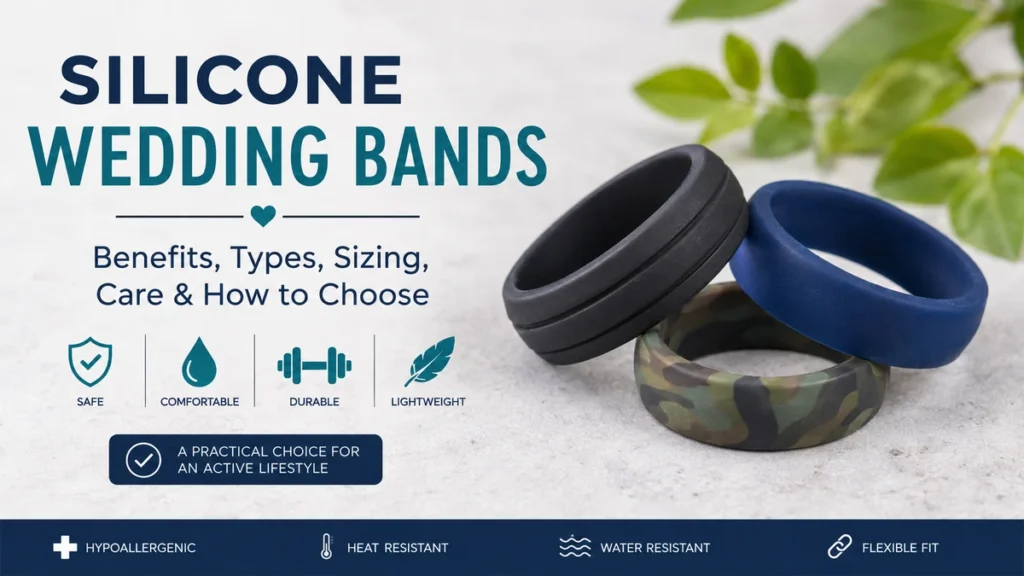
A traditional metal wedding ring can feel perfectly natural at dinner and completely impractical five minutes into a workout, construction job, climbing session, or hands-on project. That conflict is one reason silicone wedding bands have become a familiar alternative.
Instead of replacing the meaning behind a wedding ring, they change the material used to represent it. Modern silicone bands can be simple and understated, colorful, engraved, stackable, textured, or even designed to resemble metal from a distance.
Silicone wedding bands are flexible, lightweight rings made from silicone rather than rigid metals such as gold, platinum, titanium, or tungsten. They are commonly worn by athletes, tradespeople, healthcare workers, travelers, and anyone who wants a comfortable alternative to a traditional wedding ring during activities where metal jewelry may be inconvenient or hazardous.
That simple definition, however, leaves out some important details. Silicone rings have real advantages, but they are not indestructible, completely maintenance-free, or automatically appropriate for every workplace.
What Are Silicone Wedding Bands?
Silicone wedding bands are non-metallic rings with a soft, rubber-like texture. Depending on the manufacturer, they may be made from medical-grade, food-grade, or other formulations of silicone.
Silicone itself should not be confused with silicon. Silicon is a chemical element, while silicone is a manufactured polymer containing silicon along with elements such as oxygen, carbon, and hydrogen. The resulting material can be soft, flexible, water-resistant and highly adaptable.
Manufacturers have taken advantage of those characteristics to produce rings that can bend and stretch rather than behaving like rigid jewelry.
Brands such as QALO, Enso Rings, Groove Life and SafeRingz have developed different approaches to silicone rings, including breathable interior channels, metallic-looking finishes, engraving, stackable bands and heavy-duty designs.
Are silicone rings actually rubber?
They are often casually called “rubber wedding bands,” but silicone is not the same material as natural rubber.
Both can feel soft and elastic, which explains the terminology. A genuine silicone wedding ring is manufactured from silicone polymer rather than conventional natural rubber.
Material quality also varies considerably. Terms such as “medical-grade” should therefore be evaluated as specific manufacturer claims rather than assumed to describe every silicone ring on the market.
Quick Takeaway: The important distinction isn’t simply silicone versus metal. Construction quality, fit, thickness, ventilation and the particular silicone formulation can significantly change how a band feels in everyday use.
Why Do People Wear Silicone Wedding Bands?
The appeal becomes clearer when you think about situations where an expensive, rigid ring isn’t particularly convenient.
A person might love their gold wedding band but prefer not to expose it to barbells every morning. An electrician may need to think about conductive jewelry. A traveler might not want to carry valuable jewelry on an outdoor trip.
Silicone provides another option.
They are lightweight and flexible
Comfort is one of the most noticeable differences.
A rigid band keeps its shape regardless of what your finger is doing. Silicone has some give, so it can feel less restrictive during exercise and other hand-intensive activities.
Its low weight can also make a silicone band barely noticeable compared with a substantial metal ring.
That flexibility doesn’t mean sizing is irrelevant, though. An excessively tight silicone ring can still trap moisture or become uncomfortable.
They can protect an expensive wedding ring
Not everyone wearing silicone considers it their permanent wedding ring.
Many people keep their original gold, platinum or other metal wedding band and use silicone as a secondary ring for:
- workouts and weightlifting
- hiking and outdoor recreation
- manual work
- swimming and water activities
- gardening and DIY projects
- vacations and adventure travel
This arrangement lets the wearer continue displaying a symbol of marriage without exposing valuable jewelry to scratches, loss or damage.
Silicone rings are generally inexpensive
Price varies by manufacturer and design, but silicone rings normally cost substantially less than fine jewelry.
That has two practical consequences.
First, losing one isn’t financially comparable to losing a precious-metal wedding band. Second, a person can own several colors or styles for different activities.
Affordability also makes silicone a realistic primary wedding-band material for couples who simply don’t place much importance on precious metals.
Are Silicone Wedding Bands Safer Than Metal Rings?
Safety is perhaps the most discussed reason for wearing silicone.
The issue is not that an ordinary metal wedding band is inherently dangerous. Rather, rigid rings can become dangerous under particular circumstances.
Understanding ring avulsion
Ring avulsion occurs when a ring catches on an object and a strong force pulls against the finger.
The rigid ring can transfer that force into the tissues of the finger, potentially damaging skin, tendons and other structures. Severe injuries can involve extensive tissue damage.
This is especially relevant around machinery, climbing equipment and other objects on which jewelry could become caught.
Silicone behaves differently because it can stretch and, depending on its design and the force involved, eventually tear or break.
That breakaway behavior is one of its principal safety advantages.
SafeRingz, for example, describes its bands as flexible and designed to reduce ring-avulsion risk, while QALO advises that its rings are designed to break under extreme pressure.
That distinction needs some perspective.
A silicone ring should never be treated as personal protective equipment or as permission to ignore workplace jewelry rules. No ring can make every hazardous activity safe. If an employer, equipment manufacturer, sports organization or safety procedure requires jewelry to be removed, remove it.
Silicone is electrically non-conductive
Metal jewelry and electrical work can be a dangerous combination.
Silicone is an electrical insulator rather than a conductor, which is one reason silicone rings have become associated with electricians and other occupations involving electrical equipment. QALO and SafeRingz both describe their silicone bands as non-conductive.
Again, that doesn’t override electrical-safety procedures. A non-conductive ring does not eliminate the many other hazards associated with electrical work.
Flexible doesn’t mean impossible to snag
This is an important limitation that marketing sometimes obscures.
A silicone ring can still catch on an object. Its advantage is that the material may deform or fail under sufficient force rather than remaining rigid like a metal band.
When you’re working around equipment where any jewelry presents an entanglement hazard, no ring is the safer option.
Quick Takeaway: Think of silicone as a potentially lower-risk ring material in certain situations, not as a universal safety device.
Silicone Wedding Bands vs. Metal Wedding Rings
Neither material is automatically “better.” They solve different problems.
| Feature | Silicone Wedding Band | Traditional Metal Band |
|---|---|---|
| Weight | Very light | Depends on metal |
| Flexibility | Flexible | Rigid |
| Electrical conductivity | Silicone itself is non-conductive | Many metals conduct electricity |
| Scratch resistance | Doesn’t scratch like metal, but can tear/wear | Can scratch, dent or polish depending on metal |
| Ring-avulsion considerations | Can stretch/tear under sufficient force | Rigid ring may remain intact |
| Water exposure | Generally water-resistant | Depends on metal and construction |
| Formal appearance | Usually casual | Traditional/formal |
| Resizing | Usually replaced rather than resized | Some metals can be professionally resized |
| Heirloom potential | Low | High |
| Maintenance | Simple washing | Depends on material |
| Lifespan | Finite and replaceable | Fine-metal bands may last generations |
| Gemstone options | Limited | Extensive |
The biggest difference is permanence.
A quality gold or platinum wedding ring can potentially become an heirloom. Silicone is better understood as a wearable product that will eventually need replacement.
That isn’t necessarily a disadvantage. A ring designed to sacrifice itself under excessive force cannot simultaneously be expected to behave like an indestructible heirloom.
Who Benefits Most From Silicone Wedding Bands?
Silicone bands have applications well beyond professional athletes.
Athletes and gym users
Weightlifting is an obvious example.
A rigid metal band can press against the finger while gripping a barbell or dumbbell. It can also be scratched by knurling or other equipment.
A soft silicone band avoids metal-on-metal contact and flexes around the finger.
People involved in CrossFit-style training, hiking, cycling and other active pursuits may appreciate the same qualities.
However, sport-specific rules still matter. Activities involving ropes, nets, climbing equipment or significant snagging hazards may call for removing all rings.
Construction and manual trades
Carpenters, mechanics, landscapers, warehouse employees, heavy-equipment operators and people in similar jobs frequently use their hands around tools and materials.
This is exactly where a low-cost, flexible band can make practical sense.
But occupational policies come first. If a workplace prohibits rings around machinery, changing from metal to silicone doesn’t necessarily change that requirement.
Electricians
Electrical insulation gives silicone a significant practical distinction from conventional metal jewelry.
SafeRingz specifically markets its silicone material as non-conductive, while other major silicone-ring manufacturers make similar claims.
Still, electrical workers should follow employer rules and applicable safety procedures rather than assuming any particular ring is approved for the job.
Healthcare professionals
Nurses, physicians and other healthcare workers often want jewelry that is low-profile and doesn’t have gemstone settings or sharp edges.
Silicone can fit that preference.
But infection-control policies vary between healthcare facilities and roles. Rings can also trap moisture and contaminants underneath them, so institutional hand-hygiene requirements take priority over convenience.
Travelers and outdoor enthusiasts
Imagine hiking, kayaking or swimming while wearing an expensive wedding ring.
Cold water can change finger size, valuables can be lost, and outdoor environments are not particularly friendly to polished jewelry.
A relatively inexpensive silicone ring removes much of that financial worry.
People whose fingers fluctuate in size
Finger size can change temporarily because of temperature, activity and other factors.
Silicone’s elasticity can accommodate modest changes more comfortably than a rigid band.
That doesn’t mean a silicone ring should be relied upon to accommodate significant or persistent swelling. A ring that becomes painful, leaves pronounced indentations or restricts the finger should be removed.
What Are the Disadvantages of Silicone Wedding Bands?
A balanced guide needs to address where silicone loses to traditional jewelry.
They don’t last forever
Silicone can eventually stretch, tear, lose surface detail or change appearance.
How quickly that happens depends on material quality, thickness, exposure, activities and care.
This finite lifespan is partly inherent to the product. A ring designed to flex and potentially break under extreme stress won’t have the permanence of a solid precious-metal band.
Silicone rings cannot really be resized
Metal rings made from certain materials can be altered by a jeweler.
Silicone bands generally cannot.
If the size is wrong, replacement is usually the solution. That makes careful measurement particularly important.
Moisture can become trapped underneath
This is one of the most overlooked disadvantages.
Silicone forms a close-fitting surface around the finger. Sweat and water can remain trapped between the band and skin, particularly during exercise or hot weather.
Groove Life specifically identifies moisture accumulation and skin maceration as potential issues with solid silicone rings and uses interior channels intended to increase airflow. Enso also offers designs incorporating ventilation features.
The practical fix is straightforward: remove the ring periodically, wash it and allow both the ring and your finger to dry completely.
Skin irritation is still possible
Silicone products are frequently marketed as hypoallergenic, but “hypoallergenic” doesn’t mean nobody will ever develop irritation while wearing one.
The problem may not even be the silicone itself.
Sweat, dirt, residual soap and prolonged moisture trapped beneath a tight ring can irritate skin.
If redness, itching, cracking or persistent irritation develops, remove the ring and let the skin recover. Persistent or significant symptoms warrant professional medical advice rather than simply trying another ring.
They look less formal
This is subjective but real.
A matte black silicone band works beautifully in a gym. It won’t necessarily provide the same visual impression as polished platinum at a formal event.
Modern designs have narrowed the gap. Enso, for example, produces metallic-looking styles, while multiple manufacturers offer patterns, textures and engraving.
Still, silicone isn’t precious metal.
Some couples solve this by maintaining two rings: traditional jewelry for formal and everyday occasions, and silicone for work, travel or exercise.
Silicone isn’t an heirloom material
A traditional wedding ring can accumulate decades of history and eventually be passed to another generation.
Silicone generally isn’t suited to that role.
For someone who considers physical permanence central to the symbolism of a wedding band, that may be its biggest drawback.
How Should Silicone Wedding Bands Fit?
Sizing deserves more attention than it often receives.
A silicone band should normally sit snugly without painfully compressing the finger. It shouldn’t rotate constantly or feel as though it will slide off, but it also shouldn’t dig deeply into the skin.
Don’t intentionally buy an extremely tight ring simply because silicone stretches.
How to measure your finger
For the most reliable result:
- Measure the finger on which you’ll actually wear the band.
- Measure when your hands are at a normal temperature.
- Avoid measuring immediately after a hard workout when fingers may be temporarily swollen.
- Compare the measurement with the specific manufacturer’s sizing chart.
- If possible, use the manufacturer’s printable ring sizer or sizing kit.
- Check the brand’s guidance before choosing between two sizes.
Sizing isn’t completely universal between brands and models. Width, thickness and elasticity affect perceived fit.
QALO, for example, recommends measuring the finger and comparing the result with its own sizing system rather than assuming any flexible ring will fit automatically.
Width changes how a ring feels
Two rings labeled with the same size may feel different if one is much wider.
Wide bands contact more skin and can feel tighter. Narrow or stackable rings tend to feel lighter and less restrictive.
SafeRingz, for instance, offers multiple band dimensions, while other manufacturers distinguish between thin, classic and heavy-duty profiles.
This matters particularly if you’ve never worn a ring before.
What Should You Look for in a Silicone Wedding Band?
You don’t need dozens of technical specifications. A handful of characteristics make the biggest difference.
1. Material transparency
Look for a manufacturer that clearly explains what the ring is made from.
You’ll commonly encounter descriptions such as medical-grade or food-grade silicone. For example, QALO states that its current silicone rings use food-grade silicone, while SafeRingz describes its material as medical-grade silicone.
Don’t assume those descriptions are interchangeable certifications across every manufacturer. Read the specific product information.
2. Appropriate breakaway characteristics
If occupational or recreational safety is the reason you’re switching, investigate how the manufacturer discusses breakaway performance.
Vague claims such as “safe for everything” deserve skepticism.
A credible description should recognize that silicone has limits and that rings may need to be removed in particularly hazardous situations.
3. Breathability
People who sweat heavily should pay particular attention here.
Some rings have channels, grooves or textured inner surfaces intended to increase airflow and reduce moisture accumulation.
Groove Life uses recessed internal grooves for this purpose, and Enso incorporates airflow features into some designs.
Even with ventilation, regular cleaning and drying remain necessary.
4. Thickness and width
Thin rings generally feel discreet.
Thicker bands may provide a more substantial appearance but can feel warmer and more noticeable.
There is no universally ideal width. Choose according to hand size, comfort and how you use your hands.
5. Surface finish
Modern silicone wedding rings range from plain matte designs to:
- metallic finishes
- camouflage patterns
- etched surfaces
- textured bands
- stackable rings
- engraved rings
- bright colors
- traditional-looking neutral shades
The best style is the one you’ll actually enjoy wearing.
6. Replacement policy
A warranty matters differently with silicone than with precious metal.
Because a silicone band can eventually stretch or tear, check what the manufacturer’s warranty actually covers, whether replacement shipping is charged, and whether normal wear is excluded.
Don’t interpret “lifetime” language without reading the terms.
Silicone Wedding Bands for Men and Women
There is little functional reason to divide silicone rings strictly by gender.
The material works the same way regardless of who wears it.
What manufacturers describe as men’s silicone wedding bands are often wider, thicker and available in darker or more rugged finishes. Designs marketed toward women frequently include narrower profiles, stackable sets and more varied colors.
Those are style conventions, not rules.
Someone with smaller hands might simply prefer a narrow 3 mm-style band. Someone wanting a substantial traditional-band appearance may prefer a wider profile.
Fit and comfort matter more than the category printed on the packaging.
Can Silicone Wedding Bands Be Your Only Wedding Ring?
Absolutely, if that suits the couple.
There is no material requirement that makes a wedding ring meaningful.
Gold, platinum, titanium, tungsten and silicone are all physical materials. The symbolic significance comes from what the couple associates with the ring.
For some people, silicone is primarily a temporary substitute.
For others, its practicality is precisely what makes it appealing as a permanent band.
A person who works with their hands every day might find that a silicone band spends far more time on their finger than the expensive metal ring sitting safely at home.
There is one tradeoff worth considering: longevity.
If having the same physical ring decades later matters to you, precious metal has an obvious advantage. If continuously wearing a comfortable symbol of marriage matters more, silicone can be a perfectly reasonable choice.
Can You Wear a Silicone Wedding Ring All the Time?
Technically, many silicone rings are designed for extended everyday wear, but giving your finger regular breaks is sensible.
Take the ring off when:
- washing and drying underneath it
- skin becomes irritated
- the band becomes uncomfortably tight
- working with chemicals that the manufacturer advises avoiding
- workplace or equipment rules prohibit jewelry
- performing activities with serious snagging or entanglement hazards
QALO specifically recommends removing its rings around strong cleaning agents, harsh chemicals, prolonged high heat and situations where severe snagging or stretching is possible.
The fact that silicone is flexible doesn’t make removing your ring unnecessary.
How to Clean Silicone Wedding Bands
Cleaning is simple, which is one of silicone’s strongest practical advantages.
For routine care:
- Remove the ring from your finger.
- Rinse it with lukewarm water.
- Wash gently with mild soap.
- Rinse thoroughly to remove soap residue.
- Pat it dry with a soft cloth or allow it to air-dry.
- Dry your finger before putting the ring back on.
QALO recommends essentially this process and advises regular cleaning, particularly after sweaty or dirty activities. It also warns that certain aggressive cleaners and abrasive products can damage silicone finishes.
Check the manufacturer’s care instructions before trying bleach, solvents, alcohol, abrasive powders or unusually high temperatures. Different formulations, coatings and printed finishes may respond differently.
Don’t forget the skin underneath
Cleaning the band but immediately replacing it on damp skin defeats much of the purpose.
Moisture trapped beneath any close-fitting ring can create irritation.
After swimming, showering or an intense workout, remove the band, rinse it if necessary and let everything dry.
That small habit can make long-term wear considerably more comfortable.
Quick Takeaway: Mild soap, water and complete drying are usually all silicone wedding bands need. More aggressive cleaning isn’t necessarily better.
How Long Do Silicone Wedding Bands Last?
There is no reliable universal lifespan.
A ring worn occasionally at the gym can experience very different wear from one worn daily by a mechanic or construction worker.
Longevity depends on factors including:
- silicone formulation
- ring thickness
- stretching
- friction
- chemical exposure
- UV and environmental exposure
- frequency of wear
- how often the wearer pulls or fidgets with it
Eventually you may notice stretching, small tears, fading, surface wear or a looser fit.
At that point, replacement makes more sense than attempting repair.
A damaged band may no longer behave as designed, particularly if you’re wearing it because of specific breakaway characteristics.
Do Silicone Rings Stretch Over Time?
They can.
Silicone is elastic, but repeated stretching and prolonged use may gradually affect fit. QALO, for example, notes that its rings can stretch over time, especially when repeatedly pulled or used as something to fidget with.
Avoid deliberately stretching a new band to make an incorrect size fit.
If your ring continually slides around after prolonged wear, replacing it with the correct size is preferable to trying to permanently shrink or modify it.
Can You Swim and Shower With a Silicone Ring?
Silicone itself handles water well, and manufacturers commonly describe their bands as suitable for swimming and other water exposure.
The bigger issue is your finger.
Cold water can temporarily reduce finger circumference, which could make a ring easier to lose. Water and soap can also remain beneath the band.
After swimming or showering, drying both the ring and your skin is a useful habit.
For ocean swimming, boating or travel, the relatively low replacement cost is one reason some people choose silicone instead of risking an expensive wedding band.
Are Silicone Wedding Bands Good for Sensitive Skin?
Quality silicone bands are frequently marketed as hypoallergenic, and many people who have trouble with particular metals find silicone comfortable. QALO and SafeRingz both make hypoallergenic claims for their silicone materials.
Still, skin reactions require a little nuance.
Redness beneath a silicone ring doesn’t automatically mean a silicone allergy. A too-tight fit, accumulated soap, sweat, prolonged wetness and friction can all contribute to irritation.
A practical routine is to:
- wear the correct size
- clean the band regularly
- dry underneath it after washing or exercise
- periodically leave the finger uncovered
- stop wearing it if persistent irritation develops
A breathable inner design can help manage moisture, but no ventilation system replaces hygiene.
Are Silicone Wedding Bands Worth It?
For the right lifestyle, yes.
Their strongest advantages are straightforward: they are lightweight, flexible, relatively inexpensive, non-metallic and easy to replace. They can also provide useful safety characteristics in circumstances where a rigid metal ring would create additional concerns.
Their weaknesses are equally clear.
Silicone doesn’t have the permanence, precious-material value, traditional appearance or heirloom potential of gold or platinum. It can stretch, wear or tear. It also needs to be removed and cleaned periodically because moisture can collect underneath.
For many couples, the most practical solution isn’t choosing silicone or metal forever.
It’s using both.
A traditional wedding band can remain the sentimental piece worn during everyday or formal occasions, while a silicone band handles workouts, travel, outdoor recreation and hands-on work.
For others, silicone wedding bands are the everyday ring. If comfort, flexibility and practicality matter more than precious metal, there is nothing inherently temporary about that choice.
The key is to choose a well-fitting band made from clearly identified material, understand its limitations, keep it clean and dry, and continue following workplace or activity-specific jewelry rules. That way, the ring remains what it was supposed to be in the first place: a simple symbol of commitment that fits comfortably into real life.