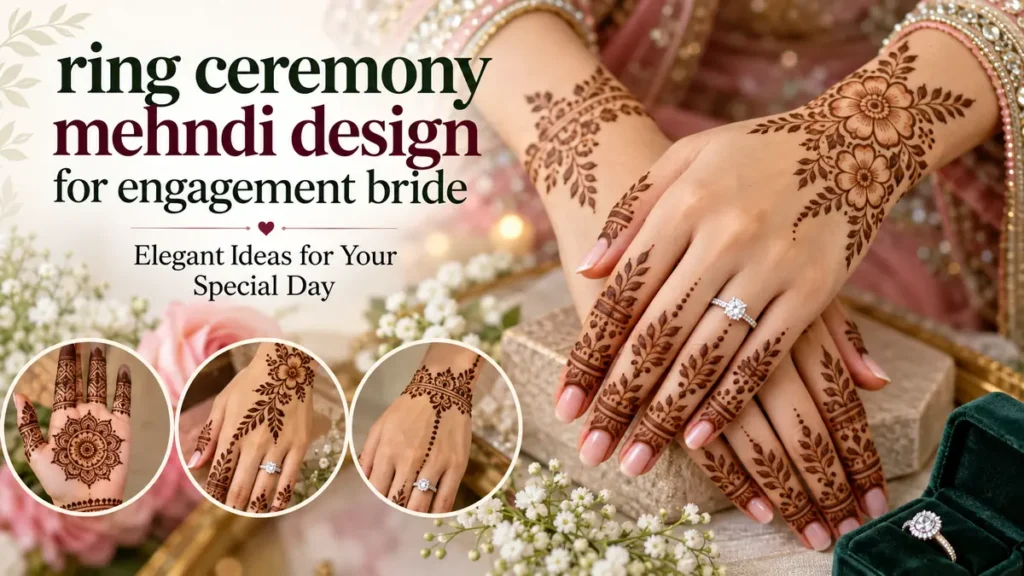
The best engagement mehndi does more than decorate your hands. During the ring exchange, your fingers become the center of attention, so the design should frame the engagement ring rather than compete with it.
A ring ceremony mehndi design for engagement bride usually combines elegant florals, mandalas, leafy vines, geometric details, jaali patterns, finger bands, and carefully planned negative space. The most flattering layouts keep the ring finger relatively open while adding visual interest to the palm, back hand, wrist, or surrounding fingers for beautiful close-up photographs.
Engagement mehndi can be simple and airy or detailed enough to resemble bridal henna. The right choice depends on your ring, outfit, jewelry, hand shape, personal style, and how traditional or contemporary you want the ceremony to feel.
ring ceremony mehndi design for engagement bride: What Makes It Different?
Wedding-day bridal mehndi often covers the hands and arms with dense storytelling motifs and intricate filling. Engagement mehndi tends to have a different purpose.
The engagement ring needs space to shine.
That is why many ring ceremony designs use intentional gaps around the ring finger, lighter finger decoration, or motifs that visually lead toward the ring. Floral trails, central mandalas, bracelet patterns, paisleys, jaali sections, dots, and geometric borders are especially common.
The strongest designs generally balance three things:
- Ring visibility: The stone and band remain clearly visible.
- Photo appeal: The design looks balanced when the bride holds out her hand.
- Bridal character: The mehndi still feels special enough for an engagement ceremony.
A design can be minimal without looking casual. Clean lines, thoughtful spacing, symmetrical placement, and one strong focal motif often look more polished than filling every available area.
Why the Back Hand Matters So Much
During a ring ceremony, the back of the hand frequently appears in photographs while the couple exchanges rings or poses afterward.
This makes back-hand mehndi particularly suitable for an engagement. A central mandala, diagonal Arabic trail, floral bracelet, or delicate vine can create a frame around the ring without overwhelming it.
If photography is a priority, plan the back-hand pattern before deciding how much detail to place on the palm.
Simple Ring Ceremony Mehndi Designs for a Modern Bride
Simple engagement mehndi works especially well with contemporary lehengas, sarees, shararas, gowns, and understated jewelry.
The word “simple” does not mean unfinished. A successful minimalist design uses fewer elements but gives each element enough room to stand out.
1. Delicate Floral Vine
A thin flower-and-leaf trail can begin near the wrist and move diagonally toward the index or middle finger.
Keep the ring finger almost bare or use only two or three tiny leaves near its base.
This layout creates movement without hiding the jewelry.
2. Minimal Mandala Design
Place a small circular mandala in the middle of the back hand or palm and leave generous negative space around it.
Add tiny dots, scallops, or leafy finger details to connect the composition.
Mandala designs remain a widely used choice for ring ceremonies because the circular centerpiece looks complete without requiring dense hand coverage.
3. Finger-Only Mehndi
For an extremely light design, decorate individual fingers with narrow bands, leaves, dots, arches, or miniature flowers.
Jewelry-style finger patterns work particularly well when the bride plans to wear several rings.
Avoid making every finger identical. Alternating motifs can make the hand appear more refined.
4. Bracelet-Style Mehndi
A decorative band around the wrist can resemble a bracelet or kada.
Connect it to one finger with a fine dotted chain or leafy trail. The result gives the illusion of hand jewelry while keeping most of the skin visible.
5. Open-Space Floral Pattern
Instead of connecting every motif, place small flowers and leaves at carefully chosen points on the hand.
The empty skin becomes part of the composition.
This technique is especially effective with statement engagement rings because there is less visual competition.
Quick Takeaway: If your ring is large or highly detailed, use lighter mehndi around the fingers. If the ring is delicate, you can safely introduce stronger motifs elsewhere on the hand.
ring ceremony mehndi design for engagement bride Back Hand Ideas
A back-hand pattern should look attractive both when the hand is relaxed and when it is photographed flat.
Several layouts consistently suit ring ceremonies.
Central Mandala With Bare Ring Finger
Place a medium-size mandala in the center of the hand.
Extend slim patterns onto the index, middle, and little fingers but give the ring finger more breathing room. This naturally draws attention toward the engagement ring.
Diagonal Arabic Mehndi
Arabic-inspired mehndi typically uses bold florals, leaves, flowing vines, and visible spaces between motifs.
For an engagement, a diagonal trail can run from one side of the wrist across the hand toward a fingertip.
It gives the hand length and elegance without requiring complete coverage.
Rose Trail Design
Roses make a beautiful focal motif when you want something softer than traditional geometric work.
Use one larger rose near the wrist, another toward the center of the hand, and connect them with leaves and small buds.
The pattern can stop before reaching the ring finger.
Lotus Back-Hand Design
A lotus centerpiece can be paired with fine leaves, dots, arches, and jewelry-style chains.
For a more bridal appearance, add a neat cuff at the wrist rather than increasing density around the fingers.
Jaali and Floral Combination
Jaali, or lattice-style work, introduces strong structure.
Use it on one side of the hand and balance it with floral motifs on the other. WeddingWire’s collection of engagement-focused designs similarly highlights combinations of pictorial elements, jaal work, roses, lotuses, geometric detailing, and floral patterns.
The combination suits brides who want detailed mehndi while maintaining enough open space for the ring.
Front-Hand Mehndi Designs for an Engagement Bride
The palm gives you considerably more room for symbolic and traditional artwork.
You can therefore make the front-hand pattern richer while keeping the back hand comparatively light.
Ring Motif Mehndi
Interlocking ring motifs directly reference the occasion.
Place two rings inside a circular medallion, floral frame, or heart-shaped composition in the center of one palm.
The second palm can feature initials, a complementary mandala, or another engagement symbol.
A similar pairing of circular motifs and interlocking rings appears in engagement-oriented henna inspiration.
Couple Initials
Initials can be worked subtly into flowers, paisleys, mandalas, or geometric sections.
They do not need to dominate the palm.
Small personalized details tend to look more sophisticated than oversized lettering and also give family members something fun to notice.
Heart and Floral Composition
A heart surrounded by flowers, dots, and leaves creates a romantic design without requiring portrait-style artwork.
Split-heart patterns can also be created across both palms so that the full motif appears when the hands are placed together.
Traditional Paisley Design
Paisleys provide a classic mehndi look and can be adapted easily to different levels of coverage.
For a lighter engagement style, combine two or three large paisleys with flowers and negative space.
For a traditional look, use smaller paisleys with denser filling and detailed borders.
Full-Hand Engagement Mehndi for Brides Who Prefer Detail
An engagement does not require minimalist henna.
If you enjoy intricate patterns, a full-hand design can look beautiful as long as the composition still respects the jewelry.
Full-hand options commonly incorporate:
- Floral clusters
- Paisleys
- Jaali or lattice panels
- Mandalas
- Peacock motifs
- Geometric bands
- Leafy vines
- Decorative borders
- Finger patterns
- Bridal-style cuffs
Traditional floral and peacock patterns, Arabic-style layouts, minimalist vines, geometric lines, and open-space compositions all appear across current engagement mehndi collections.
Symmetrical Full-Hand Design
Both hands can mirror one another through repeated flowers, jaali panels, arches, and borders.
Symmetry gives dense mehndi a more orderly appearance.
Keep one small section around each ring finger lighter so rings remain comfortable and visible.
Indo-Arabic Fusion
This approach combines the bold flow and open areas associated with Arabic patterns with the intricate filling often seen in Indian bridal mehndi.
It works especially well when you want a full-looking hand without covering every centimeter of skin.
Traditional Indian Bridal Pattern
For a formal engagement with heavily embroidered attire, a more traditional design may suit the overall styling.
Use paisleys, lotuses, peacocks, fine linework, geometric fills, and patterned fingertips.
The key difference from wedding mehndi can simply be length: stop at the wrist or lower forearm instead of extending far up the arms.
How to Choose Mehndi According to Your Engagement Ring
Your ring should influence the pattern more than many brides realize.
Solitaire Ring
A solitaire already creates a strong focal point.
Pair it with thin finger lines, small flowers, dots, or negative space.
Avoid placing a dense circular motif directly beneath a large stone because both elements will compete visually.
Halo Ring
Halo settings are visually detailed.
Keep the ring finger mostly clear and shift the strongest mehndi motif toward the center or outer edge of the hand.
Minimal Band
A simple band can handle slightly richer finger decoration.
Small arches, leafy segments, jewelry-style bands, or geometric details can make the finger itself more visually interesting.
Large Statement Ring
Give a statement ring maximum breathing room.
A central back-hand mandala positioned slightly away from the finger works better than dense coverage around the jewelry.
| Ring Style | Mehndi Approach | Best Placement |
|---|---|---|
| Solitaire | Light, spacious motifs | Back hand and wrist |
| Halo ring | Fine florals and negative space | Center hand |
| Simple band | Detailed finger accents | Fingers and palm |
| Statement ring | Minimal ring-finger decoration | Wrist or outer hand |
| Vintage ring | Paisleys and classic florals | Palm and back hand |
The principle is simple: the more visually complex the ring, the quieter its immediate surroundings should be.
Trending Motifs for Engagement Mehndi
Recent engagement-mehndi collections repeatedly feature floral motifs, ring imagery, mandalas, geometric work, leafy vines, Arabic trails, jaali patterns, initials, open-space layouts, and jewelry-inspired designs.
Rather than copying a complete pattern, pick the elements that fit your overall look.
Floral Mehndi
Flowers are extremely adaptable.
Roses give a romantic feel, lotuses work beautifully in Indian-inspired designs, and tiny blossoms suit minimalist compositions.
Jewelry-Style Mehndi
Finger rings, chains, wrist cuffs, bracelet patterns, and hathphool-inspired layouts make henna resemble jewelry.
This is particularly effective for engagement events because it complements the real ring rather than changing the theme.
Geometric Patterns
Lines, grids, diamonds, arches, and symmetrical blocks create a contemporary appearance.
Mix geometric sections with small flowers to prevent the pattern from feeling too rigid.
Peacock Motifs
Peacocks suit brides wanting a traditional, decorative design.
Because the motif itself is detailed, place it on the palm or forearm instead of immediately beside the engagement ring.
Negative-Space Patterns
Negative space is one of the most practical techniques for an engagement design.
Rather than treating uncovered skin as an empty area, the artist intentionally uses it to separate and emphasize motifs.
This also makes detailed patterns easier to read in photographs.
Should You Choose Half-Hand or Full-Hand Mehndi?
Both can work beautifully.
The decision should come from your outfit and desired visual weight rather than the assumption that brides must always wear full-hand mehndi.
A half-hand design generally covers the palm and fingers or the back hand through the wrist, ending before significant forearm coverage. This makes it practical with embellished sleeves and modern engagement outfits.
Choose half-hand mehndi when:
- Your outfit has elaborate cuffs or sleeves.
- You prefer a clean modern aesthetic.
- Your ring and jewelry are statement pieces.
- You want faster application.
- You prefer visible negative space.
Choose full-hand mehndi when:
- Your ceremony is highly traditional.
- Your sleeves leave much of the arms exposed.
- You enjoy intricate bridal henna.
- Your jewelry is relatively balanced rather than oversized.
- You want the mehndi itself to become a major part of your bridal styling.
Neither approach is inherently more bridal. Execution matters more than coverage.
Matching Mehndi With Your Engagement Outfit
The safest strategy is to think of your hands, outfit, jewelry, nails, and ring as one composition.
Heavy Lehenga
A heavily embroidered lehenga can support detailed mehndi, but avoid copying every visual element from the fabric.
If the clothes already feature dense floral embroidery, structured jaali or geometric mehndi can create useful contrast.
Minimal Saree
A slim floral trail, mandala, or bracelet pattern complements an understated saree without making the hands look overdecorated.
Contemporary Gown
Minimal Arabic trails, geometric patterns, negative-space florals, and jewelry-inspired designs usually integrate well with contemporary silhouettes.
Sharara or Gharara
Paisleys, florals, mandalas, jaali, and traditional finger work pair naturally with these outfits.
The goal is harmony rather than exact matching.
How to Make the Engagement Ring Stand Out in Photos
Good ring-ceremony mehndi should be designed with the camera angle in mind.
Before application, imagine how your hand will look while:
- Receiving the ring.
- Holding your partner’s hand.
- Showing the ring toward the camera.
- Holding flowers or a clutch.
- Resting your hands on your outfit.
Then adjust the design accordingly.
Keep the strongest back-hand motif visible from the most common camera-facing angle. Avoid a heavy cluster directly beneath the ring if your stone is small.
Clean fingertips and controlled negative space are equally useful.
One current engagement-mehndi guide specifically recommends designs that frame the hand while keeping the ring area visually clear, particularly with vines and floral trails.
Quick Takeaway: Ask your artist to see your actual engagement ring—or at least a photograph of it—before finalizing the back-hand layout.
Practical Mehndi Planning Before the Ring Ceremony
Beautiful artwork can still disappoint if the timing and practical details are ignored.
Choose the Design Before the Appointment
Save references for individual features rather than expecting the artist to reproduce several unrelated designs at once.
For example:
- Mandala from one reference
- Finger pattern from another
- Floral wrist cuff from a third
- Ring-finger spacing from a fourth
Ask the artist to combine them into a coherent composition.
Consider Your Nails
Long embellished nails already add visual detail.
Pair them with relatively clean finger mehndi.
If your manicure is minimal, more detailed fingertips can balance the hand.
Account for Bangles and Bracelets
Do not spend time creating complicated wrist artwork that will disappear completely beneath heavy jewelry.
Either end the design above the bracelet area or deliberately make the wrist pattern visible around your accessories.
Avoid Overcrowding
This is one of the most common mistakes with engagement henna.
The bride finds several beautiful motifs and tries to include every one.
A rose, peacock, couple portrait, ring motif, mandala, lotus, initials, jaali, paisleys, and heavy finger filling can become visually chaotic when forced onto one hand.
Choose one dominant feature and two or three supporting elements.
Getting a Rich, Even Mehndi Stain
A strong design deserves good aftercare.
Natural henna typically develops gradually after the dried paste is removed, rather than showing its deepest tone immediately.
Follow the instructions of your henna artist because paste formulas and application methods vary.
As a practical rule, avoid washing away fresh paste prematurely. Let it dry and remain on the skin for the period recommended by your artist.
Competitor guides commonly suggest allowing several hours of paste contact and limiting immediate water exposure, though exact instructions should follow the product and artist being used.
Never use an unknown product purely because it promises an unusually instant dark or black result. Traditional henna produces orange-to-brown staining rather than a jet-black tattoo-like color.
Common Engagement Mehndi Mistakes to Avoid
Covering the Ring Finger Too Heavily
Dense lines immediately around the ring can make both the jewelry and mehndi harder to see.
Keep some visual separation.
Choosing a Design Without Considering the Ring
A delicate solitaire and a large statement ring need different surrounding patterns.
Show your jewelry to the artist first.
Making Both Sides Equally Dense
You do not need heavy front and back coverage.
One side can carry intricate detail while the other feels lighter.
Ignoring Sleeve Length
Long embroidered sleeves may conceal expensive forearm work.
Plan where the mehndi ends according to your outfit.
Copying a Design Without Adapting It
Hand shape, finger length, jewelry, and nail style change how a pattern looks.
A talented artist should resize and reposition motifs rather than copy a reference mechanically.
Using Too Many Motifs
A strong engagement design needs a clear visual hierarchy.
Pick a focal point and support it.
A Simple Formula for Designing Your Own Engagement Mehndi
If you are overwhelmed by hundreds of references, use this five-step framework.
- Pick the coverage: finger-only, back hand, half hand, or full hand.
- Choose one focal motif: mandala, rose, lotus, peacock, paisley, or engagement rings.
- Choose a connector: vines, dots, chains, geometric lines, or jaali.
- Plan the ring finger: mostly open, lightly decorated, or framed.
- Finish the wrist: bracelet, floral cuff, border, or intentional open space.
For example, a modern bride could choose a small back-hand mandala, leafy connectors, minimalist fingers, an open ring finger, and a thin bracelet border.
A traditional bride might choose a paisley focal pattern, jaali sections, floral connectors, detailed fingertips, and a decorative wrist cuff.
Both are unmistakably bridal; they simply express different styles.
Choosing the Best ring ceremony mehndi design for engagement bride
The most successful ring ceremony mehndi design for engagement bride is not automatically the largest or most intricate one. It is the design that makes your hand, ring, outfit, jewelry, and personal style feel connected.
For a modern look, start with negative space, floral vines, delicate mandalas, jewelry-inspired bands, or a diagonal Arabic pattern. For a traditional finish, explore paisleys, lotus motifs, peacocks, jaali work, symmetrical florals, and detailed full-hand compositions.
Above all, protect the visual focus of the ceremony: the engagement ring. Keep enough space around it, place your main motifs deliberately, and ask your mehndi artist to adapt the pattern to your actual hand rather than copying a reference exactly. That small amount of planning can turn a beautiful mehndi design into one that looks exceptional in every ring-exchange photograph.