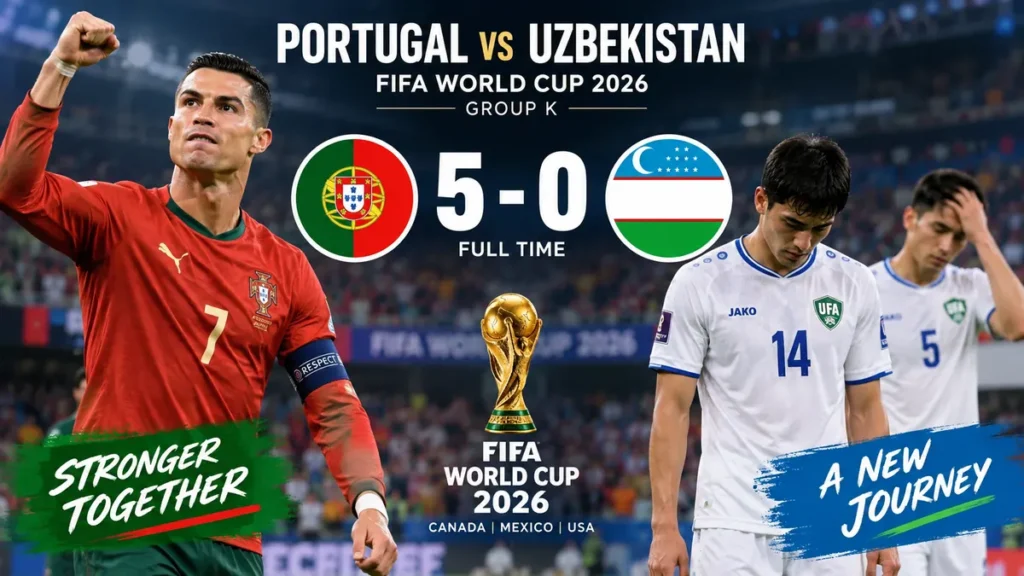
The portugal vs uzbekistan match became one of Portugal’s most emphatic performances of the 2026 FIFA World Cup group stage. Cristiano Ronaldo scored twice, Nuno Mendes produced a memorable free-kick, and Portugal controlled the game from the opening stages to record a 5-0 victory in Houston.
Portugal beat Uzbekistan 5-0 on June 23, 2026, in their FIFA World Cup Group K match at Houston Stadium. Cristiano Ronaldo scored in the 6th and 39th minutes, Nuno Mendes struck in the 17th, Abduvohid Nematov conceded an own goal in the 60th, and Rafael Leão completed the scoring in the 87th minute.
FIFA World Cup • Group K
NRG Stadium • Houston, TX

Portugal
(1-2-0)
5
Full-time
Tue, Jun 23
0

Uzbekistan
(0-0-3)
Give feedback
The result was significant beyond the scoreline. Ronaldo became the first men’s player to score at six different FIFA World Cups, while Uzbekistan’s first World Cup campaign suffered another difficult setback.
portugal vs uzbekistan Result and Match Details
The game was played at Houston Stadium, also known as NRG Stadium, in Houston, Texas. Official match records list an attendance of 68,777.
| Match detail | Information |
|---|---|
| Competition | FIFA World Cup 2026 |
| Stage | Group K |
| Date | June 23, 2026 |
| Venue | Houston Stadium/NRG Stadium, Houston |
| Result | Portugal 5-0 Uzbekistan |
| Half-time | Portugal 3-0 Uzbekistan |
| Attendance | 68,777 |
| Portugal captain | Cristiano Ronaldo |
| Uzbekistan captain | Eldor Shomurodov |
| Portugal manager | Roberto Martínez |
| Uzbekistan manager | Fabio Cannavaro |
Portugal entered the fixture after drawing 1-1 with DR Congo in its opening Group K game. Uzbekistan, making its World Cup debut, had lost 3-1 to Colombia. That made the second group match particularly important for both teams.
portugal vs uzbekistan Goals
The scoring unfolded as follows:
- 6′ — Cristiano Ronaldo: Portugal 1-0 Uzbekistan
- 17′ — Nuno Mendes: Portugal 2-0 Uzbekistan
- 39′ — Cristiano Ronaldo: Portugal 3-0 Uzbekistan
- 60′ — Abduvohid Nematov own goal: Portugal 4-0 Uzbekistan
- 87′ — Rafael Leão: Portugal 5-0 Uzbekistan
Portugal therefore had the contest firmly under control before half-time, with Ronaldo’s brace surrounding Mendes’ goal. The own goal widened the gap after the interval before substitute Rafael Leão supplied the final strike.
How Portugal Took Control So Quickly
The most important phase of portugal vs uzbekistan came during the opening 20 minutes.
Portugal did not allow Uzbekistan much time to settle into its defensive structure. Ronaldo opened the scoring after only six minutes, immediately changing the nature of the game. Instead of being able to sit compactly and frustrate Roberto Martínez’s team, Uzbekistan had to consider how and when to move forward.
That created more space for Portugal.
João Cancelo, Nuno Mendes and Portugal’s attacking players were able to stretch the defensive shape, while Vitinha, João Neves and Bruno Fernandes helped maintain control around midfield and the final third.
The second goal arrived in the 17th minute through Mendes. FIFA described the goal as a cleverly taken free-kick at a moment when the defence appeared to anticipate Ronaldo taking the set piece.
By that point, Portugal had both a two-goal cushion and tactical control.
Ronaldo Makes It 3-0 Before Half-Time
Uzbekistan did show occasional attacking ambition.
Aziz Ganiev appeared to have produced a spectacular response around the half-hour mark, but the effort was disallowed following an infringement in the build-up. Portugal soon punished Uzbekistan at the other end.
In the 39th minute, Bruno Fernandes found Ronaldo, who converted his second goal of the game.
Portugal went into half-time leading 3-0. The three-goal advantage meant Martínez could manage the second half differently, while Uzbekistan faced the difficult task of attacking without exposing even more space.
Cristiano Ronaldo Makes World Cup History
The biggest individual story from portugal vs uzbekistan was Cristiano Ronaldo’s latest World Cup milestone.
His opening goal made him the first men’s footballer to score in six different FIFA World Cup editions. Before the match, Ronaldo and Lionel Messi had both scored at five different World Cups.
Ronaldo’s World Cup scoring record spans:
| World Cup | Goals |
|---|---|
| 2006 | 1 |
| 2010 | 1 |
| 2014 | 1 |
| 2018 | 4 |
| 2022 | 1 |
| 2026 through this match | 2 |
His two goals against Uzbekistan brought him to 10 World Cup goals at that point, taking him past Eusébio’s nine on Portugal’s all-time World Cup scoring list.
There was another age-related milestone. Ronaldo was 41 years and 138 days old and became the second-oldest player to score in a men’s World Cup, behind Cameroon’s Roger Milla, according to FIFA.
Why Ronaldo Remained Difficult to Defend
The goals also demonstrated why Ronaldo could remain dangerous without dominating every phase of Portugal’s possession.
His role centered heavily on penalty-area movement, timing and occupying defenders. With Fernandes, João Félix, Pedro Neto, Cancelo and Mendes capable of progressing or delivering the ball, Ronaldo could focus on finding decisive positions around Uzbekistan’s defensive line.
The 39th-minute goal was a good example: Fernandes supplied the pass and Ronaldo exploited the space to finish.
That is a different attacking function from constantly carrying the ball, but against a defence under sustained pressure it can be extremely effective.
portugal vs uzbekistan Match Stats
The underlying statistics support the impression created by the 5-0 score.
Sky Sports recorded Portugal with 65.9% possession compared with Uzbekistan’s 34.1%. Portugal attempted 17 shots and put nine on target, while Uzbekistan managed seven attempts and two on target. Portugal also completed 561 accurate passes compared with Uzbekistan’s 262.
| Statistic | Portugal | Uzbekistan |
|---|---|---|
| Possession | 65.9% | 34.1% |
| Shots | 17 | 7 |
| Shots on target | 9 | 2 |
| Accurate passes | 561 | 262 |
| Pass accuracy | 89.9% | 80.1% |
| Corners | 3 | 2 |
| Yellow cards | 1 | 1 |
Different statistical providers can vary slightly in categories such as total passes and expected goals because of their data definitions. FotMob, for example, recorded approximately 66% possession and an expected-goals figure of 2.61 for Portugal against 0.24 for Uzbekistan.
The broader picture does not change: Portugal generated far more high-quality attacking activity.
Expected Goals Tell an Interesting Story
The final score was 5-0, while FotMob’s xG figures were 2.61 to 0.24.
That difference matters when interpreting the match.
Portugal clearly deserved to win based on the quality and quantity of its chances, but five goals from roughly 2.6 expected goals also reflects efficient finishing and the impact of the own goal.
Uzbekistan, meanwhile, created very little high-value shooting threat.
Quick takeaway: Portugal’s superiority was not simply possession for possession’s sake. It turned control into shots, touches in dangerous areas and goals, while restricting Uzbekistan to relatively low-quality opportunities.
Portugal Starting Lineup vs Uzbekistan
Portugal started in a structure listed as a 4-2-3-1, with Ronaldo leading the attack.
Portugal XI: Diogo Costa; João Cancelo, Rúben Dias, Renato Veiga, Nuno Mendes; João Neves, Vitinha; Pedro Neto, Bruno Fernandes, João Félix; Cristiano Ronaldo.
The lineup offered a mixture of technical midfield control and attacking width.
Fernandes could operate between the lines and create opportunities, Vitinha helped dictate possession, while Mendes and Cancelo offered additional progression from the full-back positions.
Portugal also had considerable quality available from the bench.
Francisco Conceição and Nélson Semedo entered at half-time, Francisco Trincão replaced João Félix, Bernardo Silva came on for João Neves, and Rafael Leão replaced Vitinha late in the match.
Leão needed little time to influence the score, making it 5-0 in the 87th minute.
Uzbekistan Starting Lineup vs Portugal
Uzbekistan started with Abduvohid Nematov in goal and Eldor Shomurodov captaining the team.
The starting group included Nematov, Abdukodir Khusanov, Rustam Ashurmatov, Sherzod Nasrullaev, Behruzjon Karimov, Abdulla Abdullaev, Otabek Shukurov, Odiljon Khamrobekov, Aziz Ganiev, Abbosbek Fayzullaev and Shomurodov.
Fabio Cannavaro made changes as Uzbekistan attempted to respond.
Akmal Mozgovoy and Khojiakbar Alijonov were introduced at the beginning of the second half. Igor Sergeev later replaced Fayzullaev, with further late substitutions following.
The difficulty was that Uzbekistan was already three goals behind by the time the first major adjustments could be made.
Why Portugal’s Tactics Worked
Portugal’s advantage came from more than individual quality.
1. The Early Goal Changed Uzbekistan’s Plan
An underdog facing a technically stronger team often benefits from keeping the match scoreless for as long as possible.
Ronaldo’s sixth-minute goal removed that possibility.
Uzbekistan now needed to balance defensive compactness with a greater need to attack, giving Portugal opportunities to find space that might otherwise have remained closed.
2. Portugal Controlled Possession Efficiently
Nearly 66% possession gave Portugal control of the rhythm. More importantly, the team combined that possession with 17 shots and nine efforts on target.
There was purpose behind the ball circulation.
Vitinha and João Neves provided midfield security, while Fernandes could move into more advanced areas.
3. Width Stretched Uzbekistan
Mendes and Cancelo gave Portugal attacking options from the defensive line, while Neto and João Félix contributed movement higher up the pitch.
Uzbekistan consequently had several problems to solve simultaneously: protect central areas around Ronaldo, track runners and prevent Portugal from progressing through wide positions.
Mendes’ contribution was particularly notable because his influence extended beyond conventional defending.
4. Ronaldo Occupied the Central Defenders
Ronaldo’s positioning demanded constant attention.
Even when he was not receiving the ball, defenders had to account for his runs and penalty-box movement. That attention could create additional room for teammates operating nearby.
5. Portugal’s Bench Maintained the Pressure
A 3-0 half-time advantage did not lead to the match becoming completely passive.
Martínez could introduce Conceição, Trincão, Bernardo Silva and Leão. The quality of those replacements allowed Portugal to maintain attacking threats even after changing several starters.
Leão’s late goal illustrated that depth.
What Went Wrong for Uzbekistan?
Uzbekistan’s problems began with conceding too early, but several factors contributed to the size of the defeat.
Defensive Spaces Became Harder to Protect
Once Uzbekistan fell behind, remaining extremely deep offered little route back into the match.
Moving forward, however, increased the spaces Portugal could exploit.
That dilemma became more severe at 2-0 and effectively decisive when Ronaldo scored the third before half-time.
Limited Attacking Threat
Uzbekistan registered seven shots but only two on target, compared with Portugal’s nine shots on target.
FotMob recorded only six Uzbekistan touches in the opposition penalty area compared with Portugal’s 36.
That illustrates the central attacking problem: Uzbekistan occasionally reached forward positions but struggled to turn those moments into sustained danger.
The Own Goal Ended Any Realistic Comeback
At 3-0, Uzbekistan needed an extraordinary second half.
Instead, Nematov’s own goal in the 60th minute made it 4-0. From there, the competitive question was effectively settled.
That should not erase the significance of Uzbekistan reaching the tournament. The AFC described the side as World Cup debutants, meaning the 2026 competition represented a new level of tournament experience for the national team.
Nuno Mendes Was More Than a Supporting Player
Ronaldo naturally dominated the headlines because of his two goals and historic record, but Nuno Mendes produced one of Portugal’s most complete contributions.
His 17th-minute goal gave Portugal a two-goal advantage and added another problem for Uzbekistan: Portugal could threaten from set pieces as well as open play.
Mendes also offered width and athleticism from left-back, allowing Portugal to create pressure without sacrificing its basic defensive structure.
His performance illustrates why simply focusing on Ronaldo misses part of what made Portugal difficult to contain. The team had creators and attacking threats from several positions.
Bruno Fernandes and Portugal’s Midfield Control
Bruno Fernandes did not score, but his influence was visible in Portugal’s attacking structure.
He supplied the pass for Ronaldo’s second goal and helped connect midfield possession with forward movement.
Alongside Vitinha and João Neves, Portugal had enough technical security to circulate possession while still looking for progressive passes.
This balance mattered.
Slow possession alone would have allowed Uzbekistan to reset its defensive block. Portugal instead combined patient circulation with sudden forward actions, especially once spaces appeared between the Uzbek midfield and defence.
portugal vs uzbekistan Head-to-Head History
The 2026 World Cup meeting carried additional historical significance because the teams had not previously met in senior men’s international competition, according to FOX’s World Cup match information.
That means the World Cup encounter established the first senior head-to-head result:
| Meetings | Portugal wins | Draws | Uzbekistan wins | Goals |
|---|---|---|---|---|
| 1 | 1 | 0 | 0 | Portugal 5-0 Uzbekistan |
The sample is obviously too small to establish a meaningful long-term rivalry.
Instead, the match is best understood as an important World Cup milestone for both nations: a record-setting night for Ronaldo and Portugal, and part of Uzbekistan’s first experience on football’s biggest international stage.
How portugal vs uzbekistan Affected Group K
The match took place in a Group K containing Portugal, Uzbekistan, Colombia and DR Congo.
Portugal had opened with a 1-1 draw against DR Congo, while Uzbekistan lost 3-1 to Colombia. Portugal’s 5-0 victory therefore gave Roberto Martínez’s team its first win of the tournament.
The group eventually finished:
| Position | Team | Played | Points | Goal difference |
|---|---|---|---|---|
| 1 | Colombia | 3 | 7 | +3 |
| 2 | Portugal | 3 | 5 | +5 |
| 3 | DR Congo | 3 | 4 | +1 |
| 4 | Uzbekistan | 3 | 0 | -9 |
Portugal subsequently drew 0-0 with Colombia and finished second in Group K with five points. Uzbekistan lost its final group game 3-1 against DR Congo and finished fourth.
The five-goal victory was therefore Portugal’s only group-stage win, but its scale contributed heavily to the team’s +5 goal difference.
Key Lessons From Portugal 5-0 Uzbekistan
The scoreline tells only part of the story.
For Portugal, the performance demonstrated how dangerous the team could become when early territorial control was converted into clear chances. The combination of Ronaldo’s movement, Fernandes’ creativity, Mendes’ attacking contribution and Portugal’s bench depth gave Uzbekistan too many threats to manage at once.
For Uzbekistan, the game showed the unforgiving nature of World Cup football against an experienced opponent. Conceding in the sixth minute disrupted the defensive game plan, and falling 3-0 behind before half-time left almost no margin for recovery.
Most importantly, the numbers broadly matched what was visible on the pitch: Portugal had around two-thirds of possession, produced 17 shots to seven and put nine efforts on target to Uzbekistan’s two.
Final Takeaway
The portugal vs uzbekistan World Cup 2026 match finished 5-0 to Portugal, with Cristiano Ronaldo scoring twice, Nuno Mendes adding a free-kick, Abduvohid Nematov conceding an own goal and Rafael Leão completing the scoring.
It will be remembered especially for Ronaldo’s achievement. His goals made him the first men’s player to score across six different FIFA World Cups and took him to 10 World Cup goals at that stage, moving him beyond Eusébio on Portugal’s tournament scoring list.
For Portugal, it was a decisive response to the opening draw with DR Congo. For Uzbekistan, it was a difficult chapter in the country’s debut World Cup campaign. And as the first senior men’s meeting between the two nations, the 5-0 result established the opening entry in their head-to-head history.