
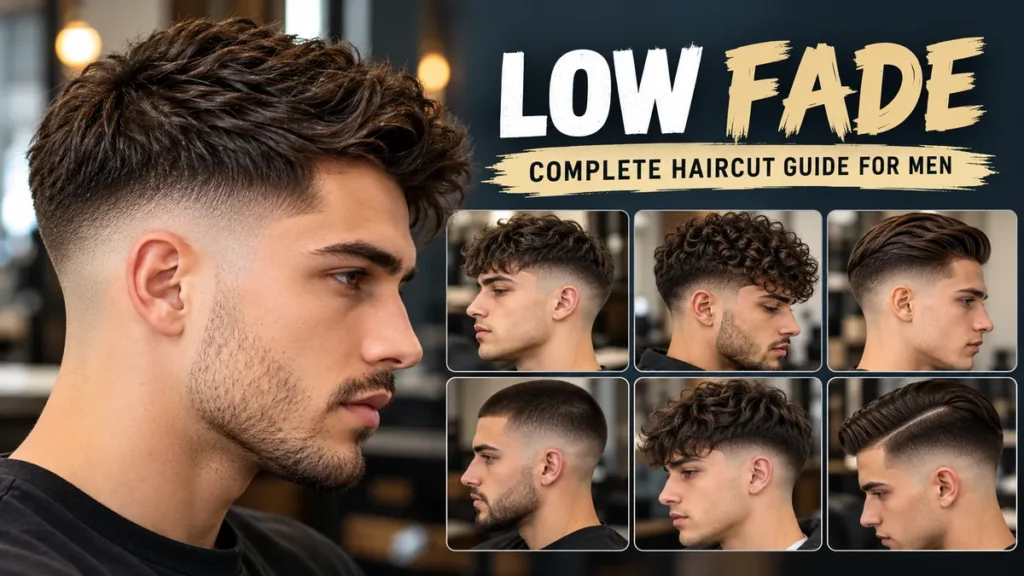
A low fade is one of the easiest ways to make a men’s haircut look cleaner without dramatically changing the overall hairstyle. Instead of removing most of the hair from the sides, the barber keeps the fade close to the ears and neckline, preserving more weight and length higher on the head.
That subtle placement is what makes the haircut so versatile. It can sit underneath a textured crop, curls, a buzz cut, pompadour, quiff, fringe, slick back, or longer hairstyle while still giving the edges a fresh, finished appearance.
A low fade is a gradual transition from very short hair near the ears and neckline into longer hair higher on the sides. The fade begins lower than a mid or high fade, usually just above the ears, creating a softer transition while preserving more hair and visual weight around the sides of the head.
What Is a Low Fade?
A low fade describes the height and placement of the fade, rather than one specific hairstyle.
With this haircut, the shortest area remains near the bottom of the sides and back. The barber gradually blends that short section into longer hair as the clippers move upward.
A typical low fade begins around a finger’s width above the ear, although the exact position depends on the client’s head shape, hairline, desired contrast, and the barber’s interpretation.
This is different from a high fade, where significantly more of the sides are cut short.
Think of fade height as three broad levels:
| Fade Type | General Starting Area | Overall Effect |
|---|---|---|
| Low fade | Just above the ears | Subtle, balanced |
| Mid fade | Around the middle of the sides | More visible contrast |
| High fade | Higher around the temples/upper sides | Strong, dramatic contrast |
The lower placement allows more of the natural side profile to remain visible.
That makes a low fade especially useful when you want your haircut to look fresh without making the fade itself the dominant feature.
How a Low Fade Actually Works
A fade is created by blending several hair lengths together so smoothly that obvious transition lines disappear.
The barber normally begins with the shortest desired length around the bottom of the haircut. Longer clipper settings are then introduced progressively as the blend moves upward.
Depending on the desired result, the bottom may be:
- bare skin
- an unguarded clipper or zero
- a #0.5 guard
- a #1 guard or longer
These choices matter because fade height and fade length are separate decisions.
For example, asking for a low fade tells the barber where you want the transition positioned. It does not necessarily tell them how short you want the bottom.
A low skin fade can begin in the same general location as a low #1 fade, yet the two will look quite different because one exposes skin and the other retains visible hair.
What Do Clipper Guard Numbers Mean?
Guard numbers help communicate approximately how much hair should remain.
Common options include:
| Setting | Approximate Result |
|---|---|
| Skin | Hair removed extremely close to the scalp |
| Zero | Very short stubble |
| #0.5 | About 1.5 mm |
| #1 | About 3 mm |
| #2 | About 6 mm |
| #3 | About 10 mm |
Exact cutting length can vary slightly by clipper system and blade configuration, so a reference photo is often more useful than relying exclusively on guard terminology.
Low Fade vs Low Taper: What’s the Difference?
This is one of the most confusing parts of modern barber terminology.
People frequently use low fade and low taper fade interchangeably, and individual barbers may interpret the terms differently.
Technically, however, they can describe different approaches.
A taper generally concentrates the shortening around the sideburns and neckline while keeping more of the sides intact. A fuller fade creates a broader blended gradient through the sides and back.
Current barber guides also differ slightly in whether the word “fade” necessarily means going all the way to bare skin. That inconsistency is exactly why describing the desired bottom length is more reliable than relying on the haircut name alone.
If you want a subtle result, you could tell your barber:
“Keep the fade low around the ears and neckline, but don’t take it down to skin. Keep some weight through the sides.”
For something sharper:
“I’d like a low skin fade, kept low around the ears and blended smoothly into the top.”
That gives the barber far more information than simply saying, “Give me a fade.”
Low Fade vs Mid Fade
The main difference between a low fade and mid fade is the position of the transition.
A low fade keeps the shortest section close to the bottom of the head. A mid fade moves the blended section farther upward.
That changes the visual balance.
The low version preserves more hair on the sides and creates less separation between the top and sides. A mid fade exposes more of the head and makes the gradient easier to see.
Choose based on the effect you want rather than assuming one is universally better.
A low fade works when you want subtle contrast.
A mid fade works when you want the fade to play a more noticeable role in the haircut.
Low Fade vs High Fade
The contrast becomes even greater with a high fade.
A high fade begins around or above the temple region and removes much more weight from the sides. This can create strong separation between the hair on top and the faded area.
A low fade does almost the opposite.
By keeping the transition near the bottom, it preserves the silhouette created by the side hair.
This is particularly useful with hairstyles where volume or shape around the upper sides contributes to the finished look.
Popular Low Fade Styles
The fade itself only determines what happens around the sides and back.
What you do with the top creates the actual hairstyle.
That means dozens of haircuts can share the same low faded foundation.
Low Skin Fade
A low skin fade, sometimes called a low bald fade, combines low placement with an extremely short base.
The transition begins close to the ears, but the lowest part is taken down to skin before gradually blending into longer hair.
This creates noticeably more contrast than a low fade that finishes at a #1 or #2.
It looks exceptionally crisp immediately after a haircut, although the skin-level portion also makes new growth easier to notice. Skin fades therefore generally require more frequent refreshing than softer fades.
Low Drop Fade
A low drop fade changes the shape of the transition.
Instead of maintaining roughly the same height as it moves toward the back, the fade curves downward behind the ear.
This follows the natural contour of the head and retains additional weight toward the back.
Drop fades are commonly paired with textured and curly hairstyles because the curved transition can complement the natural shape of the hair.
Low Fade With Textured Crop
A textured crop combines short or medium-length hair on top with deliberate texture and relatively clean sides.
The low fade works particularly well here because it cleans up the perimeter without removing all the weight from the haircut.
For styling, a small amount of matte clay or texture paste can help separate the top without making it appear overly polished.
Low Fade With Curly Hair
Curly hair benefits from controlled contrast.
Keeping curls longer on top while cleaning the area around the ears can make the natural texture more prominent.
The barber should account for curl pattern and shrinkage rather than treating curly hair exactly like straight hair.
For tighter curls or coily hair, preserving enough density above the fade is especially important. Removing too much weight can change the overall silhouette of the haircut.
Low Fade With Wavy Hair
Wavy hair naturally provides movement and texture, so it rarely needs an aggressive fade to create visual interest.
A low fade cleans the sides while leaving enough length above the blend for the waves to remain visible.
Sea-salt spray, lightweight styling cream, or a small amount of matte product can help emphasize natural movement.
Low Fade With Straight Hair
Straight hair can reveal uneven blending more easily because the strands often lie in a consistent direction.
A smooth gradient therefore matters.
The top can be worn forward as a crop, swept sideways, pushed backward, styled into a quiff, or left relatively natural.
Thicker straight hair can retain substantial weight around the upper sides, while fine hair may benefit from a softer transition that avoids excessive scalp exposure.
Low Fade With Buzz Cut
A buzz cut and low fade create a straightforward, low-styling combination.
The top remains short while the fade introduces enough variation in length to give the haircut structure.
One important decision is how short the base should be.
A low skin fade creates strong contrast, while a #0.5 or #1 at the bottom gives the buzz cut a softer appearance.
Low Fade With Fringe
A fringe draws attention toward the front of the face.
Keeping the fade low prevents the sides from competing with that shape.
The combination works particularly well with textured, messy, wavy, or curly fringes because the clean lower edges contrast with movement at the front.
Low Fade With Pompadour
A pompadour depends on volume.
A low fade can support that volume without creating the disconnected appearance sometimes produced by a very high fade.
Keeping some weight through the upper sides helps the barber build a smoother transition into the longer top.
Low Fade With Quiff
The quiff combines height toward the front with shorter or controlled sides.
Pairing it with a low fade keeps attention on the front while giving the ears and neckline a neat outline.
A blow dryer is particularly useful here. Directing the hair upward and backward before applying product usually creates better structure than attempting to build the entire shape with styling product alone.
Low Fade With Slick Back
Longer hair can also work with a low fade.
With a slick back, the lower sides are cleaned up while sufficient hair remains higher on the head to connect visually with the longer top.
This creates a less extreme contrast than combining a slick back with a high skin fade.
Low Fade With Side Part
The traditional side part and low fade complement each other because both can be kept understated.
The fade cleans the perimeter while the part gives the top definition.
You can keep the part natural for a softer result or ask for a more defined line if you prefer sharper detailing.
Does a Low Fade Work With Every Hair Type?
One reason this haircut appears across so many styles is that the fade is not dependent on a single hair texture.
It can be adapted for:
- straight hair
- wavy hair
- curly hair
- coily hair
- thick hair
- fine hair
- short tops
- medium-length tops
- longer hairstyles
The technique should still change according to the hair.
Thick Hair
Thick hair gives the barber plenty of density for building a smooth gradient.
However, removing too much weight too quickly can make the upper sides appear bulky compared with the faded section.
Good blending connects those areas gradually.
Fine Hair
With fine or lower-density hair, extremely short sections may expose more scalp.
A low fade that finishes slightly longer—such as a #0.5 or #1 rather than bare skin—can produce a softer transition.
Curly and Coily Hair
Curl pattern affects how length appears.
The barber needs to judge the fade visually rather than depending entirely on guard numbers. The objective is to maintain a smooth transition while preserving the desired shape and density above it.
Choosing a Low Fade for Your Face Shape
There is no rigid rule saying a particular face shape must have one fade height.
Hair density, forehead proportions, beard shape, head shape, top length, and styling all influence the final result.
Still, understanding proportions can help you communicate what you want.
Round Face
If your face appears round, adding some height or texture on top can create more vertical emphasis.
A low fade preserves side structure, so the top hairstyle becomes especially important. A quiff, textured top, or controlled volume can provide additional definition.
Square Face
A square face often has a strong jawline and angular proportions.
A clean low fade can emphasize those existing lines without stripping away too much side volume.
Buzz cuts, crops, side parts, and short textured tops are all practical pairings.
Oval Face
Oval faces can generally accommodate a wide variety of top lengths and fade combinations.
Instead of choosing purely by face shape, consider hair texture and how much maintenance you want.
Oblong or Longer Face
A very tall hairstyle can make an already long face appear even longer.
Keeping moderate volume on top and retaining some weight on the sides with a low fade can create a more balanced silhouette.
Heart or Diamond Face
These shapes may have more width around the cheekbones or upper face.
Because a low fade removes less side volume than a high fade, it gives the barber more control over the overall proportions.
The best result is usually achieved by evaluating the entire haircut rather than choosing the fade independently.
How to Ask Your Barber for a Low Fade
This is where many disappointing fades begin.
Saying only “low fade” leaves several decisions unanswered.
A clearer request specifies four things:
- Fade height: Tell the barber how low you want the blend to remain.
- Bottom length: Choose skin, zero, #0.5, #1, or another preferred length.
- Top length: Explain how much you want removed or how many centimetres you want left.
- Finish and shape: Mention texture, fringe, side part, slick back, natural neckline, drop shape, or other preferences.
A useful request might sound like:
“I’d like a low fade starting just above the ears. Take the bottom to a #0.5, keep some weight through the upper sides, and blend it into a textured top.”
If you want skin:
“Give me a low skin fade and keep the transition low around the ears. Don’t take the fade too high. Leave the top long enough to style forward with texture.”
Current barber guidance consistently recommends communicating the fade height and shortest length separately because those two variables define different parts of the cut.
Bring a Reference Photo
A photograph can solve terminology problems immediately.
“Low” is relative. One barber’s low fade may sit slightly higher than another’s.
Ideally, bring images showing both the side and back of the haircut.
Then explain what you specifically like about the reference:
- fade height
- amount of exposed skin
- top length
- texture
- neckline
- sideburns
- overall shape
That gives the barber concrete information rather than expecting them to reproduce an image without knowing which features matter most to you.
How Often Should You Get a Low Fade?
There is no universal schedule because hair growth rate, fade length, and personal preference differ.
A skin-level fade shows growth fastest because even a small amount of new hair reduces the skin-to-hair contrast.
A softer fade beginning with a #0.5, #1, or longer setting generally grows out less abruptly.
As a practical guideline:
| Style | Typical Refresh Preference |
|---|---|
| Low skin fade | Around 1–3 weeks |
| Low zero fade | Around 2–3 weeks |
| Low #0.5 or #1 fade | Around 3–4 weeks |
| Soft low taper | Around 3–5+ weeks |
These are not deadlines. Current barber sources give somewhat different maintenance intervals, which reflects differences in hair growth and how sharp someone wants the haircut to remain.
If you prefer a freshly cut outline at all times, book sooner.
If you are comfortable with a softer grow-out, wait longer.
How to Maintain a Low Fade Between Haircuts
You cannot prevent hair from growing, but a few habits can keep the overall haircut looking controlled.
Keep the Top Styled
As the fade grows, the way the top sits becomes increasingly important.
Blow-drying hair in the direction you intend to style it can create shape before any product is applied.
Use the Right Styling Product
Choose the product according to the hairstyle rather than the fade.
Matte clay or paste works well for textured crops and messy looks.
Pomade can provide a more polished finish for side parts or slick backs.
Styling cream can help control curls and waves without necessarily creating a stiff appearance.
Avoid Trying to Re-Fade the Sides Yourself
A professional fade is created through controlled transitions between several lengths.
Running a clipper into the blend with the wrong guard can introduce a visible line that becomes harder to correct.
If only the edges need attention, a barber shape-up is safer than attempting to rebuild the gradient yourself.
Common Low Fade Mistakes
The haircut is simple in concept, but small decisions can dramatically change the result.
Taking the Fade Too High
The most obvious mistake is losing the defining characteristic of the haircut.
If too much hair is removed above the ears, the result begins to resemble a mid fade.
Tell the barber explicitly that you want to preserve weight through the upper sides.
Not Specifying the Shortest Length
“Low” describes placement, not necessarily length.
If you do not want visible scalp, say so before the barber starts.
Ask for a #0.5, #1, or another comfortable setting rather than assuming “low fade” automatically means the same thing everywhere.
Choosing Skin Because It Looks Sharp in Photos
Skin fades create strong contrast, but they also reveal regrowth quickly.
If you do not want frequent barber visits, consider leaving a small amount of hair at the bottom.
Ignoring the Back of the Haircut
People naturally focus on the front and sides, but the back changes the overall shape.
Ask whether you want the fade to remain relatively level or drop lower behind the ears.
Removing Too Much Weight
The fade should support the hairstyle above it.
If you have a pompadour, curls, long fringe, or slick back, retaining enough hair through the upper sides can make the transition appear much more natural.
Is a Low Fade Professional?
A low fade can create a restrained appearance because the shortest section stays close to the natural hairline and more hair remains through the upper sides.
Several contemporary barber guides specifically describe low fades and low tapers as suitable for professional or formal environments because they produce less dramatic contrast than higher fades.
The hairstyle on top still matters.
A neatly styled side part with a soft low fade looks very different from an aggressively textured top with a low skin fade, even though both use the same general fade height.
If workplace appearance is a concern, keeping the bottom slightly longer and avoiding extreme contrast creates the more conservative version.
Is a Low Fade Good for Beginners?
If you have never had a fade before, keeping the transition low is a practical way to experiment without dramatically changing the shape of your haircut.
Most of the upper side hair remains intact.
If you decide you want more contrast next time, you can move toward a mid fade, high fade, or skin variation.
The reverse is harder immediately after a haircut because removed hair needs time to grow back.
For a first attempt, consider asking for:
low fade + #0.5 or #1 base + natural blend + your normal top hairstyle.
That gives you the character of a fade without committing to bare skin or a very high transition.
What Makes a Good Low Fade?
A quality fade should not simply be short.
Look at the gradient.
You should see a smooth transition between the shortest and longest sections without obvious horizontal lines or patches.
Around the ears, the blend should follow the shape of the head cleanly.
The back should connect naturally into the neckline.
Most importantly, the fade should work with the haircut above it.
A technically perfect skin fade can still feel wrong if it removes the weight needed for your hairstyle.
Good barbering is therefore not just about making the blend invisible. It is about controlling shape, proportion, length, and contrast as one haircut.
Should You Get a Low Fade?
A low fade makes sense if you want clean sides while preserving more hair around the head than a mid or high fade would.
Its biggest advantage is flexibility.
You can make it understated by leaving visible hair at the bottom, or dramatically sharper by turning it into a low skin fade. It works underneath short buzz cuts, textured crops, curls, waves, fringes, quiffs, side parts, pompadours, and longer tops.
Before your next haircut, decide on three things: how low the fade should stay, how short the bottom should be, and how much length you want on top.
Then show your barber a reference image and describe those details clearly.
That simple preparation is far more reliable than walking into the shop and asking for “a low fade” without specifying what you actually want.


