
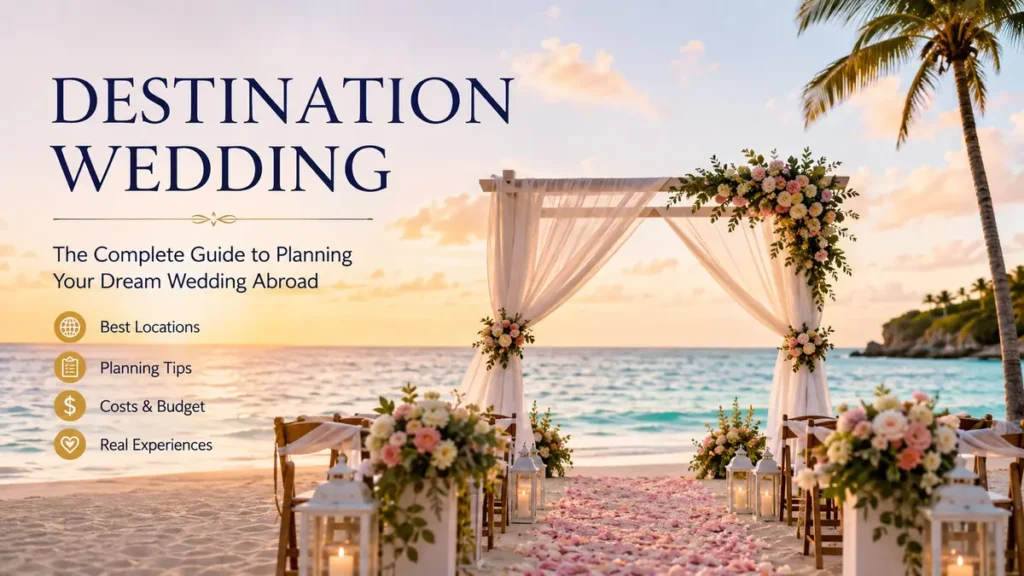
A destination wedding turns a marriage celebration into something bigger than a single ceremony. Instead of gathering close to home, couples invite family and friends to travel to a meaningful city, island, mountain retreat, resort, or overseas location—and often spend several days together rather than a few hours.
A destination wedding is a wedding held somewhere that requires significant travel for most of the couple and their guests. It may take place internationally or within the same country and commonly combines the ceremony and reception with accommodations, group travel, welcome events, local experiences, and a multi-day celebration.
The popular image is a beachfront ceremony in Mexico or the Caribbean, but that is only one version. A wedding in another state, a European villa celebration, a mountain lodge weekend, or a gathering in a city where neither partner lives can all qualify.
Planning one successfully requires more than choosing a beautiful backdrop. Travel costs, passports, weather, legal marriage requirements, accessibility, guest expectations, hotel arrangements, vendors, transportation, and contingency plans all matter.
This guide explains how destination weddings work, what they cost, who normally pays for what, how far ahead to plan, and how to make the experience manageable for both the couple and their guests.
What Is a Destination Wedding?
Traditionally, a destination wedding means holding the ceremony and reception away from the couple’s hometown, requiring most attendees to travel.
That definition has become broader.
A destination does not have to be another country. The Knot’s discussion of modern destination weddings notes that many couples now marry elsewhere within their own country rather than flying internationally. Its 2025 Real Weddings Study found that only a minority of destination celebrations were specifically tropical or international.
That means all of these could reasonably be considered destination weddings:
- A beach ceremony in Cancun
- A resort wedding in Punta Cana
- A vineyard celebration in Tuscany
- A villa wedding in Greece
- A weekend in the South of France
- A mountain wedding several states away
- A ceremony in Hawaii for a mainland U.S. couple
- A small wedding in a city where neither partner lives
- An intimate overseas elopement with a few guests
The defining feature is travel, not palm trees.
Most destination celebrations also extend beyond the ceremony itself. Guests may arrive a day or two early, attend a welcome dinner, enjoy free time or excursions, attend the wedding, and meet again for brunch before leaving.
That creates a noticeably different experience from a traditional local wedding.
Destination wedding vs. traditional wedding
| Factor | Destination Wedding | Traditional Local Wedding |
|---|---|---|
| Location | Away from home for most attendees | Near the couple or most guests |
| Typical duration | Often 2–4 days | Usually one main day |
| Travel planning | Major consideration | Usually limited |
| Guest list | Often smaller | Can be considerably larger |
| Accommodation | Frequently coordinated | Usually optional |
| Guest expenses | Often higher | Usually lower |
| Legal considerations | Can be complex internationally | Usually straightforward |
| Events | Welcome parties, excursions, brunches | Ceremony and reception dominate |
| Vendor planning | Often handled remotely | Easier to manage in person |
Neither style is automatically better. They simply create different planning priorities.
Why Couples Choose a Destination Wedding
The strongest reason to choose a destination wedding usually has little to do with trends. Couples tend to want a different type of experience.
Instead of seeing guests primarily during a five- or six-hour reception, they may spend an entire weekend together.
A more intimate guest list
Travel naturally changes attendance.
Someone who might attend a local reception may be unable or unwilling to take several days off work, purchase airfare, pay for accommodation, or arrange childcare.
As a result, destination wedding guest lists are often smaller.
That can be a benefit for couples who genuinely want a more intimate celebration, but it should never be used as a strategy to invite people while hoping they decline. Guests should receive invitations because the couple truly wants them there.
More time with guests
This is one of the biggest practical differences.
A typical destination wedding schedule might look like:
Thursday: arrivals
Friday: welcome gathering
Saturday: ceremony and reception
Sunday: farewell brunch
Monday: departures or honeymoon begins
Guests still need free time. A destination wedding should not become a compulsory four-day itinerary.
The best schedules combine meaningful group moments with enough space for people to enjoy the place they traveled to see.
A meaningful setting
Some couples return to a place connected to their relationship.
Others choose somewhere they have always wanted to visit.
The destination might represent:
- where the couple first traveled together
- a family heritage or cultural connection
- a favorite vacation location
- a shared interest such as skiing or hiking
- an environment that matches the desired atmosphere
- a practical meeting point for families living in different countries
Choosing a location for emotional reasons can make the ceremony especially personal, provided the destination also works logistically.
A built-in travel experience
A destination wedding can combine the marriage celebration with a vacation for the couple and, optionally, their guests.
Some couples also begin their honeymoon immediately afterward.
However, calling the wedding a “vacation for everyone” can overlook an important reality: guests are traveling primarily because of the wedding. Their flights, accommodation, leave from work, childcare, and other expenses are real.
Good planning recognizes both sides.
How Much Does a Destination Wedding Cost?
There is no useful universal price because destination wedding costs vary enormously.
An intimate ceremony for ten people at an all-inclusive resort and a three-day luxury villa wedding for 100 guests belong to the same category but have completely different budgets.
Current planning resources commonly place smaller or moderately sized destination celebrations anywhere from several thousand dollars to tens of thousands, while customized luxury events can exceed those figures substantially.
The mistake is assuming that a destination wedding is automatically cheaper.
Sometimes it is. Sometimes it is considerably more expensive.
What determines the cost?
The biggest factors are:
| Cost Factor | Why It Matters |
|---|---|
| Guest count | Catering, seating, transportation and events often scale per person |
| Destination | Flights, accommodation and local vendor rates vary widely |
| Season | Peak travel periods usually cost more |
| Venue | Resort packages and private venues use different pricing models |
| Number of events | Welcome dinners and brunches increase spending |
| Accommodation | Couples may subsidize rooms or upgrades |
| Travel | The couple has airfare, baggage and local transportation too |
| Décor | Imported or highly customized décor can become expensive |
| Vendors | Flying photographers or planners in adds travel costs |
| Legal paperwork | Documents, translation and administrative fees may apply |
| Currency | Exchange-rate changes can alter overseas budgets |
| Taxes and service fees | Resort quotes may not represent the final total |
Guest count often remains one of the most powerful budget controls.
A smaller destination celebration can cost less than a large hometown reception even when travel expenses are included.
But comparing only venue packages is misleading.
What an all-inclusive destination wedding package may include
Resort wedding packages can simplify planning by bundling several services together.
Depending on the property and package, they may include:
- ceremony venue
- chairs
- basic décor
- officiant
- bouquet and boutonniere
- cocktail hour
- reception space
- food and beverages
- wedding cake
- sound equipment
- onsite coordinator
- photography credit
- couple’s room or room upgrade
“Inclusive” does not mean everything is included.
Premium flowers, private reception upgrades, additional photography, entertainment, lighting, hair and makeup, outside-vendor fees, rehearsal dinners and extra guests can all increase the final bill.
Before paying a deposit, couples should ask for an itemized estimate based on their actual expected guest count, not the attractive starting price displayed online.
Quick Takeaway: Compare complete wedding budgets, not package prices. Travel, accommodation, extra events, décor upgrades, taxes, service charges, vendor fees and legal requirements can substantially change the final cost.
Who Pays for What at a Destination Wedding?
One of the most common destination wedding etiquette questions is whether the couple must pay for everyone’s travel.
Usually, no.
Guests generally expect to cover their own airfare and accommodation, while the couple pays for the wedding itself and any events they formally host. Current destination-wedding etiquette guides follow broadly the same division.
A useful starting framework is:
| Expense | Couple Usually Pays | Guest Usually Pays |
|---|---|---|
| Ceremony | ✓ | |
| Reception | ✓ | |
| Wedding food and drinks | ✓ | |
| Wedding décor | ✓ | |
| Couple’s vendors | ✓ | |
| Guest airfare | ✓ | |
| Guest hotel room | ✓ | |
| Personal travel insurance | ✓ | |
| Personal excursions | ✓ | |
| Meals outside hosted events | ✓ | |
| Welcome party, if formally hosted | ✓ | |
| Farewell brunch, if formally hosted | ✓ | |
| Airport transfers | Varies | Varies |
There are exceptions.
Couples may decide to pay for accommodations for parents or the wedding party, subsidize rooms, provide airport transfers, or cover a group excursion.
Those are generous choices rather than universal requirements.
Should destination wedding guests give a gift?
Traveling to a destination wedding can already represent a significant financial commitment.
Guests should not feel pressured to spend beyond their means on an expensive present as well. Some etiquette guidance explicitly recognizes the substantial cost guests have already taken on when considering gifts.
Couples can make this easier by avoiding any language that creates gift expectations.
How to Choose a Destination Wedding Location
Beautiful photographs are not enough.
A destination that looks spectacular online can become difficult once flight schedules, weather, accessibility, visa requirements and hotel prices enter the picture.
Start with practical filters.
1. Consider where guests are traveling from
Map where the people you most want present actually live.
Then examine:
- nonstop flight availability
- flight duration
- typical airfare
- airport-to-venue transfer time
- entry requirements
- accessibility for elderly guests
- travel difficulty for families with children
A stunning island requiring three flights and a two-hour ferry may be perfect for an elopement but frustrating for 90 guests.
2. Check the climate by month
Do not simply search for the “best time” to visit a destination.
Look specifically at your wedding month.
Research:
- average rainfall
- temperature
- humidity
- hurricane or cyclone season
- wildfire risk
- snowfall
- sunset time
- daylight hours
- seasonal winds
Beach ceremonies especially need backup plans because wind, rain and extreme heat can affect comfort even when conditions remain technically safe.
3. Understand high and low seasons
Peak season generally brings more predictable conditions but higher hotel rates and heavier demand.
Shoulder season may offer a good balance between cost and weather.
Low season can save money, but savings may come with greater weather risks, closures or limited flight schedules.
The cheapest month is not automatically the smartest month.
4. Compare accommodation choices
Guests have different budgets.
Whenever possible, choose a destination offering more than one reasonable lodging category, or negotiate several room types within the same property.
Ask:
- What is the cheapest realistic room?
- Is there a minimum stay?
- Is an all-inclusive rate mandatory?
- Are children permitted?
- Are single-occupancy rates significantly higher?
- Is the property accessible?
- Can guests stay elsewhere?
- Will off-property guests have to pay resort day fees?
That final question is particularly important at all-inclusive resorts.
5. Think beyond the wedding venue
Guests may spend three to five days in the area.
Research restaurants, beaches, museums, excursions, transportation and activities so the location works as a destination—not merely a ceremony backdrop.
Popular international regions include Mexico, the Caribbean and parts of Europe, while domestic destination weddings can range from coastal resorts and mountain towns to major cities and national-park regions.
Destination Wedding Planning Timeline
A destination wedding generally benefits from more lead time than a local wedding because guests must arrange travel.
Some current planning guides recommend approximately 12 to 18 months for the overall planning process.
You do not need every floral detail decided a year early. You do need the information guests require to make travel decisions.
12–18 months before
- Establish the overall budget.
- Draft the guest list.
- Research destinations.
- Compare travel accessibility.
- Research marriage laws.
- Choose a wedding season.
- Compare venues or resorts.
- Hire a planner if using one.
- Select a date.
- Review venue contracts carefully.
Venue availability and hotel inventory can disappear quickly during popular seasons.
9–12 months before
Secure the major logistical pieces:
- venue
- room block
- photographer
- planner or coordinator
- primary entertainment
- important outside vendors
Send save-the-dates early enough for guests to estimate the cost and determine whether attending is realistic.
Include the destination immediately. Guests need that information before committing.
6–9 months before
Now move into practical guest planning:
- create or update the wedding website
- publish accommodation details
- explain how room reservations work
- provide passport or visa reminders
- research transportation
- finalize ceremony plans
- begin attire planning
- review legal documentation deadlines
Do not wait until invitations arrive to disclose expensive hotel requirements.
3–6 months before
At this stage:
- send formal invitations
- confirm group transportation
- finalize menus
- arrange welcome events
- choose music
- review décor
- verify vendor logistics
- develop a rain or weather backup
- confirm local documentation requirements
If the ceremony is legally binding abroad, double-check every document rather than relying on assumptions.
1–3 months before
Gather final details:
- RSVPs
- rooming information
- airport arrivals
- dietary restrictions
- seating plans
- vendor timelines
- welcome information
- emergency contacts
Send guests a concise travel update containing only information they need.
Wedding week
Confirm:
- vendor arrival times
- weather
- transportation
- ceremony backup location
- final guest count
- accessibility arrangements
- payments and gratuities
- passports and documents
- rings and attire
Keep critical items in carry-on luggage when flying.
A delayed checked bag containing wedding attire is a preventable crisis.
Destination Wedding Legal Requirements
This is where international planning becomes more complicated.
Getting married ceremonially in another country does not automatically mean completing the legal marriage there.
Countries may require combinations of:
- valid passports
- birth certificates
- tourist permits
- divorce decrees
- death certificates from former spouses
- blood tests
- medical certificates
- certified translations
- apostilles
- local witnesses
- residency periods
- government fees
Requirements depend on the jurisdiction and can change.
Never rely exclusively on a wedding blog for legal instructions. Confirm current rules directly with the appropriate government authority, consulate, civil registry or qualified local professional.
Legal ceremony vs. symbolic ceremony
Many couples simplify matters by legally marrying in their home jurisdiction before or after traveling and then holding a symbolic ceremony at the destination.
A symbolic ceremony can still include:
- vows
- ring exchange
- readings
- officiant remarks
- processional
- recessional
- cultural rituals
To guests, it can look and feel exactly like the wedding celebration the couple intended.
The difference is that the legal paperwork was completed elsewhere.
That approach can avoid foreign-language documents, residency rules and administrative uncertainty. It is not necessary everywhere, but it is worth comparing before committing to an overseas legal ceremony.
How Many Guests Attend a Destination Wedding?
Expect some invited guests to decline.
That does not mean they care less about the couple.
Attending may require airfare, accommodation, vacation days, childcare, passports and several days away from home.
Recent planning resources often estimate destination attendance below what might be expected for a local celebration, although the percentage varies greatly by guest group and destination.
Instead of relying on a generic percentage, divide guests into realistic groups:
Highly likely: parents, siblings, wedding party, closest friends.
Possible: extended family and friends with flexible schedules and adequate travel budgets.
Less certain: people with young children, health or mobility limitations, restrictive work schedules, long flight routes or significant financial constraints.
Build the budget around realistic attendance while checking how the venue handles minimum guest commitments.
Most importantly, avoid guilt.
An invitation asks someone to celebrate with you. It does not create an obligation to purchase a vacation.
Destination Wedding Etiquette for Couples
Travel creates responsibilities that do not exist in quite the same way for a local celebration.
Give guests plenty of notice
Guests need time to:
- save money
- request leave
- obtain passports
- arrange childcare
- compare flights
- plan other annual travel
Earlier communication reduces stress.
Be transparent about costs
Guests should know what attendance realistically involves.
Provide approximate:
- hotel rates
- minimum-stay requirements
- resort fees
- airport transfer costs
- expected number of nights
- meals included
- required resort passes
Do not hide expensive requirements behind a romantic invitation.
Make attendance optional in both words and tone
“No pressure” loses its meaning when followed by repeated questions about whether someone has booked.
Respect declines graciously.
Traveling to someone’s wedding can be meaningful, but nobody should take on harmful debt to prove a relationship.
Do not over-schedule the trip
People paid to travel there. Allow them to enjoy the destination.
A welcome party and farewell brunch can be lovely. Mandatory sunrise yoga, compulsory excursions, daily lunches and late-night activities may become exhausting.
Mark optional activities clearly.
Think about accessibility
Beautiful cobblestone streets, mountain staircases and sandy ceremonies can create difficulties for guests with limited mobility.
Ask venues about:
- step-free routes
- elevators
- accessible guest rooms
- accessible bathrooms
- transport
- ceremony seating
- wheelchair access
Accessibility should be evaluated before booking, not discovered during wedding week.
Destination Wedding Etiquette for Guests
Guests have responsibilities too.
Respond promptly once you understand the travel requirements.
If you cannot afford to attend, a polite decline is enough. You do not owe anyone a detailed explanation of your finances.
If you do attend:
- meet passport and visa deadlines
- book within stated deadlines when possible
- respect the dress code
- arrive early enough to account for travel disruption
- attend events marked as part of the wedding
- communicate dietary or accessibility needs in advance
- do not complain to the couple about normal vacation expenses after accepting
Guests should also distinguish between wedding time and personal vacation time.
Adding days before or after the event is perfectly reasonable, but the couple should not be expected to coordinate everyone’s independent itinerary.
Travel and Accommodation Planning
Guest logistics are where otherwise excellent destination wedding plans often break down.
Use a room block carefully
A hotel room block can simplify accommodation and sometimes provide preferred group pricing or additional wedding benefits.
Before signing anything, understand:
- deposit requirements
- cancellation terms
- attrition clauses
- minimum room nights
- complimentary-room policies
- cutoff dates
- whether rates include taxes
- whether guests pay the hotel directly
- whether you become financially responsible for unused rooms
Never promise guests that a room block is the “cheapest rate” unless you have verified it.
Should you use a travel advisor?
A travel advisor can be particularly useful for complicated resort weddings or large groups.
They may coordinate:
- room reservations
- guest questions
- airport transfers
- flight guidance
- payment schedules
- travel insurance information
- resort communication
This can reduce the number of logistical messages reaching the couple.
However, understand how the advisor is compensated and whether guests are required to book through them.
Recommend travel insurance thoughtfully
Travel plans can be disrupted by illness, severe weather, flight cancellations or emergencies.
Couples can remind guests to evaluate travel insurance, but should avoid promising that a particular policy covers every scenario.
Coverage varies substantially.
Guests should read exclusions, limits and cancellation provisions themselves.
Weather Planning Is Not Optional
Outdoor destination weddings need a real backup plan.
Not a backup consisting of “hopefully it won’t rain.”
Ask the venue exactly what happens if conditions change.
Questions worth asking include:
- Where does the ceremony move?
- Is the backup area private?
- When is the weather decision made?
- Who makes it?
- Can décor be relocated?
- Does the reception space have climate control?
- What happens during extreme heat?
- What happens during high winds?
- Is there an evacuation or severe-weather policy?
A backup location should be somewhere you would genuinely accept using.
This matters especially in destinations with hurricane seasons, monsoons, tropical storms, extreme summer heat or unpredictable mountain conditions.
Vendors and Destination Wedding Planning
Couples usually have three choices: local vendors, resort-preferred vendors, or professionals brought from home.
Each has advantages.
Local vendors
Local professionals understand the destination.
They may already know:
- venue rules
- weather patterns
- local transportation
- installation logistics
- regional flowers
- cultural customs
- permit requirements
They also avoid international transportation for equipment.
Resort-preferred vendors
Resort weddings may encourage or require an approved supplier list.
This simplifies coordination but reduces flexibility.
Before signing, ask whether outside vendors trigger:
- access fees
- day passes
- setup fees
- insurance requirements
- restrictions on equipment
A photographer who appears reasonably priced can become expensive after travel and outside-vendor charges.
Bringing vendors from home
Couples sometimes fly in a trusted photographer, videographer, planner, makeup artist or entertainment team.
That can produce greater creative consistency.
Budget for:
- airfare
- hotel
- local transportation
- baggage
- equipment
- work permits where applicable
- meals
- travel days
Never assume a professional can legally work in another country simply because they can enter it as a tourist.
Cultural Respect at an Overseas Wedding
A destination is not merely scenery.
People live there, traditions belong to communities, and cultural practices have meanings beyond wedding aesthetics.
Research local etiquette before incorporating:
- religious ceremonies
- traditional clothing
- sacred symbols
- dances
- rituals
- indigenous designs
- culturally significant music
Work with knowledgeable local professionals whenever cultural traditions are involved.
There is a difference between appreciating the destination and treating its culture as decoration.
The same principle applies to guests. Share useful information about appropriate clothing, tipping, customs, language basics and behavior at religious or culturally sensitive sites.
Common Destination Wedding Mistakes
Several planning mistakes repeatedly create unnecessary stress.
Choosing the destination before setting a budget
A place can be perfect emotionally but impossible financially.
Set a realistic overall range before falling in love with a venue.
Ignoring guest costs
A hotel may seem reasonable to the couple while being unrealistic for half the guest list.
Evaluate the celebration from the guest’s perspective too.
Assuming a smaller wedding is automatically cheaper
Travel, multi-day events, luxury accommodations and imported vendors can offset savings from a smaller guest count.
Sending information too late
The earlier guests understand dates, destination and accommodation expectations, the better.
Filling every day with events
Leave breathing room.
Forgetting the weather backup
Outdoor scenery is valuable only when there is a workable alternative.
Signing contracts without understanding fees
Read cancellation clauses, attrition requirements, service fees, taxes and outside-vendor policies.
Trying to control where everyone vacations
Guests may arrive early, leave later or stay somewhere different.
Unless a logistical requirement affects the wedding itself, allow flexibility.
Expecting everyone to attend
Destination weddings come with higher barriers to attendance. Accept that before sending invitations.
Are Destination Weddings Cheaper?
They can be, but the format itself does not guarantee savings.
Consider two hypothetical celebrations.
Wedding A: large hometown wedding
- 160 guests
- city ballroom
- traditional reception
- minimal travel expenses for couple
- one primary wedding day
Wedding B: destination wedding
- 55 guests
- resort package
- couple’s flights and accommodation
- welcome dinner
- wedding reception
- farewell brunch
- transfers and travel logistics
Wedding B may cost less because 105 fewer people require meals, drinks, seating and décor.
But if Wedding B uses a luxury European villa, designer florals, several private events and flown-in vendors, it could easily cost more.
The right question is therefore not:
“Are destination weddings cheaper?”
It is:
“Would the destination wedding we actually want cost less than the local wedding we would actually plan?”
Build both budgets and compare them line by line.
Quick Takeaway: Smaller guest counts can make destination celebrations more economical, but travel and multi-day events introduce costs that local weddings may not have.
Destination Wedding Pros and Cons
The format works beautifully for some couples and poorly for others.
| Pros | Cons |
|---|---|
| More intimate guest list | Some important guests may be unable to attend |
| Several days with loved ones | More travel logistics |
| Memorable setting | Higher guest expenses |
| Can combine wedding and honeymoon travel | Legal paperwork may be complicated |
| Smaller guest count may reduce some costs | Multi-day events can increase costs |
| Natural opportunities for shared experiences | Remote vendor coordination |
| Many resorts offer bundled packages | Less control with package-based vendors |
| Distinctive photography and scenery | Weather disruption can affect travel |
Think carefully about which side carries more weight for you.
If having grandparents, siblings or certain friends present matters more than the location, verify their ability to travel before booking.
If celebrating somewhere meaningful is central to the experience and your core guests can realistically join, the format may be ideal.
What Makes a Destination Wedding Comfortable for Guests?
The most guest-friendly celebrations tend to share several characteristics.
They provide early notice.
They offer clear pricing.
They make transportation understandable.
They avoid unnecessary mandatory expenses.
They provide free time.
They respect declines.
They choose accommodation with realistic options.
They explain the itinerary without bombarding guests with messages.
They also remember that not everyone is an experienced traveler.
Simple information can eliminate anxiety:
Airport: Which airport should guests use?
Transfers: How do they reach the hotel?
Currency: What currency is generally useful?
Weather: What should they expect?
Dress: What does the wedding dress code actually mean in this climate?
Documents: Is a passport or visa necessary?
Schedule: Which events are essential and which are optional?
Emergency contact: Who should guests contact if travel goes wrong?
Put these details on the wedding website rather than sending them repeatedly through individual messages.
How Far Should a Destination Wedding Be From Home?
There is no minimum distance.
A wedding can qualify as a destination celebration when the location requires meaningful travel for most attendees—even if it is within the same country.
The Knot has specifically highlighted the rise of domestic destination weddings, sometimes described as “domestination weddings.”
A three-hour drive to a resort town may create the same multi-day structure as a short international flight.
Domestic destinations can also simplify:
- passports
- currency conversion
- language barriers
- marriage paperwork
- international roaming
- work permits for vendors
Couples who love the idea of a wedding weekend but dislike international logistics should not overlook destinations closer to home.
How Long Does a Destination Wedding Usually Last?
The ceremony and reception still occupy one primary day, but the overall experience commonly lasts around three or four days.
One practical structure is:
Day 1: Arrival
Allow guests to settle in without requiring attendance at a formal event.
Day 2: Welcome gathering
Keep it relaxed—a dinner, cocktails or informal gathering.
Day 3: Wedding
Ceremony, cocktail hour and reception.
Day 4: Farewell
Optional brunch or casual goodbye.
Guests extending the trip can then continue independently.
This structure gives the wedding a sense of occasion without turning every hour into scheduled programming.
How to Decide if a Destination Wedding Is Right for You
Before booking anything, answer six practical questions.
- Who absolutely needs to be there?
Check whether those people can realistically travel. - What can we comfortably spend?
Include travel and secondary events, not only the wedding package. - What can our guests realistically spend?
You cannot know everyone’s finances, but you can avoid obviously unreasonable requirements. - How comfortable are we planning remotely?
Some couples enjoy delegating. Others want to inspect every detail personally. - How important is legal simplicity?
If overseas paperwork feels burdensome, consider a symbolic destination ceremony after legally marrying at home. - Do we want a wedding or a wedding weekend?
Destination celebrations work best when the shared travel experience itself appeals to you.
If those answers align, planning becomes much easier.
A Practical Destination Wedding Checklist
Once the decision is made, tackle the project in this order rather than jumping directly into flowers and décor:
- Establish your total budget.
- Draft a realistic guest list.
- Identify must-have attendees.
- Shortlist accessible destinations.
- Research seasonal weather.
- Check passport and visa considerations.
- Investigate legal marriage requirements.
- Compare venues and resorts.
- Request complete pricing.
- Read contracts and cancellation policies.
- Confirm the date.
- Secure accommodation arrangements.
- Send early save-the-dates.
- Build the wedding website.
- Book important vendors.
- Arrange guest transportation.
- Create the wedding-day backup plan.
- Plan optional surrounding events.
- Confirm RSVPs and travel details.
- Recheck documentation before departure.
The order matters.
A beautifully styled reception cannot compensate for impossible flights, unaffordable hotel rates or overlooked legal requirements.
Final Thoughts on Planning a Destination Wedding
A destination wedding works best when the location improves the experience rather than making travel itself the point.
Choose somewhere that suits your budget, your priorities and the people you most want beside you. Research the climate and legal requirements early, give guests substantial notice, communicate costs clearly, and build enough flexibility into the schedule for everyone to enjoy the destination.
Most of all, plan from the perspective of both host and traveler.
A memorable destination celebration is not necessarily the one with the farthest flight, most elaborate resort or longest itinerary. It is the one where the couple gets the setting and experience they hoped for while guests understand exactly what is expected of them—and feel genuinely welcome once they arrive.


