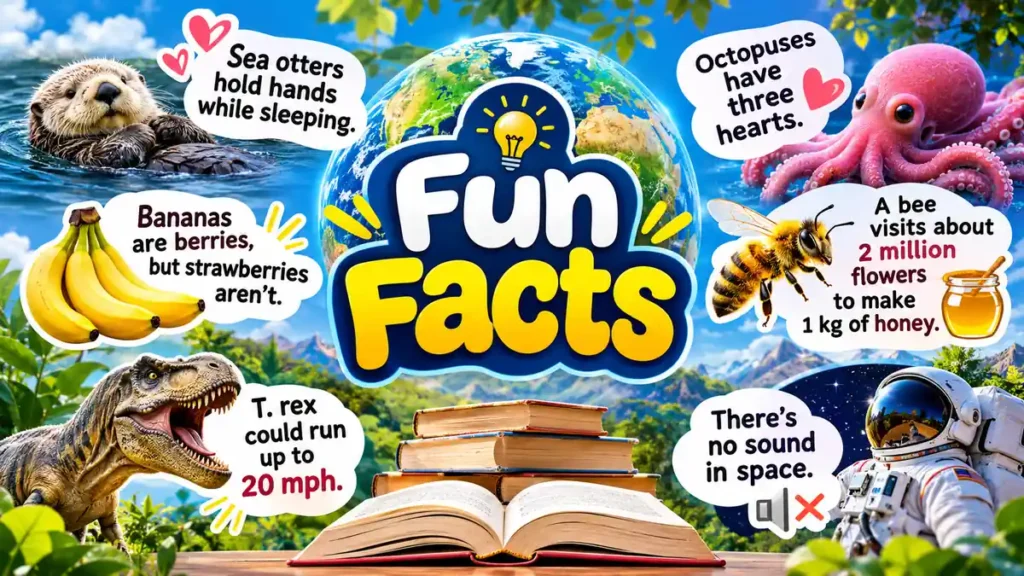
Did you know that an octopus has three hearts, a day on Venus lasts longer than its year, and some sharks can live for centuries? The world is packed with surprising discoveries that sound almost impossible but are supported by science.
From unusual animal behavior to incredible human abilities, these fun facts reveal how fascinating everyday life can be.
Fun facts are short, surprising pieces of information that reveal something unusual, interesting, or unexpected about the world. They cover subjects such as animals, science, space, history, geography, food, and the human body. The best facts are entertaining, easy to remember, and supported by reliable evidence rather than popular myths.
Here are 100 fascinating facts, organized by topic, with explanations that make them easier to understand and share.
Amazing fun facts About Animals
Understanding Octopuses for a Friendly Photographic Experience
The animal kingdom contains some of nature’s most extraordinary adaptations. From creatures with unusual anatomy to animals that communicate in unexpected ways, these interesting animal facts show just how diverse life on Earth can be.
1. Octopuses have three hearts
An octopus has two hearts that pump blood through its gills and a third that circulates blood throughout its body. Its blood is blue because it uses a copper-containing protein called hemocyanin to transport oxygen.
2. Wombats produce cube-shaped poop
Australian wombats produce droppings shaped like small cubes. Scientists have discovered that differences in the elasticity of their intestinal walls help create this unusual shape.
3. Sharks existed before trees
Shark ancestors appeared more than 400 million years ago, before the earliest known forests developed. These ancient marine predators survived multiple mass extinction events.
4. Flamingos are not naturally born pink
Young flamingos have grayish or whitish feathers. Their familiar pink coloring develops from carotenoid pigments in algae and small crustaceans they consume.
5. Sea otters have incredibly dense fur
Sea otters can have hundreds of thousands of hairs per square inch, with some areas exceeding a million. Their thick fur traps air and helps them stay warm in cold ocean water.
6. Butterflies taste with their feet
Butterflies have chemical receptors on their feet that help them identify suitable plants. Female butterflies use these receptors when selecting places to lay eggs.
7. A blue whale is the largest animal known to have lived
The blue whale can reach lengths of around 30 meters (98 feet) and weigh well over 100 metric tons. Despite its enormous size, it feeds primarily on tiny crustaceans called krill.
8. Koalas can sleep for most of the day
Koalas may rest or sleep for 18–22 hours daily. Their eucalyptus-based diet provides relatively little usable energy, making long periods of rest advantageous.
9. Bats are the only mammals capable of sustained powered flight
Flying squirrels and sugar gliders can glide, but bats actively flap their wings to generate lift and propulsion.
10. Some jellyfish can reverse their life cycle
The jellyfish Turritopsis dohrnii can sometimes return from its adult stage to an earlier developmental stage. This ability has earned it the nickname “immortal jellyfish,” although it can still die from disease or predators.
11. Elephants have unusually long pregnancies
African elephants typically carry their young for approximately 22 months, one of the longest gestation periods among mammals.
12. Owls cannot rotate their eyes like humans
An owl’s eyes are relatively fixed in their sockets. Instead, its flexible neck allows it to turn its head up to about 270 degrees.
13. Penguins can take thousands of tiny naps
Research on chinstrap penguins found that some nesting birds sleep in extremely brief episodes lasting only a few seconds, accumulating substantial rest across the day.
14. Greenland sharks may live for centuries
Scientists have estimated that some Greenland sharks can live for several hundred years. Age estimates based on eye-lens proteins suggest that they are among the longest-lived vertebrates.
15. A giraffe has seven neck vertebrae
Despite its exceptionally long neck, a giraffe has seven cervical vertebrae, the same number typically found in humans. The difference is that each vertebra is greatly elongated.
Quick takeaway: Animals have evolved remarkable survival strategies, including specialized senses, unusual circulatory systems, energy-saving behaviors, and extraordinary lifespans.
Mind-Blowing fun facts About Space and the Universe
Cracking the Mysteries of Venus: New Information on Planet’s Spin and Internal Structure
Staring at Saturn – NASA Science
Space contains some of the most astonishing facts in science. Planets behave in ways that seem impossible on Earth, and the distances between celestial objects challenge ordinary human experience.
16. A day on Venus is longer than its year
Venus takes approximately 243 Earth days to rotate once relative to the stars but only about 225 Earth days to orbit the Sun.
This makes its rotation period longer than its orbital period.
17. The Sun contains nearly all the solar system’s mass
Approximately 99.86% of the solar system’s mass is concentrated in the Sun. Jupiter and the other planets account for most of what remains.
18. Sunlight takes about eight minutes to reach Earth
Light travels at approximately 299,792 kilometers per second in a vacuum. Even at this incredible speed, sunlight takes around eight minutes and 20 seconds to cross the average distance between the Sun and Earth.
19. Saturn would float in water under a hypothetical comparison
Saturn’s average density is lower than that of liquid water. Although no ocean could realistically hold the planet, the comparison illustrates how low its average density is.
20. The Moon is slowly moving away from Earth
Measurements using laser reflectors left on the lunar surface show that the Moon recedes from Earth by approximately 3.8 centimeters annually.
This gradual movement results from tidal interactions between Earth and the Moon.
21. Mars has the tallest known volcano in the solar system
Olympus Mons, a giant shield volcano on Mars, rises more than 20 kilometers above its surrounding reference level. It is far larger than any volcano on Earth.
22. Space is mostly silent
Sound requires a medium such as air, water, or solid matter to travel. Because space is nearly a vacuum, ordinary sound waves cannot propagate across it as they do on Earth.
23. Jupiter has the shortest day of any planet
Jupiter completes one rotation in approximately 9 hours and 56 minutes, despite being the largest planet in the solar system.
24. Neptune has extraordinarily powerful winds
Atmospheric winds on Neptune can exceed 2,000 kilometers per hour, making them among the fastest recorded in the solar system.
25. Uranus rotates almost on its side
Uranus has an axial tilt of about 98 degrees. This unusual orientation produces extreme seasonal patterns as the planet travels around the Sun.
26. Saturn’s moon Titan has lakes of liquid methane
Titan has rivers, lakes, and seas filled with liquid hydrocarbons, primarily methane and ethane. Its surface is so cold that water behaves more like solid rock.
27. The Milky Way contains billions of stars
Astronomers estimate that our galaxy contains roughly 100–400 billion stars, although the precise number remains uncertain.
28. A neutron star is incredibly dense
A teaspoon-sized amount of typical neutron-star matter would have a mass of billions of metric tons under Earth-like conditions.
29. Footprints on the Moon can survive for extremely long periods
Because the Moon lacks Earth’s wind and flowing water, astronaut footprints can remain recognizable for very long periods, although micrometeorites and space weathering gradually alter the surface.
30. The observable universe is about 92 billion light-years across
Although the universe is approximately 13.8 billion years old, the observable region is much larger than 13.8 billion light-years across because space has expanded while light has been traveling.
The observable universe’s diameter is estimated at roughly 92–93 billion light-years.
For more background on planetary science, see NASA’s Solar System Exploration.
Surprising Science and Human Body Facts
Early warning signs of brain infection in children identified in new study
DNA strand on scientific background
Naturwunder Schneeflocke: Warum jede einzigartig ist
The human body is a complex biological system, and ordinary physical phenomena often hide remarkable scientific explanations.
31. Your brain contains approximately 86 billion neurons
The human brain contains an estimated 86 billion nerve cells, connected through enormous networks that support memory, movement, perception, and thought.
32. Your heart beats around 100,000 times a day
At an average resting rate of about 70 beats per minute, a person’s heart beats approximately 100,800 times in 24 hours.
The actual number varies with activity, health, and age.
33. Human DNA is extraordinarily long when stretched out
The DNA contained in a typical human diploid cell would measure roughly two meters if fully extended.
It fits inside the nucleus because it is tightly packaged around proteins called histones.
34. Your stomach lining renews itself regularly
Cells lining the stomach surface are replaced frequently, often within several days. This helps maintain the protective barrier against stomach acid and digestive enzymes.
35. Babies are born with more separate skeletal elements than adults
Newborns have roughly 270 bones and developing skeletal elements, depending on how they are counted.
As children grow, some bones fuse, leaving most adults with 206 bones.
36. Your skin is your largest organ
Skin covers nearly the entire exterior of the body. It protects against pathogens, helps regulate temperature, and contains sensory receptors that detect pressure, temperature, and pain.
37. The human nose can distinguish an enormous variety of odors
Research suggests humans may be able to discriminate at least a trillion different odor mixtures under experimental conditions, although the exact number of recognizable smells is debated.
38. Your body contains trillions of microorganisms
The human microbiome includes bacteria, fungi, archaea, and viruses. Many microorganisms play important roles in digestion, immune function, and maintaining healthy tissues.
39. Water can boil and freeze at the same time
At water’s triple point, solid ice, liquid water, and water vapor can coexist in equilibrium.
This occurs at a precisely defined combination of temperature and pressure.
40. Lightning can be hotter than the surface of the Sun
A lightning channel can briefly reach temperatures near 30,000 kelvin, several times hotter than the Sun’s visible surface.
The temperature is extremely high, but the heated channel is narrow and short-lived.
41. Hot water can sometimes freeze faster than cold water
This phenomenon is called the Mpemba effect.
Under certain experimental conditions, initially hotter water may freeze sooner, but the effect is not universal and depends on the setup.
42. The human body produces millions of red blood cells every second
Bone marrow continually generates red blood cells to replace aging cells.
A typical red blood cell circulates for approximately 120 days before being removed.
43. Some metals can remember their original shape
Shape-memory alloys, such as nickel-titanium, can return to a previously established shape when heated.
These materials are used in medical devices, engineering, and specialized mechanical systems.
44. Snowflakes usually have sixfold symmetry
The molecular structure of ice causes snow crystals to develop sixfold patterns.
Their precise shapes depend on temperature, humidity, and the conditions they encounter while falling.
45. Human bones are living tissue
Bones continuously undergo remodeling through the activity of osteoblasts, which build bone, and osteoclasts, which break down old bone.
This process helps maintain skeletal strength and regulate minerals.
Interesting History and Geography Facts
The majestic Great Pyramid of Giza stands tall against a clear blue sky
The Role of Roman Aqueducts in the Growth of an Empire
Could More Snow in Antarctica Slow Sea Level Rise? | Scientific American
History and geography contain some particularly surprising trivia because they challenge our assumptions about civilizations, timelines, and the physical world.
46. Cleopatra lived closer to the Moon landing than to the building of the Great Pyramid
Cleopatra VII died in 30 BCE, roughly 2,500 years after the Great Pyramid of Giza was constructed.
The Apollo 11 Moon landing occurred in 1969, approximately 2,000 years after Cleopatra’s death.
47. Oxford University is older than the Aztec Empire
Teaching at Oxford existed by 1096.
The Aztec Empire, commonly dated from the formation of the Triple Alliance, began in 1428.
48. The shortest recorded war lasted less than an hour
The Anglo-Zanzibar War of 1896 is commonly described as lasting approximately 38–45 minutes.
It occurred between the British Empire and the Sultanate of Zanzibar.
49. Antarctica is the world’s largest desert
Deserts are classified primarily by low precipitation, not high temperatures.
Antarctica receives very little precipitation across much of its interior, making it the largest desert on Earth.
50. Africa is the only continent crossed by both tropics and the equator
The Equator, Tropic of Cancer, and Tropic of Capricorn all pass through Africa.
This contributes to the continent’s remarkable diversity of climate zones.
51. The Pacific Ocean is larger than all Earth’s land combined
The Pacific Ocean covers approximately 165 million square kilometers, exceeding the total area of Earth’s land surfaces.
52. Mount Everest is not the farthest point from Earth’s center
Mount Chimborazo in Ecuador is farther from Earth’s center because Earth bulges around the equator.
Mount Everest remains the highest mountain above mean sea level.
53. Ancient Romans developed remarkably durable concrete
Some Roman marine structures have survived for nearly 2,000 years.
Researchers have studied how volcanic materials and lime-rich components contribute to the durability of certain Roman concrete mixtures.
54. The Eiffel Tower can expand during hot weather
Thermal expansion causes the tower’s metal structure to change dimensions as temperatures rise.
The amount varies with conditions, and the tower can also shift slightly as different sides warm unevenly.
55. The Sahara was once much greener
During the African Humid Period, parts of the Sahara supported lakes, grasslands, and wildlife.
Changes in Earth’s orbital patterns influenced regional rainfall over thousands of years.
56. Scotland’s national animal is the unicorn
The unicorn has been associated with Scottish heraldry for centuries and remains the country’s traditional national animal.
57. The world’s deepest known ocean point is in the Mariana Trench
Challenger Deep, in the western Pacific Ocean, reaches approximately 10,900 meters below sea level, depending on the measurement.
58. The Great Wall of China is not visible from the Moon with the naked eye
Despite a widespread claim, the Great Wall is far too narrow to be distinguished unaided from the Moon.
Its visibility from low Earth orbit also depends heavily on viewing conditions.
59. The first modern Olympic Games took place in 1896
Athens, Greece, hosted the first modern Olympic Games, reviving a tradition inspired by athletic competitions in ancient Greece.
60. Earth’s continents are still moving
Tectonic plates move at rates typically measured in centimeters per year.
Over millions of years, this motion creates mountain ranges, opens oceans, and causes earthquakes.
Weird and Wonderful Food Facts
strawberries with leaves macro shot
Is honing gezonder dan suiker? | Gezondheidsnet
Bunch of fresh rainbow carrots
Food is full of unexpected science. Some familiar fruits are not what we think they are, while certain ingredients have properties that make them surprisingly unusual.
61. Bananas are berries, but strawberries are not
Botanically, bananas qualify as berries because they develop from a single flower ovary and have seeds embedded in their flesh.
Strawberries are classified as aggregate accessory fruits because their fleshy portion develops mainly from the flower’s receptacle.
62. Honey can remain edible for extremely long periods
Honey’s low water content, acidity, and antimicrobial properties make it difficult for many microorganisms to grow.
Properly sealed and stored honey can remain stable for years, although contamination or moisture can cause spoilage.
63. Carrots were not always predominantly orange
Historically, cultivated carrots came in purple, yellow, white, and other colors.
Orange carrots became especially prominent in European cultivation over several centuries.
64. Chocolate comes from the seeds of a tropical tree
Chocolate is produced from cacao beans, which are seeds of Theobroma cacao.
The name Theobroma comes from Greek words meaning “food of the gods.”
65. Pineapples are made of many fused fruits
A pineapple develops from an entire cluster of flowers. Each flower produces a small fruit that eventually joins with its neighbors to create the familiar structure.
66. Apples float because they contain air spaces
An apple’s internal tissues contain air-filled spaces that lower its overall density.
This is why apples generally float in water.
67. Peanuts are legumes, not true nuts
Peanuts belong to the legume family, along with beans, lentils, and peas.
Unlike most familiar tree nuts, peanut pods develop underground.
68. Popcorn pops because of water trapped inside the kernel
When heated, moisture inside a popcorn kernel turns into steam, increasing internal pressure.
Eventually, the hard outer shell ruptures, and the starch rapidly expands into the fluffy structure we eat.
69. Vanilla comes from an orchid
Natural vanilla flavoring is produced from the cured seed pods of orchids belonging to the genus Vanilla.
Vanilla cultivation often requires hand pollination outside areas where its natural pollinators are present.
70. Chili peppers feel hot because of capsaicin
Capsaicin activates receptors involved in detecting heat and irritation.
The burning sensation is a neurological response rather than evidence that the pepper is physically hot.
71. White chocolate does not contain cocoa solids
White chocolate is made using cocoa butter, sugar, and typically milk ingredients.
Unlike dark or milk chocolate, it does not contain the nonfat cocoa solids responsible for chocolate’s characteristic brown color.
72. Cranberries can bounce when ripe
Fresh, firm cranberries contain internal air pockets and elastic tissues.
Their ability to bounce has even been used as part of commercial sorting processes.
73. The world’s most expensive spice by weight is commonly saffron
Saffron comes from the dried stigmas of the Crocus sativus flower.
Each flower produces only three stigmas, and harvesting requires considerable manual labor.
74. Some cheeses contain living microorganisms
Cheese production often involves bacteria and fungi that ferment milk and develop distinctive flavors.
Examples include Penicillium roqueforti, used in certain blue cheeses, and bacterial cultures used in cheddar.
75. Tomatoes are fruits in botanical terms
Tomatoes develop from flowers and contain seeds, making them botanical fruits.
In cooking, however, they are usually treated as vegetables because of their savory flavor.
Quick takeaway: Many surprising food facts come from the difference between botanical classifications, cooking traditions, and the chemistry that determines flavor, texture, and preservation.
Random fun facts About Everyday Life and Technology
Smartphone Releases in 2026: The Year AI, Foldables and Experimental Hardware Redefined the Market
Beautiful landscape with a rainbow in the sky
Some of the most interesting random facts involve objects we use every day. From the keyboard to the internet, familiar inventions have fascinating stories behind them.
76. The first computer mouse was made partly from wood
Douglas Engelbart and his team developed an early computer mouse during the 1960s.
The prototype featured a wooden housing and helped introduce a new way of interacting with computers.
77. The first website is still accessible
Tim Berners-Lee created the first website at CERN in 1991 to explain the World Wide Web project.
A preserved version is available at CERN’s first website.
78. The QWERTY keyboard layout originated with typewriters
The familiar QWERTY arrangement developed during the 19th century and became widely used on mechanical typewriters.
Its history is connected to early typing technology, although claims that it was deliberately designed to slow typists oversimplify its development.
79. The first text message said “Merry Christmas”
In December 1992, engineer Neil Papworth sent a text message containing the words “Merry Christmas” over a mobile network.
It marked an important milestone in the development of SMS communication.
80. The dot above a lowercase “i” has a name
The small dot above the lowercase letters “i” and “j” is called a tittle.
The term comes from the historical language of writing and typography.
81. Bubble wrap was originally developed as wallpaper
Inventors Alfred Fielding and Marc Chavannes initially experimented with textured plastic material as a decorative wall covering.
The product later found success as protective packaging.
82. The first webcam monitored a coffee pot
Researchers at the University of Cambridge used a camera to monitor a coffee pot in the Trojan Room.
The system helped people check whether coffee was available without walking to the room.
83. Bluetooth is named after a Viking king
Bluetooth technology takes its name from Harald Bluetooth, a 10th-century Scandinavian ruler.
The name reflects the technology’s original goal of connecting different devices and communication systems.
84. A rainbow is actually part of a circle
Rainbows form when sunlight interacts with water droplets through refraction, reflection, and dispersion.
From the ground, the horizon usually hides the lower portion. From an elevated position, a complete circular rainbow may sometimes be visible.
85. Paper can be folded more than seven times
The popular claim that paper cannot be folded more than seven times is false.
In 2002, Britney Gallivan folded a long strip of tissue paper 12 times, demonstrating that the number of possible folds depends on the paper’s dimensions and thickness.
86. The first barcode scanned on a retail product was on chewing gum
In 1974, a package of Wrigley’s chewing gum became the first retail product scanned using a Universal Product Code at a supermarket checkout in Ohio.
87. The word “robot” became famous through a play
The word entered widespread use through Karel Čapek’s 1920 play R.U.R. (Rossum’s Universal Robots).
The term was suggested by his brother Josef and is connected to a Czech word associated with forced labor.
88. The internet and the World Wide Web are different
The internet is the global network infrastructure connecting computers.
The World Wide Web is a system of linked documents and resources accessed through that network using technologies such as HTTP and web browsers.
89. Your smartphone contains multiple types of sensors
Modern smartphones commonly include accelerometers, gyroscopes, magnetometers, proximity sensors, and light sensors.
These components allow devices to detect motion, orientation, nearby objects, and environmental conditions.
90. QR codes were invented to track automotive parts
Denso Wave developed the QR code in Japan in 1994.
The technology was originally designed to improve the tracking of components in manufacturing and logistics.
Short fun facts for Kids, Students, and Trivia Games
bubble macro against a black background
Anche i tardigradi hanno un tallone d’Achille – Focus.it
These quick facts are especially useful for classroom activities, family conversations, science projects, and trivia games. Each one is easy to remember but opens the door to a bigger scientific explanation.
91. The Sun is a star
The Sun is a medium-sized star made primarily of hydrogen and helium. It generates energy through nuclear fusion in its core.
92. Some frogs can survive being partially frozen
The wood frog can survive winter conditions in which much of its body water freezes.
Special physiological adaptations help protect its cells until temperatures rise again.
93. An ostrich has larger eyes than its brain
An ostrich’s eyes are among the largest of any land animal, measuring approximately five centimeters across.
Its brain is relatively small compared with the size of its eyes.
94. The Earth is not a perfect sphere
Earth is an oblate spheroid, meaning it is slightly flattened at the poles and wider around the equator.
This shape results mainly from its rotation.
95. Sound travels faster through water than through air
At ordinary temperatures, sound travels at roughly 343 meters per second through air and about 1,480 meters per second through water.
The exact speed depends on temperature and other physical conditions.
96. Some plants can move rapidly
The Venus flytrap closes its modified leaves when sensory hairs are triggered in a suitable pattern.
This allows the plant to capture insects and other small prey.
97. A group of flamingos is sometimes called a flamboyance
“Flamboyance” is a colorful collective noun used for a group of flamingos.
It is particularly popular in wildlife trivia and informal descriptions.
98. Tardigrades can survive extreme conditions
Tardigrades, also called water bears, are microscopic animals known for their resilience.
Some species can enter a dormant state that allows them to tolerate dehydration, intense cold, and even temporary exposure to the vacuum of space.
99. The smell after rain has a name
The earthy smell associated with rainfall is called petrichor.
It is partly linked to compounds released from soil, including geosmin produced by certain microorganisms.
100. Earth is approximately 4.54 billion years old
Scientists estimate Earth’s age using radiometric dating of ancient minerals and meteorites.
This evidence indicates that our planet formed about 4.54 billion years ago, long before the earliest known life appeared.
Why Are fun facts So Interesting?
Fun facts attract attention because they challenge expectations.
When people encounter information that conflicts with what they assume to be true, they often become curious about the explanation.
For example, learning that sharks existed before trees immediately raises questions about prehistoric oceans, evolution, and the history of life.
Several psychological and educational principles help explain why unusual facts are memorable.
Surprise encourages curiosity
Unexpected information creates a gap between what someone knows and what they want to understand.
This curiosity can motivate people to investigate a subject more deeply.
Unusual details create memorable associations
A statement such as “octopuses have three hearts” is easier to picture than an abstract explanation of marine circulatory systems.
Concrete imagery can help people remember information.
Interesting trivia connects different subjects
A single fact can lead to discussions involving several fields.
For example, the discovery that Venus has an unusually slow rotation introduces astronomy, orbital mechanics, and planetary formation.
Short facts are useful educational starting points
Teachers often use surprising information to introduce scientific or historical topics.
However, an entertaining statement becomes more valuable when readers understand the evidence and explanation behind it.
How to Tell Whether a Fun Fact Is Actually True
Not every surprising claim circulating online is accurate. Some are exaggerated, missing important context, or based on outdated research.
A few popular examples illustrate the difference.
| Popular claim | What the evidence actually shows |
|---|---|
| Humans use only 10% of their brains | Different brain regions are active at different times; the 10% claim is a myth |
| Goldfish have a three-second memory | Goldfish can learn and retain information much longer |
| Lightning never strikes the same place twice | Lightning frequently strikes tall structures repeatedly |
| Bulls become angry when they see red | Bulls respond mainly to movement rather than the color red |
| The Great Wall is visible from the Moon | It cannot be distinguished with the naked eye from the Moon |
| Humans have only five senses | Human sensory systems also include balance, proprioception, and other forms of perception |
A reliable fact should be supported by trustworthy evidence, such as research from universities, scientific journals, museums, or established institutions.
For scientific and historical information, useful reference sources include NASA, NOAA, Smithsonian Institution, and Encyclopaedia Britannica.
Some facts also require careful wording. A scientific estimate, such as the age of a Greenland shark, should not be presented as an exact measurement. Similarly, records and discoveries can change as new evidence becomes available.
How Can You Remember and Share Interesting Facts?
Remembering trivia becomes easier when information is connected to something familiar.
A few practical techniques can help:
- Connect the fact to an image. Picture a three-hearted octopus or a cube-shaped wombat dropping.
- Understand the explanation. Knowing why something happens makes it easier to remember than memorizing the statement alone.
- Group facts by topic. Animals, space, history, and science provide natural categories for recall.
- Test yourself. Try remembering five facts without looking at the answers.
- Explain them to someone else. Teaching a fact in your own words reinforces understanding.
- Verify before sharing. Check unusual claims against reputable references, especially if they involve statistics or world records.
For classroom use, an effective activity is to present three surprising statements and ask students which are true. The explanation can then introduce the underlying scientific or historical concept.
For family trivia, mix easier questions with more challenging ones so that everyone can participate.
Final Thoughts on fun facts
The world is far more interesting than it first appears.
From animals with extraordinary adaptations to planets with unusual rotations, these 100 fun facts demonstrate how much there is to discover about nature, history, science, technology, and everyday life.
The most memorable facts do more than surprise us. They encourage questions, challenge assumptions, and make complex subjects easier to understand.
Choose five facts that caught your attention, explore the explanations behind them, and share what you learned. A single surprising detail can be the beginning of a much bigger discovery.