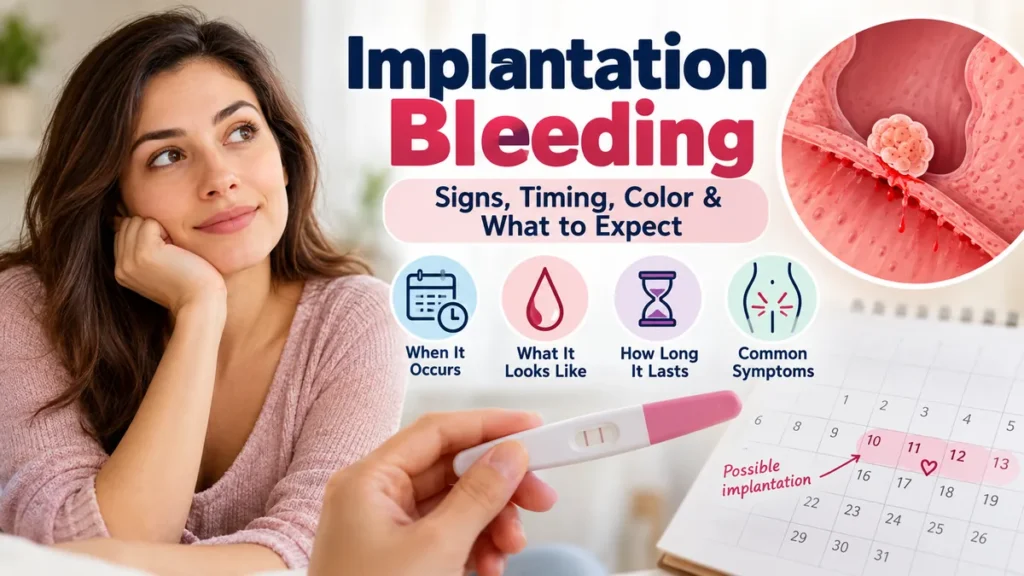
Seeing unexpected spotting when you are hoping to be pregnant can be confusing. Is your period starting, or could the bleeding be related to early pregnancy?
Implantation bleeding is light vaginal spotting that may occur around the time a fertilized egg attaches to the lining of the uterus. It is typically much lighter than menstrual bleeding, often pink or brown, and usually lasts from a few hours to about one or two days. Cleveland Clinic
Not everyone who becomes pregnant experiences noticeable spotting. And because bleeding has many possible causes, appearance alone cannot confirm that implantation has occurred.
What Is Implantation Bleeding?
Implantation is an early stage of pregnancy in which a developing embryo attaches to the endometrium, the lining inside the uterus.
After ovulation, an egg may be fertilized by sperm in a fallopian tube. The fertilized egg then undergoes cell divisions as it travels toward the uterus and develops into a blastocyst.
The blastocyst eventually attaches to and begins embedding within the uterine lining. Small amounts of spotting around this stage are commonly described as implantation bleeding.
Cleveland Clinic describes implantation bleeding as very light bleeding or spotting associated with a fertilized egg implanting into the uterine lining. Cleveland Clinic
It is important, however, not to diagnose pregnancy from spotting alone. Early pregnancy bleeding can have several causes, and many people who become pregnant never notice implantation-related bleeding.
When Does Implantation Bleeding Occur?
Timing is one of the biggest clues.
Implantation bleeding is commonly described as occurring approximately 10 to 14 days after ovulation or conception, although the exact timing varies. That puts it close to when many people expect their next menstrual period. Cleveland Clinic
Consider a simplified menstrual-cycle timeline:
| Stage | Approximate Timing* |
|---|---|
| First day of period | Day 1 |
| Ovulation | Around the middle of the cycle |
| Fertilization | Around ovulation |
| Embryo travels toward uterus | Following several days |
| Implantation | Several days after fertilization |
| Possible light spotting | Around implantation |
| Expected period | Depends on cycle length |
*This is an illustration, not a universal schedule. Ovulation and cycle length vary considerably between individuals and between cycles.
This variation is one reason that counting cycle days cannot reliably prove whether bleeding is caused by implantation.
Can implantation bleeding happen before your period?
Yes. Because implantation occurs before an established pregnancy progresses, any associated spotting may appear shortly before the expected menstrual period.
For some people, the timing is so close to their expected period that the spotting is mistaken for unusually light menstruation. Mayo Clinic notes that this confusion can even affect how someone initially estimates pregnancy timing. Mayo Clinic
What Does Implantation Bleeding Look Like?
Implantation bleeding is generally described as spotting rather than a menstrual-like flow.
Common characteristics include:
- Light pink, brown or dark-brown spotting.
- A very small amount of blood.
- Spots visible on underwear or toilet paper.
- Bleeding that does not progressively become heavy.
- No large blood clots.
- Short duration.
Cleveland Clinic notes that implantation bleeding is generally pink or brown and light enough that it should not soak through a pad. Cleveland Clinic
Brown blood does not necessarily mean something is wrong. Blood can turn brown as it oxidizes and takes longer to leave the reproductive tract.
Color by itself, however, cannot identify the cause of bleeding.
Is implantation bleeding bright red?
Typical descriptions emphasize pink or brown spotting rather than a significant bright-red flow.
A tiny amount of fresh blood can potentially look red, so color should never be treated as a diagnostic test. Persistent bright-red bleeding, increasing flow, clots, significant pain or heavy bleeding deserves medical attention rather than being assumed to be implantation.
Implantation Bleeding vs Period
This is the comparison most people want to make, but there is no single visual feature that can distinguish the two with certainty.
A typical period usually develops into a recognizable menstrual flow. Implantation bleeding, when it occurs, tends to remain light.
| Feature | Implantation Bleeding | Menstrual Period |
|---|---|---|
| Flow | Very light spotting | Light to heavy flow |
| Typical color | Pink or brown | Usually red to dark red |
| Duration | Usually brief | Commonly several days |
| Clots | Not typical | May occur |
| Cramping | None or mild | Can range from mild to strong |
| Amount | Usually does not soak a pad | May require regular menstrual products |
| Timing | Around early implantation | According to menstrual cycle |
Mayo Clinic specifically describes implantation bleeding as lighter than menstrual bleeding and notes that it generally stops on its own. Mayo Clinic
Your usual menstrual pattern matters too. Someone who normally has very light periods may find the distinction particularly difficult.
The practical answer is that you cannot reliably confirm implantation bleeding simply by looking at it. A pregnancy test taken at an appropriate time provides much more useful information.
How Long Does Implantation Bleeding Last?
Implantation bleeding is generally short-lived.
It may appear once, continue for several hours or persist intermittently for a day or two. Cleveland Clinic says it should usually stop on its own after about two days, although individual experiences vary. Cleveland Clinic
Spotting that becomes progressively heavier is less characteristic.
If bleeding continues, particularly after pregnancy has been confirmed, contact a healthcare professional rather than assuming that prolonged bleeding is implantation-related.
Is Implantation Bleeding Heavy?
Heavy bleeding is not typical of implantation bleeding.
Spotting might be noticeable enough to use a panty liner, but soaking through pads, passing significant clots or experiencing a menstrual-like heavy flow does not fit the usual description. Cleveland Clinic
Heavy bleeding can have numerous causes, including early pregnancy complications.
If you are pregnant or could be pregnant and the bleeding is moderate or heavy, medical assessment is appropriate.
Does Implantation Bleeding Have Clots?
Blood clots are not considered a typical feature.
The amount of blood associated with implantation spotting is usually too small to produce the kind of clots sometimes seen during menstruation.
Passing clots or tissue, particularly with heavier bleeding, abdominal pain or cramping, should therefore not automatically be labeled implantation bleeding.
Mayo Clinic recommends promptly contacting a healthcare professional for moderate to heavy bleeding, passage of tissue, or bleeding accompanied by abdominal pain, cramping, fever or chills during the first trimester. Mayo Clinic
Can Implantation Bleeding Cause Cramps?
Some people report mild cramping around the same time as early spotting.
When present, these cramps are generally described as mild rather than intense. Cleveland Clinic notes that cramping associated with implantation bleeding should be light or mild and less intense than typical period cramps. Cleveland Clinic
Symptoms such as breast tenderness, fatigue, nausea, bloating and headaches may also occur around early pregnancy. The difficulty is that many of these symptoms overlap with premenstrual syndrome (PMS).
Symptoms alone therefore cannot establish pregnancy.
Severe, persistent or one-sided abdominal or pelvic pain requires more caution, especially when accompanied by bleeding.
Implantation Bleeding and Other Early Pregnancy Symptoms
After implantation, the developing pregnancy begins producing increasing amounts of human chorionic gonadotropin (hCG). This is the hormone detected by most pregnancy tests.
At the same time, hormones such as progesterone and estrogen help support early pregnancy.
Possible early pregnancy symptoms include:
- Missed period.
- Breast tenderness.
- Fatigue.
- Nausea.
- Bloating.
- Increased urination.
- Changes in vaginal discharge.
- Mild cramping.
None of these symptoms—including spotting—is proof of pregnancy.
Some pregnant people experience several early symptoms, while others feel completely normal.
When Should You Take a Pregnancy Test After Implantation Bleeding?
Taking a test immediately after spotting starts may be too early.
Home pregnancy tests detect hCG in urine. If implantation has only recently occurred, hCG may not yet be high enough for the test to detect reliably.
That creates the possibility of a false-negative result.
Cleveland Clinic recommends waiting until the bleeding has stopped and you have missed your period for a more accurate home-test result. A healthcare professional may also use a blood test when earlier or more detailed evaluation is necessary. Cleveland Clinic
If you test negative but your period still does not arrive, follow the instructions supplied with your pregnancy test regarding when to repeat it or speak with a healthcare professional.
Does implantation bleeding guarantee a positive pregnancy test?
No.
Spotting does not prove that implantation occurred, and even if pregnancy has begun, testing too early can produce a negative result because hCG levels are still low.
A pregnancy test is therefore more informative than trying to diagnose pregnancy from the color or amount of spotting.
Implantation Bleeding vs Early Pregnancy Bleeding
One of the most important distinctions is that not all bleeding in early pregnancy is implantation bleeding.
Vaginal bleeding during the first trimester is relatively common. Cleveland Clinic reports that roughly 15% to 25% of pregnant women experience bleeding or spotting during the first 12 weeks. Cleveland Clinic
Possible causes include:
- Implantation-related spotting.
- Hormonal changes.
- Cervical changes.
- Bleeding after sexual intercourse.
- Cervical inflammation or polyps.
- Infection.
- Miscarriage.
- Ectopic pregnancy.
- Molar pregnancy.
Sometimes a specific cause is not identified.
This is why unexplained bleeding during a known pregnancy deserves attention even when it seems light.
Implantation Bleeding vs Miscarriage
Light spotting by itself does not necessarily mean miscarriage.
Early pregnancy bleeding can occur in pregnancies that continue normally. However, miscarriage can also cause vaginal bleeding, which may range from spotting to heavier bleeding.
Warning features can include increasing bleeding, significant cramping, abdominal pain and passage of fluid or tissue.
Appearance alone cannot reliably distinguish a miscarriage from other causes of early pregnancy bleeding.
Mayo Clinic advises contacting a healthcare professional promptly for moderate or heavy bleeding, passage of tissue, or bleeding associated with abdominal pain or cramping. Mayo Clinic
If you know you are pregnant and are bleeding, giving your healthcare professional details about the amount, duration, color, pain and presence of clots or tissue can help with assessment.
Implantation Bleeding vs Ectopic Pregnancy
An ectopic pregnancy occurs when a fertilized egg implants outside the uterus, most commonly in a fallopian tube.
This condition can become life-threatening if it ruptures and causes internal bleeding.
Ectopic pregnancy symptoms often develop between weeks 4 and 12. Possible warning signs include vaginal bleeding or brown watery discharge, pain low on one side of the abdomen, shoulder-tip pain and discomfort when urinating or having a bowel movement. nhs.uk
Emergency warning signs include:
- Sudden, severe abdominal pain.
- Significant dizziness.
- Fainting or collapse.
- Severe weakness or feeling very unwell.
These symptoms require urgent medical attention.
Importantly, you should not wait for a positive pregnancy test before seeking help if pregnancy is possible and symptoms suggest an ectopic pregnancy. The NHS specifically recommends seeking medical advice for concerning combinations of symptoms even without a positive test. nhs.uk
Other Reasons for Spotting Around Your Period
Spotting around the expected menstrual period does not necessarily mean pregnancy.
Other possible explanations include hormonal contraception, ovulation-related hormonal changes, cervical irritation, sexual intercourse, infections, polyps and other gynecological conditions.
Hormonal birth control can also cause breakthrough bleeding, particularly after starting or changing a contraceptive method. Cleveland Clinic notes that infections, pregnancy, medications, fibroids, polyps, endometriosis, stress and significant changes in weight or exercise can also be associated with bleeding between periods. Cleveland Clinic
Recurring unexplained bleeding between periods is worth discussing with a healthcare professional.
Does Everyone Get Implantation Bleeding?
No.
Many people have no noticeable spotting and go on to have healthy pregnancies.
The absence of implantation bleeding therefore tells you very little about whether conception occurred.
Likewise, experiencing spotting does not automatically mean you are pregnant.
This makes pregnancy testing—rather than symptom spotting—the more reliable next step when pregnancy is possible.
What Should You Do If You Think You Have Implantation Bleeding?
If the bleeding is extremely light, brief and you otherwise feel well, keep track of what you notice.
Record when the spotting started, its color, approximately how much blood there is, whether it is increasing or decreasing, whether you have cramps or other pain, and when your next period is expected.
A panty liner can make the amount easier to monitor. Implantation bleeding itself does not require a medication or treatment and should resolve spontaneously. Cleveland Clinic
Then take a pregnancy test at an appropriate time.
If pregnancy is confirmed, tell your healthcare professional about any vaginal bleeding, particularly if it persists, becomes heavier or occurs with pain.
When Should You Contact a Doctor?
Any bleeding during pregnancy deserves appropriate attention because implantation is only one possible explanation.
For first-trimester bleeding, Mayo Clinic advises contacting a healthcare professional within 24 hours if bleeding lasts longer than a day and seeking prompt care for moderate or heavy bleeding, passage of tissue, or bleeding accompanied by abdominal pain, cramping, fever or chills. Mayo Clinic
Seek urgent medical care for severe or rapidly worsening symptoms, particularly:
- Heavy vaginal bleeding.
- Severe abdominal or pelvic pain.
- Sharp one-sided abdominal pain.
- Shoulder-tip pain.
- Fainting or severe dizziness.
- Significant weakness or collapse.
Those symptoms can occur with serious pregnancy complications, including a ruptured ectopic pregnancy. nhs.uk
What Implantation Bleeding Can—and Cannot—Tell You
Implantation bleeding is generally described as brief, light pink or brown spotting around early pregnancy, often near the time a menstrual period would otherwise be expected. It should not resemble a heavy period, soak through pads or routinely involve significant clots. Cleveland Clinic
But spotting cannot confirm pregnancy by itself.
If pregnancy is possible, the most useful next step is an appropriately timed pregnancy test. If you already know you are pregnant, report unexplained vaginal bleeding to your healthcare professional, especially when it persists or is accompanied by pain.
Most importantly, do not assume that heavy bleeding, severe cramps, one-sided pain, shoulder-tip pain, dizziness or fainting are implantation bleeding. Those symptoms require prompt medical evaluation.