Search for scan manga and you may find raw Japanese pages, translated chapters, manga readers, manhwa, scan VF websites, or discussions about scanlation. The phrase is used in several overlapping ways, which makes it easy to misunderstand what a “manga scan” actually is.
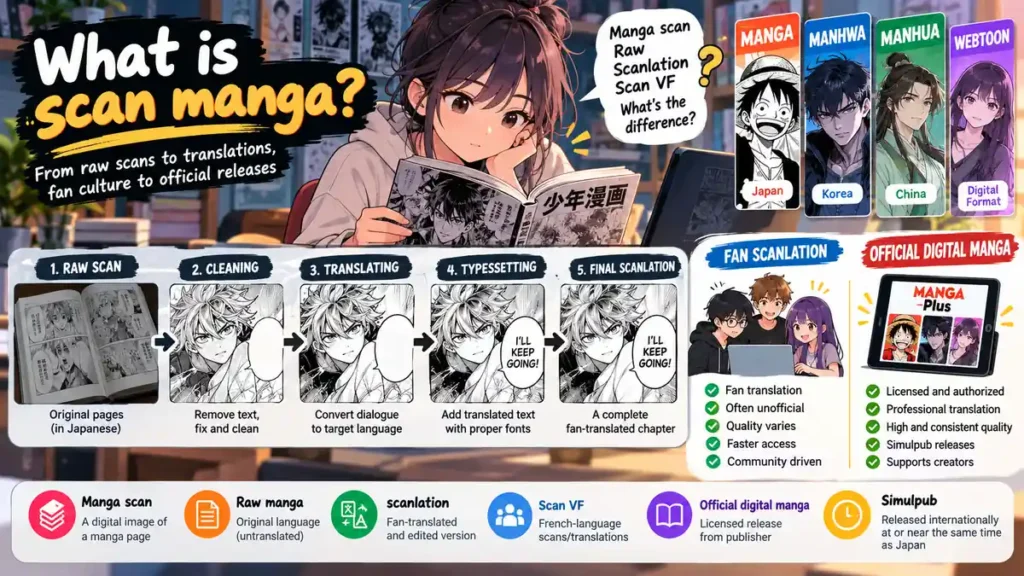
A scan manga is generally a digital reproduction of a manga page or chapter. A scan may remain in its original language as a raw, or it may be translated, cleaned, edited, and typeset by fans to create a scanlation. Not every digital manga is a scanlation; licensed publishers also distribute official digital editions.
The distinction matters because the source, translation method, image quality, distribution rights, and legality can differ significantly.
What Does scan manga Mean?
At its simplest, a manga scan is a manga page converted into a digital image.
Traditionally, someone could take pages from a printed manga volume or magazine and digitize them with a scanner. Today, manga may already exist digitally, so the word “scan” is sometimes used loosely for digital chapter images even when a physical scanner was never involved.
The terminology also changes between manga communities and languages.
English-speaking readers commonly encounter terms such as:
- manga scans
- manga raws
- raw manga
- scanlations
- fan translations
- digital manga
French-speaking communities frequently use scan manga, scan VF, and scantrad when discussing manga chapters available digitally in French. Current French-language search results also associate the phrase with manga, Korean manhwa, Chinese manhua, and webtoons. Modes de Vie
This broader usage explains why searching the same phrase can produce very different results.
Manga Scan vs. Raw vs. Scanlation
These terms are related, but they are not interchangeable.
| Term | Meaning |
|---|---|
| Manga scan | A digital image or reproduction of a manga page |
| Raw manga | Manga in its original language before translation |
| Scanlation | A fan-made translation and edited version of manga |
| Scanlator | A person involved in creating scanlations |
| Scan VF | Common term for French-language manga scans/translations |
| Scantrad | French term associated with translated manga scans |
| Official digital manga | A licensed electronic edition from an authorized publisher or platform |
| Simulpub | An authorized translated chapter released at or near the Japanese release |
The most important distinction is between a scan and a scanlation.
A raw scan might simply reproduce a Japanese manga page without changing anything. Scanlation goes further: fans translate the text and modify the digital page to accommodate that translation.
Academic research similarly describes scanlation as scanning manga, translating its text into another language, and replacing or editing textual elements on the page. ResearchGate
How scan manga Became Part of Online Manga Culture
Scanlation developed partly because manga once traveled internationally much more slowly than it does today.
Japanese readers could access a chapter when it appeared in a magazine, while readers elsewhere might wait months or years for a licensed translation. Some titles received no international edition at all.
Fan communities tried to bridge that gap.
Research into scanlation culture identifies both unmet international demand and increasingly accessible digital technology as major factors behind its growth. The internet made it possible for fans to digitize pages, collaborate internationally, and distribute translated versions to readers far from Japan. SSRN
The practice became particularly visible around the late 1990s and early 2000s. Intralinea
Today the situation is quite different.
Official publishers can release translated chapters digitally at nearly the same time as their Japanese publication. Shueisha’s MANGA Plus, for example, explicitly promotes simultaneous international access to current manga chapters. MANGA Plus
That has reduced one of the historical reasons readers depended on fan translations.
How Manga Scanlation Works
A finished scanlation can look deceptively simple: artwork, speech bubbles, and translated dialogue.
Producing it well, however, can involve several specialized jobs.
1. Obtaining the Source
The process begins with source material.
Traditionally, a physical manga magazine or collected volume could be scanned. Modern workflows may instead begin with a digital source.
The untranslated source is commonly called a raw.
Raw does not mean free or legally distributable. It simply describes material that has not been translated.
2. Scanning or Digitizing Pages
For physical material, pages must be converted into digital images.
Scanning quality influences everything that follows. Poor alignment, shadows near the spine, visible paper texture, blur, dust, or insufficient resolution can make editing more difficult.
Older scanlation workflows therefore placed considerable emphasis on producing clean source images.
3. Cleaning
The cleaner prepares the pages for editing.
This may involve:
- adjusting brightness and contrast
- straightening pages
- removing scanning artifacts
- correcting uneven backgrounds
- removing original dialogue
- cleaning speech bubbles
- preparing artwork for translated text
Black-and-white manga presents its own challenges because careless processing can destroy thin lines, screentones, gradients, and fine artwork.
4. Redrawing
Removing Japanese text is easy when it appears on a plain white speech bubble.
It becomes much harder when text overlaps artwork.
In those situations, an editor or redrawer may reconstruct the artwork that was hidden behind the original characters.
This is one reason high-quality scanlation involves more than simply running text through a translator.
5. Translating
The translator converts dialogue, captions, signs, sound effects, and other text into the target language.
Good manga translation requires context.
Japanese frequently leaves information implicit that English and other languages may require the translator to state explicitly. Character relationships, honorifics, jokes, idioms, wordplay, cultural references, and speech patterns can all affect meaning.
Scanlation communities have also developed distinctive translation practices. Research has examined their use of translation notes and preservation of culturally specific elements that professional editions may handle differently. University of Alberta Journals
6. Proofreading
A proofreader checks the translated script.
Typical problems include:
- spelling errors
- unnatural dialogue
- incorrect names
- inconsistent terminology
- missing text
- mistranslations
- punctuation errors
- dialogue assigned to the wrong character
Consistency becomes especially important across long-running series.
7. Typesetting
Typesetting places translated dialogue back into the page.
The typesetter chooses appropriate fonts, sizes, spacing, alignment, and positioning so that dialogue fits naturally within speech bubbles and captions.
Good typesetting should complement the artwork rather than distract from it.
8. Quality Checking
A final quality check looks for translation, editing, and visual mistakes before a chapter is released.
Well-organized scanlation groups historically divided these responsibilities among multiple people. Academic studies describe scanlation communities as collaborative networks rather than simply individuals translating pages independently. UB Bid
What Is Raw Manga?
Raw manga generally means manga presented in its original language, most commonly Japanese for Japanese manga.
A raw can be useful to readers who understand the original language or translators who need source material.
It is worth separating two concepts:
Raw describes language state, not copyright status.
An authorized Japanese digital edition is raw manga. An unauthorized copy uploaded elsewhere can also be described as raw manga.
The word itself therefore tells you very little about whether distribution is permitted.
What Is Scan VF?
Scan VF is a term particularly common among French-speaking manga readers.
“VF” means version française, or French version.
A scan VF therefore generally refers to manga pages or chapters available with French text. Related terminology includes scantrad, derived from scanning and translation.
French-language search results for scan manga currently include catalogs covering Japanese manga alongside manhwa, manhua, webtoons, comics, and other illustrated formats. Scan Manga
The phrase can therefore have a broader practical meaning than the strict technical definition of physically scanning Japanese manga.
Manga, Manhwa, Manhua, and Webtoons
Online manga readers frequently mix several Asian comic traditions into the same catalog.
Understanding the distinction makes browsing easier.
Manga
Manga originates from Japan.
Traditional Japanese manga is commonly printed in black and white and read from right to left, although formats vary considerably.
Manhwa
Manhwa refers to Korean comics.
Modern online manhwa is strongly associated with vertically scrolling, full-color digital formats, although not every manhwa follows that structure.
Manhua
Manhua generally refers to Chinese-language comics, particularly works originating from China and other Chinese-speaking regions.
Webtoon
A webtoon is primarily a digital publishing format rather than simply another word for Korean comics.
Webtoons are typically designed for scrolling vertically on phones and tablets. Their popularity has heavily influenced modern digital comic publishing.
Because manga-reading platforms may catalog all four formats together, readers sometimes casually call everything “manga scans.” Technically, the categories remain different.
Are scan manga and Scanlation the Same Thing?
No.
This is one of the most common misunderstandings.
A manga scan can simply be a digital copy of a manga page. It does not necessarily contain a translation.
A scanlation, by contrast, specifically involves fan translation and editing.
The word itself combines scan and translation, and research literature consistently uses it for fan-produced translated comics. ResearchGate
A simple way to remember it is:
Scan = digitized page.
Raw = untranslated source.
Scanlation = fan-translated and edited version.
Official digital edition = publisher-authorized digital manga.
Is scan manga Legal?
There is no single answer for every digital manga image because authorization is what matters.
Official digital manga distributed by a publisher, creator, or licensed service is authorized.
Scanning copyrighted manga and publicly distributing the pages without permission is a different situation. Fan scanlations are also generally produced without explicit authorization from the copyright holder, according to academic and reference descriptions of scanlation culture. SSRN
Copyright rules also vary by jurisdiction, so specific legal questions depend on the country and circumstances.
One common misconception deserves particular attention:
“The Manga Hasn’t Been Licensed in My Country, So a Scanlation Is Legal”
Lack of a local commercial translation does not automatically give someone permission to reproduce, translate, or distribute copyrighted material.
Historically, some fan communities developed informal norms around unlicensed series. Groups might stop translating a title once an official edition appeared.
Those community conventions should not be confused with legal permission from a copyright holder.
“A DMCA Page Means the Manga Is Licensed”
Not necessarily.
A website having a copyright notice, takedown system, or DMCA page does not by itself demonstrate that it possesses distribution rights for every title it offers.
The useful question is whether the service is authorized by the relevant rights holder or publisher.
“Free Manga Is Pirated”
That is also incorrect.
Official manga can be free.
Publishers may provide selected chapters without charge, offer introductory chapters, use ad-supported distribution, or make new chapters temporarily available.
Price alone does not establish authorization.
Official Digital Manga vs. Fan Scanlation
Readers may see little visual difference between a polished scanlation and an official digital chapter, but their origins are fundamentally different.
| Feature | Fan Scanlation | Official Digital Manga |
|---|---|---|
| Translation | Usually fans | Licensed translators/editorial teams |
| Authorization | Often unauthorized | Authorized |
| Quality | Highly variable | Professionally controlled |
| Release speed | Can be rapid | Increasingly simultaneous |
| Terminology | May vary by group | Usually standardized |
| Creator/publisher support | Generally indirect or absent | Part of authorized distribution |
| Availability | Can disappear unexpectedly | Managed through licensed services |
Fan translations have historically played an important role in international manga fandom, especially when official editions were unavailable.
At the same time, the modern official manga ecosystem offers something that was far less common during scanlation’s early growth: simultaneous or near-simultaneous international releases.
What Is a Simulpub?
Simulpub means simultaneous publication.
In manga, it usually refers to an officially translated chapter becoming available internationally around the time the original chapter is published in Japan.
This dramatically reduces the waiting period that once separated Japanese and overseas audiences.
For example, MANGA Plus by SHUEISHA describes itself as an official service managed directly by Japanese publisher Shueisha and offers titles internationally in multiple languages, with current chapters released alongside Japan. MANGA Plus
Similarly, VIZ Manga and Shonen Jump provide licensed digital manga, including selected same-day releases. VIZ
For readers, simulpubs combine two things that historically drove interest in scanlations: speed and accessibility.
How to Tell Whether a Manga Source Is Official
A polished website does not automatically mean its manga is licensed.
Look for clearer signals.
An official or licensed platform will normally identify the publisher, rights holder, or licensing relationship. It may also provide publisher information, subscription details, copyright notices tied to the actual works, and links from established publishers.
Be more cautious when a site:
- provides large numbers of commercial series without explaining licensing
- relies heavily on intrusive pop-ups or redirects
- claims fan translations are automatically legal
- uses constantly changing domains
- asks you to install unusual browser extensions or files
- provides no clear information about who operates the service
These signs do not individually prove infringement, but they are reasonable reasons to investigate before using the platform.
Why Manga Scan Quality Varies So Much
Two scanlations of the same chapter can look dramatically different.
Quality depends on several stages rather than translation alone.
Source Image Quality
A clean digital source gives editors more information to work with.
Low-resolution or heavily compressed pages can produce blurry text, damaged screentones, and artifacts that later processing cannot fully restore.
Translation Accuracy
Literal translation is not automatically accurate translation.
Dialogue must make sense within the panel, chapter, character relationship, and larger story.
A translator also has to make decisions about:
- honorifics
- names
- jokes
- idioms
- dialect
- sound effects
- cultural references
- character voice
Those choices explain why different translations of the same Japanese dialogue may read differently without either being a simple word-for-word copy.
Cleaning and Redrawing
Strong cleaning preserves the artwork while removing unwanted text and scanning defects.
Poor cleaning can erase line art or leave obvious blocks where text once appeared.
Redrawing becomes particularly noticeable when Japanese sound effects are integrated directly into illustrations.
Typesetting
Typography has a surprisingly large impact on readability.
Text that is too small, crowded, inconsistently aligned, or poorly matched to the artwork can make even an accurate translation uncomfortable to read.
AI, OCR, and Modern Manga Translation
Modern manga processing increasingly involves automation.
OCR, or optical character recognition, can detect text inside images and convert it into machine-readable characters. Translation systems can then process the extracted dialogue, while image-processing models can help remove text from speech bubbles or reconstruct backgrounds.
Some modern tools combine multiple stages such as text detection, OCR, translation, image inpainting, and typesetting into one workflow. XianScan
That sounds like complete automation, but manga presents unusually difficult translation problems.
OCR Can Misread Stylized Text
Manga text may be:
- handwritten
- vertical
- curved
- partially obscured
- highly stylized
- placed over complex artwork
Sound effects create another challenge because their typography is often part of the illustration itself.
Translation Requires Context
Japanese frequently omits subjects and other information that must be inferred from context.
A translation system may correctly recognize every word yet misunderstand who is speaking, the emotional tone, a relationship, an implied subject, or a recurring joke.
Human Editing Still Matters
Automation can accelerate repetitive work, but polished localization still benefits from human judgment.
Character voices should remain consistent. Names and terminology need continuity. Jokes sometimes require adaptation rather than literal translation. Dialogue also has to fit into limited visual space without changing its meaning.
Technology has changed the workflow, but it has not eliminated the importance of contextual translation and editing.
Common Misunderstandings About scan manga
Several myths appear repeatedly around digital manga.
Every Manga Scan Is a Scanlation
False.
A scan can remain untranslated. Scanlation specifically refers to the translation-and-editing process.
Raw Manga Means Legal Manga
Not necessarily.
“Raw” describes untranslated source material, not its distribution rights.
Scanlations Are Always Poorly Translated
Quality varies.
Some fan groups have involved experienced translators, proofreaders, cleaners, redrawers, and typesetters working collaboratively. Research into scanlation communities shows that these groups can develop sophisticated translation practices and shared conventions. University of Alberta Journals
That does not change the copyright question, but it does explain why quality cannot be judged merely from the word “fan.”
Official Translation Always Appears Long After Japan
That was once much more common.
Simultaneous digital publication has significantly changed the landscape. MANGA Plus says readers can access numerous releases internationally at the same time as Japan, while VIZ likewise offers same-day releases for selected series. MANGA Plus
How to Read Digital Manga More Safely
Digital manga reading itself is straightforward, but unfamiliar sites deserve caution.
Prefer established official services when they carry the series you want. Before creating an account or entering payment details, verify who operates the platform and whether the publisher recognizes it.
Avoid downloading unexpected executable files or browser extensions simply to view comic pages. A normal web manga reader should not require unrelated software installations.
On mobile devices, official apps from recognized publishers also reduce uncertainty about where the content originated.
Availability varies by title, language, and region, so one service will not necessarily contain every manga series.
Why scan manga Still Matters to Manga History
Scanlation is more than an old method for putting translated comic pages online.
It became part of international manga fan culture during a period when geographic and linguistic barriers were much larger. Fan communities organized translation projects, developed editing conventions, shared terminology, and helped international readers discover works that might otherwise have remained inaccessible to them.
Academic research has consequently studied scanlation not only as a copyright issue but also as fan translation, collaborative production, intercultural communication, and participatory culture. ResearchGate
The environment that created it, however, continues to change.
Official digital publishing, worldwide distribution, subscription libraries, mobile readers, and simulpub releases increasingly allow readers to access translated manga quickly without waiting for physical editions.
The Bottom Line on scan manga
scan manga can refer broadly to digitized manga pages, raw chapters, fan-translated scanlations, or—in some communities—online manga reading itself. The terms overlap, but they should not be treated as identical.
A manga scan is fundamentally a digital reproduction of manga. A raw remains in its original language. A scanlation adds fan translation and editing. An official digital manga is distributed with authorization from the relevant publisher or rights holder.
Understanding those differences makes it easier to interpret search results, evaluate manga sources, recognize how fan translation works, and distinguish unofficial scans from licensed digital releases.
For readers who mainly want fast access to new chapters, modern official services such as MANGA Plus and VIZ demonstrate how much digital manga distribution has evolved: some releases can now reach international audiences at essentially the same time as readers in Japan.