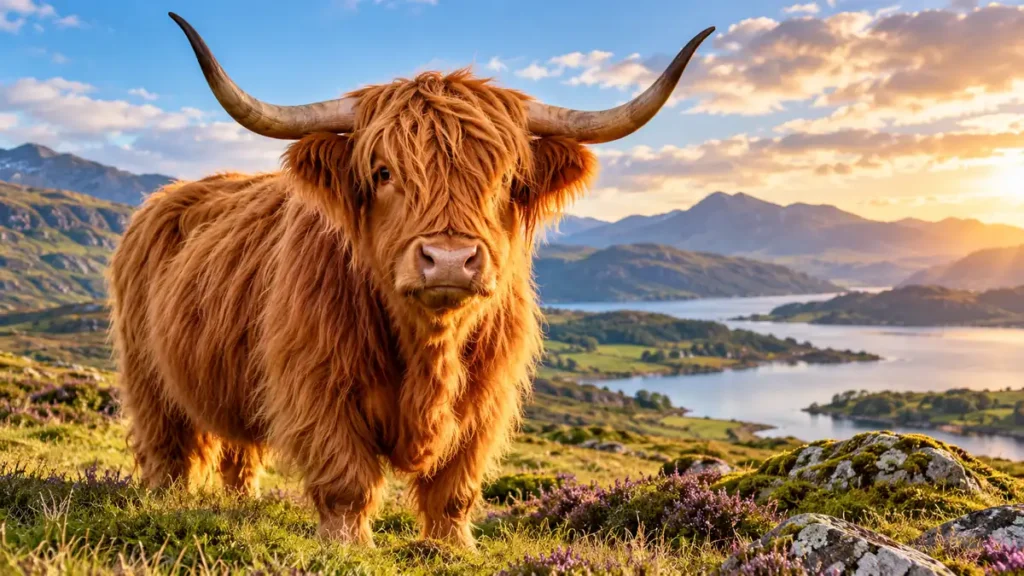
Few cattle are as instantly recognizable as the highland cow. Long sweeping horns, a thick shaggy coat, and a heavy fringe over the eyes give these Scottish cattle an appearance unlike almost any other breed.
But that famous coat is more than decoration. Highland cattle developed in the cold, wet, windswept Scottish Highlands and Western Islands, where hardiness, efficient grazing, and the ability to cope with difficult terrain were essential for survival. Today, the breed is found around the world and is valued for beef production, conservation grazing, small farms, and its distinctive appearance. Highland Cattle Society
A Highland cow is the female of the Highland cattle breed, an old Scottish beef breed known for long horns, a shaggy double coat, hardiness, longevity, and strong maternal ability. Mature cows commonly weigh roughly 900–1,200 pounds (410–545 kg), while bulls are substantially heavier. AHCA
What Is a Highland Cow?
Technically, the term Highland cow refers to an adult female Highland. A male is a Highland bull, a young female is a heifer, and a young animal is a calf. In everyday conversation, however, “Highland cow” is often used for the entire breed.
Highland cattle belong to Bos taurus and originated in Scotland. They are primarily a beef breed, although historically cattle on small Scottish farms could provide both milk and calves for their owners. Northwest Highland Cattle Association
The breed is especially easy to recognize because of three features:
- Long, sweeping horns
- A thick, long-haired coat
- A prominent hairy forelock, sometimes called a dossan
Both males and females are naturally horned. The Highland Cattle Society’s breed description also emphasizes a broad head, short broad muzzle, prominent forelock, and abundant long, wavy hair. Highland Cattle Society
Despite the familiar image of a ginger or red Highland, the breed comes in several colors.
Highland Cow Origin and History
Highland cattle developed in northern and western Scotland, particularly the Scottish Highlands and Western Islands, where the environment placed considerable pressure on livestock.
Cold temperatures were only part of the challenge. Animals also had to contend with high rainfall, strong winds, rough terrain, and limited-quality forage.
Over generations, these conditions favored cattle capable of surviving and reproducing with relatively modest inputs. That background helps explain the modern Highland’s reputation for hardiness, browsing ability, longevity, and efficient use of rough grazing. Highland Cattle Society
Highlander and Kyloe cattle
Historically, there were two recognized types.
The Kyloe was generally the smaller type associated with Scotland’s western islands and was often black. Mainland Highland cattle tended to be larger and were more commonly reddish in color.
These are no longer treated as separate breeds; both became part of the modern Highland breed. breeds.okstate.edu
The name “Kyloe” nevertheless remains an important part of Highland cattle history.
The Highland Cattle Society and herd book
Formal breed organization developed during the nineteenth century.
The Highland Cattle Society was established in 1884, and the first herd book was published in 1885. These records helped establish pedigrees and preserve the characteristics associated with the breed. breeds.okstate.edu
Highland cattle subsequently spread well beyond Scotland. They are now raised across North America, Europe, Australia, New Zealand, and other regions. Highland Cattle Society
What Does a Highland Cow Look Like?
The Highland’s appearance reflects the environment in which the breed developed.
Its most striking characteristics are the long hair and horns, but underneath the coat is a sturdy, functional beef animal.
The famous Highland cow coat
Highland cattle have a distinctive double hair coat.
The outer layer consists of long, coarse hair that provides protection from wind and wet weather. Beneath it is a softer insulating undercoat. This combination helps protect the animal in cold conditions. AHCA
The hair around the forehead can become particularly long, creating the shaggy fringe for which the breed is famous.
The Highland Cattle Society’s standard calls for abundant, long, gracefully waved hair rather than simply the fluffiest coat possible. Highland Cattle Society
Highlands also adapt their coats seasonally. In warmer conditions, they shed much of their winter hair rather than carrying the same heavy coat throughout the year. AHCA
Highland cow horns
Both Highland cows and bulls have horns.
There is generally a visible difference between the sexes. Female horns tend to be finer and sweep upward, while mature males commonly develop heavier horns that project more forward. AHCA
The horns aren’t merely ornamental. Highland cattle can use them while dealing with brush, scratching themselves, and interacting with their environment.
Their presence does, however, matter when designing handling facilities. A calm animal with large horns still requires adequate space and sensible handling.
Highland Cow Colors
Red is the color most people associate with Highland cattle, but it is far from the only one.
Traditional Highland colors include:
| Color | General appearance |
|---|---|
| Red | Classic reddish or ginger coat |
| Black | Deep black coat |
| Yellow | Light golden or yellow shade |
| Dun | Muted gray-brown coloration |
| Silver | Pale silvery appearance |
| Brindle | Mixed or striped pattern |
| White | Very light coat |
The American Highland Cattle Association recognizes red, black, yellow, dun, white, brindle, and silver among the breed’s traditional colors. AHCA
Interestingly, black has deep historical roots in the breed. The old island Kyloe population contained a higher proportion of black and brindled animals, while mainland cattle were more often associated with reddish coloring. breeds.okstate.edu
So the popular orange Highland cow represents only one part of the breed’s natural color range.
How Big Does a Highland Cow Get?
Highland cattle are generally moderate-framed animals, but size varies according to sex, genetics, nutrition, age, and environment.
The American Highland Cattle Association gives mature cows an average range of approximately 900–1,200 pounds, while mature bulls average around 1,500–1,800 pounds. AHCA
Canadian breed information gives representative breeding-condition averages of about 1,100 pounds (500 kg) for mature cows and 1,800 pounds (800 kg) for mature bulls. breeds.okstate.edu
| Animal | Approximate mature weight |
|---|---|
| Highland cow | 900–1,200 lb (410–545 kg) |
| Highland bull | 1,500–1,800 lb (680–815 kg) |
| Steer | Varies substantially with age and feeding |
These figures should be treated as useful breed references rather than guaranteed target weights.
An animal raised on rich pasture with carefully managed nutrition may develop differently from one maintained on harsh upland grazing.
Are Highland cows miniature?
Standard Highland cattle are not miniature cattle.
The internet popularity of so-called “mini Highland cows” can make the distinction confusing. A normal Highland cow is a substantial farm animal weighing hundreds of pounds.
Animals marketed as miniature Highlands should therefore not automatically be assumed to represent the size or characteristics of standard registered Highland cattle.
Highland Cow Temperament
Those dramatic horns can make Highland cattle look intimidating, but the breed is generally associated with a calm, manageable disposition.
The Livestock Conservancy describes the breed’s temperament as docile, while the American Highland Cattle Association describes Highlands as generally calm and relatively easy to handle. The Livestock Conservancy
That doesn’t mean they should be treated like oversized pets.
Cattle are powerful animals, and Highlands add long horns to the equation. Even a normally quiet animal can become dangerous when frightened, cornered, stressed, or protecting a calf.
Are Highland cows friendly?
Well-socialized Highland cattle can become comfortable around familiar handlers.
Their actual behavior, however, depends on:
- Genetics
- Early handling
- Previous experiences
- Herd dynamics
- Sex and age
- Individual temperament
- Whether a cow has a young calf
- The quality of livestock handling
A useful rule is to distinguish docile from harmless.
Highlands may be calm cattle, but handlers should still maintain appropriate boundaries and use facilities designed for horned livestock.
Cows also have strong maternal instincts. Extra care is sensible around newborn calves because an otherwise quiet mother may become much more protective. Northwest Highland Cattle Association
Why Are Highland Cows So Hairy?
Their shaggy appearance is essentially natural weather protection.
The Highland breed evolved under conditions involving cold, rain, and strong winds. Its double coat provides insulation and helps shield the body from challenging weather. AHCA
This adaptation is particularly valuable because Highlands rely heavily on hair for insulation rather than requiring the same degree of insulating body fat.
That doesn’t mean a thick coat eliminates the need for good husbandry. Animals still need access to suitable water, nutrition, shade, shelter or wind protection where appropriate, veterinary care, and safe ground conditions.
What happens during warm weather?
Highlands naturally shed hair as temperatures rise.
The American Highland Cattle Association notes that they shed earlier in spring and grow less hair in warmer climates. AHCA
Still, a breed developed for cold Scotland requires thoughtful heat management in hot climates.
Owners should provide abundant clean water, shade, ventilation, and opportunities for animals to avoid excessive heat load.
What Do Highland Cows Eat?
Highland cattle are herbivores. Their diet is based primarily on pasture, grasses, forage, hay, and other appropriate roughage. Edinburgh Zoo
One of the breed’s historically valuable traits is its ability to make use of rough grazing.
The Highland Cattle Society notes that Highland cattle can thrive on poor mountain land and efficiently use comparatively poor forage. The breed is also recognized for browsing ability, meaning animals may consume vegetation beyond conventional pasture grasses. Highland Cattle Society
This can make them useful in certain land-management systems.
However, “hardy” does not mean an animal can live on inadequate nutrition.
Basic nutritional requirements
A practical feeding program needs to consider:
- Adequate forage
- Clean drinking water
- Appropriate minerals and salt
- Seasonal pasture quality
- Pregnancy and lactation
- Age and growth stage
- Body condition
- Local soil and forage deficiencies
Hay or other conserved forage is often necessary when pasture growth becomes insufficient.
Pregnant or lactating cows and growing animals may have different nutritional requirements from mature animals at maintenance.
The correct ration should therefore be based on the actual forage, environment, production stage, and professional livestock nutrition guidance rather than assumptions about the breed’s ruggedness.
Highland Cattle and Harsh Weather
Hardiness is one of the defining characteristics of the Highland breed.
These cattle developed in areas exposed to bitter winds, substantial rainfall, difficult terrain, and limited forage. Modern Highlands retain many of the traits that made survival in those environments possible. Highland Cattle Society
Their advantages include:
- Dense protective hair
- Strong foraging ability
- Ability to use rough vegetation
- Good maternal characteristics
- Functional feet and legs for varied terrain
- Adaptability to outdoor production systems
This helps explain why Highlands have successfully spread to countries with demanding climates, including Canada and northern parts of the United States.
Adaptability nevertheless has limits. Management should always be designed around the climate in which the animals actually live.
How Long Do Highland Cows Live?
Longevity is another standout Highland characteristic.
The Highland Cattle Society reports that many Highland cows continue breeding beyond 18 years of age, with some producing as many as 15 calves. Highland Cattle Society
That is particularly valuable in a breeding herd because a productive cow that remains healthy for many years reduces the frequency with which replacement females are needed.
An individual animal’s lifespan depends on many factors, including:
- Nutrition
- Disease prevention
- Parasite control
- Injuries
- Reproductive health
- Genetics
- Climate
- Quality of husbandry
It is therefore better to regard the breed as notably long-lived rather than assume every Highland cow will reach a particular age.
Highland Cow Pregnancy, Calves, and Mothering Ability
Highland cows have a strong reputation for maternal ability.
The breed is known for protective mothers and comparatively straightforward calving. The American Highland Cattle Association reports typical calf birth weights of around 60–70 pounds, which can contribute to a lower incidence of difficult births. AHCA
Are Highland cows good mothers?
Strong mothering ability is one of the traits repeatedly associated with the breed.
Highland cows generally care closely for their calves, and their long productive lives mean successful females may raise numerous calves over their lifetime. Highland Cattle Society
For a farmer, those maternal instincts are useful.
For a handler, they also mean caution.
A mother that strongly protects her calf should be given adequate space, particularly around calving and during the calf’s early life.
Highland calves
Highland calves may not immediately have the spectacular horn spread of an adult, but they already show much of the breed’s characteristic shaggy appearance.
They grow into relatively slow-maturing cattle compared with some intensive commercial beef breeds. That slower development is part of a production system traditionally centered on forage, hardiness, and longevity rather than maximum growth speed.
What Are Highland Cows Used For?
Although social media has made Highland cattle famous for their appearance, they are a functional livestock breed rather than simply decorative animals.
Beef production
The principal modern agricultural use of Highland cattle is beef production.
Their ability to utilize rough forage makes them particularly interesting for pasture-based systems and land that may be less suitable for more intensive production. The Livestock Conservancy classifies the Highland as a beef breed and highlights its foraging ability, longevity, maternal performance, and hardiness. The Livestock Conservancy
Highland beef is often associated with good flavor and a relatively lean carcass.
Production results still depend heavily on genetics, finishing system, animal age, nutrition, slaughter conditions, and meat handling. Breed alone does not guarantee a particular eating experience.
Conservation grazing
Highlands can browse as well as graze.
That ability has led to their use in vegetation and habitat management projects. The American Highland Cattle Association notes their use for clearing brush and in grazing-improvement and oak-savanna restoration projects. AHCA
Heavy grazing must still be managed carefully. Stocking rate, soil condition, biodiversity goals, and seasonal vegetation growth all matter.
Small farms and homesteads
Their moderate frame, hardiness, visual appeal, and generally calm temperament have also made Highlands popular with small farms.
But their popularity shouldn’t obscure their requirements.
A Highland is still a large bovine requiring secure fencing, grazing space, water, handling facilities, health management, and livestock experience.
Highland Cow Care Requirements
Highlands have a reputation for being relatively low-input cattle, but “low input” should never be confused with no maintenance.
Good Highland cattle management begins with the same fundamentals that apply to responsible cattle keeping.
1. Adequate land and forage
Pasture must support the number of animals being kept.
Overstocking damages pasture, increases mud and parasite pressure, and can leave cattle without adequate nutrition.
Rotational grazing can help manage forage utilization and allow paddocks time to recover.
2. Reliable water
Cattle require continuous access to clean, fresh water.
Consumption changes with body size, lactation, diet, weather, and temperature, so the water system needs sufficient capacity for peak demand rather than average conditions.
3. Secure fencing
Highlands are powerful livestock.
Fencing should be built for cattle rather than for small pets. Horns also deserve consideration around gates, feeders, narrow passages, and handling areas.
4. Heat and weather management
A thick winter coat gives Highlands excellent protection in cold climates, but warm regions present a different challenge.
Shade, ventilation, clean water, and heat-stress management become especially important.
5. Hoof and health monitoring
Hardiness doesn’t make an animal immune to illness.
Owners still need a herd-health plan addressing vaccination where appropriate, parasites, injuries, reproductive problems, nutrition, body condition, and hoof health.
A local large-animal veterinarian is the right person to tailor that plan to regional diseases and farm conditions.
6. Safe handling facilities
The horns change how facilities should be designed.
Chutes, alleys, gates, trailers, and feeders should provide enough clearance to reduce the chance of horns becoming trapped or animals injuring each other.
Are Highland Cows Easy to Raise?
Highlands have several characteristics that can simplify cattle production.
They are hardy, capable foragers, generally docile, and noted for calving ability and long productive lives. The Livestock Conservancy
Those advantages can make them attractive to less-intensive farms.
Still, they aren’t automatically an ideal first animal for every new livestock owner.
The practical challenges include their size, horns, fencing needs, veterinary costs, winter feed requirements where pasture becomes unavailable, and heat management in warmer regions.
Before acquiring Highland cattle, a new keeper should already have:
- Sufficient grazing land
- Dependable cattle fencing
- A year-round water supply
- A plan for winter or dry-season feed
- Safe livestock handling facilities
- Access to large-animal veterinary care
- A strategy for manure and pasture management
- A plan for breeding, calves, or herd separation
Their rugged genetics can reduce some management challenges, but they cannot replace sound husbandry.
Highland Cow vs. Other Cattle Breeds
Highland cattle differ from mainstream commercial beef breeds in several obvious and less obvious ways.
| Characteristic | Highland cattle | Many commercial beef cattle |
|---|---|---|
| Coat | Long, dense double coat | Usually much shorter |
| Horns | Naturally horned in both sexes | Depends on breed/genetics |
| Climate heritage | Cold, wet Scottish uplands | Varies widely |
| Foraging | Strong grazing and browsing ability | Breed dependent |
| Maturity | Relatively slow | Often selected for faster growth |
| Longevity | Notably long productive life | Varies |
| Main use | Beef, grazing, breeding | Primarily beef |
| Appearance | Long hair and sweeping horns | Highly breed dependent |
Neither type is automatically “better.”
The appropriate cattle breed depends on land, climate, feed resources, production goals, facilities, market, and the farmer’s management system.
Common Misconceptions About Highland Cows
Their unusual appearance and growing online popularity have produced several misconceptions.
“All Highland cows are orange”
False.
Red is famous, but black, yellow, dun, silver, brindle, and white cattle also occur within the breed. AHCA
“Highland cows are tiny”
Standard Highlands are not tiny.
Mature cows commonly weigh around 900–1,200 pounds, with bulls considerably heavier. AHCA
“Their hair means they never need shelter”
The coat provides excellent weather protection, but responsible management still requires protection appropriate to local conditions.
Cold tolerance also shouldn’t be confused with unlimited heat tolerance.
“They survive on anything”
Highlands are efficient foragers, not animals that can thrive without adequate nutrition.
Rough grazing ability is an advantage, but cattle still require sufficient energy, protein, minerals, water, and forage.
“Docile means completely safe”
No large bovine is completely risk-free.
Highland cattle can be calm and manageable, but adults are powerful, horned animals. Cows protecting calves and mature bulls require particular respect.
Why Are Highland Cows So Popular?
Part of their popularity is obvious: they photograph exceptionally well.
The combination of shaggy hair, broad forelock, long horns, and varied colors makes the breed visually memorable.
But the Highland’s importance extends beyond appearance.
These cattle represent centuries of adaptation to difficult farming conditions. Their continued appeal rests on a combination of traits: hardiness, forage efficiency, maternal ability, longevity, temperament, distinctive beef characteristics, and adaptability to pasture-based management. Highland Cattle Society
They also remain strongly associated with Scottish rural heritage.
That combination of cultural history and practical agricultural value explains why the breed has moved from remote Scottish landscapes to farms around the world.
Final Thoughts on the Highland Cow
The highland cow is much more than the fluffy Scottish animal seen in photographs. It belongs to a hardy heritage cattle breed shaped by the wet, windy, and demanding environment of the Scottish Highlands and Western Islands.
Its long double coat, sweeping horns, strong maternal instincts, browsing ability, docile disposition, and remarkable longevity all reflect that history. Highland cattle can perform well in pasture-based beef systems and conservation grazing, while their unmistakable appearance has introduced the breed to an audience far beyond farming.
For anyone considering raising them, the key is to appreciate both sides of the breed. Highland cattle can be hardy and comparatively self-sufficient, but they remain large, horned livestock that require adequate land, nutrition, fencing, water, health care, heat management, and safe handling. With those needs properly met, the characteristics that allowed the Highland breed to endure for centuries remain genuinely useful today.