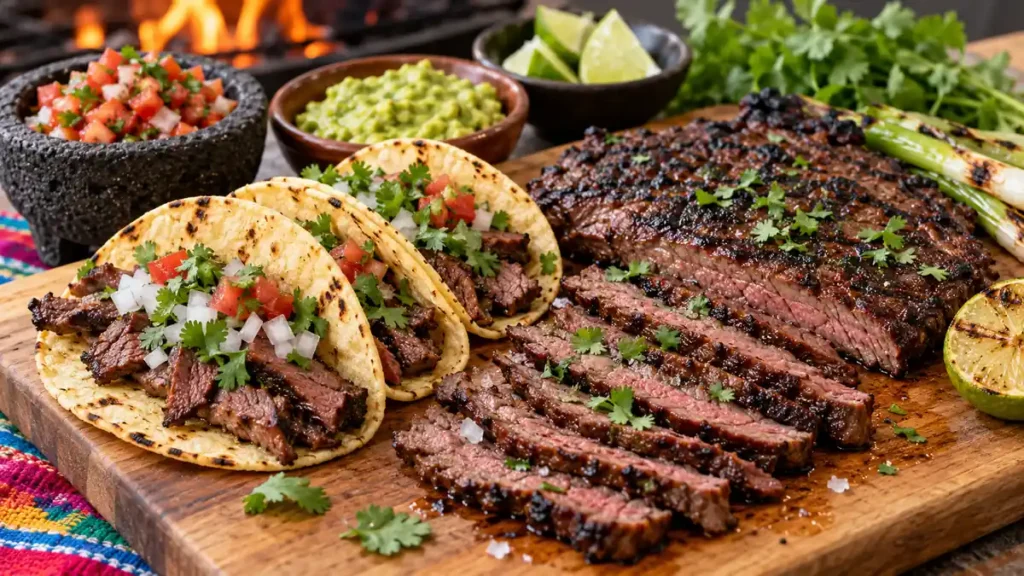
Few foods capture the flavor of an outdoor Mexican cookout quite like carne asada. The combination is simple but memorable: beef, bold seasoning, intense heat, a little smoke, and fresh tortillas waiting nearby.
The real trick isn’t loading the steak with dozens of seasonings. Great carne asada depends more on choosing the right cut, balancing the marinade, developing a charred exterior without drying out the center, resting the meat, and slicing it correctly.
Carne asada is Mexican-style grilled beef, usually prepared from thin cuts such as skirt steak or flank steak. The beef may be simply seasoned or marinated with ingredients such as lime, orange, garlic, and spices, then grilled over high heat and sliced thinly across the grain for serving in tacos or as a main dish.
This guide explains what carne asada is, which meat works best, how to build a balanced marinade, how long to marinate the steak, and how to grill it so it stays juicy.
What Is Carne Asada?
The Spanish words carne asada essentially refer to grilled meat, but the dish has a much richer culinary identity than that literal description suggests.
In Mexican cooking, carne asada commonly refers to beef cooked over a grill, particularly at family gatherings, weekend cookouts, and social events. Preparation varies considerably by region and household.
That variation matters because there isn’t one universal marinade that defines authentic carne asada.
Some cooks use little more than good beef and salt. Others marinate the meat with citrus juice, garlic, pepper, soy sauce, beer, herbs, or chiles. In parts of northern Mexico, straightforward seasoning is common, while other regional preparations make greater use of marinades.
What consistently matters is the cooking method: flavorful beef exposed to strong heat until the surface develops deep browning and lightly charred edges.
Carne asada vs. steak
Carne asada is steak, but not every steak is carne asada.
A thick ribeye cooked in a skillet with butter and rosemary is simply a steak. Carne asada usually involves thinner beef, grilling or similarly intense heat, Mexican-influenced seasoning, and slicing the cooked meat into thin strips or smaller pieces.
It is also frequently served with foods such as:
- Corn tortillas
- Salsa
- Guacamole
- Pico de gallo
- Lime wedges
- Cilantro
- White onion
- Grilled green onions
- Nopales
- Mexican rice
- Beans
That versatility is one reason the dish works equally well as the centerpiece of a meal or as the filling for tacos, burritos, quesadillas, and nachos.
Quick Takeaway: Carne asada isn’t defined by one mandatory marinade. The essential idea is well-seasoned beef cooked quickly over strong heat, rested, and sliced properly.
What Meat Is Best for Carne Asada?
Choosing the right beef makes a bigger difference than adding another spice to the marinade.
Skirt steak and flank steak are two of the most useful cuts for carne asada. Both have pronounced beef flavor and work particularly well with fast, high-temperature cooking.
Skirt steak
Skirt steak is thin, intensely beefy, and relatively loose-grained.
Its thin profile means it cooks quickly, making it excellent for a hot charcoal or gas grill. It also develops charred edges easily.
The main danger is overcooking it. A skirt steak can move from juicy to dry surprisingly quickly.
Flank steak
Flank steak is leaner and generally thicker than skirt steak. It still has a strong grain and excellent beef flavor but usually requires a little more cooking time.
It is widely available and easy to slice into neat strips for tacos and burritos.
What about sirloin?
Sirloin can also work. Some carne asada preparations use sirloin or other relatively thin beef cuts.
It won’t have exactly the same loose texture as skirt steak, but it can produce excellent results when grilled properly and sliced thinly.
| Cut | Texture | Flavor | Cooking Speed | Best Use |
|---|---|---|---|---|
| Skirt steak | Loose, slightly chewy | Very beefy | Very fast | Traditional-style grilling and tacos |
| Flank steak | Lean and firm | Rich | Fast | Tacos, burritos and sliced servings |
| Sirloin | Tenderer, moderately lean | Mild to rich | Moderate | Main dishes and tacos |
Whatever cut you choose, look for a steak of reasonably even thickness. Uneven meat is harder to grill because the thin sections can become dry before thicker portions finish cooking.
Carne Asada Marinade: What Actually Matters
A good carne asada marinade should complement the beef rather than hide it.
Popular modern versions combine citrus, oil, garlic, chile, herbs, and savory seasonings. Orange and lime are especially common because they provide both sweetness and acidity.
A practical marinade for about 2 pounds of steak can include:
| Ingredient | Amount | Purpose |
|---|---|---|
| Fresh orange juice | 1/3 cup | Citrus flavor and mild sweetness |
| Fresh lime juice | 3 tbsp | Bright acidity |
| Vegetable or olive oil | 1/3 cup | Helps distribute flavors |
| Garlic | 4 cloves | Savory aroma |
| Jalapeño | 1/2–1 pepper | Fresh chile flavor |
| Fresh cilantro | 1/4 cup | Herbal freshness |
| Ground cumin | 1 tsp | Warm, earthy note |
| Kosher salt | 1 1/2–2 tsp | Seasons the beef |
| Black pepper | 1/2–1 tsp | Mild heat and aroma |
Orange juice, lime juice, garlic, jalapeño, cilantro, cumin, oil, salt, and pepper form a particularly useful combination for citrus-marinated carne asada.
Does authentic carne asada need soy sauce?
No.
Soy sauce appears in many Mexican and Mexican-American carne asada recipes because it contributes salt and savory umami. Some preparations also combine soy sauce with citrus juice and beer.
It is an option rather than a requirement.
If using it, reduce the amount of additional salt so the finished steak doesn’t become excessively salty.
Can you add beer?
Yes. Beer is another established variation.
A light beer adds subtle malty flavor without overwhelming the steak. A marinade containing orange juice, lime juice, beer, soy sauce, oil, and black pepper is one example of the regional and household variation surrounding carne asada.
Again, think of beer as an optional style rather than something every recipe needs.
What about chipotle?
Chipotle peppers in adobo sauce produce a smokier, deeper chile flavor. They’re especially useful if you’re cooking on a gas grill or stovetop and want another smoky element.
For a fresher, greener heat, jalapeño is the better choice.
How Long Should You Marinate Carne Asada?
More marinating time does not automatically mean more flavor.
For a citrus-heavy marinade, about 2 to 8 hours is a practical window. The Kitchn similarly recommends at least two hours but no more than eight for its citrus-based version.
Acid changes the surface texture of meat. Leaving thin steak in a strongly acidic mixture for too long can eventually give the exterior an unpleasant texture rather than making the entire steak dramatically more tender.
A simple timing guide:
| Marinating Time | Expected Result |
|---|---|
| Under 1 hour | Mostly surface seasoning |
| 2–4 hours | Good balance of flavor and texture |
| 4–8 hours | Deeper flavor without excessive exposure |
| Overnight | Can be too long for strongly acidic marinades |
Always marinate raw beef in the refrigerator rather than on the counter.
Does marinade tenderize carne asada?
To a degree, but don’t expect marinade to transform a tough cut all the way through.
Most marinade ingredients affect the surface far more than the center of the steak. Tender carne asada therefore depends heavily on three other factors:
- Avoid overcooking the beef.
- Rest it after grilling.
- Slice it thinly against the grain.
That third step is particularly important with flank and skirt steak.
How to Make Carne Asada Step by Step
Once the marinade is prepared, the actual cooking process is straightforward.
1. Prepare the steak
Trim away unusually thick pieces of surface fat or tough membrane if necessary.
If a long skirt steak is difficult to handle, divide it into manageable sections. This also makes it easier to position the meat over the hottest section of the grill.
2. Mix the marinade
Combine the orange juice, lime juice, oil, garlic, jalapeño, cilantro, cumin, salt, and black pepper.
Taste the mixture before adding raw beef. It should taste bright, salty, aromatic, and slightly spicy.
If you’re adding soy sauce, use less salt.
3. Marinate the beef
Put the steak into a food-safe container or resealable bag and pour the marinade over it.
Turn the steak so every surface is coated.
Refrigerate for approximately 2 to 8 hours.
4. Preheat the grill
Carne asada benefits from serious heat.
Heat the grill thoroughly before adding the meat. For thin skirt or flank steak, you want rapid browning on the outside without spending so long over the heat that the interior becomes dry.
A charcoal grill is particularly effective because the live-fire environment creates the smoky, charred character associated with carne asada.
A gas grill works too.
5. Remove excess marinade
Take the beef from the marinade and allow excess liquid to drip away. Patting the surface relatively dry helps it brown instead of steaming.
Discard marinade that has been in contact with raw beef unless it is subsequently boiled thoroughly for a safe use.
6. Grill over high heat
Put the steak directly over the hot grill.
Thin skirt steak may need only a few minutes per side, while thicker flank steak takes longer. Recipes vary substantially because steak thickness, grill temperature, cut, and preferred doneness all affect cooking time.
That’s why a meat thermometer is more reliable than blindly following the clock.
For reference, recipe sources commonly use temperatures around 125°F for medium-rare before carryover cooking or roughly 135°F for medium, depending on the method and desired final doneness.
For food-safety guidance, USDA recommendations for whole cuts of beef call for cooking to 145°F (62.8°C) followed by at least a three-minute rest.
7. Rest the steak
Move the meat onto a clean cutting board and let it rest for around 5 to 10 minutes.
Don’t immediately attack it with a knife.
Resting gives the steak time to settle before slicing and helps retain more of its juices.
8. Slice against the grain
Look closely at the meat and identify the direction in which the muscle fibers run.
Turn your knife perpendicular to those fibers and cut thin slices across them.
This physically shortens the long muscle fibers, making each bite easier to chew.
For flank steak in particular, this can be the difference between pleasantly tender meat and steak that seems tougher than it really is.
Quick Takeaway: Hot grill, short cooking time, a brief rest, and thin slices across the grain are the four steps that have the greatest impact on the final texture.
How to Cook Carne Asada Without a Grill
An outdoor grill is traditional and produces excellent char, but it isn’t your only option.
Cast-iron skillet
A heavy cast-iron skillet can produce an excellent crust.
Heat the pan until very hot, add a small amount of high-heat cooking oil, and cook the steak in batches if necessary.
Don’t crowd the pan. Too much meat drops the surface temperature and traps moisture, making browning more difficult.
Expect some smoke, particularly when cooking marinated steak at high heat.
Grill pan
A grill pan works similarly to a skillet and creates defined sear marks.
The ridges don’t completely reproduce the flavor of an outdoor grill, but the method is useful when cooking indoors.
Broiler
The broiler is another effective alternative because the beef receives strong direct heat.
Place the steak on a foil-lined baking sheet near the broiling element and cook until browned and cooked to your preferred doneness. One tested approach for relatively thin carne asada uses approximately 8 to 10 minutes under a high broiler.
Thickness matters, so check temperature rather than treating the cooking time as universal.
Why Carne Asada Sometimes Turns Out Tough
If you’ve followed a recipe but ended up chewing each bite forever, the marinade may not be the problem.
Several common mistakes make a much larger difference.
Overcooking thin steak
Skirt steak cooks exceptionally quickly.
Leaving it on the grill while waiting for “more char” can dry the interior. Build your crust with intense heat rather than unnecessarily long cooking.
Cutting with the grain
This leaves long muscle fibers intact.
Instead, identify the grain before slicing and cut across it.
Using low heat
Low or moderate heat can slowly cook the interior before the exterior has developed enough browning.
Preheat the grill properly.
Putting soaking-wet meat on the grill
A dripping-wet surface makes browning harder.
Remove excess marinade before grilling.
Slicing immediately
Give the steak a short rest first.
Marinating too long
An overnight soak may sound useful, but strongly acidic marinades can negatively affect the steak’s surface when given too much time.
More isn’t always better.
Carne Asada Tacos and Other Ways to Serve It
Freshly sliced steak can be served straight from the cutting board, but carne asada tacos are arguably its most recognizable use.
Warm corn tortillas, add chopped or thinly sliced beef, then finish with a few fresh toppings.
You don’t need to bury the steak.
A simple combination of diced white onion, chopped cilantro, salsa, and fresh lime lets the grilled beef remain the main flavor.
Classic taco setup
Try:
- Warm corn tortillas
- Chopped carne asada
- Diced white onion
- Fresh cilantro
- Salsa roja or salsa verde
- Lime wedges
Guacamole or sliced avocado can add richness.
Carne asada burritos
For a more substantial meal, wrap the beef in a flour tortilla with beans, rice, salsa, guacamole, or cheese.
Because a burrito already contains several ingredients, chopping the meat into smaller pieces makes it easier to distribute.
Quesadillas
Chopped leftover steak works particularly well inside a crisp tortilla with melted cheese.
Serve salsa on the side so the quesadilla stays crisp.
Nachos
Scatter diced beef over tortilla chips with cheese, bake until melted, and add fresh toppings afterward.
Pico de gallo, jalapeños, cilantro, guacamole, and sour cream all work well.
Carne asada fries
Carne asada fries combine French fries with grilled beef, melted cheese, and toppings such as salsa, guacamole, sour cream, queso fresco, jalapeños, cilantro, and lime.
It’s a heavier preparation than tacos but makes good use of intensely seasoned grilled steak.
Serve it as a main dish
Carne asada doesn’t need a tortilla.
Serve slices of steak with grilled green onions, nopales, beans, Mexican rice, salsa, guacamole, and lime for a complete plate.
What Goes Well With Carne Asada?
The best sides provide contrast.
Carne asada is smoky, savory, and rich, so fresh, acidic, or vegetable-based accompaniments keep the meal balanced.
Good pairings include:
| Side | What It Adds |
|---|---|
| Pico de gallo | Freshness and acidity |
| Salsa verde | Bright chile flavor |
| Guacamole | Creaminess |
| Grilled nopales | Earthy vegetable flavor |
| Mexican rice | Mild, filling accompaniment |
| Beans | Richness and texture |
| Grilled onions | Sweetness and char |
| Corn tortillas | Soft base for tacos |
| Lime wedges | Fresh acidity |
| Radishes | Crisp, peppery contrast |
Don’t underestimate plain lime wedges. A squeeze immediately before eating wakes up the flavors of grilled beef without adding another heavy sauce.
How Spicy Is Carne Asada?
Carne asada doesn’t have to be spicy.
Heat depends almost entirely on the marinade and toppings.
Removing the seeds and internal membranes from a jalapeño generally reduces its heat. You can also omit fresh chile from the marinade and provide salsa separately, allowing each person to control the spice level.
For more chile character, consider jalapeño, serrano, or chipotle in adobo.
Remember that “spicy” and “flavorful” aren’t the same thing. Garlic, citrus, cumin, black pepper, cilantro, smoke, and char can produce a deeply flavorful steak without making it particularly hot.
Can You Make Carne Asada Ahead of Time?
Yes, and preparing the marinade in advance is often the easiest approach.
You can mix the marinade earlier, refrigerate it, and add the beef several hours before grilling. One tested recipe notes that its marinade can be prepared a day ahead, while the beef itself is marinated for up to eight hours.
For the best texture, grill the meat relatively close to serving time.
If you’re cooking for a gathering, prepare the salsa, guacamole ingredients, chopped onion, cilantro, tortillas, and side dishes beforehand. Then the steak can be the final major item to cook.
How to Store and Reheat Leftover Carne Asada
Cool leftovers promptly and refrigerate them in an airtight container.
When reheating, the main objective is avoiding a second full cooking cycle.
Thin steak dries quickly, so use gentle heat and stop as soon as the meat is hot enough for serving.
You can also avoid reheating altogether. Thinly sliced leftover steak works in salads, sandwiches, or other dishes where chilled or room-temperature beef makes sense.
For hot leftovers, carne asada is especially useful in:
- Breakfast steak and eggs
- Quesadillas
- Tacos
- Burritos
- Nachos
- Rice bowls
If you know you’ll have leftovers, keeping some of the steak unsliced can help it retain moisture better during storage.
Carne Asada Recipe
Here is a straightforward version that combines the techniques covered above.
Ingredients
For the steak:
- 2 pounds skirt steak or flank steak
For the marinade:
- 1/3 cup fresh orange juice
- 3 tablespoons fresh lime juice
- 1/3 cup vegetable or olive oil
- 4 garlic cloves, minced
- 1/2 to 1 jalapeño, finely chopped
- 1/4 cup chopped fresh cilantro
- 1 teaspoon ground cumin
- 1 1/2 teaspoons kosher salt
- 1/2 teaspoon freshly ground black pepper
For serving:
- Warm corn tortillas
- Diced white onion
- Chopped cilantro
- Salsa
- Guacamole
- Lime wedges
Instructions
- Make the marinade. Whisk together orange juice, lime juice, oil, garlic, jalapeño, cilantro, cumin, salt, and pepper.
- Add the steak. Place the beef in a resealable food-safe bag or covered container and coat thoroughly with the marinade.
- Refrigerate. Marinate for approximately 2 to 8 hours.
- Preheat the grill. Prepare a charcoal or gas grill for strong direct heat.
- Prepare the beef for grilling. Remove it from the marinade and let excess liquid drip away. Lightly pat the surface dry.
- Grill. Cook over high heat, turning as needed, until the exterior develops good browning and the center reaches your desired safe doneness.
- Rest. Transfer the steak to a clean cutting board and rest for 5 to 10 minutes.
- Find the grain. Look for the direction of the muscle fibers.
- Slice thinly across the grain. For tacos, you can then chop the strips into smaller pieces.
- Serve immediately. Add the beef to warm tortillas and finish with onion, cilantro, salsa, guacamole, and fresh lime.
Getting Carne Asada Right Every Time
Great carne asada comes down to technique more than complexity.
Start with skirt steak or flank steak. Use a balanced marinade without leaving the meat in strong citrus for too long. Get the grill properly hot, develop real browning, monitor the steak rather than relying solely on cooking time, and let it rest before cutting.
Most importantly, slice across the grain.
Once those fundamentals are right, the recipe becomes flexible. Keep the seasoning simple, add soy sauce or beer, bring in chipotle for smoke, or use jalapeño for fresher heat. Serve the finished steak with corn tortillas and salsa, build carne asada tacos, or plate it alongside rice, beans, nopales, and guacamole.
The next step is simple: prepare the marinade a few hours before cooking, heat the grill thoroughly, and focus on a deeply browned exterior and properly sliced, juicy beef.