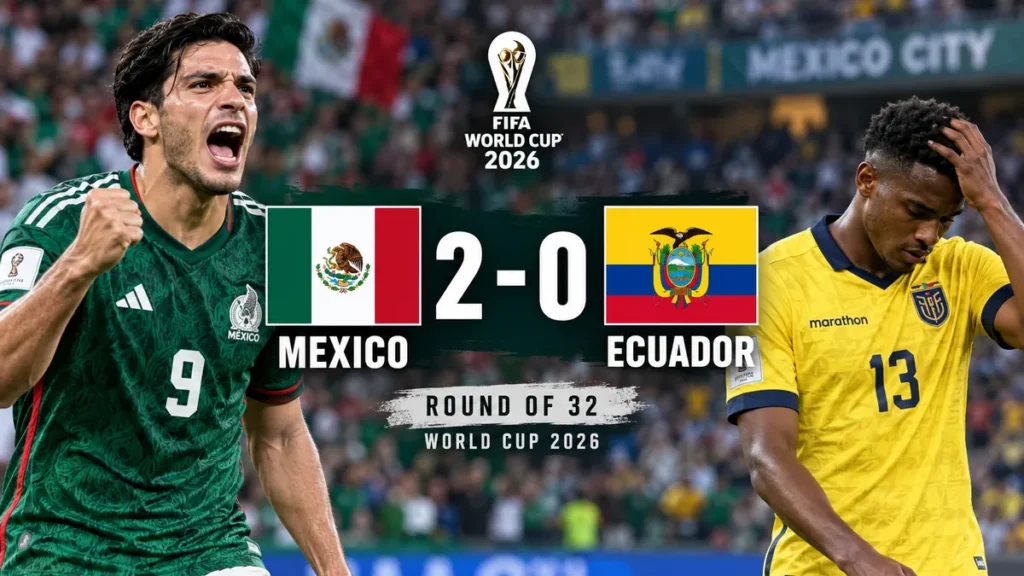
Mexico delivered when the stakes were highest. Facing Ecuador in the Round of 32 at the 2026 FIFA World Cup, the tournament co-hosts scored twice in the first half and protected their lead to earn a 2-0 victory in Mexico City.
The mexico vs ecuador World Cup 2026 match finished 2-0 to Mexico, with Julián Quiñones scoring in the 22nd minute and Raúl Jiménez adding the second in the 31st. Mexico advanced to the Round of 16 after another clean sheet, while Ecuador were eliminated from the tournament.
The score alone does not fully explain the match. Ecuador had more possession, but Mexico were more dangerous with it, producing more shots and turning two well-constructed first-half attacks into goals. The performance highlighted the efficiency, defensive organization and transition threat that had already made Mexico one of the tournament’s strongest early performers.
mexico vs ecuador World Cup 2026 Result at a Glance
The knockout match was played at Mexico City Stadium, also widely known as the Estadio Azteca, in front of 80,824 spectators. Mexico entered the game after winning all three of its Group A matches, while Ecuador had progressed from Group E as one of the best third-placed teams.
| Match detail | Mexico | Ecuador |
|---|---|---|
| Final score | 2 | 0 |
| Half-time | 2 | 0 |
| Goals | Julián Quiñones 22′, Raúl Jiménez 31′ | — |
| Possession | 43% | 57% |
| Total shots | 15 | 7 |
| Shots on target | 3 | 1 |
| Expected goals | 1.05 | 0.75 |
| Red cards | 0 | Piero Hincapié 90+5′ |
The statistical picture is revealing. Ecuador controlled 57% of possession and recorded slightly lower expected goals than Mexico, but Mexico attempted more than twice as many shots—15 to seven.
That difference between possession and genuine attacking output became one of the defining stories of the game.
How Mexico Beat Ecuador 2-0
Julián Quiñones Opens the Scoring
The breakthrough came in the 22nd minute.
Julián Quiñones found space on the left side of the penalty area and produced the finish Mexico needed. Roberto Alvarado supplied the assist as Quiñones struck right-footed to give the hosts a 1-0 advantage.
It was another important moment in an excellent tournament for the forward. According to Concacaf, the goal was Quiñones’ third in four matches at the 2026 World Cup.
Mexico now had exactly the type of game it wanted. Ecuador needed to push higher and take greater risks, creating opportunities for the hosts to attack spaces in transition.
Raúl Jiménez Makes It 2-0
Only nine minutes later, Ecuador were punished again.
This time Quiñones became the provider.
He combined with Raúl Jiménez, who finished in the 31st minute to double Mexico’s advantage. Concacaf described the move as a give-and-go between the two forwards, while match records credit Quiñones with the assist.
In less than ten minutes, Mexico had transformed a tight knockout match.
The combination was particularly significant because it demonstrated that Mexico did not require prolonged possession to create high-value attacking situations. The hosts attacked quickly and decisively when Ecuador’s structure opened.
Quick Takeaway: Mexico’s first-half efficiency settled the contest. Quiñones was directly involved in both goals—scoring the opener and creating Jiménez’s second.
mexico vs ecuador Match Stats: What the Numbers Tell Us
At first glance, Ecuador’s 57% possession might suggest the South American side controlled much of the game. That interpretation would be misleading.
Mexico generated 15 shots compared with Ecuador’s seven. The hosts also put three attempts on target, while Ecuador managed only one. Expected goals were approximately 1.05 for Mexico and 0.75 for Ecuador.
| Statistic | Mexico | Ecuador |
|---|---|---|
| Possession | 43% | 57% |
| Expected goals (xG) | 1.05 | 0.75 |
| Total shots | 15 | 7 |
| Shots on target | 3 | 1 |
| Goals | 2 | 0 |
The numbers underline an important tactical distinction: having more of the ball is not the same as controlling the dangerous moments of a match.
Ecuador circulated possession but struggled to turn that territorial advantage into clean shooting opportunities. Mexico were comfortable defending for periods because César Montes, Johan Vásquez and the players around goalkeeper Raúl Rangel limited the quality of Ecuador’s final actions.
Mexico, meanwhile, were much more direct when possession changed hands.
Why Ecuador’s Possession Did Not Produce Goals
Ecuador had technically gifted players capable of progressing the ball, most notably Moisés Caicedo. Pedro Vite and Alan Franco also operated in midfield, while Enner Valencia provided experience in attack.
But Mexico’s defensive shape prevented Ecuador from consistently turning midfield possession into clear opportunities inside the penalty area.
Ecuador recorded just one shot on target.
That statistic matters more than the possession figure.
Once Mexico went 2-0 ahead, Javier Aguirre’s team did not need to chase the game. Ecuador had to break down an opponent that could protect central spaces and then counterattack when possession changed.
The result was plenty of Ecuadorian possession without enough penetration.
Mexico’s Starting XI and Tactical Approach
Mexico were managed by Javier Aguirre and used a starting group featuring Raúl Rangel in goal, with César Montes and Johan Vásquez among the key defensive players.
The midfield included Luis Romo, Érik Lira and teenage midfielder Gilberto Mora, while Roberto Alvarado, Raúl Jiménez and Julián Quiñones supplied the attacking threat.
Mexico Key Players
Raúl Rangel: Mexico’s goalkeeper had another successful night as the team maintained its perfect defensive record through four matches.
César Montes and Johan Vásquez: The central defenders were central to Mexico’s ability to absorb Ecuador’s possession without allowing a high volume of dangerous shots.
Érik Lira: Helped give the midfield defensive stability and supported Mexico’s transition play.
Gilberto Mora: Offered mobility in midfield as Mexico balanced defensive responsibility with the need to progress quickly after turnovers.
Roberto Alvarado: Supplied the assist for the opening goal.
Julián Quiñones: The outstanding attacking influence, producing a goal and an assist.
Raúl Jiménez: Led the line and converted Mexico’s second major opportunity.
Mexico’s plan did not depend on dominating possession. Instead, Aguirre’s side stayed compact, attacked space and relied on decisive forward movement once Ecuador’s defensive structure was disrupted.
That approach worked particularly well after the opening goal.
Ecuador’s Lineup and Why the Attack Struggled
Ecuador’s starting side featured Hernán Galíndez in goal and a defensive unit containing Piero Hincapié, Willian Pacho and Joel Ordóñez. Moisés Caicedo was the most recognizable figure in midfield, with Alan Franco and Pedro Vite also involved.
Further forward, Ecuador had attacking options including Enner Valencia, John Yeboah, Gonzalo Plata and Nilson Angulo.
On paper, there was enough technical quality to trouble Mexico.
The problem was converting that talent into chances.
Moisés Caicedo vs Mexico’s Midfield
Caicedo gave Ecuador a player capable of receiving the ball under pressure and progressing possession. But Mexico did not need to prevent Ecuador from having the ball everywhere on the pitch.
The more important objective was denying easy progression into dangerous central areas.
That helped explain the unusual statistical profile: Ecuador had significantly more possession but less than half Mexico’s total shots.
Enner Valencia Could Not Find the Breakthrough
Enner Valencia remained Ecuador’s experienced reference point in attack, but he and the players around him struggled to create enough separation from Mexico’s defensive line.
Kevin Rodríguez eventually replaced Valencia during the second half as Ecuador searched for a route back into the game. Other changes included Kendry Páez, Ángelo Preciado and Yaimar Medina entering as Ecuador attempted to alter the contest.
None produced the goal Ecuador desperately needed.
Piero Hincapié Red Card in Stoppage Time
Ecuador’s difficult evening ended with another major incident.
Piero Hincapié was sent off in second-half stoppage time. The initial disciplinary decision was reviewed, with VAR involved before the card was upgraded to red. Match records place the dismissal at 90+5 minutes.
Kendry Páez had been booked shortly beforehand, while Moisés Caicedo also received a yellow card late in the game.
The dismissal did not change the result—the match was already effectively decided—but it reflected Ecuador’s frustration as its World Cup campaign came to an end.
Why Mexico’s Defensive Record Mattered
One of the most impressive aspects of Mexico’s 2026 World Cup run was not simply that the team kept winning.
It was that opponents could not score.
Before facing Ecuador, Mexico had won all three Group A matches without conceding:
- Mexico 2-0 South Africa
- Mexico 1-0 Korea Republic
- Mexico 3-0 Czechia
The 2-0 victory over Ecuador therefore extended Mexico’s streak to four consecutive World Cup matches without conceding a goal.
That consistency transformed expectations around the team.
Knockout football rewards defensive reliability. A team does not necessarily need to dominate every phase if it can deny opponents high-quality chances and capitalize efficiently at the other end.
Against Ecuador, Mexico demonstrated exactly that formula.
Quick Takeaway: After four matches at the tournament, Mexico had four wins and four clean sheets. Ecuador’s single shot on target showed how difficult the Mexican defensive structure had become to break down.
mexico vs ecuador Head-to-Head History
Mexico and Ecuador have developed a substantial international history through friendlies, Copa América meetings and now the FIFA World Cup.
Mexico have traditionally held the advantage.
The teams had already met repeatedly before the 2026 tournament, including several Copa América matches. Their competitive history includes Mexico victories in the 1993 semifinal and group-stage wins in 2004 and 2007, while Ecuador defeated Mexico 2-1 at the 2015 Copa América.
Recent meetings before the World Cup were much tighter.
| Date | Competition | Result |
|---|---|---|
| July 1, 2026 | FIFA World Cup | Mexico 2-0 Ecuador |
| October 15, 2025 | International Friendly | Mexico 1-1 Ecuador |
| July 1, 2024 | Copa América | Mexico 0-0 Ecuador |
| June 6, 2022 | International Friendly | Mexico 0-0 Ecuador |
| October 28, 2021 | International Friendly | Mexico 2-3 Ecuador |
The pattern shows why the 2026 result stood out.
Three of the four previous meetings listed above had either been draws or an Ecuador victory. Mexico therefore entered the World Cup knockout game with historical superiority overall but without a recent run of convincing victories against Ecuador.
The 2-0 result changed that recent trend decisively.
What Happened in Mexico vs Ecuador at Copa América 2024?
The 2024 Copa América meeting is particularly important because the circumstances were almost the reverse of the 2026 World Cup encounter.
Mexico needed to beat Ecuador in their final Group B match to progress.
The match ended 0-0.
Mexico dominated possession with 60%, attempted 20 shots and recorded four shots on target, while Ecuador had nine attempts and three on target. Yet Mexico could not find the decisive goal.
There was late drama when Mexico initially received a penalty in stoppage time. After a VAR review, the decision was overturned.
The draw sent Ecuador into the Copa América quarterfinals on goal difference and eliminated Mexico.
That makes the contrast with 2026 striking.
In 2024, Mexico had more possession and more attempts but failed to score.
In 2026, Ecuador had more possession, yet Mexico created more shots and won 2-0.
It is a useful reminder that match control cannot be measured by possession alone.
What Happened in the 2025 Mexico vs Ecuador Friendly?
Mexico and Ecuador met again in October 2025 at Estadio Akron.
That match finished 1-1.
Germán Berterame put Mexico ahead after only three minutes. Jordy Alcívar equalized from the penalty spot in the 20th minute, and neither side found another goal.
That encounter gave both national teams another opportunity to assess one another before the 2026 World Cup.
But a friendly and a knockout match create very different tactical pressures.
At the World Cup, Mexico’s ability to establish an early two-goal advantage meant Ecuador could not afford to remain patient. Every passing minute increased the need to commit players forward.
Mexico used that situation intelligently.
Julián Quiñones Was the Difference Maker
When one player scores the first goal and creates the second in a 2-0 knockout victory, identifying the decisive performer is straightforward.
Julián Quiñones shaped the match.
His 22nd-minute goal changed Ecuador’s tactical problem. His combination with Jiménez nine minutes later made that problem dramatically harder.
By then, Mexico no longer needed to dictate possession.
Quiñones had also developed into Mexico’s leading scorer at the tournament, reaching three goals in four matches after finding the net against Ecuador.
His performance demonstrated why direct attackers become so valuable in knockout football. Mexico needed someone who could exploit a brief opening rather than requiring sustained attacking dominance.
Quiñones did exactly that.
Raúl Jiménez’s Experience Paid Off
Raúl Jiménez’s contribution should not be overshadowed by Quiñones.
The veteran striker’s 31st-minute goal gave Mexico breathing room and fundamentally changed the remainder of the contest.
With a two-goal advantage, Mexico could manage risk rather than constantly seek another breakthrough. Ecuador were forced to dictate play against a defense that had not conceded during the tournament.
Jiménez also gave Mexico a reliable central presence. His movement provided an outlet when the team regained possession, while his experience helped connect Mexico’s attacking transitions.
For a host nation carrying enormous expectations, that type of composed finishing mattered.
What the Result Meant for Mexico
The victory sent Mexico into the Round of 16 of the 2026 FIFA World Cup.
More broadly, it confirmed that Mexico’s perfect group stage was not simply the product of favorable early circumstances.
The team carried the same core strengths into knockout football:
- Defensive organization — Ecuador managed only one shot on target.
- Efficient finishing — Mexico converted its best first-half opportunities.
- Transition threat — Quiñones repeatedly gave Ecuador problems when space appeared.
- Experienced leadership — Jiménez provided the crucial second goal.
- Game management — Mexico protected the lead without needing to dominate possession.
Winning knockout matches requires a different mentality from collecting points in a group. Mexico showed it could handle that transition.
What the Defeat Meant for Ecuador
For Ecuador, the 2-0 loss ended its 2026 World Cup campaign.
The frustrating part was that Ecuador were not simply overwhelmed in possession. They had more of the ball and enough technically accomplished players to compete in midfield.
The issue was what happened in both penalty areas.
Mexico were clinical when opportunities arrived. Ecuador were unable to generate the same quality or volume of chances.
Piero Hincapié’s late dismissal added an unfortunate ending, but it was not the reason Ecuador lost. By that stage, Mexico’s first-half goals had controlled the direction of the match for more than an hour.
For Ecuador, the lesson is less about retaining possession and more about turning possession into penetration, shots and goals.
Mexico vs Ecuador: The Tactical Lesson
This match offered a simple lesson for anyone trying to understand football beyond the possession statistic.
Efficiency matters more than possession without penetration.
Ecuador had 57% of the ball. Mexico had 43%.
Yet Mexico led 15-7 in total shots and 3-1 in shots on target.
Mexico were willing to defend without becoming passive. When opportunities to transition appeared, the forwards attacked quickly rather than allowing Ecuador to reorganize.
The first goal rewarded that attacking intent.
The second punished Ecuador before it could regain control.
From there, the match demanded patience rather than constant attacking aggression from Mexico.
That is often what strong tournament teams do well: recognize when the nature of the game has changed and adjust accordingly.
Final Verdict on mexico vs ecuador
The mexico vs ecuador Round of 32 match was decided by Mexico’s superior efficiency in the moments that mattered most.
Julián Quiñones opened the scoring in the 22nd minute and then created Raúl Jiménez’s goal nine minutes later. Ecuador finished with more possession but only one shot on target, while Mexico protected its 2-0 advantage and recorded a fourth consecutive clean sheet at the tournament.
For Mexico, the victory represented another step in an impressive home World Cup campaign and secured progression to the Round of 16. For Ecuador, it was a frustrating elimination in a match where having more of the ball never translated into control of the scoreboard.
The defining image of the contest was not Mexico endlessly dominating possession. It was something more valuable in knockout football: Mexico knowing exactly what to do when the decisive opportunities arrived.