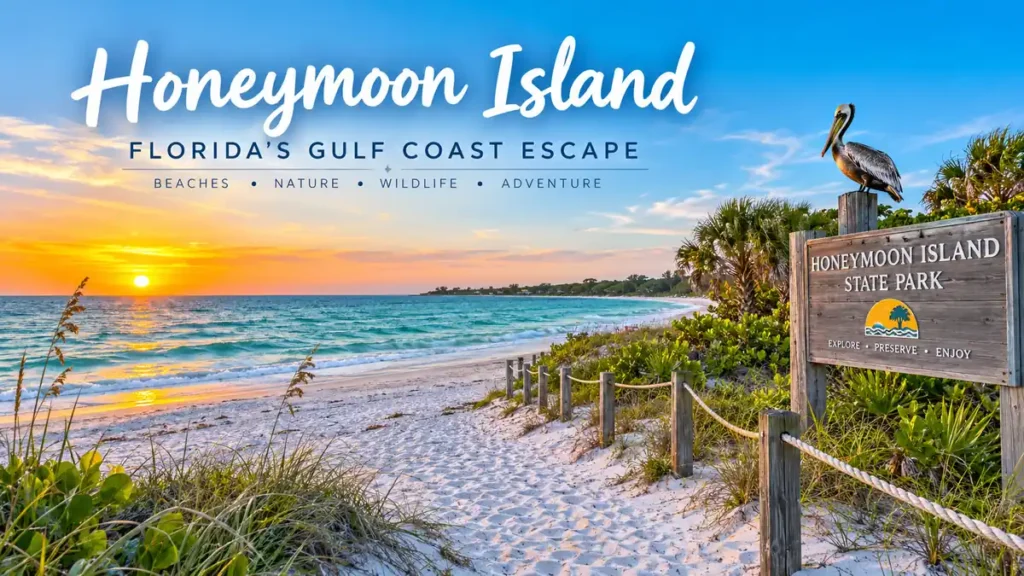
Four miles of Gulf shoreline, a pine forest filled with ospreys, a dog-friendly beach, excellent shelling, and direct ferry access to another protected island make honeymoon island much more than a typical Florida beach stop.
Located just west of Dunedin in Pinellas County, Honeymoon Island State Park is a barrier-island park that can be reached by car across the Dunedin Causeway. That easy access is one reason it appeals to families, wildlife watchers, beachgoers, anglers, hikers, and visitors who want a natural coastal experience without taking a boat first.
Quick answer: Honeymoon Island State Park is a protected barrier island near Dunedin on Florida’s Gulf Coast. Visitors come for more than four miles of beach, swimming, shelling, fishing, the Osprey Trail, wildlife viewing, Pet Beach, picnicking, sunsets, and ferry trips to neighboring Caladesi Island State Park.
Where Is honeymoon island?
Honeymoon Island State Park sits at the western end of Causeway Boulevard in Dunedin, Florida. Its official address is 1 Causeway Blvd., Dunedin, FL 34698. Unlike many undeveloped Gulf Coast islands, you do not need a ferry or private boat to reach it. The road crosses St. Joseph Sound and leads directly into the park.
That accessibility is one of the island’s biggest advantages. You can drive in with beach chairs, coolers, fishing equipment, children’s gear, or bicycles without coordinating a boat schedule.
The park lies north of Clearwater Beach and west of Dunedin, making it practical for visitors staying around Clearwater, Tampa, Palm Harbor, or the wider St. Petersburg-Clearwater area.
| Visitor information | Details |
|---|---|
| Location | Dunedin, Florida |
| Address | 1 Causeway Blvd., Dunedin, FL 34698 |
| Park type | Florida barrier-island state park |
| Hours | 8 a.m. until sundown, 365 days a year |
| Standard vehicle admission | $8 per vehicle |
| Single-occupant vehicle | $4 |
| Pedestrian or bicyclist | $2 |
| Main activities | Beachgoing, swimming, hiking, shelling, fishing, cycling, wildlife viewing |
| Nearby island | Caladesi Island State Park |
The official entrance fees and opening hours can change, so checking Florida State Parks before a trip is sensible. As of September 2026, the park is open from 8 a.m. until sundown every day of the year.
Why Is It Called Honeymoon Island?
The romantic name is surprisingly literal.
Before 1921, modern-day Honeymoon Island and Caladesi Island formed a larger landmass known as Hog Island. A major hurricane that year created Hurricane Pass and separated the area into two islands.
The “honeymoon” identity arrived later.
In the late 1930s, businessman Clinton Washburn purchased the island. According to Florida State Parks, Washburn discussed the island’s potential as a honeymoon destination with an editor from Life magazine. The idea was promoted nationally, and 50 honeymoon cottages were constructed. The first honeymooners arrived on May 8, 1940, and 164 couples eventually participated in the venture.
World War II brought the short-lived honeymoon resort era to an end. The island later faced ambitious development proposals during the 1960s, including plans for thousands of waterfront residential units.
Those plans never fully materialized. Florida began acquiring portions of the property in 1974, eventually preserving the island for public recreation and conservation. Honeymoon Island State Recreation Area was established in 1981.
The bungalows are gone, but the name survived.
Best Things to Do on honeymoon island
Most visitors come for the beach, but treating Honeymoon Island as nothing more than a swimming spot means missing much of what makes it distinctive.
Spend Time on the Gulf Beaches
Honeymoon Island has more than four miles of shoreline, with different stretches suited to different activities. The main beach areas are popular for swimming and relaxing, while the northern shoreline attracts walkers and shell collectors.
The shoreline here is more natural than the manicured beaches associated with large resorts. Depending on currents, tides, storms, and erosion, you may encounter shells, driftwood, coarse sand, exposed limestone, or sections of narrower beach.
That constantly changing character is normal for a barrier island.
The water can appear blue-green under favorable weather conditions, and shallow areas make the park appealing to families. However, there are no lifeguards, so swimmers should pay close attention to beach warning flags and current conditions.
Search for Shells
Shelling is one of Honeymoon Island’s best-known activities.
Walk slowly near the waterline, especially when lower tides expose more shoreline. Conditions after changing tides and moderate weather can reveal fresh material that was previously underwater.
Common Gulf Coast finds may include small gastropod and bivalve shells, although exactly what appears changes constantly.
The key rule is simple: treat wildlife as wildlife. Do not remove living animals, disturb nesting areas, or enter sections closed for conservation.
For a quieter shelling experience, many visitors head north rather than staying beside the busiest beach access points.
Hike the Osprey Trail
A beach day can easily be combined with a forest walk.
The Osprey Trail passes through one of the region’s remaining mature slash pine habitats. Florida State Parks notes that some trees in this forest are nearly 200 years old.
Watch the trees and sky for:
- Ospreys
- Bald eagles
- Great horned owls
- Woodpeckers and other woodland birds
- Gopher tortoises
- Armadillos
- Raccoons
The trail provides a completely different perspective from the exposed Gulf shoreline. Within one visit, you can move from open beach and dune habitat into pine flatwoods used by nesting raptors.
Eastern diamondback rattlesnakes also occur on the island, so stay on established trails, watch where you step, and give any snake plenty of space.
Visit the Rotary Centennial Nature Center
For context about what you are seeing outdoors, stop at the Rotary Centennial Nature Center.
Displays explain the natural history of Honeymoon and Caladesi islands, including local plants, animals, geology, and human history. The elevated observation area also overlooks St. Joseph Sound and surrounding seagrass habitat.
As currently listed by Florida State Parks, the nature center operates from 9 a.m. to 5 p.m. Wednesday through Sunday.
It is especially useful for families with children or anyone interested in understanding how this coastline changes over time.
Honeymoon Island Wildlife and Bird Watching
Honeymoon Island is a genuine wildlife habitat rather than simply a recreational beach with a few birds nearby.
Its beaches, dunes, pine forest, estuaries, seagrass beds, and tidal areas support numerous species.
Birders may encounter ospreys, American oystercatchers, snowy plovers, least terns, roseate spoonbills, snowy egrets, great blue herons, black skimmers, and bald eagles.
Loggerhead and green sea turtles also nest in the area.
On land, gopher tortoises are among the most recognizable residents. If one crosses a roadway or trail, give it space rather than approaching or handling it.
Why the Dunes Matter
The dunes are not piles of unused sand.
Sea oats, beach elder, sea rocket, and other specialized coastal plants anchor sand with their root systems. Those dunes act as natural reservoirs that can help beaches recover after storms remove sand from the shoreline.
Walking across dunes damages vegetation and contributes to erosion, which is why visitors should use designated boardwalks and obey closed-area signs.
This matters particularly on Honeymoon Island because its geography is constantly being reshaped by wind, storms, waves, currents, and sand migration.
What Happened to the North End of Honeymoon Island?
Visitors using old photographs, maps, or travel guides should know about a significant recent geographical change.
Florida State Parks reports that erosion and sand migration separated the northernmost mile of the sandspit from the main island, creating a temporary cut. The advisory has been in effect since April 9, 2024.
The park specifically warns visitors not to attempt to cross the water at the cut. Conditions can include:
- Deep water
- Rapidly changing depths
- Strong currents
- Hidden underwater hazards
This is a useful example of why barrier islands should never be treated as fixed landscapes.
The northern shoreline has historically included an extended sand spit popular with walkers and shell collectors, but erosion can change exactly how far visitors can safely travel.
Follow current signs rather than relying on an old map or someone’s previous walking route.
Pet Beach: Can You Bring Dogs to Honeymoon Island?
Yes. Honeymoon Island is notable for having a designated Pet Beach on the southern portion of the island.
Dogs can enjoy the shoreline there, but it is not an off-leash dog beach. Florida State Parks requires pets to remain on a hand-held leash no longer than six feet, and owners are expected to clean up after them.
Bring:
- Plenty of drinking water
- Waste bags
- A leash
- Shade when conditions are hot
- Paw protection awareness for very hot sand
Do not assume dogs are permitted everywhere simply because the park has a Pet Beach. Follow posted boundaries and pet restrictions.
Also remember that pets are not permitted on the Caladesi Island ferry.
Fishing at Honeymoon Island
The waters around Honeymoon Island support productive saltwater fishing.
Depending on season and conditions, anglers may encounter species such as:
- Snook
- Redfish
- Spotted seatrout
- Spanish mackerel
- Flounder
- Sheepshead
- Pompano
- Snapper
- Cobia
- Tarpon
- Whiting
Hurricane Pass at the southern end is a particularly well-known fishing area.
Florida fishing regulations covering licenses, seasons, bag limits, fish sizes, and permitted methods still apply inside the state park. Check current Florida Fish and Wildlife Conservation Commission rules before fishing rather than relying on an older guide.
Swimming and Beach Safety
Swimming is permitted in designated areas, but Honeymoon Island does not provide lifeguards.
Florida State Parks uses the standard beach warning flag system:
| Flag | Meaning |
|---|---|
| Green | Lower-hazard conditions |
| Yellow | Moderate hazard; use caution |
| Red | High hazard |
| Double red | Water closed to swimming |
| Purple | Dangerous marine life may be present |
Conditions can change within a day.
Wind, storms, tides, currents, and marine life all affect Gulf swimming. A calm-looking shoreline should not override a posted warning.
Parents should also remember that “shallow” does not automatically mean “safe.” Stay close to children and choose designated swimming areas.
Taking the Ferry From Honeymoon Island to Caladesi Island
One of the most useful features of Honeymoon Island is that it serves as the ferry departure point for Caladesi Island State Park.
Caladesi is substantially less accessible because it is reached primarily by boat. Its protected beaches, trails, and natural environment make it a natural extension of a Honeymoon Island visit.
As of September 2026, this point deserves special attention: Caladesi Island reopened for day-use visitors on June 29, 2026, and ferry service from Honeymoon Island resumed after storm-related disruption from Hurricane Helene. Some marina facilities remain limited while repairs continue.
Current state-listed round-trip ferry fares are:
- Adults: $20
- Children ages 6–12: $10
- Children 5 and younger: Free
The ferry normally allows a stay of up to four hours, depending on the ticket and departure time. Schedules remain weather-dependent and can change.
Remember that the ferry ticket is separate from your Honeymoon Island entrance fee.
Honeymoon Island vs. Caladesi Island
| Feature | Honeymoon Island | Caladesi Island |
|---|---|---|
| Access | Drive across causeway | Primarily ferry/private boat |
| Beaches | 4+ miles | Undeveloped island shoreline |
| Dog beach | Yes, designated area | Ferry does not allow pets |
| Nature trails | Yes | Yes |
| Food/services | Concessions available | More limited |
| Best for | Easy all-day access | Quieter island excursion |
| Ferry required | No | Usually yes |
If you have limited time, Honeymoon Island is easier because you control your arrival and departure.
If you have most of a day and want a more isolated coastal experience, combining the two parks can be worthwhile.
When Is the Best Time to Visit Honeymoon Island?
There is no single perfect month because the best season depends on what you want to do.
Fall Through Spring
Cooler months are usually more comfortable for hiking, wildlife watching, long shoreline walks, and picnics.
Winter and spring can also be rewarding for observing nesting raptors such as ospreys, bald eagles, and great horned owls.
Summer
Summer provides warm Gulf water and long daylight hours, but heat, humidity, thunderstorms, and intense sunshine become more significant.
Early morning is usually more comfortable than midday for hiking or bringing a dog.
Florida’s summer weather can change quickly, so visitors planning water activities should check conditions shortly before arriving.
For Shelling
Tide and recent wave action can matter more than the month.
Lower water can expose additional beach, while changing conditions may bring new shells ashore.
For Sunset
The west-facing Gulf shoreline is naturally positioned for sunset views. Arrive well before sundown so you have enough time to park and reach the beach.
Florida State Parks currently offers a reduced $4-per-vehicle sunset entrance fee beginning one hour before closing.
Facilities, Food, Parking, and Accessibility
Honeymoon Island has more infrastructure than many natural barrier-island beaches.
Available amenities include parking areas, restrooms, shower stations, picnic facilities, playground facilities, concessions, elevated beach boardwalks, and the Rotary Centennial Nature Center.
Food, beverages, beach supplies, and souvenirs are available through park concessions. Kayaks, beach chairs, and umbrellas are also listed among available rentals.
Accessibility features include elevated beach boardwalks and accessible facilities. Beach wheelchairs are available free of charge through the ranger station, subject to availability.
Parking is included with the normal vehicle entrance fee, but popular weekends and holidays can become busy.
Arriving earlier is particularly helpful when good beach weather coincides with weekends.
What to Bring for a Day at Honeymoon Island
A simple packing plan avoids most common problems:
- Water: Bring more than you expect to drink, especially in warmer months.
- Sun protection: Sunscreen, a hat, sunglasses, and shade are useful on exposed beaches.
- Footwear: Sandals work near the main beach, but closed or supportive shoes are better for longer trails.
- Insect protection: Helpful around vegetated areas, especially when mosquitoes are active.
- Binoculars: Worth carrying if bird watching is part of your visit.
- Beach equipment: Chairs, towels, umbrella, and a cooler make a long beach day easier.
- Leash and water for dogs: Essential when visiting Pet Beach.
- Fishing equipment and license information: Required if you plan to fish.
- A reusable trash bag: Pack out anything that does not belong on the island.
Try not to overpack if you are taking the Caladesi ferry. The operator does not permit beach carts or wagons, although strollers, wheelchairs, and walkers are allowed.
Common Mistakes First-Time Visitors Make
The biggest mistake is assuming every part of Honeymoon Island works like a conventional resort beach.
It is a protected natural area, and natural areas change.
Ignoring the North Sandspit Warning
Do not attempt to wade or swim across the erosion-created cut at the northern end. Follow park warnings even if the water appears manageable.
Expecting Lifeguards
There are none. Check warning flags and watch children closely.
Walking on Dunes
Those plants are holding the coastline together. Use designated access points.
Approaching Wildlife
Gopher tortoises, nesting birds, owls, snakes, and other animals should be observed from a respectful distance.
Arriving Too Late for a Ferry Trip
A Caladesi visit involves ticket availability, scheduled departures, weather, and a limited stay. Build your day around the ferry rather than treating it as a last-minute add-on.
Assuming Every Beach Section Looks the Same
Erosion and previous dredging have produced different shoreline characteristics. Some areas may be sandy, while others contain exposed limestone or rougher material. Honeymoon Island’s south shore was significantly altered by dredging in 1969, while the northern shoreline remained more natural.
Is Honeymoon Island Worth Visiting?
For travelers who want a highly developed resort beach with nightlife, beachfront hotels, and rows of restaurants, there are better choices elsewhere along Florida’s Gulf Coast.
Honeymoon Island offers something different.
Its appeal comes from combining easy road access with an unusually natural environment. In a single day, you can walk beside the Gulf, look for shells, watch an osprey carrying a fish, encounter a gopher tortoise near the pine forest, swim, fish, bring a dog to a designated beach, study barrier-island ecology, or board a ferry for Caladesi.
The island also demonstrates why Florida’s barrier islands are never static. Hurricanes, erosion, sand migration, rising water, and human activity have repeatedly changed its shape—from the 1921 hurricane that separated Honeymoon and Caladesi to the modern cut through the northern sandspit.
For most visitors, the best approach is uncomplicated: arrive early, choose one or two main activities, respect wildlife and closed areas, check current beach and ferry conditions, and leave enough time to watch the Gulf at the end of the day.
That balance of accessibility and wild coastline is what makes honeymoon island one of the most distinctive outdoor destinations near Dunedin and Clearwater.