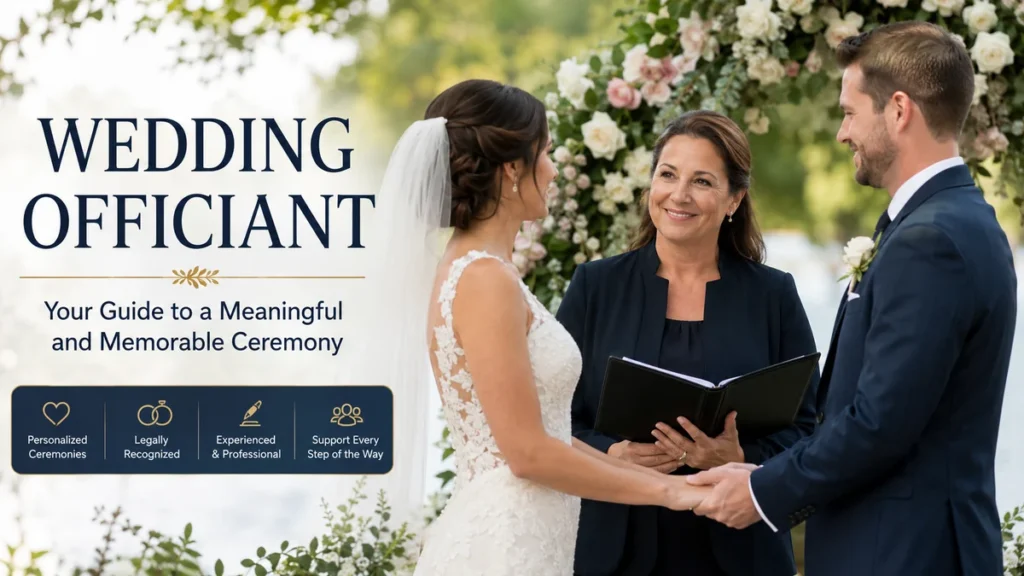
A wedding ceremony may last only 15 or 30 minutes, but the person leading it has responsibilities that begin well before anyone walks down the aisle.
A wedding officiant is the person who leads a marriage ceremony and, where legally authorized, solemnizes the marriage. The officiant guides the couple through the ceremony, including the welcome, declaration of intent, vows, ring exchange, and pronouncement, while also handling applicable legal requirements such as reviewing and signing the marriage license.
The exact role varies considerably. A priest conducting a religious service may follow an established liturgy. A civil officiant might conduct a brief, straightforward ceremony. A professional celebrant may build an entirely personalized service around the couple’s story. In some places, even a friend or relative can become authorized to perform the marriage.
That flexibility is useful, but it also creates confusion about what an officiant actually does, who can legally perform a wedding, and which parts of the ceremony are optional.
This guide explains the entire role from the first planning conversation to the marriage paperwork after the ceremony.
What Is a Wedding Officiant?
A wedding officiant is a person who conducts a marriage ceremony. When local law authorizes that person to solemnize marriages, the officiant also performs the legal function required to establish the marriage.
In practical terms, the officiant has two connected jobs:
Ceremonial role: Guide the couple and guests through a meaningful, organized wedding ceremony.
Legal role: Follow the marriage laws that apply in the jurisdiction where the ceremony takes place.
That distinction matters because not every person who can lead a symbolic ceremony can legally solemnize a marriage.
For example, a friend could deliver the welcome, tell the couple’s story, introduce readings, and coordinate the vows beautifully. But unless that friend meets the legal requirements of the jurisdiction, another authorized person may still be needed to make the marriage legally valid.
The requirements also differ significantly between countries and even between states, provinces, counties, or municipalities. Couples should therefore verify the rules with the government authority responsible for marriage licenses where the wedding will physically occur rather than relying solely on general online advice.
Officiant vs. celebrant: are they the same?
The terms often overlap, but they aren’t universally interchangeable.
An officiant generally means someone who officiates or conducts the ceremony and may have legal authority to solemnize the marriage.
A celebrant commonly creates and conducts personalized ceremonies, including weddings, commitment ceremonies, and vow renewals. Depending on the country and the celebrant’s credentials, that person may or may not have legal authority to solemnize a marriage.
Australia illustrates why the distinction matters. Legal marriage ceremonies there must involve an appropriately authorized celebrant; simply asking a friend to conduct the ceremony does not automatically give that person authority to solemnize the marriage.
Always check the terminology and legal rules where the ceremony is taking place.
What Does a Wedding Officiant Do?
People tend to remember the moment when the officiant pronounces the couple married. In reality, that is only one part of the job.
The responsibilities generally fall into three stages.
| Stage | Typical responsibilities |
|---|---|
| Before the wedding | Meet the couple, discuss ceremony style, explain the structure, prepare the script, coordinate readings and rituals, check legal requirements |
| During the ceremony | Welcome guests, guide each ceremony element, prompt vows and rings, manage transitions, make required declarations and pronounce the marriage |
| After the ceremony | Complete applicable signatures, check paperwork and follow local procedures for returning or filing the marriage license |
Professional officiants often begin preparing with couples months before the ceremony rather than simply appearing on the wedding day.
Let’s look at those responsibilities more closely.
Wedding Officiant Duties Before the Ceremony
The strongest ceremonies usually come from preparation rather than improvisation.
Even an experienced public speaker can struggle to conduct a wedding without knowing the ceremony order, couple’s preferences, names, cues, legal wording, and responsibilities.
1. Learn about the couple
A personalized ceremony should sound like it belongs to the people getting married.
An officiant might discuss:
- how the couple met
- significant moments in their relationship
- what marriage means to them
- their preferred tone
- religious or cultural traditions
- family involvement
- readings and music
- personal vows
- topics they want included
- subjects or stories they specifically want excluded
These conversations help prevent the ceremony from becoming a generic speech with two names inserted into it.
They are particularly important for interfaith and intercultural weddings. The officiant needs enough understanding to incorporate traditions respectfully rather than treating meaningful customs as decorative additions.
2. Determine the ceremony style
Not every marriage ceremony should sound alike.
Couples might want a ceremony that is:
Traditional: Formal language and a familiar wedding structure.
Religious: Prayers, scripture, blessings, hymns, or rituals from a particular faith tradition.
Secular: Focused on the couple, commitment, family, and partnership without religious language.
Spiritual: Incorporating spiritual ideas without following a particular religious service.
Interfaith: Respectfully incorporating traditions from two faith backgrounds.
Civil: Usually concise and centered on the declarations necessary for marriage.
Personalized: Built heavily around the couple’s relationship, personality, stories, and values.
The officiant’s task isn’t to impose a preferred style. It is to help the couple create a coherent ceremony within whatever legal or institutional requirements apply.
3. Build the ceremony structure
Most modern ceremonies contain recognizable elements even when their wording differs dramatically.
A common structure is:
- Processional
- Welcome or opening remarks
- Reflection on marriage or the couple
- Readings, prayers, or rituals
- Declaration of intent
- Exchange of vows
- Exchange of rings
- Pronouncement
- Kiss
- Presentation and recessional
WeddingOfficiants.com uses a similar framework, including gathering words, declaration of intent, readings, charge to the couple, vows, rings, pronouncement, kiss, and recessional.
This isn’t a universal legal formula. Think of it as a useful framework that can be adjusted for the couple and the requirements of the jurisdiction.
4. Prepare the wedding ceremony script
The wedding officiant script is the actual language spoken during the ceremony.
It is different from a ceremony timeline.
A timeline might say:
4:05 — Welcome
4:08 — Reading
4:12 — Vows
The script contains what will actually be said at those moments.
A prepared script reduces forgotten names, awkward pauses, missed transitions, and accidental omissions. It also gives the couple an opportunity to review sensitive stories or religious language beforehand.
Experienced officiants can sound spontaneous while still working from a carefully planned structure.
5. Confirm the legal requirements
This is one responsibility that should never be improvised.
Marriage laws vary by jurisdiction. Depending on where the ceremony occurs, there may be rules concerning:
- who can solemnize marriages
- officiant registration
- ordination or credentials
- marriage licenses
- waiting periods
- declarations during the ceremony
- witnesses
- signatures
- deadlines for returning documents
Some U.S. jurisdictions, for example, impose requirements beyond simply obtaining an online ordination.
The safest approach is straightforward: verify the current requirements directly with the appropriate government office for the location of the wedding.
Quick Takeaway
The officiant should know three things before ceremony day: what the couple wants, exactly how the ceremony will flow, and what local law requires.
Creativity belongs in the first two. Legal compliance should be verified rather than assumed.
Who Can Be a Wedding Officiant?
There isn’t one universal qualification.
Depending on the jurisdiction and type of ceremony, officiants can include clergy, civil officials, professional celebrants, ordained ministers, and sometimes authorized friends or relatives.
Religious officiants
Religious wedding officiants can include:
- priests
- pastors and ministers
- rabbis
- imams
- other recognized clergy or religious leaders
Their ceremonies may follow established religious rites, although the degree of personalization depends on the faith community and individual officiant.
Zola identifies religious officiants such as priests, pastors, rabbis, and imams among the common types of people who perform weddings.
Some houses of worship also have their own requirements for marriage preparation, counseling, membership, venue choice, or ceremony wording.
Civil officiants
A civil ceremony is performed under civil rather than religious authority.
Who can conduct one depends entirely on local law and can include judges, magistrates, justices of the peace, clerks, registrars, or other authorized officials.
Civil doesn’t necessarily mean impersonal. Depending on local rules and the person performing it, there may still be room for vows, readings, rings, and personalized remarks.
Professional wedding officiants
Some people specialize professionally in conducting weddings.
A professional wedding officiant may help with:
- ceremony planning
- script development
- vow guidance
- rehearsal
- readings
- symbolic rituals
- ceremony delivery
- marriage-license procedures
Experience can be particularly valuable when a ceremony includes complicated family arrangements, several readings, blended traditions, large wedding parties, or unusual logistics.
Can a friend or family member officiate?
Sometimes.
This has become a popular choice because someone close to the couple can tell their story with a level of personal knowledge that a stranger may not have.
In many parts of the United States, people use ordination organizations such as American Marriage Ministries or the Universal Life Church when preparing to officiate. However, ordination by itself should never be treated as proof that someone can legally perform a marriage everywhere.
Rules vary, and some jurisdictions require registration, documentation, or different qualifications.
A friend planning to officiate should therefore investigate the law well before the wedding rather than discovering a credential problem days before the ceremony.
Wedding Officiant Legal Responsibilities
The ceremonial and legal sides of a wedding overlap, but they aren’t identical.
A beautiful ceremony doesn’t correct defective paperwork. Likewise, completing paperwork doesn’t automatically compensate for failure to satisfy whatever ceremony requirements local law imposes.
Marriage license
A marriage license is generally obtained through the government authority responsible for marriages in the jurisdiction.
The couple usually takes the lead in obtaining it, but the officiant should understand what needs to happen next.
Depending on local rules, the officiant may need to:
- Examine the license.
- Confirm relevant information.
- Conduct the legally required ceremony.
- Sign the document.
- Obtain or verify witness signatures where required.
- Return the completed document or ensure it reaches the appropriate office within the required period.
Procedures aren’t identical everywhere, so both couples and first-time officiants should verify the local process.
Declaration of intent
The declaration of intent is the familiar portion of many ceremonies where each person confirms their intention to marry the other.
It is often associated with the response:
“I do.”
Several officiant resources identify the declaration of intent as a central legal component in many U.S. marriage ceremonies, but exact legal requirements vary by jurisdiction.
Don’t assume that wording copied from an internet ceremony template satisfies local law.
Pronouncement
Near the end of the ceremony, the officiant formally pronounces the couple married.
This creates one of the ceremony’s clearest transitions: the couple entered the ceremony unmarried and is now publicly recognized as married.
A pronouncement might be very formal or extremely simple, depending on the ceremony and applicable legal requirements.
Signing and returning documents
Paperwork can be less memorable than the vows, but mistakes here can create real problems.
After the ceremony, the officiant should follow the instructions attached to the marriage license and applicable government requirements.
Common errors include forgetting signatures, entering information incorrectly, assuming someone else will return the license, or missing a filing deadline.
The practical rule is simple: know who is responsible for every document before the wedding begins.
What Does a Wedding Officiant Say?
There is no single universal wedding officiant speech.
Most scripts are a sequence of shorter speaking sections rather than one long address. Common elements include the welcome, remarks about marriage, declaration of intent, vow prompts, ring exchange, pronouncement, and closing.
Opening and welcome
The opening tells everyone why they have gathered and establishes the atmosphere.
A good welcome is usually brief. The guests already know they are attending a wedding.
Its purpose is to bring everyone’s attention toward the couple and mark the transition from arrival to ceremony.
The couple’s story
Personalized ceremonies often include a short reflection on the relationship.
This can cover how the couple met, what they admire about each other, shared experiences, or what their relationship says about partnership.
The common mistake is turning this into a long biography.
Two or three carefully selected stories usually communicate more than a chronological account of the entire relationship.
Readings and traditions
Readings may come from:
- sacred texts
- literature
- poetry
- letters
- family traditions
- cultural sources
Other couples include symbolic rituals such as handfasting, unity ceremonies, blessings, or culturally specific marriage traditions.
The officiant should explain unfamiliar rituals briefly enough that guests understand their significance without turning the ceremony into a lecture.
Wedding vows
Vows express the commitments each partner is making.
They can be:
Traditional vows: Established wording from a religious or cultural tradition.
Repeat-after-me vows: The officiant speaks short lines that each partner repeats.
Personal vows: Each person writes and delivers their own promises.
Combination vows: Traditional or structured promises combined with personalized vows.
The officiant’s job here is usually facilitation, not performance. Slow prompts, eye contact, and strategic pauses give the couple room to speak without feeling rushed.
Ring exchange
The rings commonly follow the vows.
The officiant may briefly explain their symbolism before guiding each person through the exchange.
This is also a practical moment requiring coordination. Someone must know who has the rings, when they should be handed over, and what the couple is expected to say.
Pronouncement and kiss
The pronouncement formally recognizes the marriage, followed in many ceremonies by an invitation to kiss.
The exact wording can reflect the couple’s preferences while still satisfying any applicable legal requirements.
Afterward, the officiant may introduce the newly married couple to the guests before the recessional begins.
How Long Should a Wedding Ceremony Be?
There is no ideal duration for every wedding.
Many standard ceremonies fall somewhere around 15 to 30 minutes, while simple civil ceremonies can be much shorter and ceremonies containing religious services, multiple rituals, music, or several readings may run longer.
WeddingOfficiants.com notes that its basic ceremony samples without additional readings run roughly 10–15 minutes and recommends approximately 20 minutes as a useful general target. Other current ceremony resources describe approximately 18–22 minutes as a common full-script runtime.
The better question isn’t “How short can we make it?”
Ask:
Does every part of the ceremony serve a purpose?
Five meaningful minutes can feel better than 20 repetitive ones. Conversely, rushing through important cultural or religious traditions simply to achieve a fashionable ceremony length makes little sense.
Quick Takeaway
For a straightforward modern ceremony, roughly 15–25 minutes is often comfortable. Add time intentionally for readings, rituals, personal vows, music, or religious elements rather than stretching the officiant’s speech.
How to Officiate a Wedding Step by Step
Being asked to officiate for the first time can feel deceptively simple. You aren’t just giving a speech; you’re directing a live ceremony while potentially carrying legal responsibilities.
Here’s a practical workflow.
1. Verify that you can legally officiate
Do this first.
Determine exactly where the wedding will take place and check that jurisdiction’s marriage laws.
If ordination, registration, credentials, identification, or advance filing is required, complete those requirements early.
2. Meet with the couple
Discuss the desired tone, length, religious elements, family traditions, vows, readings, names, pronouns, and anything that shouldn’t be mentioned.
Ask practical questions too.
Who has the rings? Who is doing each reading? Is someone being escorted? Will the couple write private vows or read them aloud?
Small details become big problems when nobody owns them.
3. Create the ceremony order
Build the structure before writing polished prose.
For example:
Processional → Welcome → Story → Reading → Declaration → Vows → Rings → Pronouncement → Kiss → Recessional
Once everyone agrees on the sequence, writing becomes much easier.
4. Write the script
Write for speaking, not silent reading.
Short sentences generally work better aloud. Mark pauses and stage directions clearly. Put names where you can’t miss them.
Avoid paragraphs that require you to stare continuously at the page.
5. Check names and pronunciation
This seems obvious until an officiant mispronounces a grandparent’s name during an emotional reading.
Write difficult names phonetically in your notes.
The same applies to prayers, places, cultural terminology, and unfamiliar languages.
6. Rehearse aloud
Reading silently isn’t enough.
Speaking the script reveals awkward wording, excessively long sentences, difficult transitions, and timing problems.
Time the full ceremony rather than estimating its length from the number of pages.
7. Attend the rehearsal when appropriate
A rehearsal is especially helpful for ceremonies involving a wedding party, multiple readers, complicated processional arrangements, children, cultural rituals, or unfamiliar venues.
The officiant doesn’t necessarily have to perform the entire ceremony.
Instead, rehearse movement and cues:
- where everyone stands
- when guests sit
- who brings the rings
- where readers approach
- when the couple turns toward each other
- when music starts
- how the recessional begins
8. Arrive early
An officiant should not be the person everyone is waiting for.
Arriving early provides time to check the microphone, meet the coordinator, confirm paperwork, speak with the couple, locate the rings or readers, and deal with unexpected changes.
9. Lead rather than rush
During the ceremony, speak more slowly than normal conversation.
Pause after emotional moments.
Give the couple time to exchange rings.
Look at them rather than continuously reading from the script.
If something small goes wrong, calmly continue. Guests often won’t realize there was a mistake unless the officiant makes it obvious.
10. Complete the legal process
After the celebration begins, don’t forget the administrative work.
Check signatures carefully and follow the jurisdiction’s requirements for handling the completed marriage license.
Wedding Officiant Script Structure
A useful ceremony script can be surprisingly simple.
| Ceremony section | Officiant’s purpose |
|---|---|
| Welcome | Gather attention and establish the occasion |
| Opening remarks | Set the tone and meaning |
| Couple’s story | Personalize the ceremony |
| Reading or ritual | Incorporate chosen traditions or voices |
| Declaration of intent | Confirm intention to marry where applicable |
| Vows | Guide the couple’s promises |
| Ring exchange | Coordinate rings and accompanying words |
| Pronouncement | Formally recognize the marriage |
| Kiss | Mark the celebratory moment |
| Closing | Present the married couple and begin the recessional |
Transitions are what make this structure feel like one ceremony rather than ten separate segments.
Instead of abruptly announcing “Now the rings,” the officiant can connect the rings to the promises the couple just made.
That small amount of connective writing creates a much more natural experience.
Religious, Secular, and Interfaith Wedding Officiants
Choosing an officiant isn’t simply about finding someone legally qualified.
The person also needs to understand the type of ceremony being created.
Religious ceremonies
Religious officiants may work within established traditions concerning prayers, scripture, blessings, marriage vows, and the meaning of marriage itself.
Some traditions offer substantial personalization. Others follow a prescribed rite more closely.
Couples should discuss this before assuming every portion of a religious ceremony can be rewritten.
Secular ceremonies
A non-religious wedding can still feel ceremonial and profound.
Instead of prayer or scripture, the ceremony might focus on commitment, partnership, family, shared values, personal stories, poetry, and promises for the future.
The absence of religion doesn’t require the absence of ritual.
Interfaith and multicultural ceremonies
These require extra care.
The goal isn’t simply to alternate traditions — one from Partner A, one from Partner B — until the ceremony feels balanced.
A thoughtful officiant learns what each tradition actually means, determines which elements matter to the families, and creates transitions that explain why those practices belong together.
When necessary, clergy or knowledgeable family members from both traditions can help ensure accuracy and respect.
Wedding Officiant vs. Other Wedding Roles
Because officiants work closely with several people, their responsibilities sometimes get confused with other wedding professionals.
Officiant vs. wedding planner
The officiant leads the ceremony itself.
The wedding planner coordinates the larger wedding, potentially including vendors, schedules, design, logistics, reception details, and overall execution.
Officiant vs. wedding coordinator
A coordinator may cue the processional, position the wedding party, communicate with musicians, and keep the day’s timeline moving.
The officiant controls the spoken flow once the ceremony begins.
Strong ceremonies often result from the two working together.
Officiant vs. master of ceremonies
The officiant generally conducts the marriage ceremony.
An MC typically manages announcements and entertainment during the reception.
They can be the same person, but they are different roles.
What Makes a Good Wedding Officiant?
Legal authorization is essential where required, but authorization alone doesn’t make someone good at conducting ceremonies.
A strong officiant combines preparation, communication, composure, and empathy.
Clear communication
Couples should understand what information the officiant needs, when decisions must be made, and how the ceremony will proceed.
Calm presence
Weddings rarely unfold with absolute precision.
A reader may miss a cue. A ring can stick. Someone may cry through a vow. A toddler may wander into the aisle.
The officiant’s composure tells everyone else that everything is fine.
Strong public speaking
Volume matters, but good delivery involves more than being loud.
Effective officiants vary their pace, make eye contact, pronounce names correctly, use pauses naturally, and avoid burying themselves in a script.
Respect for the couple
An officiant shouldn’t use the ceremony to promote personal beliefs the couple didn’t request.
That includes unwanted religious messaging, embarrassing stories, jokes at someone’s expense, or lengthy personal commentary.
The ceremony belongs to the couple.
Attention to legal details
For an officiant responsible for solemnizing the marriage, paperwork isn’t an afterthought.
A person can deliver an unforgettable ceremony and still cause unnecessary complications by mishandling the license.
Common Wedding Officiant Mistakes
First-time officiants often worry about forgetting their speech. More practical mistakes are frequently the bigger issue.
Making the ceremony about themselves
Personal stories can help when the officiant knows the couple well.
But the officiant isn’t giving a wedding toast.
Every story should reveal something meaningful about the couple rather than demonstrating how close the speaker is to them.
Telling embarrassing stories
A funny story shared privately isn’t automatically appropriate in front of parents, grandparents, coworkers, children, and friends.
When uncertain, get the couple’s approval.
Reading the entire script without looking up
A script should provide security, not become a wall between the officiant and the couple.
Use large text, generous spacing, clear section headings, and stage directions so you can easily find your place.
Speaking too quickly
Nervous speakers speed up.
During a wedding, that can make vows and emotional passages disappear before guests have absorbed them.
Practice slower delivery and intentional pauses.
Forgetting practical cues
The officiant may need to tell guests to sit, invite a reader forward, ask the couple to face one another, cue the rings, step aside for the kiss, or introduce the newlyweds.
Include these directions in the script.
Standing directly behind the first kiss
This creates an awkward photograph.
Once the pronouncement is complete and the kiss is about to happen, the officiant can discreetly move aside when the ceremony setup allows it.
Assuming the legal process
This is the most consequential mistake.
Online ceremony templates are writing resources, not substitutes for local marriage law.
Requirements for officiants, witnesses, declarations, signatures, licenses, registration, and filing can change from one jurisdiction to another.
How Couples Can Choose the Right Wedding Officiant
The right person should fit both the ceremony and the couple.
Start by considering what kind of service you want.
If religious tradition is central to the marriage, a clergy member familiar with that tradition may be the natural choice.
If personalization is the priority, an experienced celebrant or professional officiant may offer greater flexibility.
If emotional connection matters most, an authorized friend or relative may create something uniquely personal.
Before deciding, couples should understand:
- the person’s legal authority
- ceremony style and philosophy
- willingness to personalize
- experience with their traditions
- approach to writing
- rehearsal expectations
- marriage-license responsibilities
- backup arrangements
- comfort with public speaking
Personality matters too.
The officiant stands at the emotional center of the ceremony. You should feel comfortable discussing personal stories, family relationships, faith, vows, and boundaries with them.
Does the Wedding Officiant Attend the Rehearsal?
Sometimes, and often it is useful.
A rehearsal is particularly valuable when the ceremony has complicated entrances, numerous wedding-party members, several readings, children, symbolic rituals, or unusual venue logistics.
An experienced officiant may not need to read every word.
Instead, the rehearsal should answer practical questions:
Who goes where? Who moves when? Who has what?
That includes the processional order, standing positions, seating cues, rings, readers, microphones, ceremony transitions, and recessional.
The actual vows can usually remain private until the wedding.
Does a Wedding Officiant Have to Be Ordained?
Not universally.
The answer depends on the laws governing the location where the marriage is solemnized.
Some jurisdictions authorize certain clergy, ministers, judges, officials, or other designated people. Some recognize ministers ordained through particular organizations, potentially with additional registration requirements. Other legal systems use entirely different categories of authorized marriage celebrants.
There are also exceptions to the conventional officiant model. Pennsylvania, for example, has a tradition of self-uniting marriage licenses, illustrating why blanket statements about who “must” officiate can be misleading.
So the reliable answer to “Do I need to be ordained?” is:
Check the current marriage law and licensing instructions for the exact jurisdiction where the ceremony will occur.
Do that before preparing the script or assuming an online credential is sufficient.
The Marriage License vs. Marriage Certificate
These terms are frequently confused.
A marriage license generally gives the couple legal permission to marry, subject to local requirements.
After the marriage has been properly solemnized and the required paperwork completed and recorded, a marriage certificate serves as official evidence of the marriage.
The terminology and process differ between jurisdictions, but the distinction is useful: getting a license usually isn’t the same thing as having a completed, recorded marriage.
That is why the officiant should know exactly what must happen to the paperwork after the ceremony.
A Practical Wedding Officiant Checklist
For someone preparing to conduct a ceremony, the responsibilities can be reduced to a manageable checklist:
- Confirm legal eligibility in the wedding’s jurisdiction.
- Review the marriage-license process and deadlines.
- Meet the couple and learn their ceremony preferences.
- Choose the ceremony structure and approximate length.
- Confirm religious, cultural, or symbolic elements.
- Coordinate readings, vows, rings, and participants.
- Write and review the ceremony script.
- Confirm pronunciations of every important name.
- Rehearse the script aloud and time it.
- Coordinate with the planner or venue team.
- Arrive early and check the microphone and setup.
- Conduct the ceremony calmly and clearly.
- Complete required signatures accurately.
- Follow the correct procedure for returning or filing marriage documents.
The legal items deserve the earliest attention. Everything else can be personalized once you know the marriage can be solemnized correctly.
Final Thoughts on the Wedding Officiant Role
A wedding officiant is much more than the person who says a few words before the first kiss. The role combines storytelling, public speaking, ceremony direction, emotional awareness, and—when the officiant is legally solemnizing the marriage—important administrative responsibilities.
The best ceremonies balance structure with personality. The welcome establishes why everyone is there. Stories make the ceremony personal. Readings and traditions add meaning. The declaration, vows, and rings express commitment. The pronouncement marks the marriage. Good transitions make all of those pieces feel like one coherent experience.
For couples, the next step is deciding what kind of ceremony reflects your relationship and finding an officiant suited to lead it. For someone preparing to officiate, start with the less glamorous but most important task: verify the marriage laws and officiant requirements for the exact place where the wedding will happen. Once that is settled, you can focus on creating a ceremony that actually sounds and feels like the people getting married.