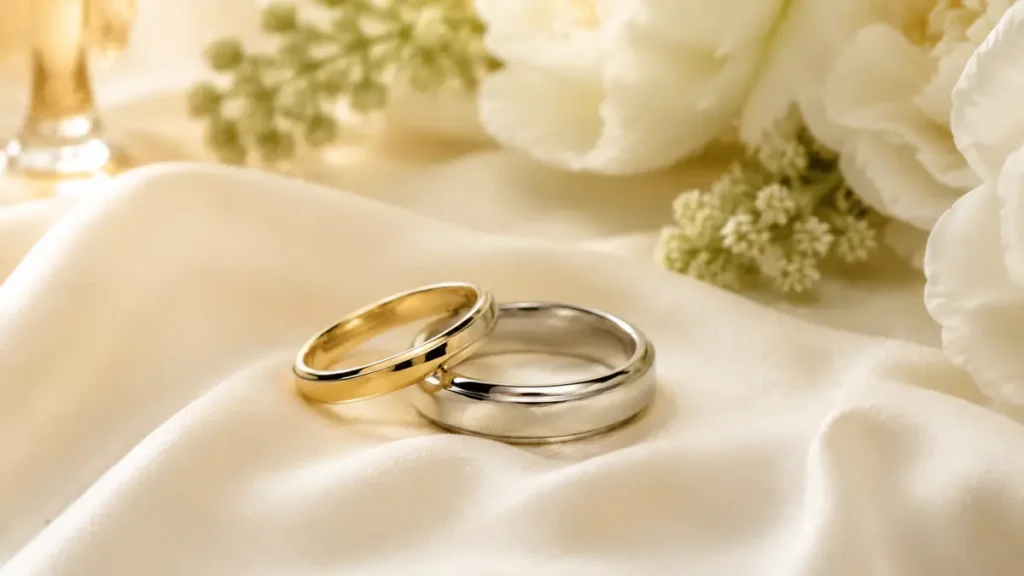
Wedding rings may look simple, but small design choices can determine whether a band remains comfortable and attractive for decades. Metal, width, profile, setting, finish, and fit all affect how a ring feels in daily life—and how well it pairs with an engagement ring.
Wedding rings are bands exchanged during a marriage ceremony as symbols of commitment. Common options include plain, diamond-set, eternity, curved, and textured bands made from gold, platinum, palladium, titanium, or tungsten carbide. The right choice balances personal style, everyday comfort, durability, maintenance, resizing options, and compatibility with other rings.
This guide explains those factors without assuming that partners must choose matching bands or follow a particular tradition.
What Wedding Rings Represent
A wedding ring is traditionally worn as a visible symbol of marriage and continuing commitment. Circular bands are often associated with continuity because they have no obvious beginning or end.
The custom has changed considerably across cultures and periods. Ancient Egyptians exchanged rings, while Roman marriage traditions helped establish rings as public markers of a union. Wedding bands later became widespread in European ceremonies. Men’s wedding rings became far more common in Western countries during the twentieth century, particularly around the World Wars.
Today, the meaning is personal. A ring may represent vows, partnership, family, faith, or simply a private promise between two people. Some couples exchange two rings, some choose one, and others use tattoos, inherited jewelry, or no physical symbol at all.
Wedding ring versus wedding band
The terms wedding ring and wedding band are usually interchangeable. In everyday usage, “band” often suggests a plain or streamlined design, while “ring” can include diamond-set and decorative styles. There is no technical rule requiring that distinction.
An engagement ring usually marks an intention to marry and commonly features a prominent center stone. A wedding band is normally exchanged during the ceremony and designed for regular wear.
Types of Wedding Rings
The best style is not necessarily the most ornate one. It is the design that suits the wearer’s hands, routine, clothing, other jewelry, and tolerance for maintenance.
Plain wedding bands
A plain band has no gemstones and relies on its shape, metal, and finish for character. It is one of the most practical choices because there are no stone settings to inspect or clean.
Common profiles include:
- Court or comfort fit: Rounded inside and outside for smooth everyday wear.
- D-shaped: Rounded on the exterior and relatively flat inside.
- Flat: Straight surfaces create a modern, architectural appearance.
- Flat court: A flat exterior combined with a comfort-fit interior.
- Half-round: A softly curved exterior with a traditional silhouette.
Plain bands may be polished, brushed, matte, hammered, sandblasted, engraved, or decorated with milgrain edges.
Diamond wedding rings
Diamond bands range from a single accent stone to rows of pavé-set diamonds. The setting style affects appearance, comfort, maintenance, and security.
- Channel setting: Stones sit between two metal walls, creating a smooth surface.
- Pavé setting: Small diamonds are held closely together for continuous sparkle.
- Prong setting: More of each diamond remains exposed to light, although the prongs require periodic inspection.
- Bezel setting: Metal surrounds each stone, offering a protective, contemporary look.
- Flush setting: Stones are placed directly into the band with little projection.
Diamonds are graded using the four Cs—cut, color, clarity, and carat weight. In a band containing many small stones, consistency across the row often matters more visually than the grade of any individual diamond.
Lab-grown and natural diamonds have the same essential crystal structure and can both be graded by recognized gemological laboratories. Their origins, pricing, supply chains, and resale markets differ, so documentation should clearly identify which type is used.
Eternity and half-eternity bands
A full-eternity ring carries gemstones around its entire circumference. It provides sparkle from every angle but can be difficult or impossible to resize because stones and settings occupy the full band.
A half-eternity or three-quarter-eternity design places stones across only part of the ring. It usually costs less, protects more of the settings from palm-side impact, and leaves a plain section that may permit future resizing.
Curved, contoured, and notched bands
Some engagement-ring settings prevent a straight band from sitting flush. A curved or contoured band follows the outline of the center stone. A notched band has a more defined opening into which part of the engagement ring fits.
These designs can create a cohesive bridal set, but they may look asymmetrical when worn alone. Try the actual rings together rather than relying only on separate measurements or photographs.
Stackable and mixed-metal bands
A ring stack might combine an engagement ring, wedding band, and anniversary band. Narrow rings make layering easier, while mixed metals allow yellow, white, and rose tones to coexist intentionally.
Stacking introduces friction. Two rings that repeatedly rub against each other can wear down delicate prongs, engraving, or softer metal edges. A jeweler can check whether the contact points are safe.
Alternative and personalized designs
Modern wedding rings may incorporate colored gemstones, black zirconium, tantalum, meteorite, wood, ceramic, carbon fiber, enamel, or engraved fingerprints and handwriting.
Unusual materials can be meaningful, but their practical limitations matter. Inlays may respond differently to moisture or impact than the surrounding metal, while some contemporary materials cannot be conventionally resized or repaired.
Quick takeaway: Choose the construction before the decoration. A secure, comfortable band suited to daily life will usually age better than a highly detailed design that conflicts with the wearer’s routine.
Choosing the Best Metal for Wedding Rings
No single metal is best for everyone. “Durable” can mean resistance to scratching, resistance to bending, ability to survive impact, or ease of repair. A very hard material may resist scratches yet crack under a severe impact, while a softer precious metal may mark more easily but remain repairable.
| Metal | Everyday characteristics | Maintenance and limitations |
|---|---|---|
| Yellow gold | Warm, traditional, widely available, and usually resizable | Softer alloys accumulate scratches; higher-karat gold is richer in color but generally softer |
| White gold | Bright appearance with familiar gold construction | Often rhodium-plated and may need replating as the coating wears |
| Rose gold | Warm pink tone created with copper-containing alloys | Usually resizable; copper may be unsuitable for some sensitive skin |
| Platinum | Dense, naturally white, durable, and commonly considered hypoallergenic | Develops a grayish patina and is typically more expensive |
| Palladium | Naturally white and lighter than platinum | Availability and repair expertise can be limited |
| Titanium | Lightweight, strong, and comfortable for people who dislike heavy jewelry | Usually difficult to resize; surface scratches can still develop |
| Tungsten carbide | Heavy, highly scratch-resistant, and maintains its polish well | Can fracture under severe impact and normally cannot be resized |
| Tantalum | Dense, dark gray, corrosion-resistant, and distinctive | Fewer jewelers work with it; resizing options vary by construction |
| Sterling silver | Affordable, bright, and easy to personalize | Softer and more prone to tarnish and deformation than common bridal metals |
| Cobalt | Bright, hard-wearing, and relatively scratch-resistant | Resizing and repair options may be restricted |
Understanding gold purity
Gold purity may be expressed in karats or fineness:
- 24K: Nearly pure gold, generally too soft for conventional daily-wear bands.
- 18K or 750: 75% gold.
- 14K or 585: 58.5% gold.
- 10K or 417: 41.7% gold.
- 9K or 375: 37.5% gold, recognized as gold in countries including the United Kingdom.
The remaining material is an alloy that changes the ring’s strength, color, weight, and price. Fourteen-karat gold often offers a practical balance of gold content and durability. Eighteen-karat gold has a richer color but normally shows wear sooner.
White gold is not naturally identical in appearance to platinum. It is commonly coated with rhodium to create a brighter white surface. As that coating wears, the underlying alloy may appear warmer, especially on frequently rubbed areas.
Platinum and patina
Platinum is naturally white and does not depend on rhodium plating for its color. It is dense and holds gemstones well, but it is not scratch-proof.
Daily wear shifts tiny amounts of metal across the surface, gradually producing a soft patina. Some people value that subdued finish; others periodically have the ring polished. Patina is a surface appearance, not evidence that the ring has lost its structural durability.
Tungsten versus titanium
Tungsten carbide is substantially heavier and more scratch-resistant than titanium. Titanium is much lighter and less brittle, making it comfortable for people unaccustomed to jewelry.
Neither should be selected solely because it is marketed as “indestructible.” Tungsten can crack when struck or dropped on a hard surface. Titanium can scratch and is difficult to resize. Confirm the retailer’s exchange policy in case the wearer’s ring size changes.
Metal allergies and skin sensitivity
Nickel is a common cause of jewelry-related contact dermatitis. Some white-gold alloys contain nickel, although compositions vary by manufacturer and region.
Platinum, high-quality titanium, tantalum, and certain nickel-free gold alloys may be better options for sensitive skin. “Hypoallergenic” does not guarantee that no reaction is possible, so ask for the complete alloy composition when sensitivity is a concern.
How to Choose the Right Wedding Ring Style
Start with the wearer’s ordinary week—not the wedding-day outfit. Someone who works with machinery, lifts weights, handles chemicals, wears gloves, or frequently uses their hands needs different features from someone whose ring faces relatively little physical contact.
Use this five-step process
- Assess everyday wear.
Consider occupation, hobbies, exercise, handwashing, protective gloves, and exposure to tools or chemicals. - Choose a practical metal.
Compare weight, scratch behavior, allergy risk, maintenance, repairability, and resizing—not just color. - Select width and profile.
Try several combinations because two bands with the same size can feel different when their widths and interiors change. - Test compatibility with other rings.
Check the gap, alignment, height, metal contact, and movement of an engagement-ring pairing. - Inspect the details in person.
Look at the ring in daylight, bend the fingers, make a fist, and wear a sample long enough to notice pressure points.
Do wedding rings need to match?
No. Matching rings can symbolize unity, but comfort and personal style usually matter more. Partners may choose the same metal with different widths, related engravings in completely different designs, or rings with no visual connection.
A coordinated pair can share one detail—such as finish, edge treatment, gemstone, or inscription—without being identical.
Choosing a finish
A high-polish finish reflects the most light but also makes fine scratches easy to see. Satin and brushed finishes soften reflections and can disguise minor marks. Hammered and stone-textured surfaces make wear less visually obvious, although deep texture may trap dirt.
Finishes are not permanent. Repeated contact gradually smooths matte surfaces and marks polished ones. Many precious-metal rings can be refinished, but frequent aggressive polishing removes small amounts of metal and may soften engraving or crisp edges.
Matching a Wedding Band to an Engagement Ring
A well-matched set is comfortable, structurally compatible, and balanced from several viewing angles. Perfectly matching metals or diamonds is optional.
Consider setting height first
A high-set solitaire often leaves enough clearance for a straight band. Low-set center stones, baskets, halos, and elongated shapes may block a straight ring, creating a visible gap.
That gap is not inherently wrong. Some wearers prefer negative space because it keeps each ring visually distinct. If a flush appearance is desired, curved, chevron, open, or notched bands may work better.
Match proportions, not necessarily designs
A very wide wedding band can overpower a delicate engagement ring, while an extremely thin band may appear visually lost beside a substantial setting. Similar proportions tend to create harmony, but contrast can work when it appears deliberate.
Center-stone shape also affects the pairing:
- Round solitaires are compatible with many straight and curved designs.
- Oval, pear, and marquise stones may suit V-shaped or contoured bands.
- Emerald and Asscher cuts often pair well with clean geometric designs.
- Halos and cluster rings may require custom contours.
- Three-stone settings should be checked for side-stone clearance.
Can different metals be worn together?
Yes. Mixed-metal stacks can look distinctive and make future additions easier. However, hardness differences and constant friction can accelerate wear where two rings touch.
When using different metals, inspect the contact points regularly. Thin prongs or pavé edges should not grind against a neighboring band. Soldering rings together can reduce movement, but it permanently changes how they are worn and serviced.
Wedding Ring Size, Width, and Comfort
Accurate sizing is one of the most important parts of selecting wedding rings. A correct fit passes over the knuckle with mild resistance and rests securely without pinching or leaving a deep indentation.
Get measured professionally
A jeweler can measure the finger with graduated sizing rings and check an existing ring on a mandrel. Measurements should be taken using a sample close to the intended band’s width and profile.
Finger size changes with temperature, activity, hydration, salt intake, pregnancy, medication, and time of day. Avoid measuring when hands are unusually cold, hot, or swollen. Taking more than one measurement under normal conditions gives a more dependable result.
At-home printable charts and plastic sizers can provide estimates, but printer scaling, paper tension, and measurement technique introduce errors. They are less reliable for wide, heavy, or custom-made designs.
How band width changes fit
Wider bands contact more skin and usually feel tighter than narrow bands in the same nominal size. A wide design may require a slightly larger size, particularly if it has a flat interior.
Common widths include:
- 2–3 mm: Delicate and easy to stack.
- 4–5 mm: Noticeable without feeling especially broad on many hands.
- 6 mm: A substantial, traditional width for standalone bands.
- 7–8 mm: Bold and heavy-looking, with more finger coverage.
These are design references, not gender rules. Finger length, knuckle shape, neighboring rings, and personal comfort are more useful than conventional labels.
Comfort fit versus standard fit
A comfort-fit band has a rounded inner surface that reduces contact with the finger. It is often preferred for wide or thick rings. A standard-fit band has a flatter interior and may feel more secure to someone accustomed to traditional jewelry.
Sizing may differ between the two profiles. Always try the exact construction—or a close physical sample—before approving a nonreturnable ring.
Resizing limitations
Plain gold and platinum bands are usually the easiest to resize. The workable range depends on thickness, engraving, alloy, shape, and construction.
Full-eternity rings, tension settings, intricate patterns, mixed-material rings, and bands made from tungsten carbide or titanium may not be conventionally resizable. Ask what happens if the size changes in five or ten years. A lifetime exchange policy can be more useful than a theoretical warranty that excludes size changes.
Quick takeaway: Never choose a size from an average or a guessed measurement. Width, profile, temperature, and knuckle shape can change the fit even when the stated ring size remains the same.
Stones, Settings, Hallmarks, and Craftsmanship
A wedding ring is subjected to thousands of small knocks and movements. Construction quality therefore matters as much as surface appearance.
Choosing gemstones
Diamonds remain common because they are highly resistant to scratching, but they can still chip when struck at a vulnerable angle. Sapphires and rubies are also suitable for frequent wear when securely set.
Softer or more fragile gemstones require greater caution. Opal, pearl, turquoise, and emerald can be damaged by impact, abrasion, heat, or chemicals. They may suit a special-occasion ring better than a band worn during every activity.
Inspecting the setting
Look for evenly spaced stones, consistent height, symmetrical prongs, and smooth edges. Run a fine cloth lightly over the ring; snagging can indicate a rough or lifted prong.
For pavé and shared-prong designs, ask whether missing stones can be replaced individually. Very thin settings may appear delicate but leave less metal available for long-term maintenance.
Hallmarks and documentation
Hallmarks can identify precious-metal purity, the maker or sponsor, and the assay office, depending on the country. Familiar fineness marks include 375, 585, 750, 950, and 925.
A hallmark does not explain every aspect of quality, but it helps verify metal content. Keep receipts, grading reports, appraisals, warranty terms, resizing records, and detailed photographs together. Diamond documentation should specify whether stones are natural or laboratory-grown.
Ethical sourcing and sustainability
Responsible sourcing is more complicated than a single label. Questions worth asking include:
- Is the metal newly mined or recycled?
- Can the supplier trace its precious metals or gemstones?
- Does a diamond come with an independent grading report?
- What labor and environmental standards apply?
- Can the ring be repaired locally rather than replaced?
- Is the design durable enough to remain in use for decades?
The Kimberley Process addresses trade in rough conflict diamonds between participating states, but it does not cover every environmental, labor, or human-rights concern. Traceable suppliers, recycled metals, vintage rings, and heirloom redesigns offer additional paths, each with its own benefits and limitations.
Planning Your Budget and Timeline
The appropriate budget is an amount that does not interfere with essential expenses or create unwanted debt. There is no credible rule requiring a fixed number of months’ salary.
Price is influenced by:
- Metal type, purity, and weight
- Ring width and thickness
- Natural or lab-grown gemstones
- Total carat weight and diamond quality
- Hand engraving or custom fabrication
- Brand, designer, and manufacturing method
- Resizing, warranties, and aftercare
Compare rings by specification, not photographs alone. Two visually similar bands can differ significantly in thickness, metal weight, setting construction, and service policy.
When should wedding rings be ordered?
Begin exploring styles several months before the wedding. Standard bands may be available quickly, while custom work, engraving, unusual sizes, shaped bands, and gemstone designs take longer.
Allow time for:
- Initial measurements and design decisions
- Manufacturing or sourcing
- Delivery and inspection
- One possible size correction
- Engraving and final cleaning
Do not engrave until the fit is confirmed. Resizing can disturb or remove an inscription.
Useful questions to ask a jeweler
Before approving a ring, ask:
- What is the exact metal and alloy composition?
- Is it solid metal, plated, filled, or hollow?
- Can this design be resized, repaired, and refinished?
- Are the gemstones natural, laboratory-grown, treated, or simulated?
- Is an independent grading report included?
- What maintenance does the setting require?
- What does the warranty exclude?
- Does the return policy apply after engraving or customization?
- What happens if an alternative-metal ring no longer fits?
- Are inspections, cleaning, or rhodium replating included?
Clear written answers are more dependable than verbal assurances.
How to Care for Wedding Rings
Routine care preserves the ring and helps reveal developing problems before stones are lost.
Safe cleaning at home
For many plain gold, platinum, and durable diamond bands:
- Mix lukewarm water with a small amount of mild dish soap.
- Soak the ring briefly.
- Clean gently with a very soft toothbrush.
- Rinse over a closed drain or in a separate bowl.
- Dry with a lint-free cloth.
This method is not suitable for every gemstone, inlay, adhesive, oxidized finish, or antique construction. Follow material-specific instructions when the ring contains pearls, opals, emeralds, enamel, wood, meteorite, or multiple bonded components.
Avoid toothpaste, baking soda scrubs, bleach, chlorine, acetone, and abrasive household cleaners. Ultrasonic and steam cleaners can loosen damaged settings or harm certain gemstones, so professional assessment should come first.
When to remove a wedding ring
Remove or protect the ring during activities involving:
- Weightlifting or forceful gripping
- Machinery and rotating equipment
- Construction or heavy manual work
- Chlorinated pools and harsh chemicals
- Gardening and abrasive materials
- Contact sports
- Dough, paint, glue, or substances that enter settings
This is not only about protecting jewelry. Rings can catch on equipment and cause severe finger injuries. People working around machinery may need to avoid rings entirely or use a workplace-approved alternative.
Store the ring in a fabric-lined compartment away from other jewelry. Diamonds and hard metals can scratch neighboring pieces.
Professional inspections
Stone-set bands should be inspected periodically, especially when worn continuously. A jeweler can check prongs, channels, cracks, looseness, distorted settings, and excessive wear.
Seek help promptly if a stone moves, a prong catches fabric, the band changes shape, or the ring suddenly feels different. Continuing to wear a damaged setting can turn a simple repair into a lost gemstone.
Insurance may be appropriate for valuable rings. Read the policy carefully to determine whether it covers loss, theft, accidental damage, unexplained disappearance, replacement value, and travel.
Common Wedding Ring Mistakes
Several avoidable mistakes cause more regret than choosing the “wrong” trend.
Prioritizing appearance over routine
An intricate eternity band may be beautiful but frustrating for someone who works with gloves or frequently grips tools. Lifestyle should narrow the options before decoration is considered.
Assuming scratch-resistant means damage-proof
Tungsten resists scratches exceptionally well but can fracture. Platinum scratches yet remains structurally durable. Gold shows wear but is widely repairable. Hardness, toughness, and maintainability are different properties.
Ignoring future resizing
Finger size can change over a lifetime. A ring that cannot be resized may eventually need replacement. This matters particularly for full-eternity bands and alternative metals.
Buying an engagement-ring match separately
Tiny differences in curve, height, width, and setting position can create unexpected gaps or damaging contact. Test both rings together whenever possible.
Choosing an extremely thin band
Very thin bands provide a delicate appearance but contain less material to withstand decades of wear. This becomes especially important when the band supports gemstones.
Following short-lived trends too closely
Trends are not automatically bad; they can capture a particular time and personality. The problem arises when someone chooses a finish, color, or shape they do not genuinely enjoy. A wedding ring is easier to live with when it reflects established personal taste.
Making the Final Choice
The most suitable wedding rings combine symbolism with ordinary practicality. Start with lifestyle, decide which metals provide an acceptable balance of weight and maintenance, test multiple widths, and confirm that the chosen profile remains comfortable during natural hand movement.
If the ring will sit beside an engagement ring, examine them as a set for alignment and harmful friction. Verify the hallmark, gemstone details, resizing possibilities, aftercare policy, and total specifications in writing before engraving.
A successful choice does not need to be expensive, perfectly matched, or fashionable. It needs to fit securely, withstand the wearer’s real routine, and feel personally meaningful. When those fundamentals are right, wedding rings can become natural companions rather than precious objects that spend most of their lives in a box.